Your utility trailer’s tires carry two pressure numbers that matter: the recommended cold pressure on the trailer’s label, and the maximum cold pressure molded into the tire sidewall. This chart lists the published maximum pressure and load for the tire sizes found on most small utility trailers, from 4.80-8 up to ST235/80R16.
Quick Answer
Set your trailer tires to the cold pressure on the trailer’s certification label or tire placard, on the front half of the left side, and never go above the maximum cold PSI on the sidewall. ST radial tires top out at 50 psi in load range C, 65 psi in D and 80 psi in E. Small bias tires vary by size: a 4.80-12 is 60 psi in load range B and 90 psi in load range C. Some tire makers, such as Carlstar, say to run trailer tires at the sidewall maximum, so check your brand’s advice.
Key Takeaways
- Check pressure cold: before towing, or after the trailer has sat for at least three hours.
- The sidewall PSI is a maximum, paired with the tire’s maximum load.
- Load range sets the max pressure: ST radials run 50 psi (C), 65 psi (D) or 80 psi (E).
- ST tires with no speed symbol are rated for 65 mph.
- Rubber snap-in valves are rated for 65 or 80 psi; higher pressures need metal clamp-in valves.
Utility Trailer Tire Pressure Chart
Max load is per tire, at the max cold pressure shown. Values come from Carlisle (Carlstar), Goodyear Endurance and Maxxis spec sheets; other brands list loads within a few pounds of these. The pressure and load printed on your own tire always win.
| Tire size | Load range | Max load per tire | Max cold PSI |
| 4.80-8 | B | 585 lbs | 60 psi |
| 4.80-8 | C | 760 lbs | 90 psi |
| 5.70-8 | B | 715 lbs | 50 psi |
| 5.70-8 | C | 910 lbs | 75 psi |
| 5.70-8 | D | 1,070 lbs | 100 psi |
| 4.80-12 | B | 785 lbs | 60 psi |
| 4.80-12 | C | 990 lbs | 90 psi |
| 5.30-12 | B | 855 lbs | 55 psi |
| 5.30-12 | C | 1,050 lbs | 80 psi |
| 5.30-12 | D* | 1,243–1,250 lbs | 105 psi |
| ST175/80R13 | C | 1,360 lbs | 50 psi |
| ST175/80R13 | D | 1,570 lbs | 65 psi |
| ST185/80R13 | C | 1,480 lbs | 50 psi |
| ST185/80R13 | D | 1,710 lbs | 65 psi |
| ST205/75R14 | C | 1,760 lbs | 50 psi |
| ST205/75R14 | D | 2,040 lbs | 65 psi |
| ST215/75R14 | C | 1,870 lbs | 50 psi |
| ST215/75R14 | D | 2,200 lbs | 65 psi |
| ST205/75R15 | C | 1,820 lbs | 50 psi |
| ST205/75R15 | D | 2,150 lbs | 65 psi |
| ST225/75R15 | D | 2,540 lbs | 65 psi |
| ST225/75R15 | E | 2,830 lbs | 80 psi |
| ST235/80R16 | E | 3,420–3,520 lbs** | 80 psi |
| ST235/80R16 | F | 3,740 lbs | 95 psi |
*Load range D in 5.30-12 is listed by Kenda and Vision, not Carlisle. **Goodyear Endurance and Maxxis list 3,420 lbs; Carlisle Radial Trail HD lists 3,520 lbs.
Products Worth Considering
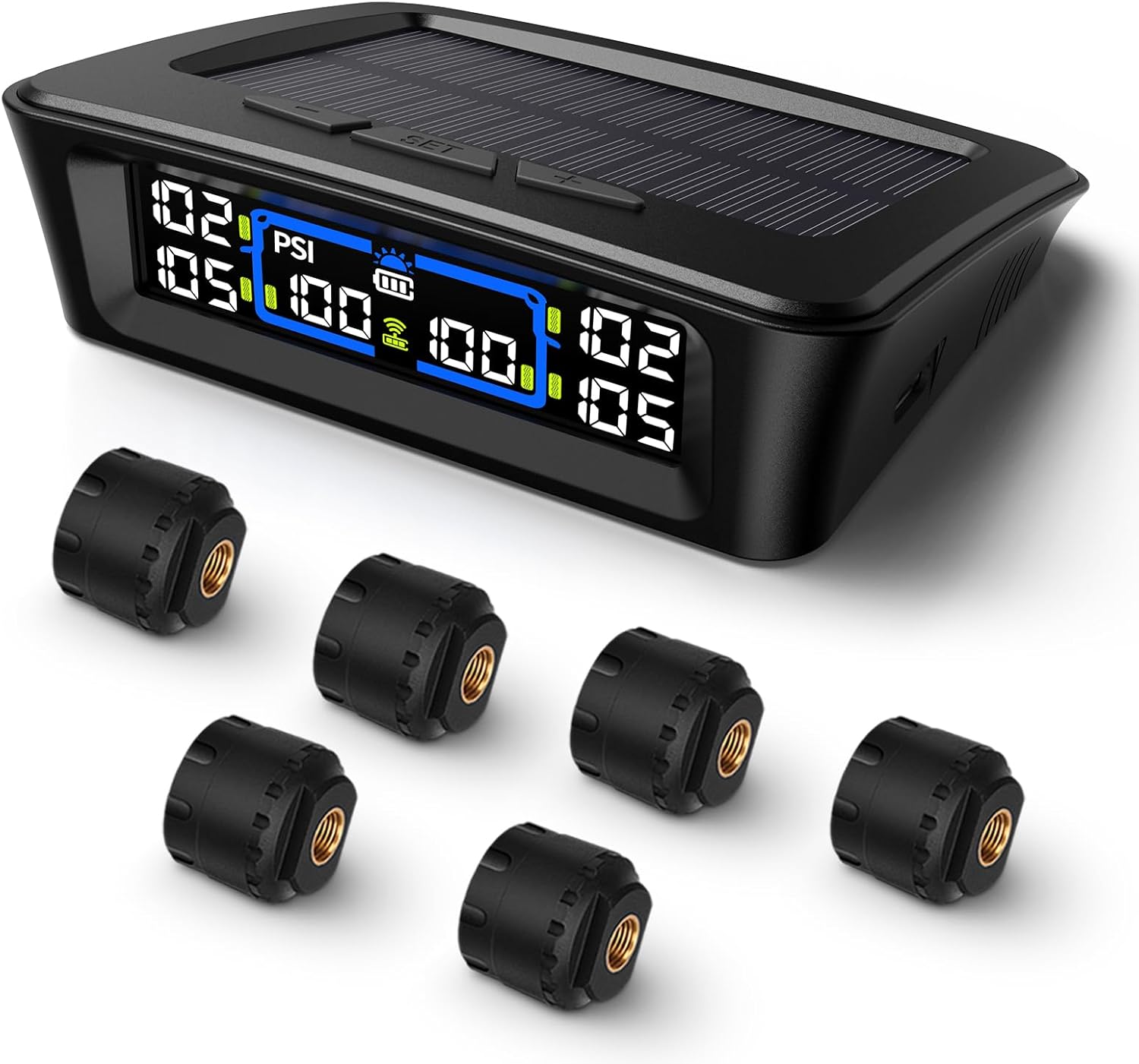
The Tymate TM12 RV TPMS delivers real-time tire pressure and temperature monitoring with a stable 433Hz display for safer long-distance driving. It supports simultaneous monitoring across vehicle and trailer zones, includes six alarm modes for pressure, temperature, leakage, battery, and signal loss, and features easy DIY installation with auto calibration. Power is supplied via USB-C charging or solar recharging, with a wide 0–144 PSI range and up to 50 ft signal coverage for RVs and towable trailers.
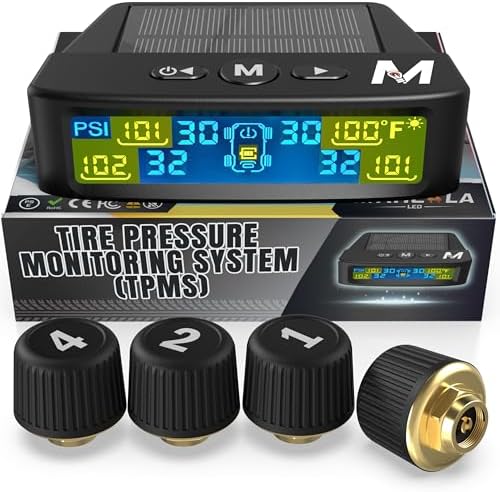
Marcala’s TPMS set of four sensors helps you monitor tire pressure and temperature in real time while driving, with updates every second. The bright color LCD uses auto-dimming for easy viewing, powered by dual solar and USB charging, and offers six alarm modes. Built for trailers, RVs, campers, trucks, and towing setups, the sensors support monitoring 1-4 wheels up to 98 PSI with IP67 waterproof protection.

Mount your spare tire directly to the inside wall of an enclosed trailer or garage to save space and keep your tire secure. This wall-mount spare tire carrier is designed for universal trailer tire fit and includes a fixed plate and chute for convenient screw replacement. Nylon insert hex lock nuts help prevent the tire from falling off, and wing hardware enables faster load and unload during maintenance.
Max PSI by Load Range: ST Radials vs. Small Bias Tires
On ST (Special Trailer) metric tires, each load range has a fixed maximum cold pressure:
| Load range | Max cold PSI (ST metric sizes) |
| B | 35 psi |
| C | 50 psi |
| D | 65 psi |
| E | 80 psi |
| F | 95 psi |
Small bias-ply sizes work differently. The maximum pressure for a load range changes with the size:
| Bias size | Load range B | Load range C | Load range D |
| 4.80-8 | 60 psi | 90 psi | – |
| 4.80-12 | 60 psi | 90 psi | – |
| 5.70-8 | 50 psi | 75 psi | 100 psi |
| 5.30-12 | 55 psi | 80 psi | 105 psi (Kenda, Vision) |
That is why a 4.80-12 tire in load range C can need 90 psi, more than an ST radial in load range E. To see how load range differs from load index, read our tire load range guide.
Where to Find Your Trailer’s Recommended Tire Pressure
Federal rules put the trailer’s certification (VIN) label on the forward half of the left side, where you can read it from outside. The label lists the tire size and recommended cold pressure for each axle, or the pressure appears on a separate tire label. Trailers with a GVWR of 10,000 lbs or less also carry a Tire and Loading Information placard near the certification label, and the placard pressure can’t be higher than the tire’s maximum.
The sidewall shows something different: the tire’s maximum load and the cold pressure needed to carry it. If you replaced the original tires with a different size or load range, the placard may no longer fit. Use your tire maker’s load and inflation table, or our step-by-step guide to setting trailer tire pressure from your trailer’s weight.
Should You Run Trailer Tires at the Max PSI?
Tire makers don’t agree, so follow the advice for the brand on your trailer:
- Carlstar (Carlisle): its FAQ tells owners to keep trailer tires at the maximum pressure shown on the sidewall.
- Goodyear: its special trailer bulletin treats the pressure on the trailer placard as the baseline.
- Hankook: the recommended pressure is the one on the trailer’s tire placard; the sidewall number is the tire’s maximum.
- Trailer King: inflate to the maximum only when the tire carries its maximum load; otherwise follow the placard or owner’s manual.
- Maxxis: on original tires, use the trailer maker’s pressure; for replacement tires, ask your dealer.
Whichever you follow, never go above the sidewall maximum, and make sure the pressure supports the heaviest-loaded tire on the trailer.
Check Trailer Tire Pressure Cold
Cold means the tires haven’t been driven for at least three hours, or have rolled less than about a mile. It has nothing to do with the outside temperature. Goodyear notes that tires can read 10–15 psi higher when hot, so never let air out of hot tires to hit the cold number.
Temperature still matters over time. Goodyear’s RV tire guide says pressure changes about 2% for every 10°F, so a tire set to 50 psi on a warm afternoon reads about 1 psi lower for every 10°F the temperature drops. Check again when the seasons change.
Products Worth Considering

Secure your trailer or RV tires with a scissor-style wheel chock stabilizer that applies opposing force to help prevent wheel shift. It fits tight wheel gaps from 3.5 inches up to 12 inches and works for travel trailers, campers, fifth wheels, toy haulers, and heavy-duty trucks. The surface uses new electrophoretic technology to help prevent rust for reliable travel use.
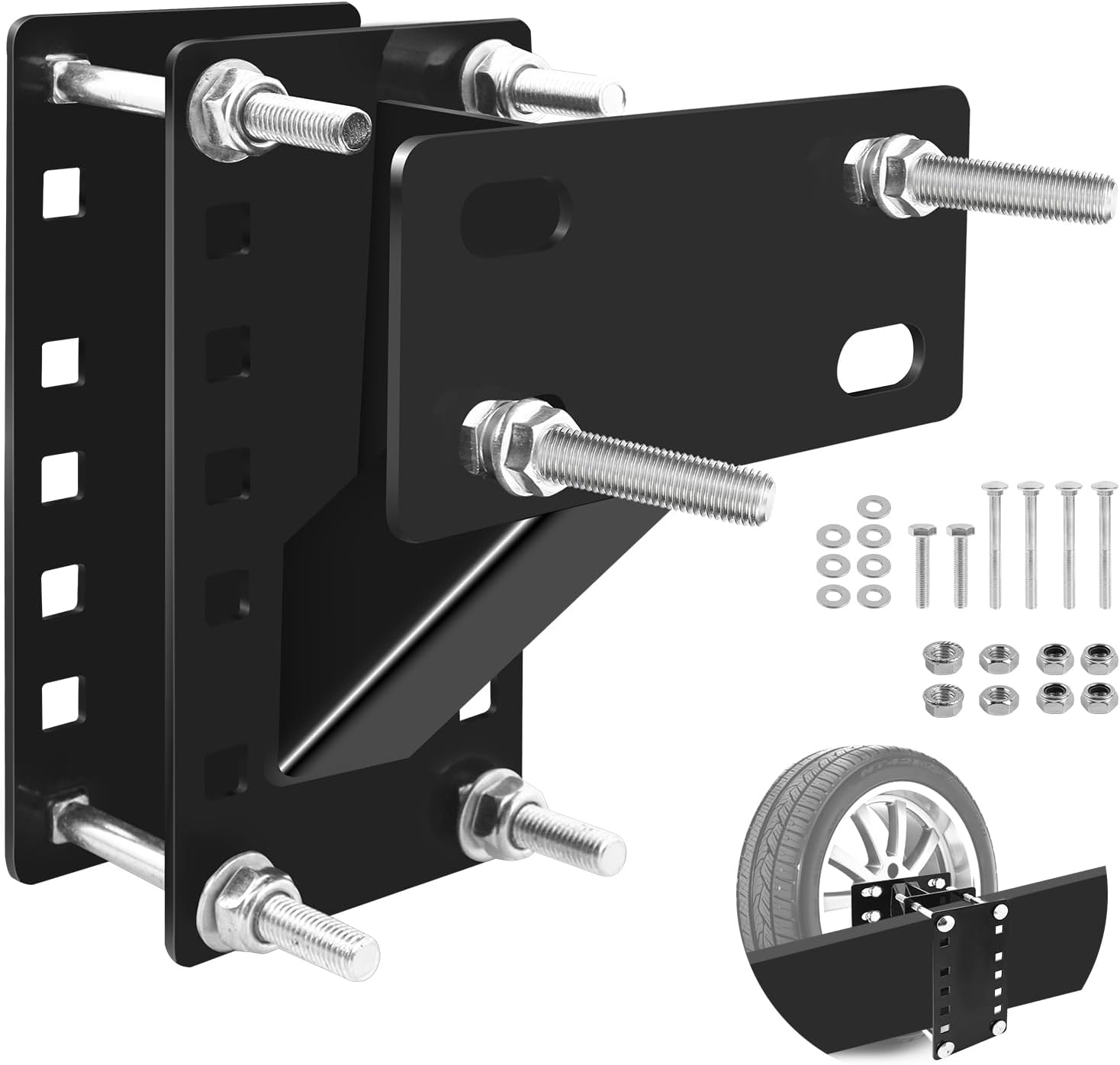
This universal spare tire mount carrier holder is built for utility trailers and boat trailers, offering a secure fit for 4, 5, and 6 lug wheels. It supports multiple bolt pattern sizes and a heavy-duty load capacity while resisting rust with a durable finish. The design allows easy installation and lets you choose the steel beam height for a better fit.

AZUNO’s digital tire inflator delivers stable, accurate pressure readings with a bright LCD and a 0.1 resolution display for confident inflation. It supports one-handed operation for inflating and quick deflating, and it’s built with rugged steel and brass components for reliable shop or garage use. With multi-unit pressure display and compatibility across cars, SUVs, motorcycles, and trucks, it’s a convenient accessory for everyday tire maintenance.
Speed Limits for Trailer Tires
Check the speed symbol after the load index on the sidewall. ST tires with no speed symbol are rated for 65 mph, according to Goodyear; Carlstar’s FAQ is more cautious, at 62 mph.
| Speed symbol | Max speed |
| None | 65 mph (Goodyear) |
| J | 62 mph |
| L | 75 mph |
| M | 81 mph |
| N | 87 mph |
Goodyear allows 66–75 mph on unmarked ST tires only if you add 10 psi above the placard pressure and the wheel and valve can take it. The extra air does not add load capacity.
Don’t Exceed Your Wheel or Valve Rating
A tire’s maximum pressure means nothing if the wheel or valve stem can’t hold it. Goodyear says rubber snap-in valves are rated for 65 or 80 psi, and higher pressures need a metal clamp-in valve such as a TR416S, rated to 200 psi. This matters most on small bias tires like a 4.80-12 in load range C, which runs at 90 psi. If you can’t find the wheel’s rating, ask the wheel or trailer maker.
When to Replace Trailer Tires by Age
Trailer tires often age out before the tread wears down. Hankook says to replace ST tires 10 years after the DOT date, even if they were never used. Trailer maker PJ Trailers says trailer tires last about five years on average and suggests considering replacement after three years, even with good tread. Read the tire date code to see how old yours are, and check the sidewalls for cracks. Our guide to keeping trailer tires from dry rotting covers storage.
Frequently Asked Questions
What PSI should 4.80-12 trailer tires be?
Carlisle lists up to 60 psi in load range B, where the tire carries 785 lbs, and 90 psi in load range C, where it carries 990 lbs. Use the pressure on your trailer’s placard if it lists one, and never go above the sidewall maximum.
What PSI do ST205/75R15 trailer tires need?
Load range C tops out at 50 psi, carrying 1,820 lbs per tire. Load range D tops out at 65 psi, carrying 2,150 lbs per tire.
Should trailer tires be inflated to the max PSI?
It depends on the tire maker. Carlstar says to run the sidewall maximum, while Goodyear, Hankook and Maxxis point you to the pressure on the trailer placard. Trailer King says to use the maximum only when the tire carries its maximum load.
Where is the tire pressure label on a trailer?
On the forward half of the left side. The certification (VIN) label lists the tire size and cold pressure, and trailers up to 10,000 lbs GVWR also have a Tire and Loading Information placard nearby.
Why do my trailer tires read higher after towing?
Tires heat up as they roll. Goodyear says hot tires can read 10–15 psi higher than cold, so don’t let air out of hot tires; check again once they have cooled for three hours.
Sources
- Carlstar – Sport Trail (bias trailer tires)
- Carlstar – Sport Trail LH
- Carlstar – Radial Trail HD
- Maxxis – M8008 ST Radial
- Goodyear Endurance specification sheet
- Kenda / Americana 2023 catalog
- Vision W811 Journey
- Goodyear PSB #2014-01, special trailer applications
- Goodyear RV Tire & Care Guide
- Carlstar – FAQ
- Hankook Special Trailer Tire Warranty Guide (2026)
- Trailer King ST radial limited warranty
- Maxxis trailer tire warranty
- 49 CFR 567.4 – Certification label
- 49 CFR 571.110 – Tire selection and rims (FMVSS 110)
- NHTSA – Tire Safety brochure
- PJ Trailers – Tire Safety
- Maxxis – Tire School (speed symbols)
Products Worth Considering

RVMATE dual-axle RV tire covers help shield your tires from sunlight, snow, rust, and dirt to keep them in better condition in harsh weather. Made with heavy-duty waterproof, UV-resistant 420D Oxford fabric, they provide strong shading and help reduce wear. They install easily by placing the cover on the wheel and fastening the rope for a stable fit.

This universal spare tire mount fits 4, 5, and 6 lug trailer wheels with bolt patterns from 4" to 5.5" and helps keep your tire securely locked in place. Its reinforced triangular structure with a sturdy behind plate is designed to handle up to 150 lbs, making it suitable for boat, camper, and RV spare tire mounting. The angled raised design reduces wind resistance and installation is straightforward with different length bolts and no drilling required.

This 100-piece set of snap-in tubeless tire valve stems is designed for standard 0.453 in (11.5 mm) rim holes and helps maintain reliable, steady tire pressure. Made with ozone-resistant rubber and brass cores, the valves are built for durability and long-term use. Easy to install by hand, they support safe driving and are suitable for cars, light trucks, trailers, and more.