
Toyota Tacoma 3rd Gen Tire Size Guide 2016 to 2023
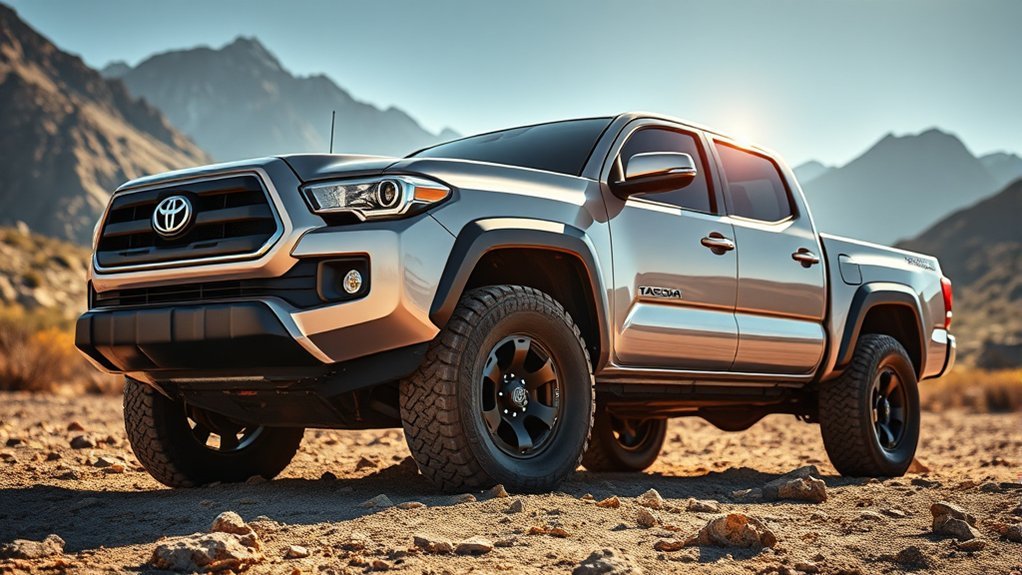
Choosing the right tire size for a 2016–2023 Toyota Tacoma starts with one rule: match the tire to your truck’s factory specs, wheel setup, and real driving needs before chasing a bigger look. The 3rd Gen Tacoma commonly came with P245/75R16, P265/70R16, P265/65R17, or P265/60R18 tires depending on trim and package, and each size affects ride comfort, clearance, speedometer accuracy, fuel economy, and off-road grip.
Quick Answer
For most 2016–2023 Toyota Tacomas, the correct factory tire size is P245/75R16, P265/70R16, P265/65R17, or P265/60R18, depending on trim and package. Use your driver’s door tire placard as the final authority, then match load rating, wheel size, and clearance before upgrading.
Key Takeaways
- The main factory tire sizes for 2016–2023 Tacoma models are P245/75R16, P265/70R16, P265/65R17, and P265/60R18.
- The Limited trim uses P265/60R18 from the factory, not 265/70R18.
- Larger tires can add traction and clearance, but they may reduce fuel economy, change speedometer readings, and cause rubbing.
- For towing, hauling, or off-road use, match or exceed the original load index and verify fitment with a qualified tire shop.
- This guide applies to 2016–2023 3rd Gen Tacomas; 2024+ Tacomas use different factory sizing and fitment assumptions.
At a Glance
| Time Required | 10–20 minutes to confirm your factory size, compare upgrade options, and check basic fitment notes |
| Difficulty | Easy for stock replacement; moderate for upsizing because clearance, offset, and calibration matter |
| Tools Needed | Driver’s door tire placard, tire size calculator, tire pressure gauge, and a professional fitment check for non-OE sizes |
| Cost | Varies by tire type, wheel size, load rating, and whether lift, trimming, alignment, or recalibration is needed |
Warning: Do not choose a tire only because it “looks right” on another Tacoma. Cab style, trim, wheel offset, suspension height, alignment, tire brand, and load rating can change fitment. Always verify the tire placard and test clearance at full steering lock and suspension compression.
Why Tire Size Matters for Your Tacoma
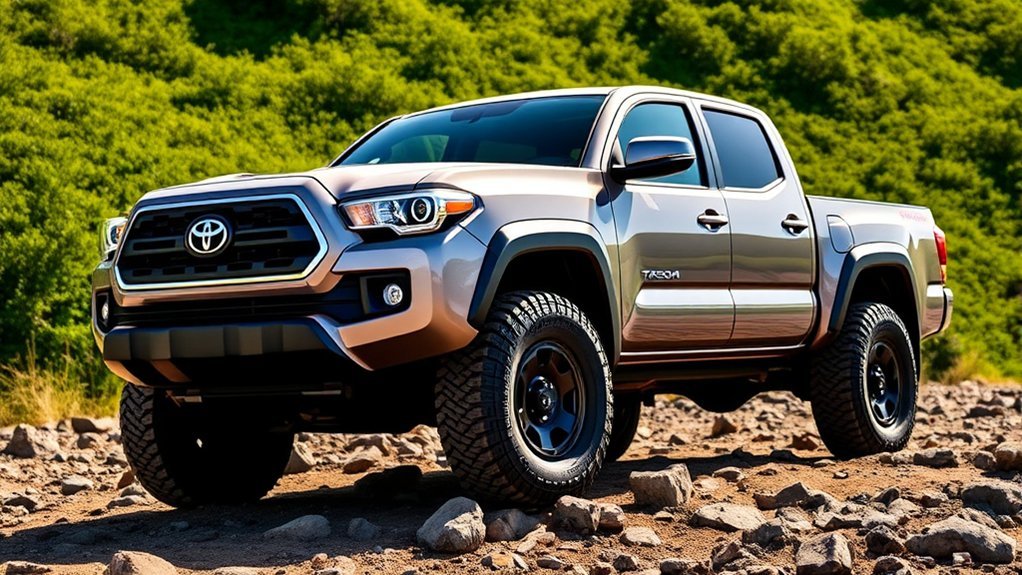
Tire size directly changes how your Tacoma feels on the road and how it performs off-road. A taller tire can add ground clearance and improve approach over obstacles, but it also increases rotating mass. That can make the truck feel slower, reduce fuel economy, and put more strain on braking and drivetrain components.
Width matters too. A wider tire may add grip on dry pavement and loose terrain, but it can rub the fender liner, body mount, upper control arm, or mud flap if the wheel offset is not right. A narrower tire can be useful for snow, rain, and overlanding because it can cut through loose surfaces instead of floating on top.
The safest starting point is the tire and loading information label on the driver’s door jamb. That label shows the original tire size and recommended cold inflation pressure for your specific Tacoma configuration.
[Products Worth Considering]

This portable cordless tire inflator delivers fast, efficient inflation for cars, motorcycles, bikes, and sports balls with a digital pressure gauge. Use the one-click PSI preset with auto shut-off for accurate, hands-free topping to your target pressure up to 150 PSI. It’s compact and rechargeable with a built-in emergency LED light plus valve adapters and accessories for quick, ready-to-go use.

The JACO FlowPro Tire Inflator measures, inflates, and airs down tires up to 100 PSI with battery-free operation and ±2% accuracy after calibration. It features a glowing pressure dial for night visibility, a heavy-duty steel build with a hybrid hose, and a precision push-to-inflate thumb trigger. The patented Lightning Air Chuck locks on for a secure seal, and the kit includes quick-connect hardware for easy inline use with your air compressor.
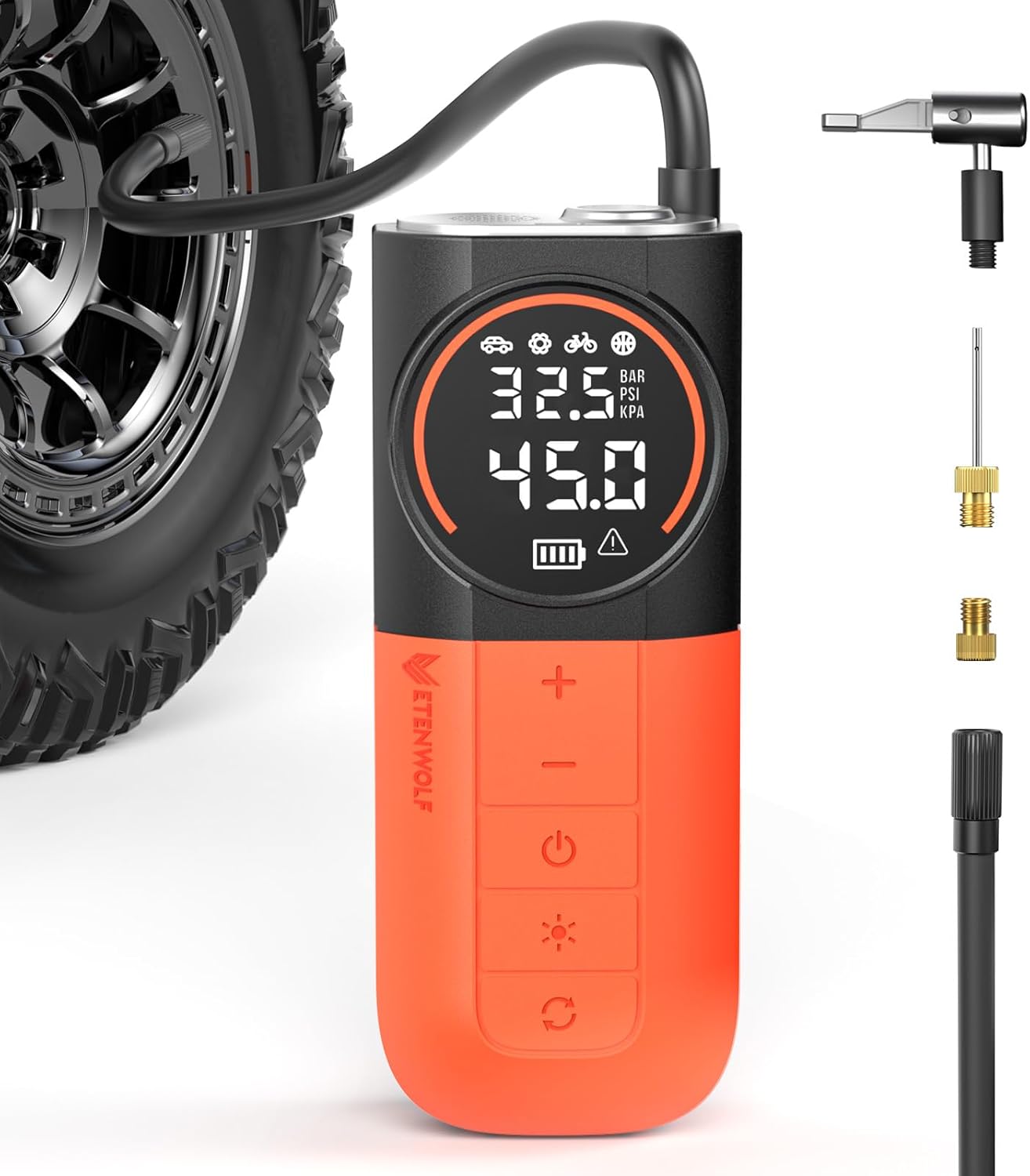
The ETENWOLF S1 cordless tire inflator delivers ultra-fast inflation with up to 160 PSI and a 20 L/min airflow for quicker tire top-offs. Its 5200mAh battery and cooling system support inflating many tires and sports balls on a single charge, while the digital pressure gauge and multi-unit display help you reach the right pressure accurately. With preset modes, pressure memory, an auto-stop feature, and an LED flashlight, it’s built for easy roadside and everyday use.
How to Read Tacoma Tire Specifications
A tire size like P265/70R16 looks complicated, but each part has a clear meaning:
- P means P-metric passenger/light-duty tire. Some replacement tires may use LT, which stands for Light Truck and often has a stronger casing but a firmer ride.
- 265 is the tire’s section width in millimeters.
- 70 is the aspect ratio. The sidewall height is 70% of the tire width.
- R means radial construction.
- 16 is the wheel diameter in inches.
After the size, you will usually see a load index and speed rating, such as 112T. Do not ignore these. A Tacoma used for towing, hauling, camping gear, or off-road travel should have tires with a load capacity suitable for the truck’s gross axle weight ratings and your real cargo use.
Note: The tire sidewall shows maximum tire capability, not the recommended pressure for your Tacoma. Use the door placard or owner’s manual for inflation pressure.
Factory Tire Sizes for 2016–2023 Toyota Tacoma
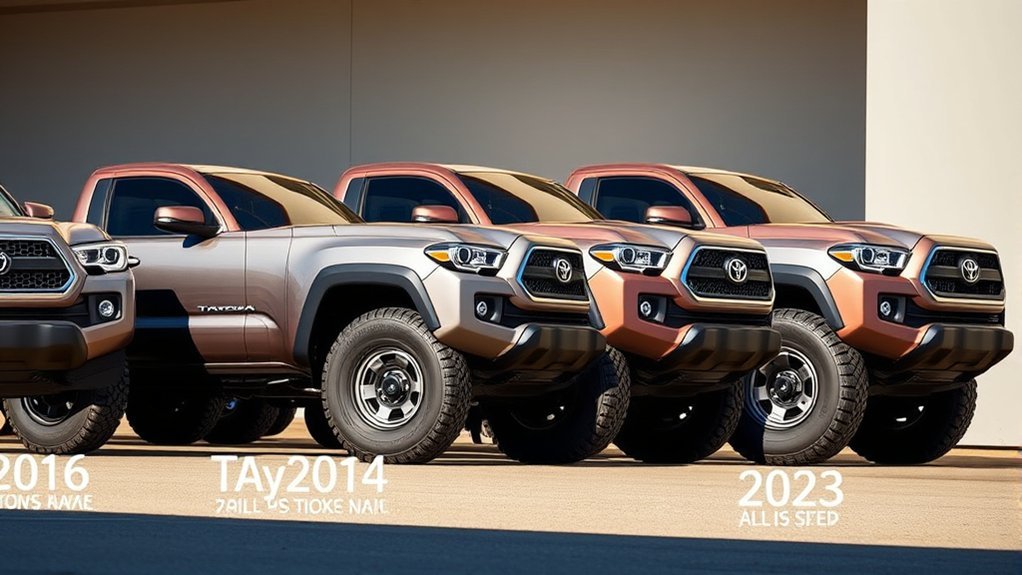
The 2016–2023 Tacoma is the 3rd Gen Tacoma. Factory tire size depends on trim, engine, package, and market, so use this table as a guide and confirm with your door placard before ordering tires.
| Factory Tire Size | Common Factory Use | Approx. Diameter | Best Replacement Approach |
|---|---|---|---|
| P245/75R16 | SR and many SR5 configurations | About 30.5 in. | Best for stock ride quality, value, and fuel economy |
| P265/70R16 | TRD Off-Road, TRD Pro, Trail Special Edition, and some packages | About 30.6 in. | Great stock-size choice for mixed road and trail use |
| P265/65R17 | TRD Sport | About 30.6 in. | Good for on-road handling with factory 17-inch wheels |
| P265/60R18 | Limited and some 18-inch wheel packages | About 30.5 in. | Best for factory Limited comfort and appearance |
Toyota’s 2016 Tacoma feature table lists P245/75R16, P265/65R17, P265/70R16, and P265/60R18 factory tire options. Toyota’s 2023 Tacoma brochure shows the same core factory sizes, with additional package-specific wheel designs. You can verify these factory listings in the 2016 Toyota Tacoma eBrochure and the 2023 Toyota Tacoma eBrochure.
Best Tire Sizes for Different Driving Conditions
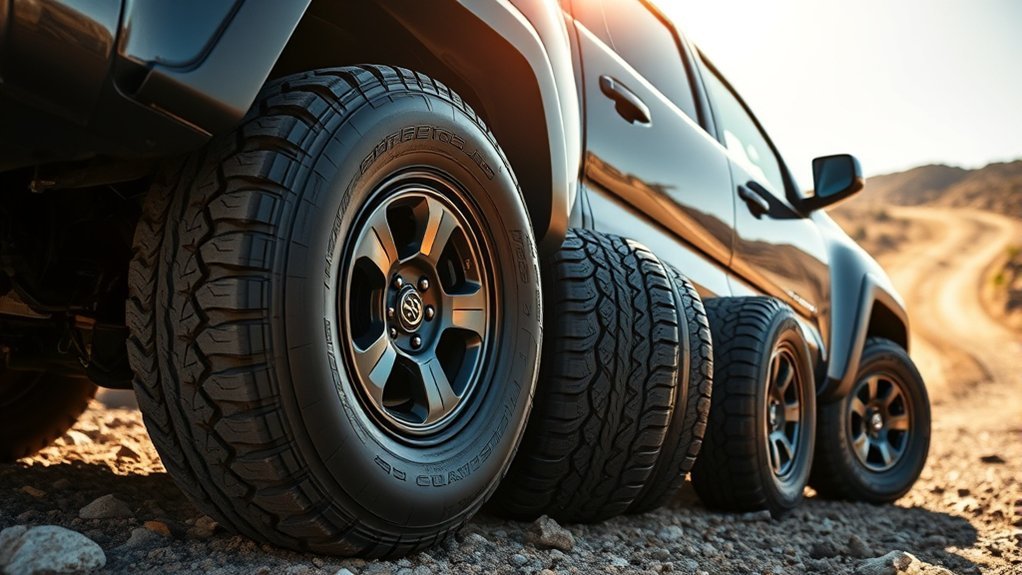
The best Tacoma tire size depends on how you use the truck. A daily driver needs quiet manners, wet traction, and predictable braking. A trail truck may need stronger sidewalls and a more aggressive tread. An overlanding build may need a balance of load capacity, puncture resistance, and highway comfort.
| Driving Use | Good Size Range | What to Know |
|---|---|---|
| Daily driving | Factory size from the door placard | Best for comfort, MPG, braking feel, and speedometer accuracy |
| Light trails and camping | P265/70R16, P265/65R17, or similar all-terrain size | Choose all-terrain tread for a balance of highway manners and dirt-road grip |
| Mild upsizing | 265/70R17 or 265/75R16 | Often considered a modest step up, but still check wheel offset, rubbing, and speedometer error |
| Overlanding | 255/85R16, 275/70R17, or similar narrow/tall sizes | Good for clearance and load-carrying builds, but may require lift, trimming, and careful wheel selection |
| Aggressive off-road | 285/70R17 or similar “33-inch” sizes | Expect lift, trimming, alignment changes, and possible body mount clearance work depending on setup |
Pro Tip: If your Tacoma is a commuter first and a trail truck second, a high-quality all-terrain tire in the factory size is usually smarter than jumping straight to a heavy oversized mud-terrain tire.
All-Terrain vs. Mud-Terrain Tires for Your Tacoma
All-terrain tires are the best choice for most Tacoma owners. They work well on pavement, gravel, forest roads, mild rocks, and weekend camping trips. They are usually quieter, lighter, and better in rain than aggressive mud-terrain tires.
Mud-terrain tires are better for deep mud, rocks, and low-speed trail grip. The tradeoff is more road noise, more weight, faster wear on pavement, and weaker wet-road manners in some designs. If your Tacoma spends most of its life on the highway, a mud-terrain tire can feel like too much tire for the job.
For winter driving, look for a tire that matches your climate. The NHTSA TireWise guide notes that winter tires are more effective than all-season tires in deep snow. The Tire Industry Association also explains that winter tires use special tread designs and rubber compounds for cold-weather performance.
Modifications Needed for Larger Tires
Larger tires can improve ground clearance, but the Tacoma’s front wheel wells have limits. The bigger and wider the tire, the more likely it is to contact the fender liner, cab mount, body mount, mud flap, or upper control arm.
- 265/70R17 or 265/75R16: Often treated as a mild upgrade, but still test-fit because wheels and tire models vary.
- 275/70R17: May need careful wheel offset, alignment, and minor trimming depending on the truck.
- 285/70R17: Common “33-inch” upgrade, but often needs a lift, trimming, and proper wheel offset.
- 34-inch and larger tires: Usually require serious suspension, trimming, gearing, and clearance work.
Wheel offset matters as much as tire size. A tire that clears on one wheel can rub badly on another wheel with a different offset. After any tire or suspension change, get an alignment and check clearance while turning both directions.
[Products Worth Considering]

This portable cordless tire inflator delivers up to 160 PSI with fast 17 L/min airflow to help you quickly top up tires and get back on the road. It features dual power mode, running on a 21V rechargeable battery or a 12V DC adapter for convenient roadside use. An automatic shut-off with digital pressure gauge helps prevent overinflation, and a built-in LED light improves visibility in low-light conditions.
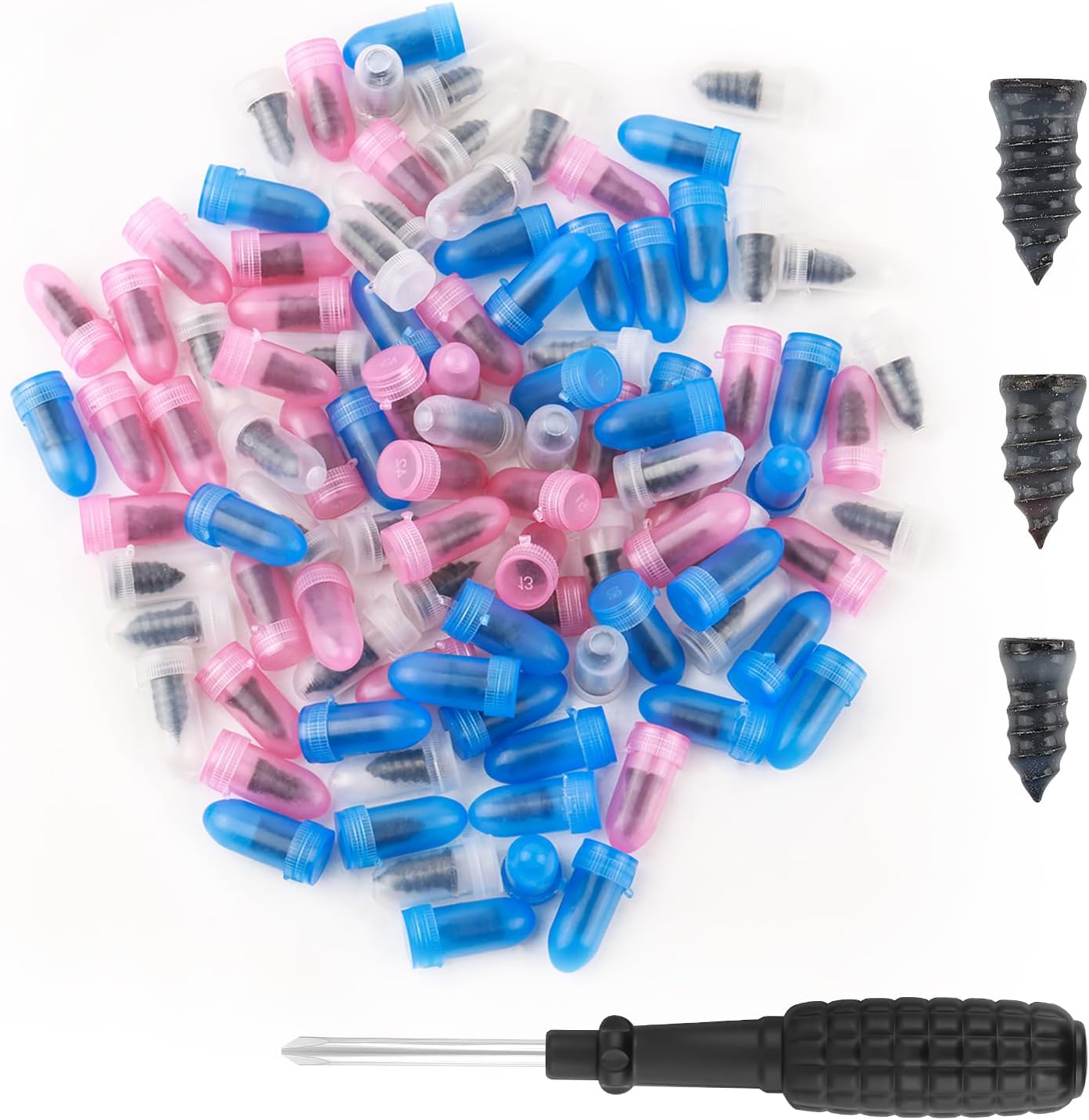
This 100-piece tire repair screw plug kit provides a fast, self-service solution for punctures on the road. Choose the correct plug size, insert it into the break, and screw it in to help seal the puncture and temporarily restore tire pressure. Thickened threads and rubber-wrapped plugs improve bite and sealing while remaining compact and easy to carry.
How Tire Size Impacts Fuel Economy, Speedometer Accuracy, and Performance
A taller tire travels farther with each rotation. That sounds helpful, but it also means your speedometer may read lower than your actual road speed. For example, if you move from an approximately 30.6-inch factory tire to a roughly 32.7-inch tire, the tire circumference increases enough to affect speed readings and shift feel.
A taller tire can make your speedometer show a slower speed than you are actually driving, so recalibration may be needed after a major size change.
Larger tires can also reduce fuel economy because they are often heavier and have more rolling resistance. The NHTSA notes that tire design, tread, construction, and rolling resistance influence performance and fuel efficiency. If MPG matters, choose the lightest tire that still meets your traction and load needs.
Braking and steering feel can change too. A heavy LT all-terrain or mud-terrain tire may feel tougher off-road, but it can make the truck feel slower and less responsive on pavement.
How to Choose the Right Tacoma Tire Size
Use this simple process before buying tires:
- Check the door placard. Write down the original tire size and recommended cold tire pressure.
- Confirm your wheel size. A 16-inch tire only fits a 16-inch wheel; a 17-inch tire only fits a 17-inch wheel.
- Match the load index. Choose a tire with a load rating that meets or exceeds the original tire, especially if you tow or haul.
- Choose a tread type. Highway tires are quietest, all-terrain tires are best for mixed use, and mud-terrain tires are for aggressive off-road conditions.
- Check diameter change. Bigger diameter can affect speedometer accuracy, gearing feel, braking, and fuel economy.
- Test fit before committing. Turn lock-to-lock, check the rear of the front fender liner, and inspect clearance under suspension compression.
- Recalibrate if needed. Larger tires may require speedometer calibration through a shop or calibration device.
Tips for Maintaining Your Tacoma’s Tires
Tire maintenance matters as much as tire size. Even the best tire performs poorly if it is underinflated, worn unevenly, overloaded, or too old.
Regular Pressure Checks
Check tire pressure at least once a month and before long trips, towing, or heavy loads. Use a quality tire pressure gauge and check the tires when they are cold, meaning the truck has been parked for several hours. The U.S. Tire Manufacturers Association recommends using the driver’s door label or owner’s manual for the correct pressure.
Do not rely only on TPMS. A TPMS warning often appears only after a tire is already significantly underinflated, so a monthly gauge check is still important.
Tire Rotation Schedule
Follow Toyota’s maintenance schedule for your exact Tacoma. If a tire-specific interval is not available, the U.S. Tire Manufacturers Association recommends tire rotation every 5,000 to 8,000 miles. Rotation helps even out tread wear, especially on trucks that see dirt roads, towing, or lots of tight parking-lot turns.
Tread Depth, Alignment, and Tire Age
Inspect tread depth and sidewalls regularly. Replace tires when they reach the legal minimum tread depth or sooner if traction drops in rain, snow, or off-road conditions. Uneven wear, pulling, vibration, or feathered tread can point to alignment or suspension problems.
Also check tire age. The DOT tire identification number on the sidewall includes a date code showing the week and year the tire was made. Older tires can become more failure-prone even when tread remains.
Frequently Asked Questions
What size tires fit a 2016 Toyota Tacoma?
Factory 2016 Tacoma sizes include P245/75R16, P265/70R16, P265/65R17, and P265/60R18 depending on trim and package. SR and SR5 models commonly used P245/75R16, TRD Off-Road used P265/70R16, TRD Sport used P265/65R17, and Limited used P265/60R18.
What is the biggest tire size for a stock 2016–2023 Tacoma?
There is no single guaranteed “biggest” size because wheel offset, tire brand, alignment, trim, and suspension condition all matter. Many owners consider sizes around 31.5 inches a mild upgrade, while 33-inch tires usually need more clearance work. Always test-fit before buying a full set.
Can I put 285/70R17 tires on a Tacoma?
Yes, many Tacoma builds use 285/70R17 tires, but they are not a simple factory-size replacement. Expect possible rubbing, trimming, alignment changes, lift requirements, and speedometer error. A professional fitment check is strongly recommended.
Does a larger tire hurt Tacoma fuel economy?
It can. Larger tires are often heavier and may have more rolling resistance, especially aggressive all-terrain or mud-terrain tires. That can reduce MPG, slow acceleration, and change braking feel.
Do I need LT tires on a Toyota Tacoma?
Not always. LT tires can be useful for heavy loads, rocky terrain, and overlanding, but they are usually heavier and firmer than P-metric tires. For mostly street driving, a properly rated P-metric or C-load all-terrain tire may ride better.
What tire pressure should I use on my Tacoma?
Use the cold tire pressure listed on the driver’s door placard or in your owner’s manual for the factory tire size. If you change tire type or load range, ask a qualified tire shop to help set pressure based on load, tire construction, and use.
Conclusion
The best tire size for your 2016–2023 Toyota Tacoma is the one that fits your truck, supports your load, and matches how you actually drive. For a stock replacement, use the factory size on your door placard. For mild trail use, a quality all-terrain in a factory or near-factory size is usually the cleanest choice. For larger 32- or 33-inch tires, plan for clearance checks, possible trimming, alignment work, and speedometer calibration.
Start with verified factory specs, then upgrade only as much as your driving requires. That approach keeps your Tacoma safer, more predictable, and more capable on the road and trail.
Sources
- Toyota 2023 Tacoma eBrochure — factory wheel and tire sizes, TRD Pro suspension details, and trim equipment
- Toyota 2016 Tacoma eBrochure — 2016 factory wheel and tire sizes by trim
- NHTSA TireWise — tire buying, maintenance, tire aging, fuel efficiency, and safety guidance
- U.S. Tire Manufacturers Association Tire Care Essentials — pressure checks, tread depth, rotation, and alignment guidance
- Tire Industry Association: Reading a Tire Sidewall — tire size codes, aspect ratio, radial construction, load index, speed rating, and winter tire markings
- America’s Tire: Tire Size and Speedometer Accuracy — how tire height changes speedometer readings and when recalibration may be needed

Related Articles
Best Toyota Tacoma Tire Set Deals
You rely on your Tacoma for daily driving, work runs, and weekend adventures, so picking the right tire set matters more than you might…
Read More
Best Winter Tire Deals for Toyota Tacoma
Choosing the right winter tires for your Toyota Tacoma matters because it directly affects your safety, traction, and confidence when roads turn icy or…
Read More
Best Highway Tire Deals for Toyota Tacoma
You rely on your Tacoma for long drives, towing, and everyday hauling, so picking the right highway tire matters more than you might think.…
Read More