Buying the right tires is about more than finding the correct diameter and a good price. You need the vehicle-approved size, load capability, suitable tire type, a clear installation quote, and a plan for maintenance afterward. Checking those details before you order can prevent fitment problems, surprise fees, vibration, uneven wear, and unnecessary replacement costs.
Quick Answer
Before buying tires, confirm the size and vehicle specifications on the door-jamb placard or owner’s manual, choose a tire type suited to your climate, review the DOT manufacturing date and warranty, and compare the complete installed price. After installation, verify pressure, balance, TPMS operation, wheel condition, and whether alignment needs to be checked.
Key Takeaways
Key Takeaways
- Use your vehicle’s door-jamb tire placard or owner’s manual as the primary reference for replacement size and cold inflation pressure.
- Match the tire category to the weather and roads you actually drive on instead of choosing by tread appearance alone.
- Compare the total installed price, including mounting, balancing, valve or TPMS service, disposal, taxes, and optional alignment.
- New tires should be balanced during installation; alignment should be checked when wear patterns, pulling, impacts, or suspension work indicate a possible problem.
- If replacing only two tires, follow the tire and vehicle manufacturer’s guidance; many tire manufacturers recommend installing the new pair on the rear axle.
- Check pressure and tread at least monthly and follow your vehicle manufacturer’s rotation schedule.
What to Check Before You Buy Tires
Start with the information supplied by your vehicle manufacturer. The National Highway Traffic Safety Administration advises buyers to use the Tire and Loading Information Label on the driver-side door area or the owner’s manual to identify the correct replacement tire size and recommended cold inflation pressure.
Do not use the maximum pressure molded into the tire sidewall as your normal inflation target. That marking describes the tire, while the vehicle placard gives the pressure specified for the vehicle.
- Confirm the complete tire size: Check width, aspect ratio, construction, and wheel diameter.
- Verify load and speed requirements: Replacement tires must be suitable for the vehicle and its intended use.
- Choose the right tire category: Consider your normal temperatures, rainfall, snow, highway use, unpaved driving, ride comfort, and expected mileage.
- Check the manufacturing date: The last four digits of the DOT Tire Identification Number show the week and year of manufacture.
- Review the warranty: Read mileage, workmanship, road-hazard, rotation, inflation, and documentation requirements. The existing guide to tire warranties can help you compare the fine print.
- Check return and fitment policies: This matters especially when ordering online or buying an uncommon size.
- Get the complete installed price: Ask about mounting, balancing, valve or TPMS service, disposal, taxes, shop fees, and optional alignment.
NHTSA reports that 511 people died in tire-related U.S. crashes in 2024, which is one reason correct fitment, inflation, and tire maintenance deserve more attention than price alone.
Warning: Do not substitute a different tire size, load capability, or other critical specification simply because the tire physically fits the wheel. Use an alternate size only when it is approved for the vehicle or confirmed by a qualified tire professional.
Match Tire Size to Your Vehicle
Match the tire size to your vehicle’s approved specifications. A different overall diameter, width, or load capability can affect clearance, steering response, braking behavior, speedometer readings, and vehicle-control systems.
Check the driver-side door-jamb placard first, then compare it with the owner’s manual and the markings on the tires currently installed. A typical tire-size code identifies the section width, aspect ratio, construction, and rim diameter, followed by load and speed information.
Do not assume the tires currently on a used vehicle are automatically the correct reference. A previous owner may have changed wheels or tire sizes, so the vehicle manufacturer’s information remains the safer starting point.
If you are considering an alternate size, confirm that the wheel, tire, load capacity, clearance, and overall diameter are appropriate for the vehicle. Also check whether the front and rear axles require the same size. Some performance vehicles use staggered fitments with different front and rear sizes.
All-wheel-drive and four-wheel-drive vehicles may be particularly sensitive to differences in tire circumference or tread depth. Follow the vehicle manufacturer’s limits before replacing only one or two tires.
Pro Tip: Photograph the door-jamb tire placard before shopping. It gives you a reliable reference when comparing tires online or discussing fitment with an installer.
Pick the Right Tread for Your Driving Conditions
The best tire is the one designed for the conditions you encounter most often. Tread appearance alone does not tell you how well a tire will brake, corner, resist hydroplaning, remain flexible in cold weather, or wear over time.
Start with the tire category. All-season tires are designed for broad everyday use, while winter tires are engineered for colder conditions. Summer and performance-focused tires may prioritize warm-weather steering and grip. All-terrain and other specialized designs trade some on-road characteristics for performance on different surfaces.
Then compare manufacturer specifications, independent test results when available, warranty coverage, wet-road performance, comfort, noise, and tread-life expectations.
NHTSA explains that many U.S. passenger tires carry Uniform Tire Quality Grading information for treadwear, traction, and temperature resistance. UTQG can provide useful context, but it should not replace the vehicle manufacturer’s fitment requirements or a broader comparison of the tire’s intended use.
Directional and asymmetric tread patterns can offer specific performance advantages, but they also have installation and rotation requirements. If you buy a directional tire, make sure it is mounted to rotate in the correct direction.
Note: A more aggressive-looking tread is not automatically safer in rain or snow. Tire construction, rubber compound, siping, tread geometry, temperature range, and the vehicle itself all affect real-world performance.
Compare Tire Installation Costs Before You Buy
Once you have selected the tire, compare the complete installed cost rather than the advertised tire price alone. Installation programs change frequently, and the final charge can depend on the retailer, location, wheel size, tire source, TPMS components, disposal rules, and included maintenance services.
| Shop Type | Pricing Reality | What to Confirm |
|---|---|---|
| Big-box retailer | Varies by tire source and package | Mounting, balancing, valves, TPMS, disposal, rotations |
| Independent shop | Usually quoted by vehicle and wheel size | Labor, outside-tire fees, disposal, road-force balance if requested |
| Dealer service center | Vehicle- and service-specific | OE fitment, TPMS programming, alignment, warranties |
| Mobile installer | Depends on location and service package | Travel/service charge, balancing equipment, TPMS capability |
| Warehouse club | May be bundled with qualifying tire purchases | Membership rules, TPMS parts, maintenance benefits, vehicle restrictions |
Ask for a written out-the-door quote whenever possible. A tire that costs less online can become more expensive after shipping, mounting, balancing, valve or TPMS service, disposal, and other fees are added.
If you are comparing a retailer-specific package, review exactly what the advertised service covers. This guide to tire installation is an example of why the line items matter more than the headline price.
[Products Worth Considering]

This TPMS sensor training and relearn reset tool is customized for Ford, Lincoln, and Mercury vehicles to help activate tire pressure programming after sensor replacement or tire rotation. It can activate individual tire pressure sensors with one-button operation, helping prevent TPMS warning light illumination. It is not a sensor programming tool and cannot program replacement sensors—use it to trigger/activate sensors only.

Autel MX TPMS sensors combine 315MHz and 433MHz in a single easy-to-install press-in design for faster tire service. They support wireless programming with strong signal performance, and the sensors are clone-able for streamlined replacement. Built for reliability and tested to SAE standards, each sensor includes a series number for quality control.

Replace worn or missing TPMS sensors with a pre-programmed 4-pack designed for compatible GM vehicles. These 315MHz sensors provide real-time tire pressure monitoring and alert you if pressure is too high, too low, or if a rapid air leak occurs. Most installations are ready with minimal relearn effort after mounting, helping improve safety and driving confidence.
What Tire Installation Should Include
A professional tire installation should begin with verifying that the tire and wheel are suitable for the vehicle. The technician should inspect the wheel and bead-seating area for damage or corrosion that could interfere with sealing.
At minimum, confirm which of these items are included in your quoted package:
- Removing the old tire and mounting the new tire.
- Balancing the new tire and wheel assembly. NHTSA states that new tires should be balanced when installed.
- Setting inflation pressure to the vehicle manufacturer’s specification.
- Inspecting or servicing rubber valve stems or TPMS valve components when appropriate.
- Handling direct TPMS sensors correctly and performing any required relearn or programming procedure.
- Torquing wheel fasteners to the vehicle manufacturer’s specification.
- Disposing of the removed tires if disposal is part of the service.
Alignment is normally a separate service unless the shop specifically includes it. Ask whether an alignment measurement or adjustment is recommended based on the wear pattern of the old tires, steering symptoms, suspension condition, or vehicle history.
Note: “Installation included” does not always mean every TPMS part, alignment service, road-hazard plan, disposal fee, or future maintenance service is included. Read the package details before paying.
[Products Worth Considering]

Replace worn or malfunctioning GM TPMS sensors with this 433MHz pre-programmed sensor set designed for compatibility with many Chevrolet, Buick, GMC, and Cadillac models. It includes guidance for proper OBDII relearning/pairing after installation and supports reliable long-term operation with a high-performance CR2032 battery. Quality tested for durability and performance to help restore accurate tire pressure monitoring.
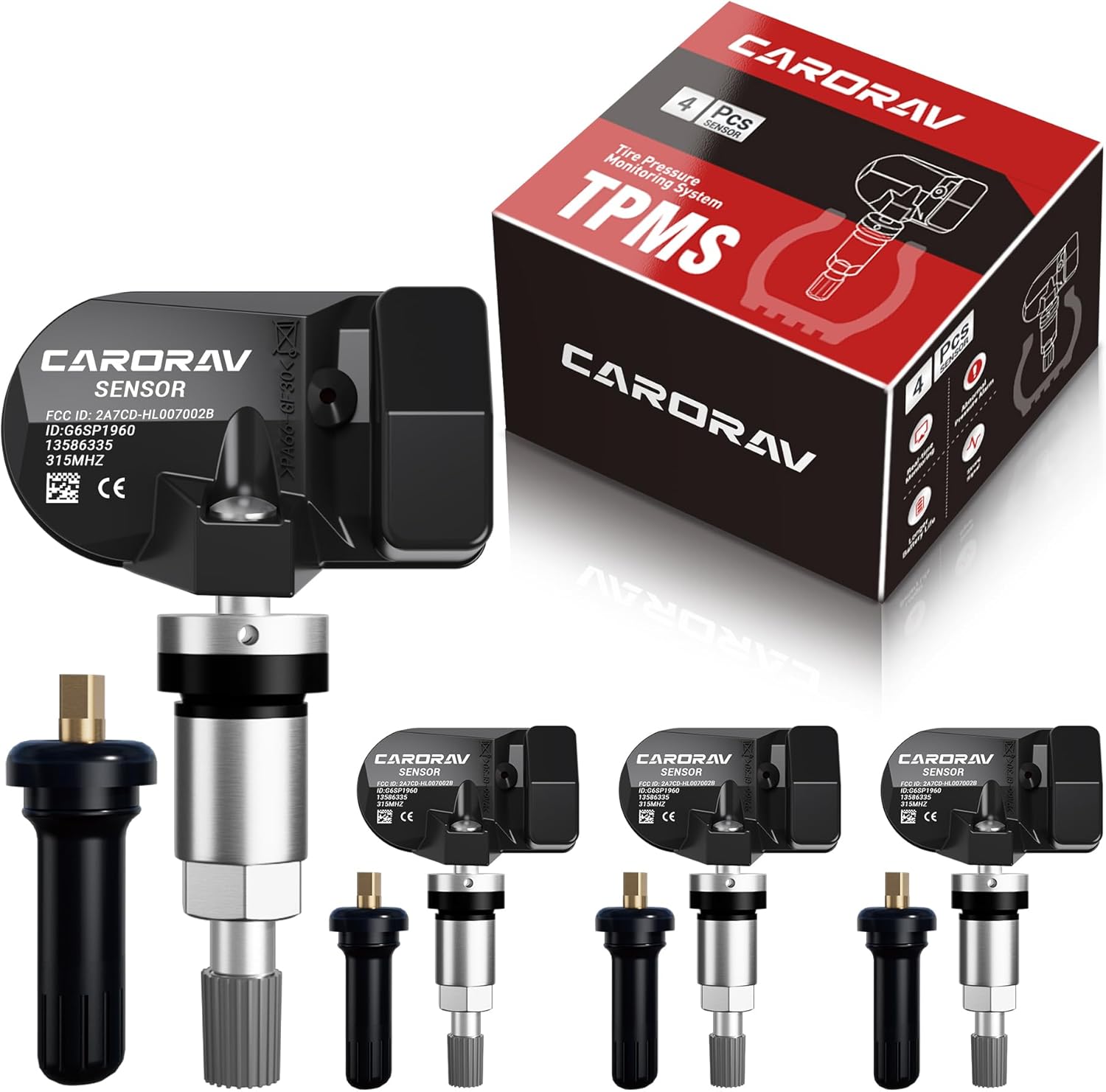
Replace worn or missing TPMS sensors with CARORAV pre-programmed GM-compatible sensors for a smoother installation experience. These 315MHz replacement sensors help monitor tire pressure in real time with long battery life, and they are designed to withstand harsh temperatures. Manual or OBDII relearn may be required to reset the system for proper recognition.

Masoll Gen 2 external TPMS sensors are a DIY replacement set of 4 for select GM vehicles made after 2006, helping you shut off the TPMS warning light quickly. Simply screw the sensors onto the tire valves and sync to your car ECU using the included EL-50448 relearn tool. Dual-frequency 315/433 MHz design provides OEM-level performance with accurate readings and replaceable batteries for about two years.
Check Tire Balancing and Alignment
Balancing and alignment solve different problems. Balancing corrects weight differences in the rotating tire-and-wheel assembly, while alignment adjusts wheel angles so the vehicle tracks and the tires contact the road as intended.
NHTSA states that new tires should be balanced when installed. An improperly balanced assembly can contribute to vibration and irregular wear.
An alignment adjustment is not automatically required simply because you installed new tires. However, it is worth checking when:
- The old tires showed uneven or rapid wear.
- The vehicle pulls on a straight, level road.
- The steering wheel is noticeably off-center.
- You recently hit a significant pothole or curb.
- Suspension or steering components were repaired or replaced.
- The shop’s alignment measurement shows the angles are outside specification.
Camber, caster, and toe affect how the wheels track and how the tread meets the road. A qualified technician can measure these angles and compare them with the vehicle manufacturer’s specifications.
If you notice vibration immediately after installation, return to the installer. The cause could involve balance, wheel damage, tire seating, a defective tire, or another mechanical issue rather than alignment alone.
[Products Worth Considering]

Replace your worn or missing TPMS sensors with pre-programmed, direct-fit sensors for compatible Ford, Lincoln, and select Mazda models. Each sensor comes ready to activate with a scan tool, helping restore accurate tire pressure monitoring and trouble-free installation. Built with a long-life CR2032 battery and tested before factory release, this set provides dependable performance with a one-year warranty.

The VEHLIVE SU-50448 II TPMS relearn tool provides a fast activation reset to restore accurate tire pressure monitoring after sensor replacement or tire rotation. It supports 315 MHz and 433 MHz GM series sensors and helps clear dashboard pressure warnings. With simple two-button operation and horn-confirmed relearning order, you can reprogram sensors conveniently at home.

Marsflex brand TPMS replacement sensors help restore tire pressure monitoring for compatible Toyota, Lexus, Scion, and Pontiac models. Each sensor is pre-programmed for the vehicle application and includes a long-life battery for up to 8 years of normal use. Designed to replace common OE numbers and requires relearning using a TPMS scan tool after installation.
Replace Valve Stems and TPMS Sensors When Needed
Check the type of tire pressure monitoring system your vehicle uses. A direct TPMS has pressure sensors associated with the wheels, while an indirect system estimates pressure changes using wheel-speed and other vehicle data. An indirect system does not have the same in-wheel pressure sensors to replace.
For direct TPMS systems, inspect the valve stem, seals, grommets, retaining hardware, and sensor condition while the tire is off the wheel. Rubber stems that are cracked, hardened, leaking, or damaged should be replaced. Metal-valve service components should be renewed when required by the sensor or service procedure.
Do not replace a functioning TPMS sensor automatically just because a tire is being changed. However, sensor age can be worth considering. Bridgestone notes that batteries inside direct TPMS sensors commonly last about 5 to 10 years, although actual life varies.
If a sensor has intermittent communication faults, physical damage, corrosion, or a depleted sealed battery, replacement may make sense while the tire is already removed.
After installation, inflate the tires to the placard pressure, perform the vehicle-specific TPMS relearn or reset if required, and investigate any warning lamp that remains illuminated or flashes.
Plan for Old Tire Disposal and Rotation
Before the new tires are mounted, decide what will happen to the old set and note the maintenance schedule for the replacements. Proper disposal prevents unwanted tire stockpiles, while planned rotation can help control irregular wear where rotation is permitted.
Old Tire Disposal
Ask whether the installer accepts the removed tires and whether disposal or recycling is already included in the quote. A tire retailer, approved recycler, or local solid-waste program is usually easier than transporting the tires yourself.
Scrap-tire rules vary by location. The U.S. Environmental Protection Agency’s scrap-tire information explains that tire collection, storage, processing, and disposal requirements are largely handled through state programs.
If you must keep tires temporarily, store them in a clean, dry location away from ignition sources and standing water. Do not abandon or illegally dump them.
If the removed tires still appear usable, do not assume they are safe for resale or donation based only on remaining tread. Their age, damage, repair history, and overall condition also matter.
Tire Rotation Timing
Follow the rotation interval and pattern in your vehicle owner’s manual and tire documentation. NHTSA notes that, when recommended by the vehicle manufacturer, a common interval is about 5,000 to 8,000 miles or sooner if irregular wear appears.
Not every vehicle can use a standard rotation pattern. Staggered front/rear sizes, directional tires, different wheel sizes, and other fitments can limit or change rotation options.
Record the mileage at each service. Regular tread-depth checks can also reveal early alignment, inflation, or suspension problems before they consume a large portion of the tire’s usable tread.
New Tire Break-In and Post-Installation Checks
New tires can feel different from the worn tires they replace. Full tread depth can make steering response feel less immediate at first, and manufacturing or mounting substances may take time to wear away.
Continental recommends smooth acceleration, braking, and cornering during roughly the first 500 miles of new-tire use. Follow the instructions from your specific tire manufacturer if they differ.
Pro Tip: Pay attention to how the vehicle feels during the first several drives. Persistent vibration, pulling, air loss, a TPMS warning, unusual noise, or contact between the tire and vehicle should be inspected rather than treated as normal break-in behavior.
After installation:
- Verify cold pressure against the door-jamb placard.
- Check that no TPMS malfunction warning remains.
- Look for obvious leaks, damaged valve stems, or unusual tire-to-body clearance.
- Follow any wheel-fastener recheck instructions supplied by the vehicle, wheel, or installer.
- Check tire pressure and tread at least monthly and before long trips.
- Inspect the tires again after major pothole or curb impacts or if handling changes.
Frequently Asked Questions
How Long Do New Tires Typically Take to Break In?
Guidance varies by manufacturer, but Continental recommends gentle acceleration, braking, and cornering for roughly the first 500 miles. New full-depth tread may also feel less responsive than the worn tread you just replaced. Follow any break-in instructions supplied by your tire manufacturer.
Can I Install Just Two New Tires on My Vehicle?
Sometimes. Michelin recommends putting the new pair on the rear axle when only two tires are replaced. However, AWD and 4WD vehicles may have additional limits on tread-depth or circumference differences, so check the owner’s manual or vehicle manufacturer before replacing fewer than four.
Should I Buy Tires Online or From a Local Shop?
Either can work. Compare the complete installed price rather than the tire price alone. For an online order, confirm shipping, return rules, local installation eligibility, outside-tire fees, warranty handling, and TPMS service. A local shop may make fitment questions, installation, and warranty service easier.
Do Performance Tires Affect Fuel Economy Noticeably?
They can, but the label “performance tire” does not tell you the size of the fuel-economy change. Rolling resistance, tire size, inflation pressure, vehicle setup, temperature, and driving behavior all matter. NHTSA estimates that reducing tire rolling resistance by 10% can improve vehicle fuel economy by roughly 1% to 2%, so compare the characteristics of the specific tire rather than assuming every performance model has the same effect.
How Often Should I Inspect My Tires After Installation?
Check inflation pressure and tread at least monthly. Also inspect the tires before long trips, after significant pothole or curb impacts, and whenever you notice air loss, vibration, pulling, unusual noise, visible damage, or a TPMS warning.
Do I Need an Alignment Every Time I Buy New Tires?
Not automatically. New tires should be balanced during installation, but alignment adjustment is needed when measurements are outside the vehicle specification. An alignment check is especially useful when the old tires wore unevenly, the vehicle pulls, the steering wheel is off-center, or the suspension has been repaired or hit hard.
Can I Mix Different Tire Brands or Models?
A matched set is usually the simplest way to maintain consistent handling. If you must replace fewer than four tires, match size, type, load capability, and other vehicle requirements as closely as possible. Follow the vehicle and tire manufacturer’s guidance, especially on AWD or 4WD vehicles where tread-depth and circumference differences may be restricted.
Conclusion
Before you buy tires, confirm the vehicle-approved size, specifications, tire type, warranty, manufacturing date, and total installation cost. Then make sure the installation includes proper mounting, balancing, inflation, wheel-fastener torque, and any required valve or TPMS service.
Do not assume that new tires automatically require an alignment or that the cheapest tire produces the lowest final bill. Look at the old wear pattern, vehicle condition, installation package, and long-term maintenance requirements. Once the tires are fitted, use a gentle break-in period where recommended, check pressure regularly, follow the correct rotation schedule, and investigate vibration, pulling, leaks, or warning lights promptly.
Sources
- National Highway Traffic Safety Administration — TireWise — tire sizing, inflation, balancing, alignment, rotation, TPMS, tire aging, tread, and current tire-safety statistics.
- Michelin — When to Replace Tires — tire age, damage, two-tire replacement, and AWD/4WD considerations.
- Continental — Braking With New Tires — new-tire break-in guidance.
- Bridgestone — How TPMS Works — direct TPMS operation and approximate sensor-battery life.
- U.S. Environmental Protection Agency — Scrap Tire Laws and Statutes — state-level scrap-tire management and disposal requirements.