
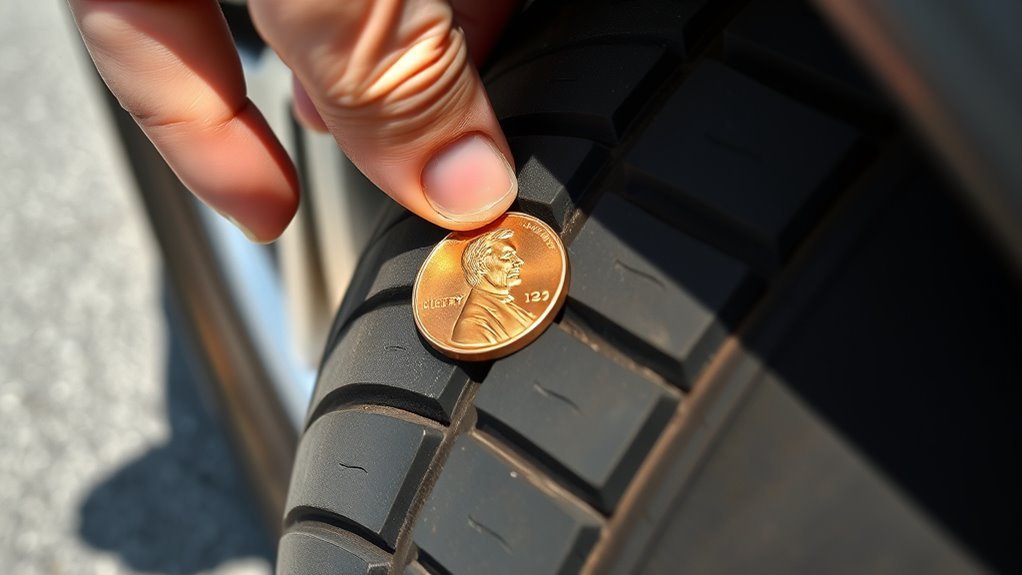
Worn tire tread can turn a quick stop into a long, risky slide. Use a penny head-first in a tire groove with Lincoln’s head facing down. If you can see the top of his head, your tread has reached about 2/32” or less, and you should replace the tire. Check several spots around each tire, including inner, center, and outer grooves, so you can catch uneven wear from poor alignment, tire pressure, or loading.
Quick Answer
Place a penny into the tire tread with Lincoln’s head facing down. If you can see the top of his head, the tread is about 2/32″ or less, and you should replace the tire. For better wet-road grip, check with a quarter or tread gauge and consider replacing tires at about 4/32″.
Key Takeaways
- Use the penny test as a quick screen for tire tread near 2/32″.
- Replace a tire when Lincoln’s head stays fully visible in any main groove.
- Check several grooves and several spots because tires often wear unevenly.
- Use a quarter or tread depth gauge when you drive often in rain.
- Fix pressure, rotation, or alignment problems before they ruin new tires.
How to Perform the Penny Test Step by Step
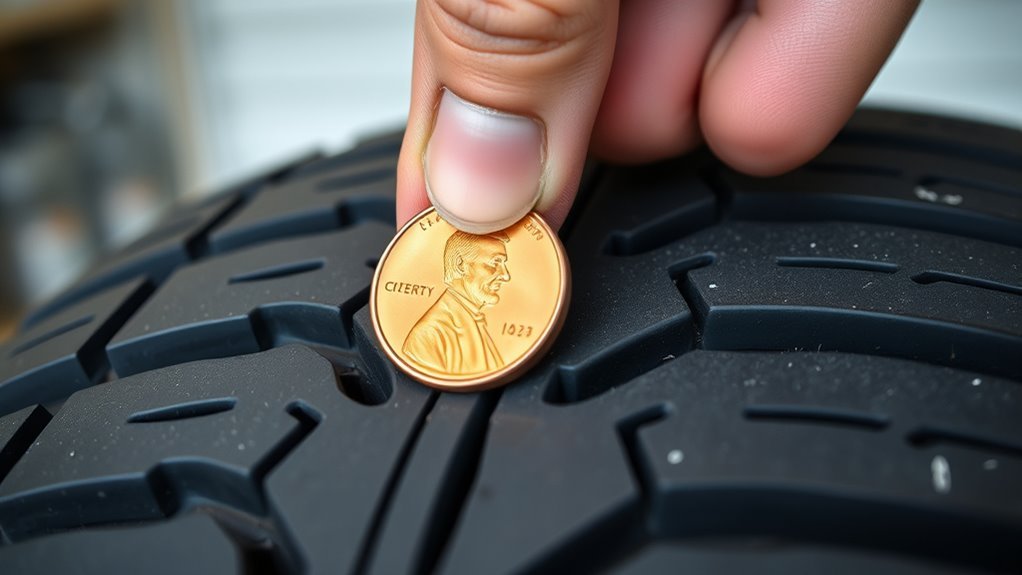
Grab a penny and press it straight into a deep tread groove with Lincoln’s head facing down. If the tread covers part of his head, the tire has more than about 2/32″ of tread in that spot. If you can see the top of his head, replace the tire.
- Park on a flat surface and set the parking brake.
- Check tire pressure when the tires are cool.
- Insert the penny vertically into a main tread groove.
- Face Lincoln’s head down toward the tire.
- Look for the top of Lincoln’s head.
- Repeat the test across the inner, center, and outer grooves.
Treat the penny test as a quick screening tool, not a full tire inspection. In wet climates, or before a long trip, follow up with a quarter test or tread depth gauge.
Quick Answer: How to Tell If Your Tires Are Unsafe
If Lincoln’s head stays visible when you place a penny into the tread, your tire has reached about 2/32″ or less. Replace that tire soon because low tread reduces grip, especially on wet roads.
Check several spots around each tire. Uneven or low tread in one area can point to improper inflation, poor alignment, worn suspension parts, or concentrated wear. Aim for about 4/32″ or more when you drive often in rain.
Warning: A tire can pass the penny test in one groove and still need service if another groove shows low or uneven tread.
Visible Lincoln’s Head
A visible Lincoln’s head means the tread has reached a dangerous level. Insert the penny into several tread grooves with Lincoln’s head facing down. If you can see the top of his head, the tread measures about 2/32″ or less.
Low tread raises the risk of hydroplaning and longer braking distances. Check more than one spot before you act, but do not ignore a failed result. One bald section can reduce control in rain or during hard braking.
Uneven or Low Tread
Uneven or low tread quickly weakens grip. Use the penny test first, then inspect the full width of the tire. Look for cupping, feathering, center wear, or inside-edge wear.
- Center wear often points to overinflation.
- Outer-edge wear often points to underinflation.
- One-side wear often points to alignment trouble.
- Cupping can point to worn suspension parts or balance issues.
Check tire pressure monthly, rotate tires on schedule, and fix alignment problems early. These steps help your tires wear evenly and last longer.
Reading Results: What Lincoln’s Head Means (2/32″ and 4/32″)
When you insert a penny, note how much of Lincoln’s head you can see. If the tread covers his head, the tire has more than about 2/32″ in that groove. If the top of his head shows, replace the tire.
The penny test only checks the basic low-tread threshold. For wet roads, use a quarter or tread gauge and treat about 4/32″ as a more cautious replacement point. Regular monitoring of tread depth helps you spot problems before they affect safety.
Interpreting Lincoln’s Visibility
Press the penny straight into the tread with Lincoln’s head facing down. If the tread covers the top of his head, the tire still clears the basic 2/32″ check. Keep checking it because tread can drop quickly as tires age.
If his head shows, the tire has reached about 2/32″ or less. Replace it to restore traction and reduce risk on wet roads. Visibility near a 4/32″ gauge reading also signals weaker wet-weather grip.
Action Steps by Tread Depth
Use your result to choose the next step. A tread depth gauge gives the best reading because it measures in 1/32″ increments. The penny and quarter tests work best as fast checks between full inspections.
| Tread depth | What it means | What you should do |
|---|---|---|
| More than 4/32″ | Better tread for normal driving | Keep checking monthly |
| About 4/32″ | Reduced wet-road margin | Plan replacement if you drive often in rain |
| About 3/32″ | Near the basic replacement point | Shop for tires soon |
| 2/32″ or less | Tread has reached the common minimum threshold | Replace the tire |
When to Use a Penny, Quarter, or Tread Gauge (Accuracy and Use Cases)
Choose your method based on how much detail you need. Use the penny test for a fast, simple check near 2/32″. Use a quarter when you want a better wet-weather screen near 4/32″.
Use a tread gauge when you need an exact number or see uneven wear. Measure the inner, center, and outer grooves on each tire.
| Method | Best use case |
|---|---|
| Penny test | Quick roadside check for the common 2/32″ threshold |
| Quarter test | Pre-trip check for wet-weather readiness near 4/32″ |
| Tread gauge | Precise measurement across several grooves |
| Multiple-location checks | Finding uneven wear and alignment issues |
Check all four tires at several points. Do this monthly, before long trips, and before heavy rain seasons.
Pro tip: Keep a low-cost tread depth gauge in your glove box so you can confirm penny and quarter results.
[Products Worth Considering]

Accurately measure tire tread depth with a calibrated gauge marked from 0 to 1 inch in 1/32 inch increments. The color-coded bar helps you quickly identify tread condition ranges, supporting safe driving for trucks, motorcycles, automobiles, and passenger vehicles.

This tire inflator with pressure gauge delivers long-lasting performance with a durable rubber-protected gauge and sturdy build. The longer hose and 360 swivel air chuck help you seal the valve securely and keep your hands free while measuring, inflating, or deflating. It’s battery-free for reliable use and provides ±2 PSI accuracy in the mid-range for most typical tires, with universal compatibility for 1/4 NPT compressor outputs.

Monitor tire tread wear with a smart, color-coded depth gauge that shows clear condition ranges at a glance. The bar is range marked for fast, easy readings, helping you maintain safer traction and performance. Each gauge is portable with a pocket clip, and the set includes 20 units for daily use and sharing.
Penny Test Mistakes to Avoid (Prevent False Readings)
Small mistakes can make a penny check look better or worse than it really is. Insert the penny vertically into the tread groove with Lincoln’s head facing down. Do not roll, tilt, or angle the coin.
Check several places across each tire. One spot cannot show the whole tire’s condition because localized wear patterns can hide problems.
Check tire inflation before tread testing. Poor inflation can change how the tire sits on the road and how the tread wears. Track your results so you can see tread loss before it becomes urgent.
Why Your Tires Wear Unevenly: What It Means for Safety
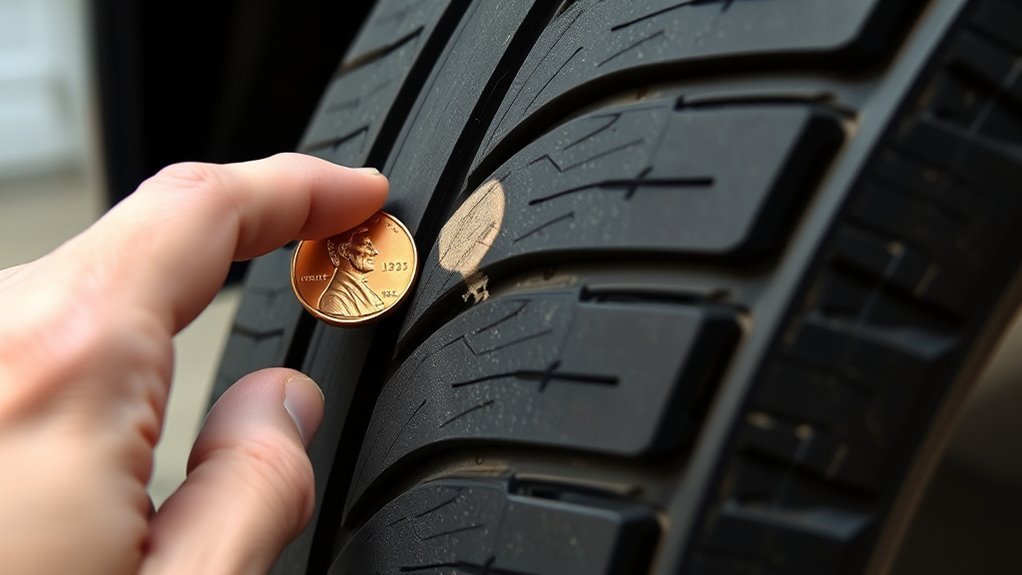
If you spot uneven tread, treat it as a warning sign. Feathered edges, cupping, or one shoulder wearing faster than the other means your vehicle needs attention.
Improper inflation changes the tire’s contact patch. Misalignment shifts load onto one part of the tire. Overloading adds heat and strain, which can speed up wear.
Measure tread depth across the inner, center, and outer grooves. Rotate tires on the schedule in your owner’s manual, and inflate them to the vehicle maker’s pressure setting. Fix the cause before you replace tires, or the same wear pattern can return.
What You’ll Need Before You Check Tire Tread
You only need a few simple items to check tread at home. A penny gives you a quick 2/32″ screen, while a tread depth gauge gives a precise reading.
- A clean penny for the basic tread check
- A quarter for a wet-weather tread check
- A tread depth gauge for exact measurements
- Your vehicle placard or owner’s manual for tire pressure
- A tire pressure gauge for inflation checks
Check tread when your vehicle sits on level ground. Let the tires cool first if you also plan to check pressure.
[Products Worth Considering]

The SAFELIFE dial tire tread depth gauge measures tread depth in 1/32 inch increments with clear, easy-to-read 2-inch dial face. Color zones using a traffic light system help you quickly judge whether tread is low, marginal, or ample for safer driving. Built with a durable zinc cast body and a metal detect probe for precise, comfortable use across cars, motorcycles, trucks, and buses.

Measure tire tread depth quickly and accurately with this LUMITECO dial gauge that reads in 1/32" increments up to 14/32". The color-coded green/yellow/red zones make it easy to judge tire wear and know when replacement is needed. A rugged, compact design with a protective pouch helps keep the gauge ready for use on cars, trucks, motorcycles, and more.

The Milton S-693 straight foot dual head air chuck is designed for accurate tire pressure checks and quick, secure valve-core engagement with lock-on threads on both ends. With a 1/4" FNPT connection and a maximum 150 PSI rating, it’s built for use on inner duals and common vehicle tires, including trucks and RVs.
When to Replace Tires: Thresholds, Next Steps, and Where to Get Help
Uneven wear patterns tell you something needs repair, but tread depth tells you when to replace a tire. Replace tires at about 2/32″ because the tread has reached the common minimum safety threshold. At about 3/32″, plan replacement soon and avoid risky wet-road driving when possible.
At about 4/32″, consider new tires if you often drive in rain. For snow or ice, many tire safety guides suggest replacing tires earlier because shallow tread reduces grip.
Keep a disciplined schedule of tread maintenance. Check depth monthly with the penny test, and inspect for uneven wear, cuts, cracks, or bulges. If you feel unsure, ask a tire shop or qualified service center for a professional measurement.
Prioritize tire safety over squeezing out a few more miles. New tires restore grip, shorten wet-road stopping distance, and help you stay in control. Selecting appropriate tires can also improve your driving experience.
[Products Worth Considering]

ETENWOLF’s tire pressure gauge helps you quickly and accurately check tire PSI across cars, trucks, motorcycles, bikes, and more. It’s manually calibrated to ANSI B40.1 Grade A for reliable readings, includes a large glow dial for easy nighttime viewing, and features a 360-degree swivel chuck for use at any valve angle. The gauge also works consistently in extreme hot or cold weather.

Measure tyre tread depth precisely with a digital gauge that reads in both MM and inches, helping you monitor safe driving conditions. The large LCD screen is easy to operate, and the compact tool fits for cars, trucks, and motorcycles. It provides high accuracy with a 0-25.4mm range and includes a 1-year warranty for added peace of mind.

The Big Rig Defense Tire Thumper is a truck tire pressure checker that lets you quickly check multiple tires by giving them a firm whack. Listen for a reassuring thump and feel the stick bounce when a tire is fully inflated, helping you get back on the road safely. It features a comfortable, glove-friendly handle and a secure wrist strap for confident use on busy routes.
Frequently Asked Questions
Is the Penny Test Accurate for Tire Tread?
The penny test works as a quick screen, but it does not give an exact measurement. Use a tread depth gauge when you need precision or when one part of the tire looks more worn than another.
How Many 32nds Is Lincoln’s Head?
Lincoln’s head on a U.S. penny gives you a rough 2/32″ tread reference. If you can see the top of his head in the groove, replace the tire or get it checked right away.
Can a Tire Fail the Penny Test in Only One Spot?
Yes. A tire can show safe tread in one groove and unsafe tread in another. That’s why you should check the inner, center, and outer grooves at several points around each tire.
Should You Use the Penny Test on All-Season Tires?
Yes, you can use the penny test on all-season tires, summer tires, and many light truck tires. Still, use a gauge for the best result because tread patterns vary by tire type.
How Often Should You Check Tire Tread Depth?
Check tread depth at least once a month and before long trips. Also check after you hit a pothole, notice vibration, or see one tire wearing faster than the others.
Safety Disclaimer: This article is for informational purposes only and does not replace a professional tire inspection. Always consult a qualified mechanic or tire professional if you see damage, uneven wear, vibration, or low tread.
Conclusion
The penny test gives you a fast way to spot tire tread that has reached about 2/32″ or less. Stick Lincoln’s head into the groove, check several spots, and replace the tire if you can see the top of his head.
Do not ignore cupping, feathering, sidewall damage, or poor inflation. Small tire problems can turn into costly and unsafe failures. Make tread checks part of your monthly routine so every drive starts with more control and confidence.
References
- Tires — National Highway Traffic Safety Administration
- Tire Safety: Everything Rides on It — National Highway Traffic Safety Administration
- Tire Safety — U.S. Tire Manufacturers Association

1 thought on “Penny Test for Tires: Check 2/32″ Tread Safely”