
Checking your Toyota Camry tire tread at home takes only a few minutes, and it can help you spot worn tires before they hurt braking, wet-weather grip, or steering control. You can use a penny, a quarter, the built-in wear bars, or a tread depth gauge. For the most accurate result, check all four tires in several grooves and treat the lowest reading as the one that matters.
Quick Answer
To check Toyota Camry tire tread, insert a penny upside down into several tread grooves. If you can see the top of Lincoln’s head, the tire is at about 2/32 inch and should be replaced. Use a quarter or tread depth gauge to plan earlier replacement around 4/32 inch for better wet-road safety.
Key Takeaways
- Use the penny test as a quick screen: visible Lincoln head means the tire is worn to the replacement limit.
- Use the quarter test or a tread depth gauge if you want to plan replacement before wet traction drops sharply.
- Check the inner, center, and outer grooves on every tire because uneven wear can hide on one side.
- Replace tires immediately for exposed cords, sidewall bulges, deep cracks, or treadwear bars that are flush with the tread.
At a Glance
| Time Required | 5 to 10 minutes |
| Difficulty | Easy beginner maintenance |
| Tools Needed | Penny, quarter, flashlight, tire pressure gauge, and ideally a tread depth gauge |
| Cost | Free with coins; usually about $5 to $15 for a basic tread depth gauge |
Warning: Do not keep driving on a tire with exposed cords, a sidewall bulge, deep cuts, a puncture that will not hold air, or treadwear bars that are flush with the tread. Use your spare or roadside help if the tire looks unsafe.
How to Check Toyota Camry Tire Tread
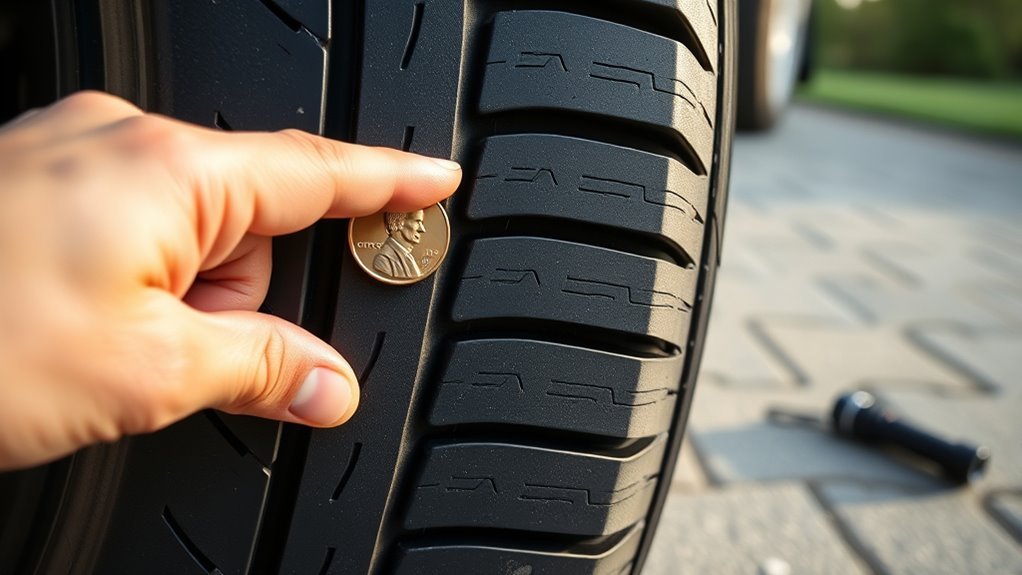
To check your Toyota Camry’s tire tread correctly, park on a level surface, set the parking brake, and inspect the tires in good light. If the tread is wet, muddy, or packed with small stones, clean the grooves first so your reading is not blocked.
Check tire pressure before judging wear. The correct cold tire pressure for your specific Camry is listed on the driver-side doorjamb label or in the owner’s manual, not on the tire sidewall. The sidewall number is a maximum tire rating, not the recommended pressure for your car. NHTSA recommends checking tire pressure at least monthly when tires are cold.
- Check each tire in three zones: outer groove, center groove, and inner groove.
- Measure several spots around the tire, not just one groove.
- Write down the lowest reading on each tire.
- Use the lowest reading to decide whether the tire is safe to keep using.
Note: A tire can have acceptable tread in the center and unsafe tread on the inner edge. This is why checking only the easiest visible groove is not enough.
Do the Penny Test on Your Camry
The penny test is the fastest way to screen for a worn-out tire. Insert a penny into the tread groove with Lincoln’s head facing down and toward you. If the tread covers part of Lincoln’s head, the tire has more than about 2/32 inch of tread at that spot. If you can see the top of Lincoln’s head, NHTSA says the tire should be replaced.
Penny Test Steps
| Check point | What to do | What it means |
|---|---|---|
| Outer groove | Insert penny upside down | Checks shoulder wear |
| Center groove | Repeat penny test | Checks common overinflation wear |
| Inner groove | Turn the steering wheel for better front-tire access if needed | Checks hidden alignment wear |
| All four tires | Repeat the same pattern | Finds uneven wear between axles |
Read Tread Depth
If part of Lincoln’s head is covered in every groove you check, the tire is above the 2/32 inch replacement limit at those spots. If Lincoln’s head is fully visible in any main groove, that tire has reached the end of safe service for normal road use.
Do not stop at one good reading. A Camry with poor alignment, incorrect pressure, worn suspension parts, or missed rotations can wear one edge faster than the rest of the tire. The lowest reading is the safest reading to use.
Know Replacement Signs
Replace the tire now if the penny test fails, treadwear indicators are flush with the tread, cords are visible, or the tire has sidewall damage. Also plan a professional inspection if the Camry pulls to one side, vibrates, makes new tire noise, or loses pressure repeatedly. Those symptoms can point to alignment, balance, suspension, or tire damage problems.
Try the Quarter Test for Deeper Tread
The quarter test helps you decide whether your Camry tires are still strong enough for wet-weather confidence. Insert a quarter into the tread groove with Washington’s head facing down. If the tread covers part of Washington’s head, you have about 4/32 inch or more. If you can see the top of Washington’s head, start shopping for tires soon, especially if you drive in heavy rain.
This matters because wet traction drops before the tire reaches 2/32 inch. AAA testing found that tires worn to 4/32 inch had much longer wet stopping distances than new tires, which is why 4/32 inch is a smart planning point for rainy driving.
At 2/32 inch, a tire is at the last-limit replacement point. At 4/32 inch, it may still be legal in many places, but wet braking and hydroplaning resistance can already be noticeably worse.
[Products Worth Considering]

Measure tire tread depth quickly and accurately with this LUMITECO dial gauge that reads in 1/32" increments up to 14/32". The color-coded green/yellow/red zones make it easy to judge tire wear and know when replacement is needed. A rugged, compact design with a protective pouch helps keep the gauge ready for use on cars, trucks, motorcycles, and more.

The SAFELIFE dial tire tread depth gauge measures tread depth in 1/32 inch increments with clear, easy-to-read 2-inch dial face. Color zones using a traffic light system help you quickly judge whether tread is low, marginal, or ample for safer driving. Built with a durable zinc cast body and a metal detect probe for precise, comfortable use across cars, motorcycles, trucks, and buses.

Monitor tire tread wear with a smart, color-coded depth gauge that shows clear condition ranges at a glance. The bar is range marked for fast, easy readings, helping you maintain safer traction and performance. Each gauge is portable with a pocket clip, and the set includes 20 units for daily use and sharing.
Quarter Test Steps
| Result | Approximate meaning | Best action |
|---|---|---|
| Part of Washington’s head is covered | About 4/32 inch or more | Continue monitoring monthly |
| Top of Washington’s head is visible | Near or below 4/32 inch | Plan replacement, especially before rain season |
| Lincoln’s head is fully visible on the penny test | Near 2/32 inch | Replace now |
Reading Tread Depth
Coin tests are useful, but they are estimates. A tread depth gauge is better when you want a precise reading in 32nds of an inch or millimeters. This is especially helpful before a long trip, before rainy weather, or when one tire looks different from the others.
Use a Tread Depth Gauge
A tread depth gauge gives you the clearest answer. Place the probe into the main tread groove, press the gauge base flat against the tread blocks, and read the number. Measure the inner, center, and outer grooves on every tire. Repeat at two or three places around the tire if you see uneven wear.
Pro Tip: Keep a small tread depth gauge in the glove box with your tire pressure gauge. Check tread and pressure together once a month so you catch wear, low pressure, and damage early.
| Tread depth | What it means | Recommended action |
|---|---|---|
| 6/32 inch or more | Generally strong tread for normal driving | Inspect monthly and rotate on schedule |
| 5/32 inch | Watch closely in rain or snow | Plan ahead if bad weather is common |
| 4/32 inch | Wet grip is reduced compared with new tires | Start shopping; replace before heavy rain trips |
| 3/32 inch | Very little margin in wet weather | Replace soon |
| 2/32 inch | Worn to the replacement limit | Replace now |
| Close to 5/32 inch on winter tires | Snow traction is reduced | Do not rely on them for snow-covered roads |
[Products Worth Considering]

Accurately measure tire tread depth with a calibrated gauge marked from 0 to 1 inch in 1/32 inch increments. The color-coded bar helps you quickly identify tread condition ranges, supporting safe driving for trucks, motorcycles, automobiles, and passenger vehicles.

This tire inflator with pressure gauge delivers long-lasting performance with a durable rubber-protected gauge and sturdy build. The longer hose and 360 swivel air chuck help you seal the valve securely and keep your hands free while measuring, inflating, or deflating. It’s battery-free for reliable use and provides ±2 PSI accuracy in the mid-range for most typical tires, with universal compatibility for 1/4 NPT compressor outputs.

Milton S-921 pencil tire pressure gauge helps you maintain optimal tire pressure for passenger cars with accurate readings in PSI and kPa. It features a built-in deflator valve for convenient pressure adjustments, plus a single chuck head and nylon indicator bar for easy use on the go. Built from durable plated brass and designed for reliable performance, it’s a practical road trip and cold-weather maintenance tool.
Check Wear Bars and Uneven Wear
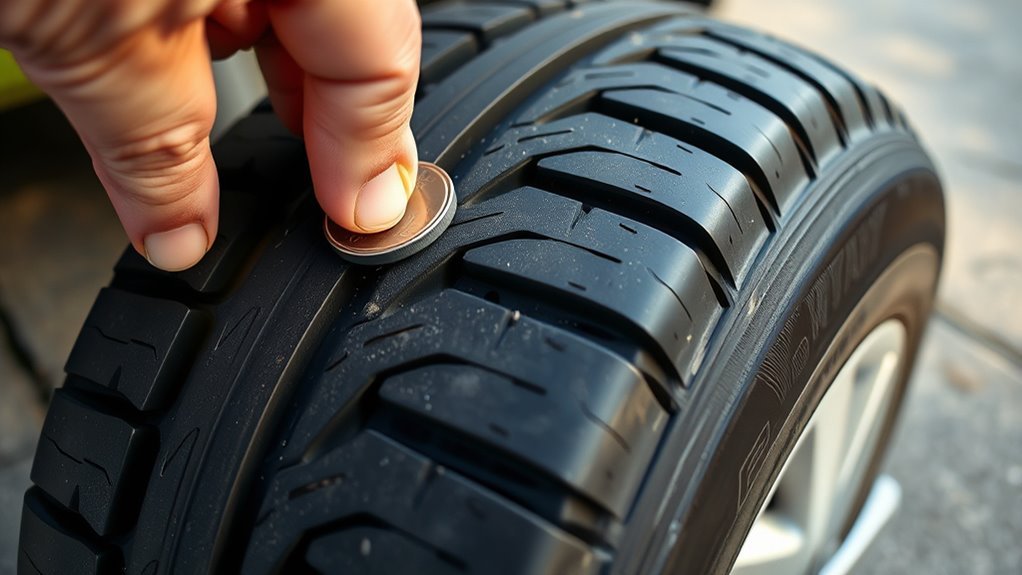
Your Camry’s tires have built-in treadwear indicators, also called wear bars. These are raised bars molded into the grooves. When the surrounding tread wears down until it is level with the bars, the tire is worn out. Toyota’s Camry owner information also notes that the location of treadwear indicators is shown by a “TWI” mark, triangle, or similar mark on the tire sidewall.
Wear bars are simple, but they are not the only thing to check. Scan the full tread face for uneven wear, cracks, cuts, nails, bubbles, and exposed cord. Uneven tread usually means the tire problem is not just age or mileage; it may point to pressure, alignment, balance, or suspension issues.
| Wear pattern | Possible cause | What to do |
|---|---|---|
| Center tread worn faster | Overinflation or incorrect pressure history | Set cold pressure to the doorjamb label and monitor |
| Both shoulders worn faster | Underinflation or heavy cornering | Correct pressure and inspect for damage |
| One edge worn faster | Alignment issue or worn suspension part | Get an alignment and suspension check |
| Cupping or scalloped dips | Balance, shock/strut, bearing, or suspension issue | Have a tire shop inspect the wheel and suspension |
| Feathered tread edges | Toe alignment problem | Schedule alignment service |
| Bulge, exposed cord, or deep sidewall crack | Structural damage or age-related failure | Stop using the tire and replace it |
[Products Worth Considering]

The Big Rig Defense Tire Thumper is a truck tire pressure checker that lets you quickly check multiple tires by giving them a firm whack. Listen for a reassuring thump and feel the stick bounce when a tire is fully inflated, helping you get back on the road safely. It features a comfortable, glove-friendly handle and a secure wrist strap for confident use on busy routes.

Keep your tires properly inflated with this analog VONDIOR tire pressure gauge, designed for fast, easy readings without batteries. The swiveling, two-axis hose and large glow dial help you measure at any tire angle with instant visibility. Built with a protective rubber shield, it supports durable, low-maintenance use for cars and trucks.

ETENWOLF’s tire pressure gauge helps you quickly and accurately check tire PSI across cars, trucks, motorcycles, bikes, and more. It’s manually calibrated to ANSI B40.1 Grade A for reliable readings, includes a large glow dial for easy nighttime viewing, and features a 360-degree swivel chuck for use at any valve angle. The gauge also works consistently in extreme hot or cold weather.
When to Replace Camry Tires
Replace your Camry tires at 2/32 inch tread depth at the latest. That is the point where the penny test fails and the treadwear bars are typically flush with the tread. For wet-weather driving, start planning replacement around 4/32 inch instead of waiting for the last limit.
Replace a tire sooner if it has uneven wear that reaches the limit on one edge, sidewall cracks, a bulge, exposed cords, repeated air loss, or damage that cannot be repaired safely. Also replace tires in axle pairs or full sets when needed so the Camry handles predictably.
Tire age matters too. NHTSA notes that some vehicle and tire manufacturers recommend replacing tires that are six to 10 years old regardless of treadwear. Check the DOT Tire Identification Number on the sidewall: the last four digits show the week and year the tire was made. For example, “2521” means the tire was made in the 25th week of 2021. If your Camry has a spare tire, check its pressure, tread, and age as well.
Frequently Asked Questions
How often should I check my Camry tire tread at home?
Check your Camry tire tread at least once a month and before long trips. It is smart to check tread when you check cold tire pressure, because both affect traction, tire life, and fuel economy.
Can tire pressure affect my tread test results?
Tire pressure does not change the coin-test measurement instantly, but it can change how the tire wears over time. Underinflation can wear both shoulders faster, while overinflation can wear the center faster. Check pressure cold and use the Camry doorjamb label.
Which axle should I inspect first on my Camry?
Start with the front tires because steering and braking can make front wear easier to spot, then check the rear tires the same way. Do not assume the rear tires are fine because the front tires look good. Measure all four tires individually.
Do winter tires use the same tread checking methods?
Yes, you can use the same penny test, quarter test, wear bars, and tread depth gauge. The replacement threshold is different for snow use, though. Transport Canada says not to use tires worn close to 4 mm, or about 5/32 inch, on snow-covered roads.
Should I check all four tires individually?
Yes. Check all four tires individually because tread depth can vary from tire to tire. Measure the inner, center, and outer grooves on each tire, then use the lowest reading to decide whether the tire needs replacement.
Is the penny test enough for a Toyota Camry?
The penny test is enough to catch a tire that has reached the 2/32 inch replacement limit, but it is not the best tool for planning ahead. A tread depth gauge is better because it gives exact readings and helps you spot uneven wear earlier.
What tread depth is best before a rainy road trip?
For a rainy road trip, do not wait until 2/32 inch. If your Camry tires are near 4/32 inch, plan replacement before the trip, especially if you expect highway speeds, standing water, or heavy rain.
How do I check the age of my Camry tires?
Look for the DOT Tire Identification Number on the sidewall. The last four digits show the week and year of manufacture. If the tire is six to 10 years old, check the tire maker’s guidance and have it inspected even if the tread still looks deep.
Conclusion
You can check Toyota Camry tire tread at home with a penny, quarter, wear bars, or a tread depth gauge. The penny test tells you when a tire is worn to the last replacement limit, while the quarter test and gauge help you plan earlier replacement for wet-weather safety. Check all four tires monthly, measure several grooves, watch for uneven wear, and replace damaged or aged tires before they decide the timing for you.
Sources
- NHTSA TireWise — penny test, 2/32 inch replacement guidance, tire pressure checks, treadwear indicators, tire age, and DOT date-code guidance.
- Toyota 2025 Camry Hybrid Owner’s Manual: Tires — Camry tire inspection, treadwear indicators, uneven wear, and spare tire checks.
- AAA Worn Tires in Wet Weather Research — wet stopping-distance impact at 4/32 inch tread depth.
- U.S. Tire Manufacturers Association Tire Facts — tire service life, age considerations, DOT Tire Identification Number, and monthly inspection guidance.
- Transport Canada: Using Winter Tires — winter tire tread-depth guidance for snow-covered roads.