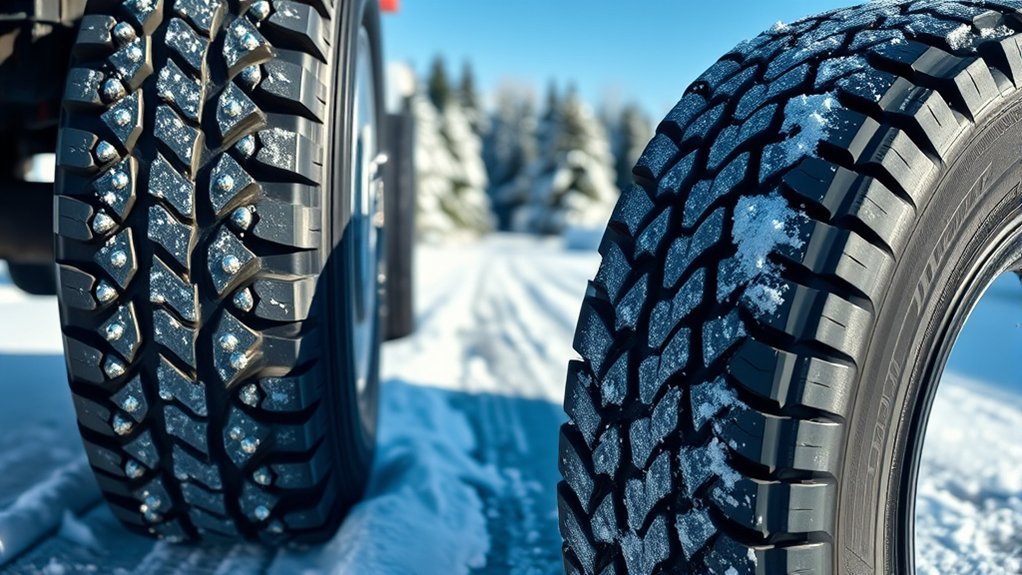
Choosing between studded and non-studded winter tires for your truck depends on the roads you drive most often. Studded tires can add mechanical grip on persistent, polished ice, while modern studless winter tires provide quieter and more balanced performance across cold pavement, snow, slush, and many icy conditions. Local laws and posted chain requirements must also guide your choice.
Quick Answer
Choose studded tires if you regularly travel on persistent, untreated ice and studs are legal where you drive. Choose studless winter tires for mixed winter roads, including snow, slush, wet pavement, and occasional ice. In Oregon, studs are generally legal from November 1 through March 31, but they never override every posted chain requirement.
Key Takeaways
- Studded tires are most useful when polished ice is a frequent and unavoidable part of your route.
- Studless winter tires generally provide better comfort and more balanced grip across snow, slush, wet roads, and cold dry pavement.
- Look for the three-peak mountain snowflake, or 3PMSF, symbol when you need a tire qualified for severe-snow service.
- Install matching winter tires on all four wheels, including on four-wheel-drive and all-wheel-drive trucks.
- Oregon may require chains during severe conditions even when your truck has studded or studless traction tires.
Understanding Studded vs Non-Studded Winter Tires
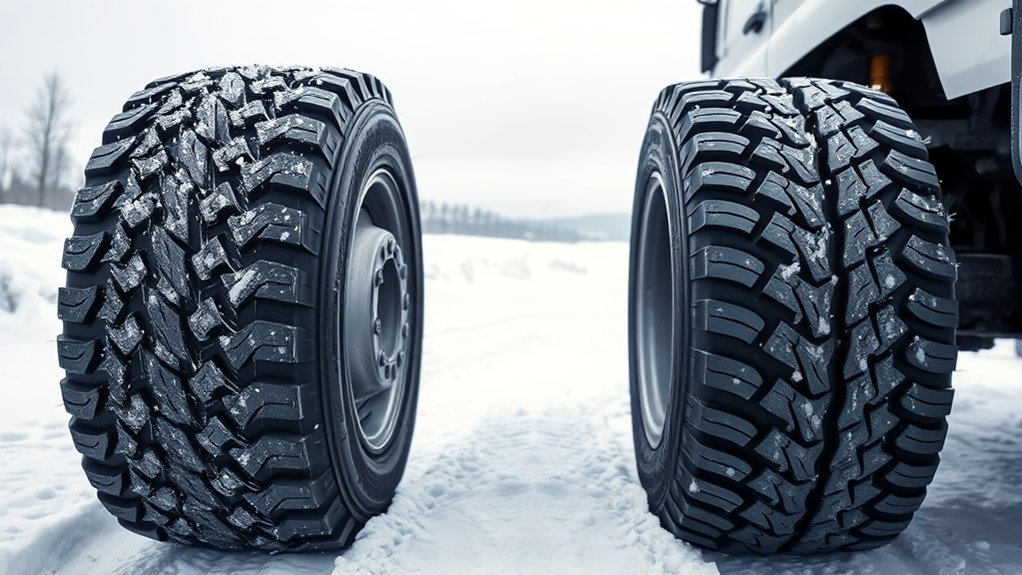
Studded winter tires contain small metal studs that extend from the tread. Those studs can bite into hard, smooth ice where rubber alone has limited surface texture to grip. Their main disadvantages are higher road noise, pavement wear, seasonal legal restrictions, and less balanced performance on clear or wet pavement.
Studless winter tires create grip through cold-weather rubber compounds, dense siping, flexible tread blocks, and grooves that move snow, water, and slush away from the contact patch. They do not contain metal studs and are sometimes called stud-free winter tires.
Do not confuse studless winter tires with ordinary all-season tires. A dedicated studless winter tire is designed primarily for cold-season use. An all-weather tire is designed for year-round use and may also carry the 3PMSF severe-snow symbol. A basic M+S marking alone does not provide the same severe-snow qualification as 3PMSF.
Note: Oregon defines qualifying non-studded traction tires by the three-peak mountain snowflake symbol. A tire symbol does not cancel posted chain requirements, towing restrictions, or temporary road closures.
Key Differences in Traction, Comfort, and Road Use
No tire is best on every winter surface. Your decision should reflect the conditions you encounter during most trips, not the worst patch of ice you might see once each year.
| Comparison | Studded Winter Tires | Studless Winter Tires |
|---|---|---|
| Polished or persistent ice | Strong mechanical bite, especially on hard untreated ice | Strong grip from rubber and siping, but results vary by tire design and ice conditions |
| Packed and loose snow | Good when the tread can clear and grip the snow | Usually excellent with a quality snow-focused tread |
| Slush and wet roads | Capable, but studs add little benefit on wet pavement | Generally the more balanced choice |
| Cold dry pavement | Noisier and may feel less refined | Quieter with more predictable everyday handling |
| Road damage | Metal studs contribute to pavement wear and rutting | Does not cause stud-related pavement damage |
| Legal restrictions | Restricted to designated dates in Oregon, Washington, and many other jurisdictions | Not subject to stud-date restrictions, although seasonal use is still recommended for dedicated winter tires |
ODOT advises that modern non-studded traction tires work about as well as studded tires on ice and perform better than studs in most other winter conditions.
That guidance makes studless tires the practical default for many Oregon drivers. Studs remain a specialized option for routes where untreated ice persists for long periods.
[Products Worth Considering]

Monitor tire tread wear with a smart, color-coded depth gauge that shows clear condition ranges at a glance. The bar is range marked for fast, easy readings, helping you maintain safer traction and performance. Each gauge is portable with a pocket clip, and the set includes 20 units for daily use and sharing.

Steelman white tire marking crayons provide high-contrast, semi-permanent marks for repairing and inspecting tires and equipment. They write on wet or dry, smooth or coarse surfaces including rubber, metal, glass, and wood, making them ideal for puncture location and damage outlining. The lead- and zinc-free crayons resist weather and fading yet wipe away when you no longer need the marks.

The Kurgo Seasonal Tire Tote helps protect your car interior, clothes, and garage from tire grime, brake dust, and residue during seasonal tire changes. Its universal design fits most passenger tires between 22" and 31" in diameter, making storage and transport simpler with less mess. Built for rugged, repeated use, it’s machine washable for easy care and comes with a lifetime warranty.
Studded Tire Laws in Oregon
Under current Oregon law, qualifying studded tires are generally allowed from November 1 through March 31. The Oregon Department of Transportation may shorten or extend the permissible period in a designated area when road preservation or public safety requires a change.
Studded Tire Usage Dates
- Normal Oregon season: November 1 through March 31.
- Before November 1 or after March 31: Studded tires are generally prohibited unless ODOT has announced a modification.
- Visitors: Out-of-state vehicles must follow Oregon law while operating in Oregon.
- Other states: Do not assume Oregon’s dates or penalties apply elsewhere.
Legal Limitations and Fines
ODOT currently states that driving with studded tires outside the permitted season can result in a fine of nearly $200. The previous $500 claim should not be used for an ordinary Oregon stud-date violation.
Separate and potentially higher penalties may apply when a driver ignores posted chain or traction-device requirements. The exact consequence depends on the violation, road condition, and current enforcement schedule.
Warning: Never rely on studded tires as an automatic substitute for chains. Oregon can require all vehicles to use chains during a conditional road closure, regardless of tire type or drivetrain.
Traction-Tire and Chain Compliance
Oregon classifies studded tires, retractable studded tires, and qualifying severe-snow tires as traction tires. Qualifying non-studded tires display the three-peak mountain snowflake symbol on the sidewall.
In typical winter conditions, a vehicle rated at 10,000 pounds GVW or less that is not towing or being towed may be allowed to use traction tires instead of chains. Requirements change for heavier vehicles, towing combinations, and severe conditions. Always follow the roadside sign rather than assuming your tire type provides an exemption.
Washington Travel Note
Washington also normally permits studded tires from November 1 through March 31. For the 2026 season, Washington stated that drivers using studs after March 31 risked a $137 fine. Washington also makes clear that studded tires do not satisfy a posted requirement to install chains.
Comparative Benefits of Studded and Studless Tires
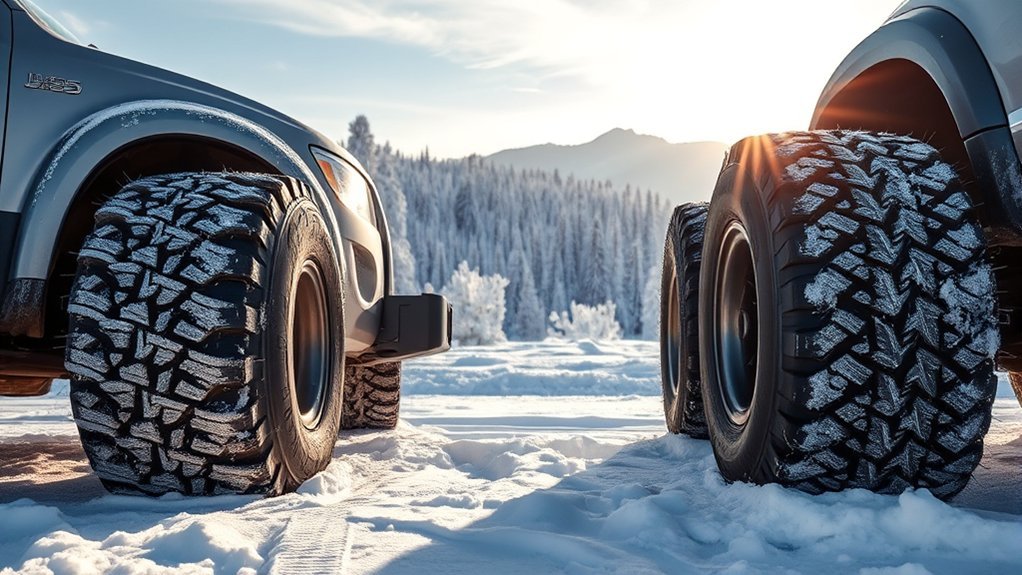
Studded tires provide their clearest advantage when your truck repeatedly encounters smooth, untreated ice. This may apply to remote roads, steep shaded routes, frozen rural roads, or areas where ice remains after a storm.
Studless winter tires provide a wider operating range. Their cold-weather compounds and tread patterns work across snow, slush, cold rain, icy patches, and clear winter pavement. They are also quieter and avoid stud-related road damage.
Pro Tip: Base your choice on the surface you drive on most often. A truck that spends most of winter on plowed highways usually benefits more from quality studless tires than from studs chosen for rare patches of extreme ice.
[Products Worth Considering]

Measure tire tread depth quickly and accurately with this LUMITECO dial gauge that reads in 1/32" increments up to 14/32". The color-coded green/yellow/red zones make it easy to judge tire wear and know when replacement is needed. A rugged, compact design with a protective pouch helps keep the gauge ready for use on cars, trucks, motorcycles, and more.

Check tire pressure with the Milton S-925 pencil gauge built for trucks, RVs, and bicycles. It features a single-head chuck with a built-in deflator valve, and it displays readings in both PSI and kPa for convenient use. The gauge is designed for accurate, repeatable pressure checks within its working range.

The SAFELIFE dial tire tread depth gauge measures tread depth in 1/32 inch increments with clear, easy-to-read 2-inch dial face. Color zones using a traffic light system help you quickly judge whether tread is low, marginal, or ample for safer driving. Built with a durable zinc cast body and a metal detect probe for precise, comfortable use across cars, motorcycles, trucks, and buses.
Ideal Conditions for Each Tire Type
Best Conditions for Studded Tires
Studded tires may be appropriate when all of the following are true:
- You regularly drive on hard, polished, or untreated ice.
- Your route receives limited plowing or deicing.
- You accept additional road noise and a firmer ride.
- You can install and remove the tires within the legal season.
- You still carry and install chains when signs require them.
Studs are less compelling when your winter driving consists mainly of wet pavement, slush, occasional snow, and well-maintained highways.
Optimal Use of Non-Studded Tires
Dedicated studless winter tires are usually the better choice for mixed winter driving. They remain flexible in cold conditions and provide multiple biting edges without metal studs.
Although dedicated studless tires are not restricted by Oregon’s stud dates, that does not make them ideal for summer use. Their softer cold-weather compounds can wear faster and provide less precise braking and handling on warm pavement. Change back to a suitable all-season or summer tire when winter conditions end.
When an All-Weather Tire May Be Enough
A 3PMSF-rated all-weather tire can be a practical year-round option when winters are moderate and you want to avoid seasonal tire changes. It offers more winter capability than a basic all-season tire but may not equal a dedicated winter tire during persistent ice, deep snow, or prolonged extreme cold.
Check that the tire has the correct size, load index, and speed rating for your truck. A winter symbol does not make an incorrectly rated tire suitable for a loaded pickup or towing application.
How Tire Choice Affects Winter Safety
Four-wheel drive and all-wheel drive can help your truck accelerate, but they do not create extra tire grip when braking or turning. Tire condition, speed, following distance, and driver input remain critical.
Install matching winter tires on all four wheels. Mixing winter tires with all-season tires can create different grip levels between the axles, increasing the risk of understeer, oversteer, or instability during emergency maneuvers.
- Reduce speed before a curve rather than braking sharply while turning.
- Leave substantially more following distance on snow and ice.
- Use smooth steering, braking, and accelerator inputs.
- Do not use cruise control when traction is inconsistent.
- Remember that no tire can provide normal dry-road stopping performance on ice.
Understanding Tread Depth
The original article alternated between 3/16 inch and 1/16 inch as universal minimums. Those figures should not be treated as a single nationwide winter-tire rule.
NHTSA advises that tire tread should be at least 2/32 inch. However, a tire at the basic minimum may have far less snow and slush capability than it had when new. Washington currently requires approved traction tires to have at least 1/8 inch, or 4/32 inch, of tread for winter travel requirements.
Measure several major grooves with a tread-depth gauge. Replace a tire that has uneven wear, exposed cords, cracking, bulges, puncture damage, or tread that no longer provides dependable winter traction.
Preparing Your Truck for Winter Driving
Start with the vehicle manufacturer’s recommended tire size, load rating, and cold inflation pressure. Find the correct pressure on the driver-side tire placard or in the owner’s manual, not on the tire’s sidewall. The sidewall number is normally the tire’s maximum pressure, not the vehicle’s recommended setting.
- Install four matching winter or severe-snow-rated tires.
- Check cold tire pressure at least monthly and before long trips.
- Confirm that the spare tire is inflated and usable.
- Carry chains that fit your exact tire size.
- Read the owner’s manual for chain-clearance restrictions.
- Practice installing the chains before winter travel.
- Carry gloves, a flashlight, reflective markers, warm clothing, water, and basic emergency supplies.
Before traveling through Oregon mountain routes, check TripCheck for road conditions, incidents, closures, and current chain requirements.
Special Considerations for Towing
Do not assume traction tires allow your truck-and-trailer combination to bypass chain requirements. Oregon’s traction-tire substitution rules are more limited when a vehicle is towing or being towed. Your trailer may also require chains on specified wheels when posted conditions demand them.
Review the current ODOT placement diagrams and your vehicle and trailer manuals before towing through winter conditions.
Maintenance Tips for Winter Tires and Chains
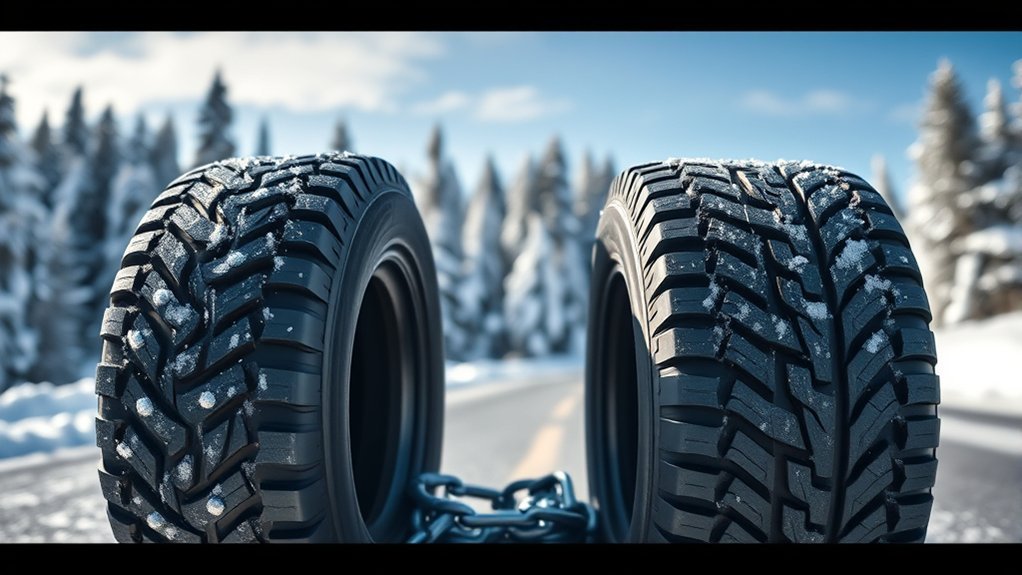
- Check pressure cold: Measure pressure before driving or after the truck has been parked for at least three hours.
- Inspect tread: Measure several grooves and check for uneven shoulder or center wear.
- Rotate as directed: Follow the tire and vehicle manufacturer’s rotation interval rather than relying on one universal mileage figure.
- Watch stud condition: Uneven stud loss or damaged tread may reduce grip and create vibration.
- Inspect chains: Look for worn cross-links, bent fasteners, broken hooks, and damaged tensioners.
- Test chain fit: Verify clearance around brake lines, suspension parts, wheel wells, and bodywork.
- Clean after use: Rinse road salt from chains, dry them fully, and store them in a sealed container.
- Store seasonal tires correctly: Clean and dry them, protect them from sunlight and heat, and mark their previous wheel positions.
If your steering wheel vibrates, the truck pulls to one side, or the tires show uneven wear, have the alignment, balance, suspension, and tire condition inspected.
Finding the Right Tires for Your Truck
Use this decision guide before purchasing:
| Your Driving Pattern | Best Starting Point |
|---|---|
| Frequent untreated or polished ice | Consider legal studded winter tires and carry chains |
| Mixed snow, slush, rain, ice, and clear pavement | Dedicated studless 3PMSF winter tires |
| Moderate winters with occasional snow | Quality 3PMSF all-weather tires may be sufficient |
| Mountain travel or rapidly changing conditions | 3PMSF tires plus correctly sized chains in the vehicle |
| Heavy loads or trailer towing | Truck-rated winter tires with the correct load index and a route-specific chain plan |
Before buying, confirm:
- The tire matches the size on your door placard or an approved alternative.
- The load index supports your truck, passengers, cargo, and tongue weight.
- The tire is approved for your wheel width and diameter.
- The 3PMSF symbol is present when severe-snow qualification is required.
- The tire can be installed as a matching set of four.
- The manufacturer permits stud installation if you are buying a studdable design.
- The tire does not create clearance problems with chains.
Legal and safety note: Tire, stud, and chain rules can change by date, location, vehicle weight, towing status, and road condition. Check the current state transportation guidance and posted signs before each winter trip.
[Products Worth Considering]

Accurately measure tire tread depth with a calibrated gauge marked from 0 to 1 inch in 1/32 inch increments. The color-coded bar helps you quickly identify tread condition ranges, supporting safe driving for trucks, motorcycles, automobiles, and passenger vehicles.

The Continental Grand Prix 5000 is an allround road bike tire engineered for faster rolling, improved ride comfort, and enhanced puncture protection. It features a Vectran Breaker cut-protection layer, Lazer Grip micro-profile tread for confident cornering control, and Active Comfort Technology to damp vibration for smoother rides. BlackChili compound optimizes grip and speed for everyday performance and long-lasting confidence.

This 2-pack closed-flow locking air chuck set delivers controlled airflow only when the valve stem is held in place, helping prevent leaks during inflation. Made for heavy-duty use with a 300 PSI maximum rating, it features a brass body for corrosion resistance and long service life. The 1/4" FNPT connection and quick-plug compatibility make it convenient for use with Schrader valve systems and common truck, RV, and auto air compressors.
Frequently Asked Questions
When can studded tires be legally used in Oregon?
Oregon generally allows studded tires from November 1 through March 31. ODOT has authority to shorten or extend the period in a designated area, so verify current guidance before installing or removing them.
Are studded tires always better on ice?
No. Studs can provide an advantage on persistent, polished ice, but modern studless traction tires can perform very well on ice and often provide better overall performance on snow, slush, wet pavement, and cold dry roads.
Can I use studless winter tires throughout the year?
They may be legal outside winter, but dedicated winter tires are not designed for sustained warm-weather use. Their softer compounds can wear faster and provide less precise warm-road handling. A 3PMSF all-weather tire is the better year-round option for moderate climates.
Does a four-wheel-drive truck need four winter tires?
Yes. Four-wheel drive helps with acceleration but does not improve the tire’s basic braking or cornering grip. Four matching winter tires provide balanced traction across both axles.
Do studded tires replace chains in Oregon?
Not in every situation. Eligible lighter vehicles that are not towing may use traction tires instead of chains under some posted conditions. During severe conditional closures, Oregon can require chains on all vehicles regardless of tire type.
Is M+S the same as the three-peak mountain snowflake symbol?
No. M+S identifies a tread design intended to provide better mud and snow capability than a basic tire, while 3PMSF indicates that the tire meets an established severe-snow traction-performance requirement.
Conclusion
Studded tires make the most sense for trucks that regularly encounter persistent, untreated ice. For most mixed winter driving, a quality set of studless 3PMSF winter tires offers quieter operation, strong snow and slush performance, and fewer legal and pavement concerns.
Whichever type you choose, use four matching tires, maintain the correct cold pressure, monitor tread and damage, carry properly sized chains, and follow current road signs. The right tire improves your margin of safety, but slower speeds and smooth driving remain essential on snow and ice.
Sources
- Oregon Department of Transportation: Traction Tires — Oregon stud dates, tire comparisons, road damage, and chain guidance.
- Oregon Department of Transportation: Chains and Traction Tires — traction-tire definitions, GVW rules, towing restrictions, and conditional closures.
- Oregon Revised Statutes, Chapter 815 — statutory studded-tire period and ODOT modification authority.
- Washington State Department of Transportation: 2026 Studded-Tire Deadline — Washington dates, fine, chain guidance, and pavement impact.
- National Highway Traffic Safety Administration: Winter Driving Tips — cold tire pressure, tire inspection, tread, and winter preparation.
- Michelin: Summer, Winter, and All-Season Tires — seasonal tire differences and four-tire winter installation guidance.