
Disclosure: As an Amazon Associate, we earn from qualifying purchases. If you click a link on this page and make a purchase, we may receive a small commission at no extra cost to you.
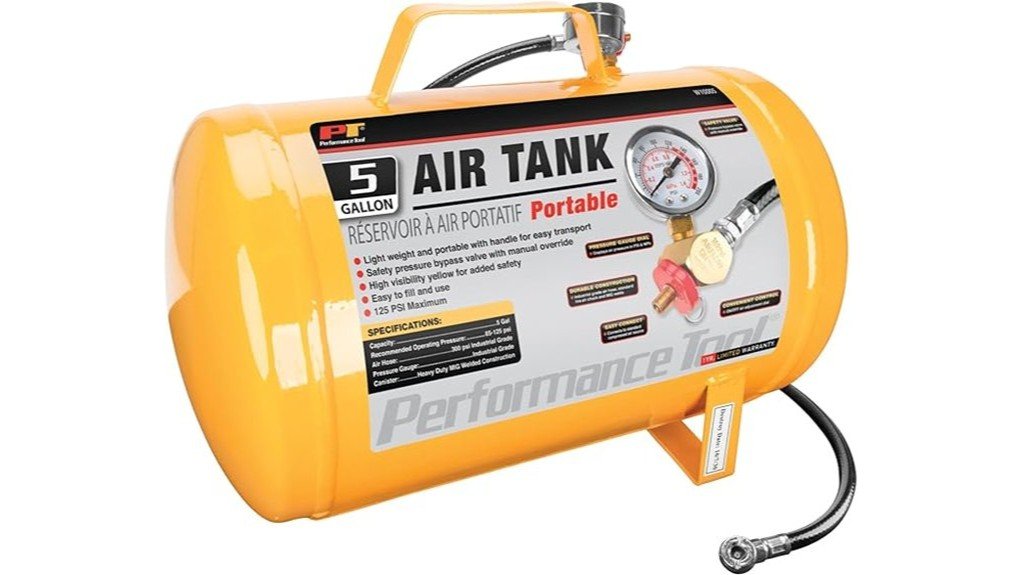
A low tire, lawn equipment, or campsite inflatable does not always justify hauling a powered compressor, but you still need a safe source of stored air. The Performance Tool W10005 is a 5-gallon portable steel air tank rated for up to 125 PSI, with a pressure gauge, tire chuck, airflow dial, safety bypass valve, and carry handle. It is useful when you want mobile inflation without an electrical connection at the point of use. Its main limitation is that it must first be filled from another clean, dry compressed-air source, and its 5-gallon reserve is not designed for sustained pneumatic-tool work.
Quick Verdict
Rating: 8/10, recommended with caveats
Best For: Drivers, homeowners, campers, and DIY users who need portable air for routine inflation and emergency top-offs.
Bottom Line: The W10005 combines a useful 5-gallon capacity with simple controls, a visible yellow finish, and manufacturer-listed replacement parts. It is convenient for inflation, but it cannot refill itself and may not carry enough air to recover a severely underinflated large truck tire.
Performance Tool W10005 Specifications
| Specification | Detail |
|---|---|
| Brand | Performance Tool |
| Model | W10005 |
| Product type | Portable compressed-air storage tank |
| Tank capacity | 5 gallons |
| Maximum pressure | 125 PSI |
| Recommended operating range | 85 to 125 PSI, according to the owner’s manual |
| Tank construction | Heavy-duty MIG-welded steel canister |
| Design | Horizontal tank with integrated carrying handle |
| Finish | High-visibility yellow |
| Pressure gauge | Industrial-grade analog gauge displaying PSI and MPa |
| Air hose | 300 PSI industrial-grade hose with a standard tire air chuck |
| Controls | On/off airflow adjustment dial and safety pressure bypass valve with manual override |
| Fill connection | Fill stem for a standard compressed-air source |
| Included equipment | Tank, gauge and manifold assembly, hose, and tire chuck |
| Replacement parts | W10055 gauge, W10056 manifold, and W10057 4-foot hose with chuck |
| Power requirement | No onboard motor or battery; requires an external compressed-air source for filling |
| Warranty | Manufacturer-listed 1-year limited warranty; the manual describes product-replacement coverage for the first 90 days and covered-parts replacement through one year |
| Best use | Tire top-offs, lawn equipment, compatible recreational inflatables, and portable emergency air |
What Is the Performance Tool W10005?
The Performance Tool W10005 is a refillable pressure vessel that stores up to 5 gallons of compressed air. Unlike a portable inflator or air compressor, it does not create air pressure by itself. You fill it from a compatible compressor or another approved clean, dry compressed-air source and then carry the stored air to the tire or inflatable.
The main selling point is simple portability. Its horizontal steel tank, built-in handle, high-visibility finish, pressure gauge, hose, and tire chuck form a self-contained inflation setup. The design is aimed at home garages, service vehicles, campsites, workshops, and roadside situations where an electrical outlet may not be available near the item you need to inflate.
Key Takeaways
- The W10005 stores 5 gallons of compressed air and has a 125 PSI maximum rating.
- It includes an analog PSI/MPa gauge, on/off airflow dial, industrial-grade hose, and standard tire chuck.
- The steel canister uses heavy-duty MIG-welded construction and a visible yellow finish.
- You must fill it from another clean, dry compressed-air source because it has no onboard compressor.
- It works best for routine tire top-offs and small inflation jobs, not sustained high-air-demand tools.
- The manufacturer lists replacement gauge, manifold, and hose assemblies for future servicing.
Who Should Buy It?
Best For
- Drivers who want stored air for tire top-offs away from an electrical outlet
- Homeowners maintaining mower, trailer, bicycle, and utility-equipment tires
- Campers or DIY users who already have access to a compressor for refilling
Skip If
- You need a device that generates pressure without a separate compressor
- You expect to run an impact wrench, spray gun, or other high-demand air tool continuously
- You regularly need to refill severely deflated large truck or off-road tires
[Products Worth Considering]

AstroAI H2 Pro cordless tire inflator delivers up to 150 PSI for fast inflation and reliable roadside performance with dual power options. Use the rechargeable battery for cordless convenience or connect to your vehicle via 12V DC for longer runtime. It features an auto shut-off system with an accurate digital pressure gauge and a bright LED for easy use in low light.
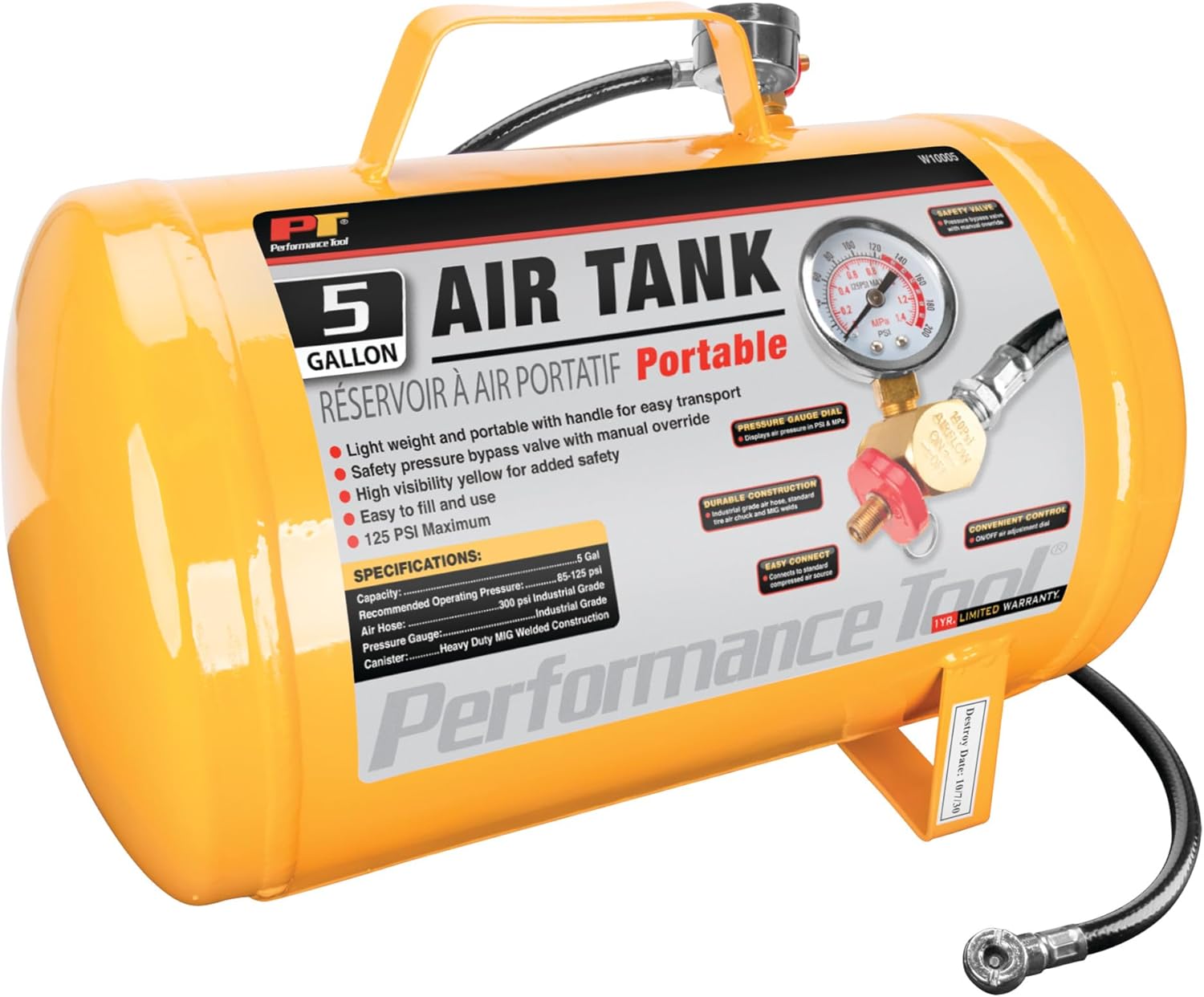
Keep your tires and air tools ready with this 5-gallon horizontal portable air tank. It features a 125 PSI pressure gauge with PSI/MPa readings, an easy-connect setup to a standard compressed air source, and a tire air chuck for quick hookups. A safety pressure bypass valve with manual override adds extra control during use.

This tire inflator with pressure gauge delivers long-lasting performance with a durable rubber-protected gauge and sturdy build. The longer hose and 360 swivel air chuck help you seal the valve securely and keep your hands free while measuring, inflating, or deflating. It’s battery-free for reliable use and provides ±2 PSI accuracy in the mid-range for most typical tires, with universal compatibility for 1/4 NPT compressor outputs.
Performance Tool W10005 Features and Benefits
5-Gallon Capacity and 125 PSI Limit
The 5-gallon capacity gives you more stored air than a tiny emergency cylinder while keeping the tank portable enough for a garage, vehicle, or campsite. It is most useful for topping off tires that are moderately below their target pressure, filling smaller pneumatic tires, or handling several low-volume inflatables.
The tank is rated to a maximum of 125 PSI. Your usable airflow decreases as the tank pressure falls, and air will stop moving into a tire once the tank pressure no longer exceeds the tire pressure. This means the number of tires or amount of pressure you can add depends on the tire size, starting pressure, target pressure, and tank pressure.
Pressure Gauge and Airflow Controls
The analog gauge displays pressure in PSI and MPa, allowing you to monitor the tank while filling and using it. The red on/off adjustment dial controls airflow from the tank to the hose. Turning the dial off after use closes the path between the tank and hose, which helps prevent pressure loss through the hose or chuck.
A safety pressure bypass valve with manual override provides an additional pressure-management feature. It does not replace careful gauge monitoring, and you should never depend on the valve as permission to exceed the tank’s 125 PSI rating.
Hose, Tire Chuck, and Fill Stem
The included industrial-grade hose ends in a standard tire air chuck suited to common Schrader-type tire valves. That covers most cars, trucks, lawn equipment, utility trailers, and many bicycles. Presta bicycle valves, sports equipment, air mattresses, and other inflatables may require adapters that are not listed as included.
The separate fill stem connects to a standard compressed-air source. Because the W10005 is an air-storage tank rather than a compressor, you need access to a home compressor, shop compressor, or another approved source whenever the tank needs to be refilled.
Steel Build and Portable Design
The owner’s manual describes the canister as heavy-duty MIG-welded construction. Steel provides a sturdy pressure-vessel structure, but moisture inside a steel tank can lead to corrosion over time. Using clean, dry air and following the maintenance instructions are therefore important parts of ownership.
The built-in handle and horizontal layout make the tank easier to move and less likely to tip than a tall upright design. Its yellow finish also makes it easier to spot in a crowded garage, service vehicle, or roadside work area.
Before You Buy: This tank arrives as stored-air equipment, not a powered compressor. You need a suitable external compressed-air source, and the 5-gallon reserve may not contain enough volume to recover a severely underinflated large tire.
How It Performs in Real Use
Passenger-Car Tire Top-Offs
The W10005 makes the most sense when a car tire needs a routine pressure correction rather than a complete refill from nearly empty. Place the tank beside the wheel, confirm the vehicle manufacturer’s recommended cold-tire pressure, open the airflow dial, and attach the chuck. Use a separate accurate tire gauge to confirm the final tire pressure because the tank gauge measures pressure inside the tank, not the tire.
Truck, Trailer, and Lawn-Equipment Tires
The 125 PSI tank rating is high enough for many tire-inflation tasks, but pressure rating and stored-air volume are different. A large truck tire can accept a substantial amount of air before its pressure rises. The W10005 may handle a modest top-off, while a significantly deflated large tire may use the tank’s available air before reaching the correct pressure.
Smaller mower, garden-cart, wheelbarrow, and utility-equipment tires require less volume and are generally a more comfortable match for a 5-gallon tank. Always follow the pressure printed by the equipment or tire manufacturer.
Roadside and Campsite Use
A filled tank can provide backup air without depending on a 12-volt socket, battery pack, or nearby outlet. The bright finish and carry handle also help when you need to move it around a vehicle or campsite. However, it is only useful if you remember to refill and inspect it before the trip.
Secure the tank during vehicle transport so it cannot roll, slide, or strike passengers or cargo. Keep it away from excessive heat, open flames, sharp objects, and any position that could damage the gauge, hose, valve, or fill stem.
Brief Airflow and Tool Use
The stored air may support a short, low-demand burst when you add compatible pressure-rated fittings, but the standard setup ends in a tire chuck. It does not include the regulator, moisture control, or quick-connect coupler normally used with pneumatic tools.
For impact wrenches, grinders, sanders, spray equipment, or continuous blow-off work, a compressor with adequate airflow is the better choice. A 5-gallon tank loses pressure quickly under sustained demand and should not be treated as a replacement for a powered compressor.
How to Fill and Use the W10005 Safely
- Inspect the tank first. Check the canister, gauge, manifold, hose, chuck, and fill stem for corrosion, cracks, wear, loose parts, or other damage.
- Confirm the stamped retirement date. The manual directs you to discard the tank before the destroy date stamped near the handle.
- Use eye protection. Keep other people away from the immediate work area and never direct compressed air toward skin, eyes, animals, or another person.
- Close the airflow dial. The tank can be filled and its pressure read while the adjustment dial is in the off position.
- Use clean, dry compressed air. Do not fill from a system charged above 150 PSI or from a compressed-gas cylinder.
- Watch the tank gauge. Stop at or below 125 PSI and never overfill the canister.
- Check the target item’s pressure limit. Never exceed the pressure specified for the tire, equipment, or inflatable.
- Open the dial slowly. Attach the chuck securely and monitor inflation with an appropriate gauge.
- Turn the dial off after use. This isolates the hose and helps reduce leakage through the hose assembly.
Never remove fittings while the tank is pressurized. If the canister itself leaks, the manual directs you to discard it immediately. Do not weld, drill, patch, heat, or otherwise modify a pressure tank.
Pro Tip: Fill the W10005 before a trip, turn the airflow dial off, and verify its pressure again the next day. An unexpected pressure drop can reveal a loose fitting or leak before you depend on the tank away from home.
Maintenance and Storage
Compressed air can carry moisture into the tank. The manual warns that condensation may contribute to internal rust and weaken the welded structure over time. Follow the manufacturer’s drainage procedure, use eye protection, and keep the tank stable while performing maintenance.
If the tank will sit unused for an extended period, the manual recommends releasing the air from the tank and hose and storing the unit in a clean, dry location. Do not carry or drag it by the hose, and avoid kinking or twisting the hose during use or storage.
The manufacturer currently lists three service parts: the W10055 air-tank gauge, W10056 manifold, and W10057 4-foot hose with chuck. Replace damaged components only with suitable pressure-rated parts and follow the manufacturer’s instructions. A leaking or structurally damaged canister should be retired rather than repaired.
Common Uses for the W10005 Air Tank
- Routine car and light-truck tire pressure adjustments
- Trailer, mower, wheelbarrow, garden-cart, and utility-equipment tires
- Schrader-valve bicycle tires
- Roadside or campsite backup air
- Compatible recreational inflatables when the correct adapter is added
- Short, controlled airflow tasks with proper pressure-rated accessories
The W10005 should not be used with oxygen, fuel gas, refrigerant, or another compressed gas. It is designed for clean, dry compressed air and should remain within the pressure and service limits in the owner’s manual.
Pros and Cons
Pros
- Useful 5-gallon capacity with a 125 PSI maximum rating
- Includes the gauge, airflow dial, hose, and standard tire chuck
- Horizontal layout, carrying handle, and visible yellow finish improve portability
- Safety bypass valve adds a secondary pressure-management feature
- Manufacturer lists replacement gauge, manifold, and hose assemblies
Cons
- Requires a separate compressor or approved compressed-air source
- Five gallons may be insufficient for a severely underinflated large tire
- No regulator, quick-connect tool coupler, or specialty inflation adapters are listed as included
Is It Worth the Price?
The Performance Tool W10005 offers strong value when you already own or can access a compressor and need a portable supply of air. You receive the tank, gauge, safety valve, airflow control, hose, tire chuck, and carry handle in one straightforward setup. The availability of manufacturer-listed replacement parts also improves its long-term practicality.
You receive less value if your real need is independent inflation. A powered 12-volt inflator or cordless compressor can create pressure anywhere, while the W10005 becomes unusable once its stored air falls below the pressure needed for the task. It is worth considering when portability and simple tire inflation matter more than continuous airflow.
[Products Worth Considering]

This portable cordless tire inflator delivers rapid inflation up to 150 PSI with a built-in pressure gauge for accurate readings. It offers multiple preset modes for car, bike, motorcycle, and ball inflation, plus an LED light system for visibility in dark conditions. The auto shut-off helps stop pumping when your preset pressure is reached, and it supports several pressure units for convenience.

This inline air pressure regulator helps you precisely control air flow from your compressor with an integrated 0-150 PSI gauge. It improves finish quality by reducing overspray and material waste for automotive spray painting and other pneumatic tools. The universal 1/4 NPT threads make it easy to connect to air hoses, compressors, and spray guns for quick, on-the-fly adjustments.

This solid brass tire inflation hose adapter screws into your inflator and uses a locking press clip to securely clamp onto the tire valve stem. It helps reduce air leakage for fast, efficient pumping and is designed for reliable performance with a wide range of vehicles and inflator setups.
How It Compares to Alternatives
The MaxWorks 51010 is another 5-gallon option and is advertised with a 140 PSI maximum and a 40-inch hose, making it worth comparing if higher listed tank pressure is a priority. The California Air Tools AUX05A also holds 5 gallons but uses an aluminum tank, which reduces weight and avoids internal tank rust at a higher typical purchase tier.
The BIG RED T88007 increases capacity to 7 gallons while retaining a 125 PSI maximum, so it may carry more usable air but takes up more space. The W10005 makes the most sense when you prefer a compact steel tank, visible yellow finish, simple tire-chuck setup, and manufacturer-listed service components.
[Products Worth Considering]

The LockNFlate locking air chuck uses six hardened steel jaws to grip any Schrader valve for a secure, hands-free connection that helps prevent leaks or accidental pop-off. It’s rated to 150 PSI and inflates tires with or without the valve core installed. Choose Open Flow for hand/foot valves and automatic inflators, or Closed Flow for compressor/air-hose use requiring valve engagement.

This tire air chuck with clip adapter helps you connect a vehicle inflator nozzle securely for faster, easier tire inflation. The brass locking design aims to prevent leaks and keeps the connection stable while you fill tires. Ideal for use with compatible air compressors and pumps with an 8mm connection.

This dual head and ball air chuck set provides closed-flow tire inflation that routes air only through the chuck engaged with the valve. It includes both dual-head and ball-head chucks plus quick plug fittings for easy, fast connections to air lines and compressors. Built for reliable, leak-resistant operation, it’s ideal for filling Schrader valves on bikes, motorcycles, cars, trucks, and more.
Frequently Asked Questions
Can the W10005 be refilled from a home air compressor?
Yes. Connect a clean, dry compressed-air source to the tank’s fill stem and watch the tank gauge while it fills. Do not exceed 125 PSI, and the manual warns against filling from a system charged above 150 PSI.
Can it inflate large truck or trailer tires?
It can provide modest top-offs when the tank pressure is higher than the tire pressure. A severely underinflated large tire may require more air volume than a 5-gallon tank can supply in one fill, so a powered compressor is safer for major pressure recovery.
Is the hose long enough to reach tires on larger vehicles?
The manufacturer’s replacement-parts list identifies the W10057 as a 4-foot hose with chuck. That length is practical when you place the tank beside each wheel, but you should not drag or carry the tank by its hose.
Should the tank hold pressure for several days?
A sound tank with the airflow dial turned off should retain stored air, but no exact retention period is guaranteed. If pressure falls unexpectedly, inspect the fittings and hose for leakage. Discard the tank immediately if the canister itself leaks.
Can the Performance Tool W10005 run pneumatic tools?
It may provide a brief burst of air with suitable pressure-rated adapters, but the included setup is intended mainly for tire inflation. It lacks the regulator and quick-connect tool coupling needed for normal air-tool use, and 5 gallons will not support sustained high-demand operation.
Are replacement parts available for the hose, gauge, and valve assembly?
Yes. Performance Tool lists the W10055 gauge, W10056 manifold, and W10057 4-foot hose with chuck as separate service parts. Confirm current compatibility and availability with the manufacturer or seller before ordering.
How should the tank be stored between uses?
For extended storage, the manual recommends releasing the air from the tank and hose and keeping the unit in a clean, dry location. Follow the manufacturer’s condensation-drain procedure and inspect the stamped retirement date before future use.
The Bottom Line
The Performance Tool W10005 is a sensible choice when you need portable stored air for tire top-offs, lawn equipment, roadside backup, or campsite inflation and already have access to a compressor. Its 5-gallon capacity, 125 PSI rating, included hose and chuck, visible finish, and replaceable service parts support an 8/10 recommendation.
Skip it if you need a self-powered inflator, continuous pneumatic-tool airflow, or enough volume to recover large tires from very low pressure. Used within its limits and maintained according to the manual, it offers practical mobility without the bulk and power requirements of a full compressor.
Ready to Buy?
Check the latest price, seller, package contents, and product details before you decide.

![[2026NEW] 5000A Jump Starter with Air Compressor (150PSI)](https://m.media-amazon.com/images/I/71oG4PFNsmL._AC_SL1500_.jpg)