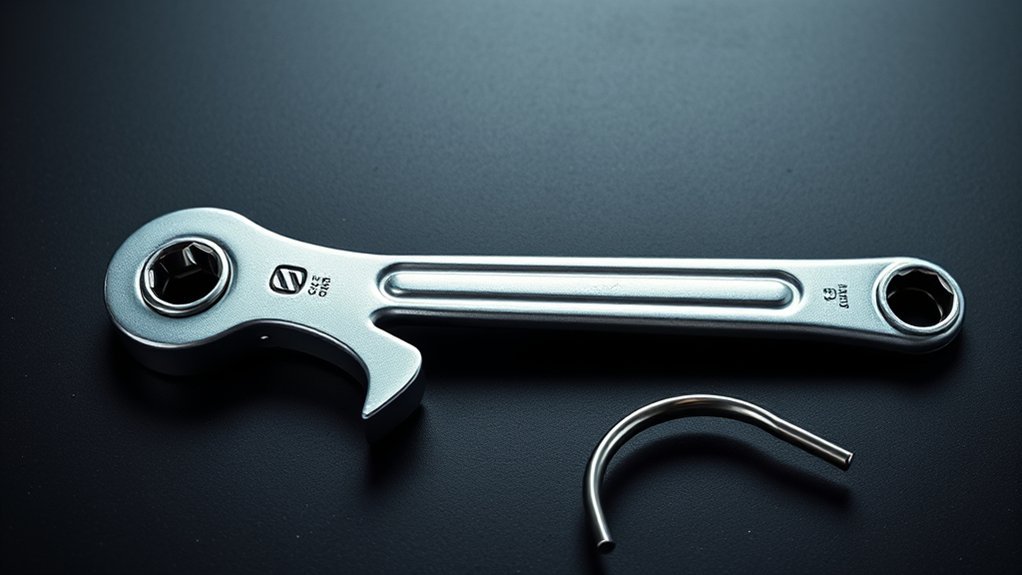
A lug wrench is made to loosen and tighten the nuts or bolts that hold a vehicle wheel in place. A tire iron is trickier to define because the term has more than one accepted meaning. It can mean a tire lever used to work a tire bead off a rim, but in North American automotive use it can also describe a wheel-changing bar that works much like a lug wrench. The right comparison therefore depends on which type of tire iron you mean.
Quick Answer
A lug wrench is specifically designed to turn wheel lug nuts or bolts. “Tire iron” may mean either a bead-prying tire lever or, especially in North American car terminology, a wheel-changing bar with a socket end. If you mean a tire lever, the tools are different; if you mean a wheel wrench, their functions can overlap.
Key Takeaways
- A lug wrench is specifically designed to loosen and snug wheel lug nuts or bolts.
- “Tire iron” has more than one meaning: it may describe a tire-bead lever or a wheel-changing wrench.
- Changing a roadside flat normally means removing the complete wheel-and-tire assembly, not prying the tire off its rim.
- Loosen wheel fasteners before lifting the vehicle, then follow the manufacturer’s specified tightening sequence and torque.
- Use a torque wrench for final tightening and follow your owner’s manual for any required post-installation torque check.
At a Glance
| Time Required | Varies by vehicle, wheel condition, and experience; do not rush a roadside wheel change. |
| Difficulty | Moderate; the mechanical steps are simple, but safe jacking and correct torque matter. |
| Tools Needed | Correct lug wrench or socket, approved jack, wheel chock, spare wheel if changing a flat, and a torque wrench for final tightening. |
| Cost | Often no extra cost if your vehicle already has the required roadside tools; replacement tools or professional tire service vary in price. |
What Is a Lug Wrench?
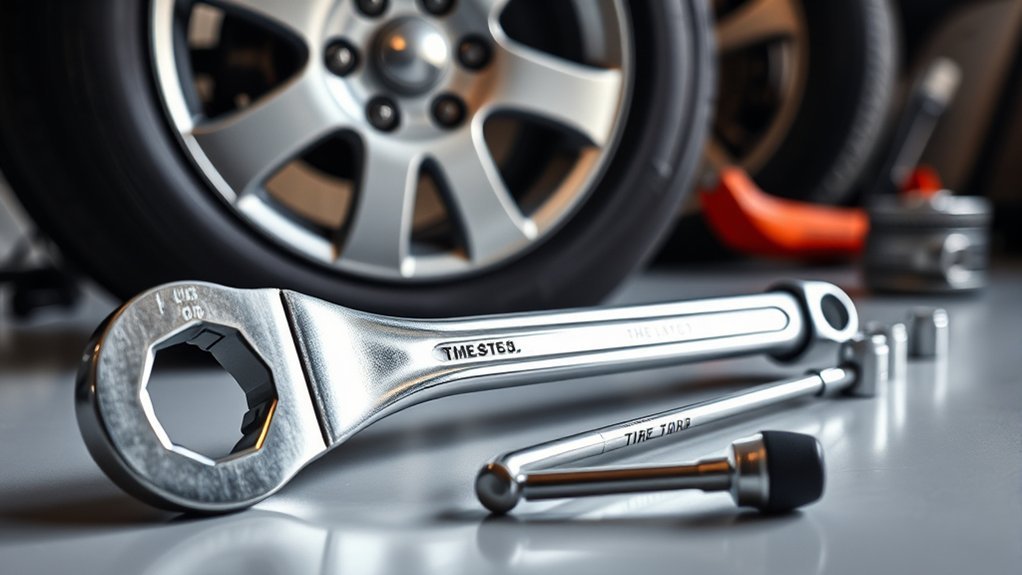
A lug wrench, also called a wheel wrench or wheel brace in some regions, is a wrench made for the fasteners that secure a vehicle wheel to its hub. Most passenger vehicles use lug nuts on wheel studs, although some vehicles use wheel bolts instead. The tool still serves the same basic purpose: turning the wheel fasteners.
Lug wrenches commonly come in L-shaped, telescoping, X-shaped, or four-way designs. An L-shaped factory wrench may also have a flattened end intended for removing a wheel cover or serving another vehicle-specific function. A four-way wrench provides several socket sizes and long arms for leverage.
A lug wrench is useful for breaking properly installed wheel fasteners loose and for initially snugging them during installation. However, it should not be treated as a substitute for a torque wrench when the wheel needs its final manufacturer-specified tightening torque.
[Products Worth Considering]

This 1/2-inch drive breaker bar delivers powerful leverage for loosening and tightening stubborn lug nuts and automotive fasteners. The 180-degree flex head helps you reach tight spaces at the angle you need, making tire and brake jobs easier. A spring-loaded ball detent design holds 1/2-inch sockets securely while the chrome-moly head provides durable strength for everyday use.

These M14x1.5 closed-end chrome lug nuts are a one-piece replacement designed for secure fitment on compatible GM, Ford, and select Chrysler/Dodge models. Featuring a 60-degree conical seat and anti-rust chrome plating, they help resist corrosion and maintain a bright look for everyday driving. Built for long-term durability, they include OEM-style part references and are backed by 12 months of support.

This spare tire tool kit is designed for the 2004 to 2018 Ford F-150 to help you loosen and tighten wheel lug nuts and manage the spare tire and provided jack functions from underneath the vehicle. It includes the lug nut wrench and extension pieces plus a convenient storage carrying case for organized transport. The jack itself is not included.
Lug Wrench vs. Tire Iron: What’s the Difference?
The most important difference is that “lug wrench” has a narrow meaning, while “tire iron” can have more than one meaning.
A lug wrench specifically grips and turns wheel nuts or bolts. A tire iron may refer to a lever used to work a tire bead over a rim, but North American automotive terminology also uses “tire iron” for a wheel-changing bar with a socket-wrench end. The Government of Canada’s TERMIUM Plus terminology database recognizes “tire iron” as a term for a tire lever.
Note: If someone says “grab the tire iron” during a roadside car-wheel change, they may mean the vehicle’s lug wrench. If a bicycle mechanic says “tire lever,” they usually mean the small tool that lifts the tire bead over the rim.
| Tool / Term | Primary Job | Typical Shape | Common Use |
| Lug wrench | Turn wheel lug nuts or bolts | L-shaped, telescoping, X-shaped, or four-way | Removing or installing a wheel |
| Tire iron used as a wheel wrench | Turn wheel fasteners; sometimes remove a wheel cover | Metal bar, often with socket and flattened end | Roadside wheel changes |
| Tire iron / tire lever used for the bead | Lift or guide a tire bead over a rim | Flat or gently curved lever | Tire dismounting and bicycle tire service |
[Products Worth Considering]

Upgrade your wheels with MIKKUPPA M12x1.5 mag seat lug nuts built for secure, corrosion-resistant performance. These closed-end chrome lug nuts are a direct replacement for select Toyota models, including Camry, Corolla, RAV4, Sienna, Avalon, Highlander, Matrix, Venza, and Prius. Triple-chromium plating and cold-forged, heat-treated steel help deliver strength for daily driving and replacement needs.

This ecocstm ratchet wrench is designed to make emergency and routine tire changes faster with a 360° rotating head and quick forward/reverse switching. The extended handle provides extra leverage to reduce effort and hand fatigue, while the adapter helps fit many scissor jacks on cars, SUVs, trucks, and vans. Built for reliable performance with durable construction, it’s a practical travel essential for on-the-road preparedness.

The Trivd Frol 1/2" air impact wrench delivers high performance torque up to 1500 ft-lbs with a twin hammer impact mechanism for strong, balanced blows. It features an ergonomic grip, compact lightweight design, and quick-stop control with 3 forward speeds up to 8000 RPM plus a reverse speed. Built for demanding automotive repair and tire shop work, the rear exhaust helps keep debris away from the surface.
Tool Shape and Use
When “tire iron” means a bead lever, the physical difference is clear. A lug wrench has a socket or socket-like end sized for wheel fasteners. Its handle provides leverage so you can rotate the fastener.
A tire lever has a thinner, flatter working end that slips beneath or beside a tire bead. Instead of rotating a nut, it applies leverage between the tire and rim.
- Use a lug wrench or correct wheel-nut socket for wheel fasteners.
- Use a proper tire lever for a tire bead when the tire-service procedure calls for one.
- Lug wrenches emphasize socket fit and rotational leverage.
- Tire levers emphasize controlled prying without damaging the tire, tube, or rim.
Vehicle lug wrenches are normally strong metal tools. Bicycle tire levers are often lightweight nonmetallic tools designed to reduce the risk of rim or tube damage.
Tire Removal Differences
It also helps to separate wheel removal from tire removal. During a normal roadside flat-tire change, you remove the complete wheel-and-tire assembly from the vehicle. You do not normally pry the tire itself off the rim.
The lug wrench handles the wheel fasteners. After the vehicle is safely raised according to its owner’s manual, you remove the fasteners and wheel, install the spare, lower the vehicle, and tighten the fasteners in the specified sequence.
Dismounting the tire itself means separating its bead from the rim. Bicycle tire service often uses dedicated tire levers. Park Tool’s tire-and-tube procedure, for example, instructs users to deflate the bicycle tire completely and use tire levers to lift the bead over the rim.
Modern passenger-car tire dismounting is normally a tire-service job using equipment designed for the wheel-and-tire combination. Do not try to pry an inflated automotive tire from its rim.
Lug Wrench Types and Common Shapes
You’ll find several practical lug-wrench designs. The best one is the tool that fully fits your vehicle’s fastener and gives you enough controlled leverage without damaging the lug nut or bolt.
[Products Worth Considering]

Upgrade your wheels with MIKKUPPA closed-end lug nuts designed for reliable fit and corrosion resistance. The one-piece, cold-forged and heat-treated steel construction helps resist rust and stripping, while the integrated finish delivers a durable black appearance. Built to OEM standards with a conical 60-degree seat, these nuts provide a secure solution for compatible Ford, Honda, Jeep, and Chevrolet models.

The SEESII cordless impact wrench delivers high tightening and loosening power for fast wheel bolt and industrial bolt work. Its brushless motor and variable-speed 3 forward/2 reverse modes help you control precision installs and stubborn nut removal. A dual-battery system with rapid charging and an included storage case make it ready for home, car, and jobsite use.

The 22800 wheel stud installer makes replacing wheel studs quick and secure, saving time and effort during tire service. It uses a ratchet or impact wrench to pull new studs firmly into place, helping when existing studs are too long. Compatible with most automotive wheels and light-duty truck wheel studs, it’s designed for easy, tool-assisted installation.
Common Lug Wrench Shapes
- L-shaped factory wrench: Compact and commonly supplied with a vehicle’s spare-wheel kit.
- Telescoping lug wrench: Extends for greater leverage and collapses for storage.
- Four-way or cross wrench: Provides long opposing arms and usually several socket sizes.
- Socket and breaker bar: Lets you match the exact socket to the fastener and provides strong leverage for initial loosening.
- Torque wrench: Not a replacement for the lug wrench during every step, but the preferred tool for final tightening to specification.
Keep the socket or wrench clean and inspect it for cracks, spreading, rounded contact surfaces, or heavy corrosion. A poor-fitting or damaged wrench can round the lug nut and make roadside removal much harder.
Spider Wrench Variants
A spider wrench, four-way wrench, and cross wrench generally describe the same basic cross-shaped concept. Different versions mainly vary in arm length, socket sizes, construction, and whether the sockets are fixed or replaceable.
| Design | Strength | Best Use |
|---|---|---|
| Four-way / cross | Multiple fixed socket sizes | Garage or multi-vehicle use |
| L-shaped | Compact | Factory roadside kit |
| Telescoping | Long adjustable leverage | Compact storage plus easier loosening |
| Socket + breaker bar | Exact socket choice | Stubborn but serviceable fasteners |
Whatever design you use, seat the tool fully on the fastener before applying force. Stop if the socket rocks excessively or begins rounding the nut.
How to Use a Lug Wrench Safely
Wheel-changing procedures differ between vehicles, so your owner’s manual is the controlling source for jack points, spare-wheel restrictions, fastener torque, and the tightening sequence. The following is a general overview rather than a substitute for those instructions.
Warning: Work on a firm, level surface away from moving traffic whenever possible. Set the parking brake, secure the vehicle as instructed by its manufacturer, and never place any part of your body beneath a vehicle supported only by its emergency jack.
- Stop safely. Move well away from traffic, turn on the hazard flashers, park on a firm and level surface, and switch the vehicle off.
- Secure the vehicle. Put an automatic transmission in Park or follow the manual-transmission procedure in the owner’s manual. Apply the parking brake and use the recommended wheel chock position.
- Check the wrench fit. Push the correct-size socket fully onto the lug nut or bolt.
- Break the fasteners loose before lifting. Many manufacturer procedures tell you to loosen each wheel fastener slightly while the tire is still on the ground. Do not remove the fasteners yet.
- Position the jack correctly. Use only the manufacturer-specified jacking point.
- Raise the vehicle. Lift only as high as needed to remove and install the wheel.
- Remove the fasteners and wheel. Keep the fasteners clean and inspect the wheel and mounting surfaces for obvious debris or damage.
- Install the replacement wheel. Start the wheel nuts or bolts by hand where the design permits so you reduce the chance of cross-threading.
- Snug them evenly. Use the specified crossing or numbered sequence while the wheel is still unloaded.
- Lower the vehicle. Then tighten every fastener to the manufacturer’s specified torque with a torque wrench.
Current Ford wheel-change guidance, for example, instructs drivers to loosen the lug nuts before raising the wheel and to complete final tightening after lowering the vehicle. See the Ford wheel-change procedure.
When a Tire Iron Makes Sense
A tire iron makes sense when you know which meaning applies to the tool in front of you.
If your vehicle manufacturer calls its wheel-changing bar a tire iron or supplies a combined bar with a wheel-nut socket, you can use it for the tasks specified in the vehicle instructions. In that context, it may function much like an L-shaped lug wrench.
If by “tire iron” you mean a tire lever or tire spoon, use it for bead-related tire service rather than wheel fasteners. On bicycles, dedicated tire levers are especially useful for lifting a tight clincher bead over the rim. They should be used carefully so you do not pinch the tube or damage the rim.
The label “tire iron” does not identify one universal tool. Check the working end: a socket turns wheel fasteners, while a tire-lever tip works on the tire bead.
For roadside car service, keep your wheel-changing tools secured in the trunk or designated storage compartment. For a bicycle, compact tire levers fit easily in a saddle bag or repair kit.
Tightening Lug Nuts the Right Way
Correct wheel installation depends on even seating and the correct final torque. Begin by installing the wheel fasteners correctly and snugging them in the sequence specified for your vehicle.
- Start threaded fasteners carefully to avoid cross-threading.
- Do not tighten one fastener fully while the others are loose.
- Use a crossing, star, or numbered pattern when the manufacturer specifies one.
- Lower the vehicle as instructed before applying final torque.
- Finish every fastener with a torque wrench set to the vehicle’s specification.
Torque specifications are not universal. They can vary substantially between vehicles and wheel designs. For example, Toyota publishes exact wheel-nut torque values in its vehicle manuals rather than recommending a generic setting.
Pro Tip: Keep your vehicle’s wheel-fastener torque specification with your roadside tools or save the relevant owner’s-manual page on your phone. That is much safer than trying to remember a generic number.
Do not use a torque wrench as a general-purpose breaker bar unless its manufacturer specifically permits that use. If a lug nut is very tight, a properly sized breaker bar can provide controlled leverage for loosening; use the torque wrench for the final measured tightening step.
Common Lug Wrench Mistakes to Avoid
Even a simple lug wrench can create problems when the socket fit, vehicle support, or tightening procedure is wrong.
- Using the wrong socket size: A loose fit can round the fastener.
- Removing lug nuts before the vehicle is safely lifted: Loosen them only as directed before jacking, then remove them after the wheel is raised.
- Using an unofficial jack point: This can damage the vehicle or make the jack unstable.
- Guessing final torque: Too little clamping force can allow loosening; excessive torque can damage fasteners or make later removal difficult.
- Tightening in a circle when a crossing sequence is specified: Follow the vehicle’s stated pattern so the wheel seats evenly.
- Cross-threading a lug nut or wheel bolt: Start it carefully and stop if it does not thread smoothly.
- Using the wrench as an improvised pry bar: Only use a flattened pry end when the tool or vehicle instructions specifically call for it.
- Using an impact wrench indiscriminately: Impact tools can over-tighten fasteners or damage wheel-lock components. Follow the wheel, fastener, and vehicle instructions.
What If a Lug Nut Is Stuck or Rounded?
First, make sure the wrench or socket is the exact correct size and fully seated. If the nut is badly rounded, the socket slips repeatedly, the stud turns with the nut, or the required force feels excessive, stop rather than making the damage worse.
A mechanic may need an extraction socket, penetrating treatment, heat used under controlled shop conditions, or replacement wheel hardware. Do not extend a roadside wrench with an unsafe improvised pipe or jump on the handle; sudden tool failure can cause injury.
What About Wheel Locks?
If the vehicle has locking wheel fasteners, keep the correct wheel-lock key with the roadside kit. The key must be fully engaged before force is applied. Toyota specifically warns against using an impact wrench on certain wheel-lock keys because it can cause permanent damage.
How to Check Lug Nuts After Driving
Do not use one universal mileage rule for every vehicle. Check your owner’s manual or wheel manufacturer’s instructions to see whether a post-installation torque check is required and when it should be performed.
Some manufacturers explicitly require one. For example, Ford’s 2026 Escape guidance says to retighten wheel nuts to the specified torque within 100 miles (160 km) after wheel disturbance such as a tire rotation, flat-tire change, or wheel removal. Toyota gives the same 100-mile/160-km instruction for the cited Tundra procedure. See the 2026 Ford Escape wheel-nut guidance and Toyota’s flat-tire procedure.
When a recheck is required:
- Park safely on a level surface.
- Use a properly set torque wrench rather than judging tightness by feel.
- Follow the vehicle’s prescribed tightening sequence.
- Apply only the specified final torque.
- If one fastener has loosened noticeably, inspect the others and consider having the wheel installation checked.
If the wheel repeatedly loses torque, the fastener will not reach specification normally, or you see damaged studs, threads, wheel holes, or mounting surfaces, have the vehicle inspected before continuing normal driving.
Frequently Asked Questions
Is a Lug Wrench the Same as a Tire Iron?
Sometimes. A lug wrench specifically turns wheel fasteners. “Tire iron” can mean a bead-removal lever, in which case it is a different tool, but it can also describe a wheel-changing bar with a socket end that performs the same basic job as a lug wrench.
What Is the Difference Between a Tire Iron and a Wrench?
A wrench turns a nut, bolt, or other fastener. When “tire iron” means a tire lever, it works by prying or guiding a tire bead over the rim instead. However, some automotive tire irons include a socket-wrench end, so the terms can overlap in everyday use.
What Is the Difference Between a Zomboid Lug Wrench and a Tire Iron?
In Project Zomboid, Lug Wrench and Tire Iron are separate game items rather than simply two real-world names for one object. Current PZwiki data lists Base.LugWrench and Base.TireIron as distinct items under the same lug-wrench-related item tag. Game behavior can change between builds, so check the current PZwiki item data if you need version-specific mechanics.
Do I Need a Lug Wrench to Change a Tire?
For a normal roadside car-wheel change, you need a tool that correctly fits and turns the wheel fasteners. That may be called a lug wrench, wheel wrench, wheel brace, or sometimes a tire iron. If you are actually dismounting the tire from its rim, you need different tire-service tools.
Should I Tighten Lug Nuts With a Lug Wrench or Torque Wrench?
A lug wrench can be used to snug the fasteners during installation, but use a torque wrench for final tightening to the exact specification in your vehicle’s owner’s manual.
Should You Retorque Lug Nuts After a Wheel Change?
Follow your vehicle and wheel manufacturer’s instructions. Some manufacturers require a post-installation torque check. Ford and Toyota, for example, specify a 100-mile (160-km) check in the vehicle guidance cited in this article, but that interval should not be assumed for every vehicle.
Conclusion
A lug wrench always has one clear job: turning the fasteners that hold a vehicle wheel in place. A tire iron may mean a bead-removal lever or, depending on the region and tool design, a wheel-changing wrench. That terminology difference explains why the two names sometimes seem interchangeable and sometimes describe completely different tools.
For a roadside wheel change, concentrate less on the label and more on using the correct tool, socket size, jack point, tightening sequence, and final torque specified for your vehicle. A properly fitted wrench helps you remove the wheel; a torque wrench helps you install it correctly.
Sources
- Government of Canada — TERMIUM Plus — terminology for tire lever, tire iron, and related terms.
- Ford — 2026 Escape Owner’s Manual, Wheel Nuts — wheel-fastener torque and post-removal retightening guidance.
- Toyota — Tundra Hybrid Flat-Tire Procedure — safe wheel removal, installation, torque-wrench use, wheel locks, and retorque guidance.
- Park Tool — Tire and Tube Removal and Installation — correct bicycle tire-lever use and bead-removal technique.
- PZwiki — Lugwrench Item Tag — current Project Zomboid Lug Wrench and Tire Iron item identification.