
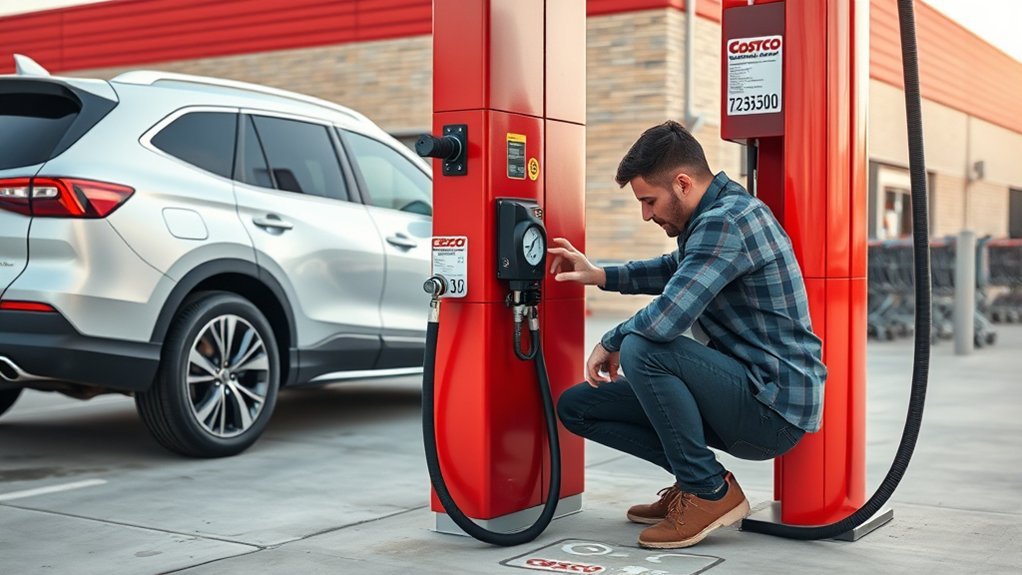
Using a Costco tire inflation station is straightforward once you know your vehicle’s correct tire pressure. The most important rule is to use the cold PSI listed on your vehicle’s Tire and Loading Information label or in the owner’s manual—not the maximum pressure molded into the tire sidewall. Then follow the instructions on the Costco self-service inflator and verify the result before leaving.
Quick Answer
Find your vehicle’s recommended cold PSI on the driver-side door placard, park by Costco’s self-inflation station, set the machine to the correct pressure if it has a preset control, attach the chuck firmly to the valve stem, and let the machine finish. Verify the pressure afterward and replace the valve cap.
Key Takeaways
- Use the vehicle manufacturer’s recommended cold PSI, not the maximum pressure shown on the tire sidewall.
- Costco says its self-inflation station is available during the same hours as its gas station.
- If the machine has a digital preset, enter the target PSI, connect the hose securely, and allow the machine to complete its cycle.
- Do not lower a warm tire to the cold placard PSI simply because driving caused its pressure to rise.
- If a tire has visible damage, loses pressure quickly, or is essentially flat, stop and have it inspected instead of repeatedly adding pressure.
At a Glance
| Time Required | About 5–10 minutes for four tires |
| Difficulty | Easy |
| Tools Needed | Costco self-inflation station and, ideally, a trusted tire-pressure gauge |
| Cost | Costco’s self-inflation FAQ does not list a separate inflation fee; local access arrangements can vary |
Check Your Recommended Tire Pressure
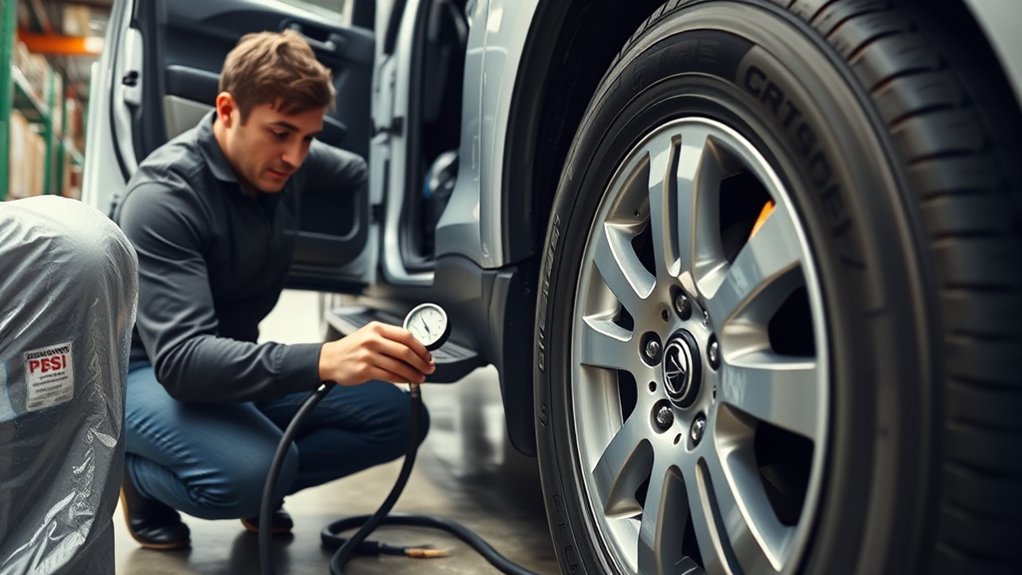
Before you inflate your tires at Costco, find the vehicle manufacturer’s recommended cold tire pressure. It is normally printed on the Tire and Loading Information label on the driver-side door edge or doorjamb and is also available in the owner’s manual.
The National Highway Traffic Safety Administration says this vehicle-specified pressure—not the number molded into the tire itself—is the proper inflation target. Costco gives the same advice in its tire-care FAQ.
Warning: Do not inflate a normal road tire to the maximum PSI printed on its sidewall just because that number is higher than the vehicle placard. The sidewall figure describes a tire limit; it is not automatically the correct operating pressure for your vehicle.
Check the front and rear specifications separately. Some vehicles require different pressures at the front and rear, so do not automatically give all four tires the same PSI.
For the most accurate measurement, check the tires when they are cold. NHTSA generally treats a tire as cold when the vehicle has been parked for at least three hours. If you tow or carry a heavy load, follow any loaded-condition pressure instructions provided by the vehicle manufacturer rather than simply adding extra PSI on your own.
The correct target is the vehicle manufacturer’s recommended cold inflation pressure—not the maximum pressure printed on the tire sidewall.
Find the Costco Tire Inflation Station
Costco says its locations have a self-inflation station that is open during the same hours as the gas station. That distinction matters because gas-station hours can be different from the Tire Center or warehouse hours.
You can confirm the hours for your location with Costco’s warehouse locator. Filter for a location with a Tire Center and gas station, then check the listed gas hours before you go.
The inflation equipment is commonly positioned near the Tire Center or nearby parking spaces. Follow the signs at your warehouse and park so the hose can reach the tires without stretching across a driving lane.
- Park fully inside the inflation space.
- Set the parking brake.
- Keep the hose away from moving vehicles.
- Locate the front and rear PSI values before removing any valve caps.
- Check the machine for operating instructions or an out-of-service notice.
Pro Tip: Check and record your cold tire pressures at home before driving to Costco. That gives you a useful baseline even if the tires warm up on the trip to the station.
Inflate Each Tire to the Right PSI
Start with one tire and remove its valve cap. If the Costco machine has a digital preset control, enter the vehicle’s recommended PSI for that wheel before attaching the hose.
- Set the target pressure. Use the machine controls and follow the instructions printed on the unit. Remember that front and rear targets may differ.
- Remove the valve cap. Put it somewhere safe so it does not roll away.
- Attach the chuck squarely. Push or lock the hose fitting firmly onto the valve stem. A brief hiss while connecting is normal, but continuous leaking usually means the chuck is not seated correctly.
- Let the machine operate. If the unit automatically adds or releases pressure to reach the preset PSI, keep the connection secure until it indicates that the cycle is complete.
- Use small adjustments only when needed. If your location has equipment without automatic target control, add air gradually and recheck with your gauge.
- Disconnect the hose and replace the cap. Repeat the process for each tire using its correct target pressure.
Avoid pulling the hose sideways against the valve stem. Valve stems and TPMS hardware can be damaged by excessive force.
[Products Worth Considering]

ETENWOLF T300 is a calibrated digital tire pressure gauge for accurate readings from 3 to 200 PSI across light and heavy-duty vehicles. It includes thermal compensation for reliable performance in extreme cold or heat, with an auto shut-off to extend battery life and an LED for easier reading. The sturdy design supports rugged everyday use, making it ideal for pickups, RVs, and industrial applications.

The ETENWOLF T600 digital tire pressure gauge delivers precise, manually calibrated readings to ANSI B40.7 Grade 2A standards with ±0.5% PSI accuracy. Its 360° rotating nozzle and display hold make it easy to check pressures from any angle, while a bleed button helps dial tires to the perfect level. With a 0–250 PSI range and support for PSI, BAR, and KPA, it’s a convenient tool for maintaining tire performance across many vehicles and seasons.

The TYAMATE TM8 solar-powered wireless TPMS delivers real-time tire pressure and temperature monitoring with six alarm modes for safer driving. A vibrant color LCD display shows readings clearly while windshield mounting keeps it hands-free and easy to read. With a wide 0–87 PSI range, strong 433.92 MHz signal transmission, and quick sensor pairing, it’s ideal for RV, sedan, SUV, MPV, and truck use.
What If You Drove to Costco and the Tires Are Warm?
The placard PSI is a cold-pressure specification. Driving heats the tires and normally causes the measured pressure to rise. That does not automatically mean the tire is overinflated.
If you already set the tires correctly while cold, do not bleed pressure from a warm tire merely to bring the reading back down to the cold placard figure. If a warm tire is clearly low, add enough pressure to avoid operating it underinflated, then check and fine-tune the pressure again when the tires are cold. NHTSA specifically recommends a later cold recheck when pressure has been adjusted after driving.
Note: Do not chase a cold-pressure target by releasing air from tires that became warm during normal driving. Their pressure should be checked again after the vehicle has cooled.
What About Costco Nitrogen Inflation?
Costco lists nitrogen tire inflation among its Tire Center services. The important point is that nitrogen does not change your vehicle’s required PSI. Whether a tire contains nitrogen or ordinary compressed air, inflate it to the pressure specified by the vehicle manufacturer.
The U.S. Tire Manufacturers Association says nitrogen inflation is permissible but is not necessary for normal tire service. It also states that nitrogen and ordinary air can be mixed when needed to maintain the correct pressure.
Verify PSI and Make Small Adjustments
After inflation, check each tire again. For a cold tire, aim for the manufacturer’s specified PSI as closely as practical rather than intentionally leaving it 1 or 2 PSI below the target.
If you use a separate gauge, press it squarely onto the valve stem long enough to obtain a stable reading. If pressure is too low, add a small amount and check again. If a cold tire is above its correct target, release a small amount of pressure and recheck.
- Confirm the correct front and rear targets.
- Check each tire individually.
- Replace every valve cap when finished.
- Check the spare tire if your vehicle has one.
- Recheck cold pressure later if the tires were warm during inflation.
NHTSA recommends checking tire pressure regularly, including the spare. A visual inspection is not enough because a tire can be significantly underinflated without looking obviously flat.
[Products Worth Considering]

ETENWOLF T300 is a calibrated digital tire pressure gauge designed for reliable readings across low and high pressure ranges. It includes thermal compensation for stable performance in extreme cold or heat, an LED light for visibility, and an auto shut-off to help preserve battery life. Ideal for pickups, RVs, and heavy-duty vehicles, it delivers accurate PSI measurements with sturdy durability.

The Tymate TM12 RV TPMS delivers real-time tire pressure and temperature monitoring with a stable 433Hz display for safer long-distance driving. It supports simultaneous monitoring across vehicle and trailer zones, includes six alarm modes for pressure, temperature, leakage, battery, and signal loss, and features easy DIY installation with auto calibration. Power is supplied via USB-C charging or solar recharging, with a wide 0–144 PSI range and up to 50 ft signal coverage for RVs and towable trailers.

AstroAI’s calibrated digital tire pressure gauge delivers precise readings across a 0–150 PSI range, with high clarity from a backlit LCD. Built for everyday road use, it features one-button operation, an anti-slip ergonomic grip, and support for multiple pressure units plus auto shutoff. Powered by AAA batteries, it’s an all-weather essential for checking tire health and TPMS warnings.
Do Not Rely on the TPMS Light as Your Pressure Gauge
A Tire Pressure Monitoring System is useful, but it does not replace manual pressure checks. NHTSA notes that the warning comes on when a tire is already significantly underinflated.
If the TPMS warning remains on after you correct the pressure, consult the vehicle owner’s manual. Some vehicles update after driving, while others have specific relearn or reset procedures. A TPMS light that flashes before remaining illuminated can indicate a system malfunction rather than simply low pressure.
Troubleshoot Common Inflation Problems
[Products Worth Considering]

This TPMS relearn tool helps you quickly activate, match, and reset GM tire pressure sensors to keep the vehicle monitoring system working properly. It clears tire pressure alarms and dashboard warning lights after sensor replacement or tire rotation, and supports learning for common 315/433 MHz TPMS sensors. Designed for simple one-button operation, it can help you avoid unnecessary trips to repair shops.

Get precise tire readings with the ETENWOLF T300 Plus digital gauge, calibrated to ANSI B40.7 Grade 2A for reliable accuracy. It measures across a wide 3–200 PSI range and includes thermal compensation for dependable performance from extreme cold to heat. The bright LED display, LED illumination, and replaceable AAA batteries make it easy to check pressures quickly, even in low light.

The Topeak SmartGauge D2 delivers precise digital tire pressure readings for bikes, motorcycles, and sports equipment up to 250 psi (17 bar). Its rotating SmartHead works with both Presta and Schrader valves, so you can check pressure quickly without adapters. The LCD display makes it easy to read results in psi, bar, or kg/cm² with an included CR2032 battery for immediate use.
The Machine Does Not Start
First, read the instructions on the unit and check for an out-of-service notice. Make sure the target pressure has been entered if the machine requires one. If it still does not operate, use another station if available or report the problem to Costco staff rather than trying to repair the equipment yourself.
Air Hisses Continuously Around the Valve
Remove the chuck and reconnect it straight onto the valve stem. Continuous hissing during the entire inflation cycle often means the fitting is not seated correctly.
If air leaks from the valve after the hose has been removed, reinstall the valve cap and have the valve inspected. A leaking valve, puncture, bead leak, damaged wheel, or other tire problem requires repair rather than repeated inflation.
The Tire Will Not Reach or Hold the Target PSI
Stop repeatedly filling the tire. A tire that loses pressure quickly may have a puncture, leaking valve, bead problem, wheel damage, or another fault that needs professional inspection.
Warning: Do not treat inflation as a repair for a tire with a visible bulge, exposed cords, major cut, obvious structural damage, or rapid pressure loss. Avoid driving on a severely damaged or essentially flat tire and have it inspected by a qualified tire professional.
The Station Reading and Your Gauge Do Not Match
Disconnect the hose and take another reading with your gauge. Make sure both connections are straight and secure. Small differences can occur between measuring devices, but a large or repeatable disagreement is a reason to use another gauge or ask the Tire Center for assistance instead of guessing.
Frequently Asked Questions
Do I need a Costco membership to use the tire inflation station?
Costco’s published Tire Center FAQ says its locations have a self-inflation station, but that specific FAQ does not state that a membership card must be scanned to operate the self-service machine. Physical access or local procedures can differ, so follow the instructions posted at the warehouse.
Is the Costco tire inflation station free?
Costco’s self-inflation FAQ does not list a separate fee for using the station. It also does not publish a universal promise about non-member access, so avoid assuming that every location handles access in exactly the same way.
Can I inflate a spare tire at Costco?
You can use an inflation source for an accessible spare tire when the equipment is suitable for its required pressure. Check the vehicle owner’s manual or the manufacturer’s specified spare-tire pressure first because a compact spare can require a very different PSI from the four road tires.
Are Costco tire inflation stations available 24/7?
No. Costco states that its self-inflation station is open during the same hours as the gas station. Gas hours vary by location and can also change for holidays, so use Costco’s warehouse locator to see the current hours for the location you plan to visit.
Does Costco offer digital tire pressure readings?
Equipment can vary by location. If your station has a digital preset display, follow the machine’s instructions to enter the target PSI and let the inflation cycle finish. A separate trusted tire-pressure gauge is still useful for confirming the final reading.
Should I use the PSI printed on the tire sidewall?
No. For normal vehicle operation, use the cold inflation pressure specified by the vehicle manufacturer on the door placard or in the owner’s manual. The pressure molded into the tire sidewall is not a substitute for that vehicle-specific recommendation.
Can I add ordinary air to a nitrogen-filled tire?
Yes. The U.S. Tire Manufacturers Association states that nitrogen and ordinary air can be mixed. Maintaining the vehicle manufacturer’s correct pressure is more important than waiting for nitrogen while driving with an underinflated tire.
What should I do if my tire is almost completely flat?
Do not assume adding pressure makes the tire safe to drive. Inspect it for visible damage and rapid leakage. A severely underinflated tire may have been damaged internally while driven low, so have it professionally inspected if there is any doubt about its condition.
Sources
- Costco Tire Center FAQs — Costco self-inflation availability, gas-station hours, and Tire Center services.
- Costco Tires FAQ — vehicle-recommended pressure, cold-tire checks, and the difference between placard PSI and sidewall maximum pressure.
- NHTSA TireWise — correct inflation pressure, cold-tire measurements, spare-tire checks, and TPMS guidance.
- NHTSA Summer Driving and Tire Safety — cold-pressure guidance, tire damage checks, and the warning not to use sidewall maximum pressure as the vehicle target.
- U.S. Tire Manufacturers Association: Using Nitrogen to Inflate Passenger and Light Truck Tires — nitrogen maintenance, recommended PSI, and mixing nitrogen with ordinary air.
Conclusion
Using a Costco tire inflation station safely comes down to one key rule: start with the vehicle manufacturer’s recommended cold PSI. Check the door placard, use the station according to its displayed instructions, inflate each tire to its proper front or rear specification, and verify the final pressure before replacing the valve caps.
If you drove to Costco and the tires are warm, remember that pressure naturally rises with temperature. Do not bleed a properly inflated warm tire down to its cold specification; check it again after it cools. And if a tire will not hold pressure or shows visible damage, stop treating inflation as the solution and have the tire inspected.

