
For recent U.S.-market Honda Accord models with standard-equipped wheels, Honda lists wheel nut torque at 80 lbf-ft (108 N·m). Hand-start the lug nuts, seat the wheel evenly, and finish with a calibrated torque wrench in a crisscross or star pattern. If your Accord has aftermarket wheels or non-OE hardware, confirm the torque specification with the wheel or hardware manufacturer before tightening.
Last updated: August 18, 2026. Torque values and tightening guidance were rechecked against current Honda owner information and wheel-installation guidance.
Affiliate disclosure: This page may contain affiliate links. If you buy through them, we may earn a commission at no extra cost to you.
Quick Answer
For recent Honda Accord factory wheel setups, use 80 lbf-ft (108 N·m) when that value matches your owner’s manual. Start every lug nut by hand, tighten in a crisscross or star pattern, and use a calibrated torque wrench for final tightening. For newly installed wheels, Tire Rack recommends a follow-up torque check after the first 50–100 miles (about 80–160 km).
Key Takeaways
- Honda lists 80 lbf-ft (108 N·m) for the recent Accord factory applications verified for this update.
- Confirm the exact value for your model year and any aftermarket wheel or lug-nut setup.
- Hand-start every lug nut and tighten in a crisscross or star pattern.
- Keep lug-nut threads and seats clean and dry unless the vehicle or wheel manufacturer specifically instructs otherwise.
- Use an impact wrench only for removal or controlled light snugging, not as the final torque measurement.
Honda Accord Lug Nut Torque at a Glance
| Item | Guidance |
|---|---|
| Recent factory wheel torque | 80 lbf-ft (108 N·m) when specified by the owner’s manual |
| Tightening pattern | Crisscross / star pattern |
| Final tightening tool | Calibrated torque wrench |
| Aftermarket wheels or hardware | Follow the wheel or hardware manufacturer’s specification |
| New-wheel follow-up | Recheck after 50–100 miles (about 80–160 km) per Tire Rack guidance |
Why Proper Honda Accord Lug Nut Torque Matters
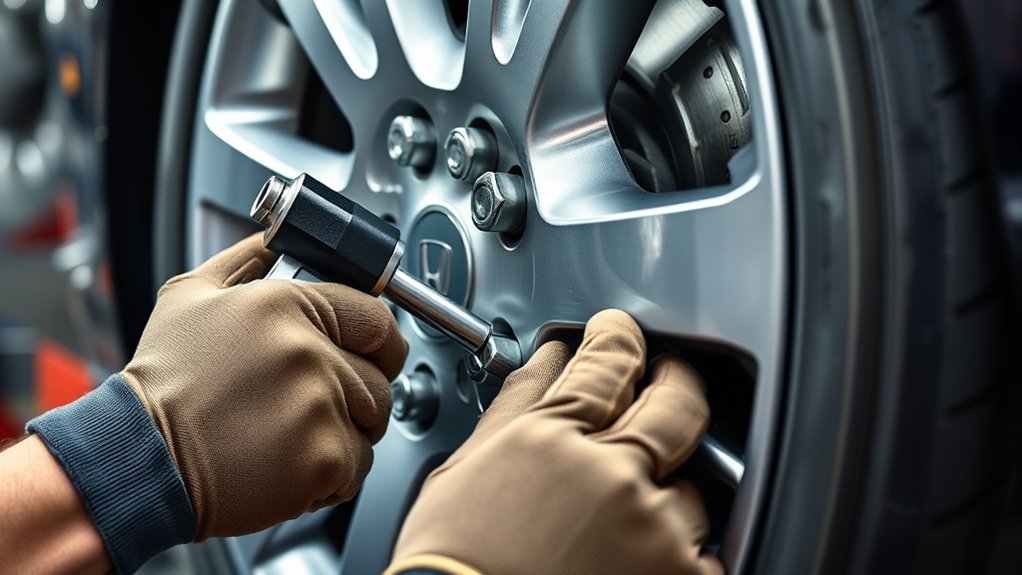
Correct torque creates the clamping force that holds the wheel securely against the hub. Honda’s recent Accord owner information lists 80 lbf-ft (108 N·m) for standard-equipped wheels, but you should still verify your exact model year and wheel setup before service.
If you under-tighten lug nuts, the wheel may not remain securely clamped. If you over-tighten them, you can damage threads, stretch wheel studs, or make the wheel difficult to remove during a roadside tire change.
Use a crisscross or star pattern so the wheel seats evenly against the hub instead of fully tightening one side first. If you need hardware dimensions rather than the torque procedure, see the Honda Accord lug nut size and thread pitch guide.
What You’ll Need Before You Torque the Lug Nuts
You don’t need many tools, but accuracy matters. A calibrated torque wrench gives you far better control than guessing by feel or relying only on an impact wrench.
- Calibrated click-type or digital torque wrench
- Correct-size socket for your Honda Accord lug nuts
- Breaker bar for loosening tight lug nuts
- Wheel chocks for added safety
- Owner’s manual or verified factory torque information for your model year
Choose a torque wrench whose specified working range comfortably includes 80 lbf-ft. Use the torque wrench for measured final tightening rather than for breaking loose stuck lug nuts.
Before installation, inspect the lug nuts, studs, wheel mounting face, and hub contact area. Start with clean hardware, and keep lug-nut threads and seats dry unless Honda or the wheel manufacturer specifically instructs you to use a lubricant.
Note: Always confirm the exact wheel-nut torque for your Accord’s model year and wheel type. Aftermarket wheels, wheel locks, replacement studs, or different lug-nut seats can require different instructions.
[Products Worth Considering]

Upgrade your wheels with MIKKUPPA M12x1.5 mag seat lug nuts built for secure, corrosion-resistant performance. These closed-end chrome lug nuts are a direct replacement for select Toyota models, including Camry, Corolla, RAV4, Sienna, Avalon, Highlander, Matrix, Venza, and Prius. Triple-chromium plating and cold-forged, heat-treated steel help deliver strength for daily driving and replacement needs.

These M14x1.5 closed-end chrome lug nuts are a one-piece replacement designed for secure fitment on compatible GM, Ford, and select Chrysler/Dodge models. Featuring a 60-degree conical seat and anti-rust chrome plating, they help resist corrosion and maintain a bright look for everyday driving. Built for long-term durability, they include OEM-style part references and are backed by 12 months of support.

This 1/2-inch drive breaker bar delivers powerful leverage for loosening and tightening stubborn lug nuts and automotive fasteners. The 180-degree flex head helps you reach tight spaces at the angle you need, making tire and brake jobs easier. A spring-loaded ball detent design holds 1/2-inch sockets securely while the chrome-moly head provides durable strength for everyday use.
How to Torque Honda Accord Lug Nuts Step by Step
Estimated total time: 10 to 15 minutes after the wheel is mounted.
The wheel must sit flat against the hub before final torque is applied. Do not use the torque wrench to force a crooked or cross-threaded lug nut into place.
- Inspect the studs, lug nuts, wheel seat, and mounting surface for damage, dirt, or heavy corrosion.
- Hand-start every lug nut several turns. If a nut does not thread smoothly by hand, stop and inspect the threads.
- Snug the lug nuts gradually in a crisscross or star pattern so the wheel seats evenly.
- Lower the vehicle until the tire contacts the ground firmly enough to keep the wheel from rotating during final tightening.
- Set your calibrated torque wrench to 80 lbf-ft (108 N·m) only if that value matches the specification for your Accord and wheel setup.
- Tighten each lug nut slowly in the same crisscross or star pattern. Go around the pattern two to three times until every nut reaches the specified torque without adding force after the wrench clicks or signals.
- Follow up according to the vehicle, wheel maker, or installer’s instructions. For newly installed wheels, Tire Rack recommends rechecking torque after the first 50–100 miles (about 80–160 km).
Don’t keep pulling after a click-type wrench clicks. Continuing to apply force can tighten the lug nut beyond the intended setting.
[Products Worth Considering]

Upgrade your wheels with MIKKUPPA closed-end lug nuts designed for reliable fit and corrosion resistance. The one-piece, cold-forged and heat-treated steel construction helps resist rust and stripping, while the integrated finish delivers a durable black appearance. Built to OEM standards with a conical 60-degree seat, these nuts provide a secure solution for compatible Ford, Honda, Jeep, and Chevrolet models.

The Trivd Frol 1/2" air impact wrench delivers high performance torque up to 1500 ft-lbs with a twin hammer impact mechanism for strong, balanced blows. It features an ergonomic grip, compact lightweight design, and quick-stop control with 3 forward speeds up to 8000 RPM plus a reverse speed. Built for demanding automotive repair and tire shop work, the rear exhaust helps keep debris away from the surface.

This spare tire tool kit is designed for the 2004 to 2018 Ford F-150 to help you loosen and tighten wheel lug nuts and manage the spare tire and provided jack functions from underneath the vehicle. It includes the lug nut wrench and extension pieces plus a convenient storage carrying case for organized transport. The jack itself is not included.
Recommended Torque Settings
For the recent Honda Accord factory applications verified for this update, Honda lists wheel nut torque at 80 lbf-ft (108 N·m). Treat that as a verified reference for those applications, not a universal substitute for your exact owner’s manual.
- Use 80 lbf-ft (108 N·m) when it matches the factory specification for your model year and wheel setup.
- For aftermarket wheels or non-OE lug hardware, follow the wheel or hardware manufacturer’s torque instructions.
- Use a calibrated torque wrench for the final tightening pass.
- Stop tightening when the wrench clicks or signals the target torque.
- Use the same crisscross or star sequence on every pass.
Do not increase the setting because another owner prefers a slightly higher number. The correct value is the specification for your vehicle and wheel hardware.
How to Use the Right Tools Correctly
A torque wrench measures tightening force, so use it for controlled final tightening. Use a breaker bar or appropriate lug wrench to loosen tight lug nuts instead of using the torque wrench as a breaker bar.
For click-type wrenches, pull slowly and stop as soon as you hear or feel the click. For digital wrenches, follow the display, light, sound, or vibration alert specified by the tool manufacturer.
After you finish, follow the wrench manufacturer’s storage instructions. Many micrometer-style click wrenches should be returned to their lowest marked setting, while other wrench designs can use different storage procedures.
| Step | Action |
|---|---|
| Set Torque Value | 80 lbf-ft (108 N·m) when specified for your setup |
| Tightening Pattern | Crisscross / star pattern |
| Maintenance | Follow the torque-wrench manufacturer’s storage and calibration instructions |
Common Honda Accord Lug Nut Torque Mistakes to Avoid
Most lug-nut installation problems come from using the wrong torque value, forcing damaged threads, tightening one nut fully before the others, or relying on an uncontrolled power tool for final tightening.
Warning: Don’t use an impact wrench as your final torque measurement. Honda also warns against adding extra tightening force with your foot or a pipe.
Using Incorrect Torque Settings
- Over-tightening can damage studs, threads, or wheel seats.
- Under-tightening may leave the wheel without the intended clamping force.
- Mixed torque settings can produce uneven clamping around the wheel.
- An impact wrench can exceed the target before you realize it.
- An inaccurate or damaged torque wrench can give misleading readings.
Use one verified torque value and one consistent tightening sequence for the entire wheel.
Using Tools the Wrong Way
Don’t use a torque wrench as a breaker bar. The high force needed to loosen a stuck lug nut can damage some torque-wrench mechanisms or affect accuracy.
Do not lubricate lug-nut threads or seats unless the vehicle, wheel, or hardware manufacturer specifically instructs you to do so. Lubrication changes friction and can change the clamping force produced at a given torque reading.
Torque sticks can help limit impact-wrench output, but they do not replace a final measured check with a calibrated torque wrench.
How to Check Lug Nuts for Proper Tightness
Check wheel-nut torque after a wheel has been removed and reinstalled according to the service instructions for the vehicle or wheels. If new wheels were installed, Tire Rack recommends a follow-up torque check after the first 50–100 miles of driving.
After tire rotation, brake work, wheel replacement, or roadside service, confirm that the wheel is seated correctly and that every lug nut reaches the specified torque in the proper sequence.
- Park on a firm, level surface before performing a torque check.
- Set the torque wrench to the verified specification for your wheel setup.
- Use the same crisscross or star pattern used during installation.
- Stop when the wrench clicks or signals the target instead of adding extra force.
- Inspect lug nuts and studs for damaged, rough, stretched, or stripped threads.
Correct tire pressure is a separate part of wheel safety. Check pressure when the tires are cold and use the vehicle’s specified inflation information rather than relying on the tire sidewall’s maximum-pressure marking.
How to Maintain Your Torque Wrench

A torque wrench works best when you store and handle it according to the manufacturer’s instructions. Keep it protected in its case when possible and avoid dropping it.
If you use a micrometer-style click wrench, check its manual for the correct storage setting. Many manufacturers specify the lowest marked value to reduce spring tension, while electronic and split-beam designs may use different procedures.
Have the wrench checked or calibrated according to its manufacturer’s interval or after an event that may affect accuracy, such as a hard drop or an obviously inconsistent reading.
Pro tip: Keep the wrench’s calibration record or service date with its case so you can see when it was last checked.
[Products Worth Considering]

The 22800 wheel stud installer makes replacing wheel studs quick and secure, saving time and effort during tire service. It uses a ratchet or impact wrench to pull new studs firmly into place, helping when existing studs are too long. Compatible with most automotive wheels and light-duty truck wheel studs, it’s designed for easy, tool-assisted installation.

This car D-wheel lock nut key provides an anti-theft solution for D-shaped wheel lock bolts, helping keep your wheels secure. It features a flower-shaped internal pattern that resists micro-adjustment theft while allowing removal and mounting of compatible locking nuts. Made for reliable performance under high torque, it’s easy to use with standard socket wrench turning for quick tire maintenance and emergency repairs.

The SEESII cordless impact wrench delivers high tightening and loosening power for fast wheel bolt and industrial bolt work. Its brushless motor and variable-speed 3 forward/2 reverse modes help you control precision installs and stubborn nut removal. A dual-battery system with rapid charging and an included storage case make it ready for home, car, and jobsite use.
When to Replace Lug Nuts or Wheel Studs
Replace lug nuts that have rounded corners, cracks, severe corrosion, or damaged threads. A damaged nut may not thread or seat correctly even if a torque wrench eventually reaches the target reading.
Inspect wheel studs if the threads feel rough, show visible damage, or will not accept the correct lug nut smoothly by hand. Do not rely on a visibly damaged or cross-threaded stud.
Never force a lug nut that doesn’t thread smoothly by hand. Stop, inspect the nut and stud, and replace damaged hardware before the vehicle is driven.
Sources
- Honda 2026 Accord Hybrid Owner Information — Tire Rotation: lists wheel nut torque at 80 lbf-ft (108 N·m, 11 kgf·m) for the standard-equipped tires.
- Honda 2025 Accord Owner Information — If a Tire Goes Flat: gives the 80 lbf-ft (108 N·m) value, ordered tightening procedure, and over-tightening warning.
- Tire Rack — How Do I Properly Torque My Wheel Lug Nuts or Bolts?: covers torque-wrench technique, tightening sequence, dry hardware, and new-wheel re-torque guidance.
Frequently Asked Questions
What Is the Torque Setting on a Honda Accord Lug Nut?
For recent U.S.-market Honda Accord models with standard-equipped wheels, Honda owner information lists 80 lbf-ft (108 N·m). Verify the specification for your exact model year, especially if the car has aftermarket wheels or non-OE hardware.
Is 108 N·m the Same as 80 lb-ft?
Yes, for practical wheel-torque specifications they represent the same setting after rounding. Honda lists the Accord value as 80 lbf-ft (108 N·m) in the recent owner information checked for this update.
Should You Torque Honda Accord Lug Nuts in the Air or on the Ground?
Hand-start and snug the lug nuts while the car is raised, then lower it until the tire contacts the ground firmly enough to prevent the wheel from rotating. Apply the final measured torque in a crisscross or star pattern.
Can You Use an Impact Wrench on Honda Accord Lug Nuts?
You can use an impact wrench for removal or carefully controlled light snugging, but don’t use it as the final torque measurement. Finish with a calibrated torque wrench set to the verified specification.
What Happens If You Over-Tighten Honda Accord Lug Nuts?
Over-tightening can damage threads, stretch wheel studs, damage wheel-seat areas, or make the wheel difficult to remove later. Honda specifically warns against adding extra torque with your foot or a pipe.
Should You Re-Torque Honda Accord Lug Nuts After Driving?
Follow the recheck instructions for your vehicle, wheels, and installer. For newly installed wheels, Tire Rack recommends re-torquing the hardware after the first 50–100 miles (about 80–160 km) of driving.
Should You Lubricate Honda Accord Lug Nut Threads?
Not unless Honda or the wheel or hardware manufacturer specifically tells you to. Tire Rack advises against lubricating wheel-hardware threads or seats because changing friction can change the clamping force produced at a given torque reading.
Final Safety Check Before You Drive
For the recent Honda Accord factory applications verified here, the key reference is 80 lbf-ft (108 N·m). Confirm that value for your exact car, hand-start each lug nut, keep the hardware properly seated, and finish in a crisscross or star pattern with a calibrated torque wrench.
If your Accord uses aftermarket wheels, wheel locks, replacement studs, or other non-OE hardware, follow the applicable manufacturer instructions instead of assuming the factory torque value automatically applies. If you also need to confirm wheel compatibility, check the Honda Accord bolt pattern and PCD before installing different wheels.