
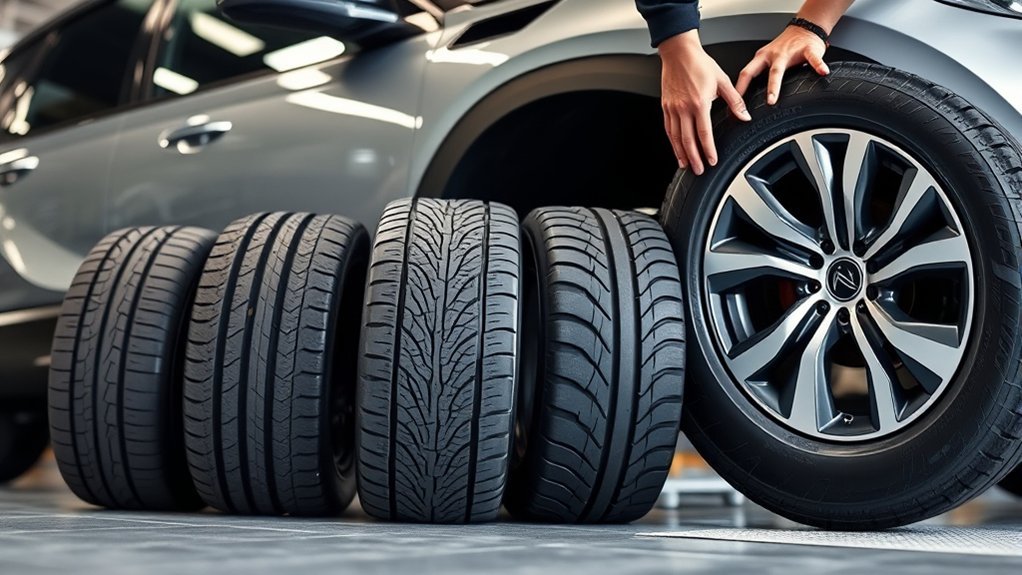
Choosing the right tires for an electric vehicle starts with fitment, not an “EV” label. Match the tire size and load requirements specified by your vehicle manufacturer, use the recommended cold tire pressure, and then compare efficiency, wet and dry grip, noise, tread life, and seasonal capability. EV weight and instant torque can place extra demands on tires, so careful selection and maintenance matter.
Quick Answer
Choose EV tires by first matching your vehicle manufacturer’s approved size, load capacity, speed requirement, and cold inflation pressure. Then compare rolling resistance, wet grip, noise, tread life, and seasonal performance. An EV-specific tire can help with weight, torque, efficiency, and cabin noise, but the correct fitment matters more than the EV label alone.
Key Takeaways
- Start with the tire size and cold-pressure information on the vehicle placard, then check the owner’s manual for any additional replacement-tire requirements.
- Never choose a tire from a generic EV load-index range; verify that the exact tire is suitable for your vehicle’s required load capacity and inflation conditions.
- Lower rolling resistance can help efficiency, but range should not come at the expense of safe wet, dry, or winter grip.
- EV-specific tires may use stronger construction, wear-resistant compounds, low-rolling-resistance designs, and noise-control technology, but these features vary by tire.
- Check pressure when the tires are cold, rotate only according to the vehicle and tire manufacturer’s instructions, and watch tread wear closely.
At a Glance
| Time Required | About 10–20 minutes to check specifications and compare suitable tires |
| Difficulty | Easy, provided you follow the vehicle manufacturer’s fitment requirements |
| Tools Needed | Vehicle placard, owner’s manual, tire specifications, and a reliable pressure gauge for maintenance checks |
| Cost | Free to verify specifications; replacement-tire cost varies widely by size, brand, performance category, and vehicle |
What Makes EV Tires Different?
Electric vehicles can place different demands on their tires than comparable combustion-powered vehicles. Battery packs can increase vehicle mass, while electric motors can deliver strong torque immediately. At the same time, a quiet electric drivetrain makes road and tire noise more noticeable inside the cabin.
Manufacturers may address those demands with stronger tire construction, durable tread compounds, optimized tread patterns, lower rolling resistance, or noise-reduction technology. Some tires also use foam or other acoustic treatments inside the tire cavity. These features are not present on every tire marketed for EV use.
The best EV tire is not simply the tire with the lowest rolling resistance. It is the tire that safely meets your vehicle’s fitment requirements while balancing efficiency, grip, durability, and comfort.
Note: An “EV-specific” label is not automatically required. A conventional replacement tire may be suitable if the vehicle and tire manufacturers confirm that its size, load capacity, speed capability, inflation requirements, and other fitment specifications are appropriate for your EV.
How to Check EV Tire Specs
Start with the Tire and Loading Information label on the driver’s door edge or door jamb. The National Highway Traffic Safety Administration recommends using the vehicle manufacturer’s specified tire size and cold inflation pressure rather than guessing from the tire’s appearance.
Then check your owner’s manual for any additional replacement-tire requirements. If you are comparing tires for electric cars, use this order:
- Match the approved tire size. Do not change width, aspect ratio, wheel diameter, or overall tire diameter simply to chase more range unless the vehicle manufacturer approves the alternate size.
- Verify load capacity. Check the complete service description and the tire manufacturer’s fitment data rather than relying on a generic load-index number.
- Check the speed rating. Use the vehicle manufacturer’s requirement and any applicable tire-manufacturer guidance.
- Confirm the season category. Choose summer, all-season, all-weather, or winter tires that match the temperatures and road conditions you actually drive in.
- Compare efficiency and traction. Look at rolling-resistance information together with wet braking, dry grip, winter performance, noise, and tread-life information.
- Check OE markings when relevant. Some tires are tuned for a particular vehicle manufacturer or model. An OE-marked tire can help preserve the original driving characteristics, but it is not the only possible replacement unless your manufacturer specifies otherwise.
Warning: Do not use the maximum pressure printed on a tire’s sidewall as your normal inflation target. Use the vehicle manufacturer’s recommended cold pressure unless the manufacturer gives different instructions for your specific tire or load condition.
How to Choose the Right EV Tire Load Index
The load index is part of a tire’s service description and relates to the load that tire can carry under specified conditions. EVs often need substantial load capacity because of their vehicle weight, but there is no universal “correct” EV load-index range.
The U.S. Tire Manufacturers Association warns that load index should not be used independently to determine whether a replacement tire has adequate load capacity. Tires with different sizing systems or inflation requirements can behave differently even when the load-index number appears equal or higher.
That is why a recommendation such as “choose a load index between 95 and 105” is not safe. Instead, verify the exact replacement tire against your vehicle manufacturer’s requirements and the tire manufacturer’s load and inflation data.
[Products Worth Considering]

The Topeak SmartGauge D2 delivers precise digital tire pressure readings for bikes, motorcycles, and sports equipment up to 250 psi (17 bar). Its rotating SmartHead works with both Presta and Schrader valves, so you can check pressure quickly without adapters. The LCD display makes it easy to read results in psi, bar, or kg/cm² with an included CR2032 battery for immediate use.

The 22800 wheel stud installer makes replacing wheel studs quick and secure, saving time and effort during tire service. It uses a ratchet or impact wrench to pull new studs firmly into place, helping when existing studs are too long. Compatible with most automotive wheels and light-duty truck wheel studs, it’s designed for easy, tool-assisted installation.

Monitor tire tread wear with a smart, color-coded depth gauge that shows clear condition ranges at a glance. The bar is range marked for fast, easy readings, helping you maintain safer traction and performance. Each gauge is portable with a pocket clip, and the set includes 20 units for daily use and sharing.
What Do XL and HL Mean?
XL generally means Extra Load. An XL tire of a given size can support more load than the corresponding standard-load version when operated at the appropriate inflation pressure.
HL or High Load is used on some modern tires designed to provide still greater load capacity within a given size envelope. These tires can be useful on heavy EVs, but you should not choose XL or HL simply because the vehicle is electric. Use the load category specified or approved for the vehicle.
A tire with greater capacity also does not raise your EV’s rated payload, Gross Vehicle Weight Rating, or axle limits. Those vehicle limits still apply.
Warning: Never assume that a higher load-index number automatically makes a tire a safe substitute. If the replacement size, load system, pressure requirement, or construction differs from the original specification, confirm the fitment with the vehicle or tire manufacturer.
How to Balance EV Tire Range and Grip
Rolling resistance affects the energy needed to keep a tire moving, so an efficiency-focused tire can help preserve EV range. But a tire is also responsible for braking, cornering, wet-road control, ride comfort, and durability. That makes tire selection a tradeoff rather than a search for the single lowest rolling-resistance number.
| Priority | What Usually Helps | What to Watch |
|---|---|---|
| Range | Lower rolling resistance, correct inflation, efficient sizing | Wet and dry grip must still meet your needs |
| Grip | Traction-focused tread and compounds | May increase rolling resistance or wear depending on the design |
| Quiet ride | Noise-optimized tread or acoustic technology | Noise varies by road surface, tire size, and vehicle |
| Long tread life | Durable compounds, correct alignment, pressure, and rotation | Aggressive acceleration can shorten life |
If you drive long highway distances, efficiency and cabin noise may be major priorities. If you regularly encounter heavy rain, snow, steep roads, or spirited driving, traction may deserve more weight in your decision.
Do not automatically switch to a narrower tire or different wheel size for extra range. Changing tire dimensions can affect load capacity, speedometer accuracy, handling, clearance, braking, and vehicle-control systems. Use only manufacturer-approved alternate sizes.
How EV Tires Affect Braking
Tires are the vehicle’s contact with the road, so their grip has a direct effect on braking performance. Many EVs are heavy, which can increase the amount of energy the tires and braking system must manage during a stop. Actual stopping distance, however, depends on much more than drivetrain type: speed, tire condition, tire compound, road surface, temperature, brakes, vehicle design, and driver input all matter.
Choose a tire with the correct load capacity and suitable wet and dry traction for your driving conditions. A low-rolling-resistance design should still provide the braking performance you need.
Inspect tread condition and inflation regularly. Excessive or uneven wear reduces the tire’s ability to manage water and can make the vehicle less predictable during hard braking.
How EV Tires Reduce Road Noise
Electric motors produce little powertrain noise at normal road speeds, so tire and wind noise can stand out more clearly in an EV cabin. Tire manufacturers address this in several ways.
Tread blocks can be arranged to reduce repeating sound frequencies. Tire construction and rubber compounds can also be tuned for vibration control. Some models add foam or another sound-absorbing material inside the tire cavity to reduce resonance.
For example, certain EV-focused tires use proprietary acoustic systems, but acoustic foam is not a requirement for a tire to work well on an electric vehicle.
When comparing tires for noise, use size-specific information whenever possible. A tire that is quiet in one size or vehicle may sound different in another because road surface, wheel diameter, tire pressure, suspension tuning, and cabin insulation all affect perceived noise.
How to Match EV Tires to the Season
Your tire’s compound and tread design should match the temperatures and conditions in which you drive. Warm-weather performance tires, general all-season tires, all-weather tires, and dedicated winter tires have different strengths.
Summer vs. Winter Tires
Summer tires are designed for warm-weather dry and wet performance. Dedicated winter tires use compounds and tread features designed to stay effective in cold weather, snow, slush, and ice.
Continental recommends considering winter tires when temperatures regularly fall below about 7°C or 45°F. Goodyear gives similar temperature guidance for switching between winter and non-winter tires.
That temperature is a practical guideline rather than a magic point where every all-season tire suddenly becomes unsafe. Tire design and road conditions vary. If your winters regularly include snow, ice, or prolonged cold, dedicated winter tires can provide a meaningful traction advantage.
- Use summer tires primarily in warm conditions.
- Use winter tires for sustained cold, snow, and ice.
- Install winter tires as a complete set of four unless the vehicle manufacturer specifies otherwise.
- Check whether your vehicle requires specific load or speed characteristics for winter fitment.
- Check tread depth and inflation throughout the season.
Temperature and Tread Grip
Look for the Three-Peak Mountain Snowflake (3PMSF) symbol when you want a tire that meets the applicable severe-snow performance requirement. An M+S marking by itself does not provide the same severe-snow performance certification.
Tread depth also becomes increasingly important in rain, slush, and snow because the grooves must move water and loose material away from the contact patch. Do not wait until a winter tire is nearly bald before considering its winter performance.
Temperature also affects inflation pressure. Check pressure more often when weather changes quickly and always use the vehicle manufacturer’s recommended cold pressure.
Why EV Tires Wear Out Faster
EV tires can wear faster than tires on a comparable combustion vehicle, although the actual difference varies widely. Two important factors are vehicle weight and torque delivery. A heavier vehicle puts more load through the tire, while strong acceleration places additional stress on the driven tires.
Michelin’s EV tire guidance identifies EV weight and instant torque as important contributors to tire wear. Alignment, tire pressure, road conditions, suspension geometry, driving style, and tire compound are also important.
Instant torque can increase tread stress, but smooth acceleration, correct pressure, proper alignment, and suitable rotation can help improve tire life.
- Hard acceleration can increase wear on driven tires.
- Incorrect inflation can create uneven or accelerated wear.
- Alignment problems can quickly damage inner or outer tread shoulders.
- Staggered or directional setups may limit rotation options.
- Frequent tread inspections help catch problems before a tire is ruined.
Regenerative braking changes how an EV decelerates, but you should not assume regeneration alone will create a particular wear pattern. Inspect the actual tires and follow the vehicle manufacturer’s maintenance recommendations.
How to Keep EV Tires Properly Inflated
Correct tire pressure supports handling, braking, tread life, comfort, and energy efficiency. The safest target is the cold inflation pressure specified by the vehicle manufacturer.
Check Pressure Monthly
NHTSA recommends checking tire pressure at least once a month while the tires are cold. “Cold” generally means the vehicle has been parked long enough for the tires to return close to ambient temperature.
Use a reliable gauge and check all four tires. Do not depend only on the tire-pressure monitoring system to manage normal inflation. TPMS is an important warning system, but a manual check can identify smaller pressure changes before a warning appears.
- Check pressure at least monthly.
- Use the pressure on the vehicle placard or other manufacturer-approved specification.
- Check the tires before a long trip.
- Inspect for cuts, bulges, punctures, and uneven tread wear at the same time.
- Do not lower a warm tire to the cold placard pressure simply because its reading increased after driving.
Pro Tip: Check pressure in the morning before driving when possible. This gives you a more consistent cold reading and makes seasonal changes easier to spot.
Adjust For Weather Changes
Cold weather lowers tire pressure. As a practical rule of thumb, pressure may change by about 1 PSI for each 10°F change in temperature, although the exact change varies.
If the weather becomes much colder, measure the tires when they are cold and restore them to the vehicle manufacturer’s recommended pressure. Do not add extra pressure simply because your car is an EV or because it has a heavy battery.
Recheck pressure after major temperature changes and before long trips. Maintaining the specified inflation helps control rolling resistance and uneven wear.
EV-Specific vs. Regular Tires: Which Should You Choose?
An EV-specific tire can be a strong choice when it has been designed around electric-vehicle priorities such as high load capacity, strong torque, efficiency, tread life, or low cabin noise. But an EV logo or marketing label does not by itself determine whether a tire is safe for your car.
A non-EV-specific tire may also work if it is approved for the vehicle and meets all required size, load, speed, inflation, and performance specifications.
When comparing the two, ask:
- Does the exact size fit my vehicle?
- Does its load capacity satisfy the manufacturer’s requirement?
- Is its speed capability suitable?
- Does it provide the seasonal traction I need?
- How does its rolling resistance affect efficiency?
- Does it offer suitable wet braking and handling?
- Are noise and tread life important for my commute?
[Products Worth Considering]

Milton S-921 pencil tire pressure gauge helps you maintain optimal tire pressure for passenger cars with accurate readings in PSI and kPa. It features a built-in deflator valve for convenient pressure adjustments, plus a single chuck head and nylon indicator bar for easy use on the go. Built from durable plated brass and designed for reliable performance, it’s a practical road trip and cold-weather maintenance tool.

ETENWOLF’s tire pressure gauge helps you quickly and accurately check tire PSI across cars, trucks, motorcycles, bikes, and more. It’s manually calibrated to ANSI B40.1 Grade A for reliable readings, includes a large glow dial for easy nighttime viewing, and features a 360-degree swivel chuck for use at any valve angle. The gauge also works consistently in extreme hot or cold weather.

Measure tire tread depth quickly and accurately with this LUMITECO dial gauge that reads in 1/32" increments up to 14/32". The color-coded green/yellow/red zones make it easy to judge tire wear and know when replacement is needed. A rugged, compact design with a protective pouch helps keep the gauge ready for use on cars, trucks, motorcycles, and more.
AWD, Staggered, and Replacement-Tire Considerations
All-wheel-drive EVs can be sensitive to differences in tire circumference and tread depth, so follow the manufacturer’s rules when replacing only one or two tires. Some vehicles may require closely matched tread depth across an axle or across all four wheels.
Staggered setups use different tire sizes at the front and rear. In that case, ordinary front-to-rear rotation may not be possible. Directional tires can also restrict rotation patterns.
For the best handling balance, avoid casually mixing unrelated tire models, construction types, or very different tread depths. If your EV came with run-flat tires, self-sealing tires, or another special tire system, check the vehicle manufacturer’s replacement guidance before changing technologies.
Best EV Tires to Consider
There is no single best EV tire for every vehicle. The correct choice depends first on exact fitment and then on your priorities. Current EV-oriented and efficiency-focused tire families worth comparing include the following.
- Michelin Primacy MXM4: an efficiency- and comfort-oriented all-season tire available in selected EV fitments. Michelin highlights low rolling resistance and noise performance for this model.
- Goodyear ElectricDrive 2: an EV-focused all-season tire designed around rolling resistance, tread life, wet/dry handling, and noise control.
- Bridgestone Turanza EV: an EV-focused all-season touring tire using Bridgestone’s ENLITEN technology, with emphasis on comfort, wear, and all-season performance.
- Continental EcoContact 6: an efficiency-focused tire available in selected sizes and markets. Check the exact seasonal category and fitment before buying.
- Hankook iON evo AS / iON evo AS SUV: EV-focused all-season options designed for passenger cars and larger EV crossovers or SUVs.
Do not buy any of these simply because the model is well known or marketed for electric vehicles. Check the exact size, service description, load category, season rating, manufacturer approval, warranty terms, and current availability for your specific EV.
[Products Worth Considering]

The SAFELIFE dial tire tread depth gauge measures tread depth in 1/32 inch increments with clear, easy-to-read 2-inch dial face. Color zones using a traffic light system help you quickly judge whether tread is low, marginal, or ample for safer driving. Built with a durable zinc cast body and a metal detect probe for precise, comfortable use across cars, motorcycles, trucks, and buses.

Add style while helping protect your tire valve stems with handmade crystal rhinestone caps and a durable plastic insert. These caps resist corrosion and help keep out rain, snow, and muddy water, extending tire life. Textured non-slip design makes them easy to grip for quick install and removal when checking tire pressure.

This tire inflator with pressure gauge delivers long-lasting performance with a durable rubber-protected gauge and sturdy build. The longer hose and 360 swivel air chuck help you seal the valve securely and keep your hands free while measuring, inflating, or deflating. It’s battery-free for reliable use and provides ±2 PSI accuracy in the mid-range for most typical tires, with universal compatibility for 1/4 NPT compressor outputs.
Frequently Asked Questions
Do EV tires work well on all-wheel-drive vehicles?
Yes. EV-compatible tires can work well on AWD vehicles when they meet the manufacturer’s fitment requirements. Pay close attention to size, load capacity, tread depth, and replacement rules because some AWD systems require closely matched tires.
How often should EV tires be rotated?
Follow the interval in your vehicle owner’s manual or tire-manufacturer guidance. Some EV manufacturers recommend intervals around 6,000 miles, but there is no universal EV rotation mileage. Staggered, directional, or unequal-size setups may require a different pattern or may prevent normal front-to-rear rotation.
Can I use regular tires on my EV?
Potentially, yes. A tire does not always need an EV-specific label, but the exact replacement must be suitable for your vehicle’s size, load capacity, speed requirement, inflation specification, and driving conditions. Confirm fitment with the vehicle or tire manufacturer when in doubt.
Do EV tires affect ride comfort?
Yes. Sidewall stiffness, tread design, wheel diameter, tire pressure, load rating, acoustic treatment, and rubber compound can all affect impact harshness and road noise. Compare the exact tire size rather than assuming every EV-specific tire will ride more quietly.
Should I buy tires based on my typical commute?
Yes. After meeting all required vehicle specifications, use your commute to prioritize features. Highway drivers may value low rolling resistance and low noise, while drivers in frequent rain, snow, or steep terrain may place more weight on wet or winter traction.
Does a higher load index let me carry more cargo?
No. A higher-capacity tire does not increase the vehicle manufacturer’s payload, axle, or gross vehicle weight limits. Never exceed the load limits listed for the vehicle.
Can I change to narrower EV tires to improve range?
Only if the alternate size is approved for your vehicle. A different width, aspect ratio, wheel diameter, or overall tire diameter can affect load capacity, handling, braking, clearance, speedometer accuracy, and vehicle-control systems.
Conclusion
The right EV tire starts with correct fitment. Match the vehicle manufacturer’s approved size, load requirements, speed capability, and cold inflation pressure before comparing efficiency, grip, noise, tread life, or EV-specific technology.
After those requirements are satisfied, choose the tire that best matches your climate and driving. Keep it properly inflated, monitor tread wear, and follow your vehicle’s rotation and replacement instructions. That approach protects range without sacrificing the braking, traction, and durability your EV needs.
Sources
- National Highway Traffic Safety Administration — TireWise — tire size, cold inflation pressure, inspection, and replacement guidance.
- U.S. Tire Manufacturers Association — Care and Service of Passenger and Light Truck Tires — load index, load capacity, inflation, speed ratings, and replacement-tire guidance.
- Michelin — EV Tire Buying Guide — EV tire efficiency, noise, weight, torque, and replacement considerations.
- Michelin — How to Reduce Tire Wear on EVs — EV weight, torque, tire wear, and maintenance.
- Continental — Electric Vehicle Tires — EV load, torque, rolling resistance, noise, and tire design.
- Continental — Buying Winter Tires — cold-weather tire selection and approximately 7°C/45°F winter-tire guidance.

