
Balancing your Honda Accord’s tires helps the tire-and-wheel assemblies spin evenly at road speed. When balance is off, you may feel vibration in the steering wheel, seat, or floor, especially on the highway. Proper balancing can improve ride comfort, reduce uneven tread wear, and help protect steering and suspension parts from extra vibration.
Quick Answer
Your Honda Accord tires likely need balancing if you feel speed-related vibration, notice cupped or uneven tread wear, recently installed or remounted tires, hit a pothole, or had a tire repaired. Pulling to one side usually points more toward tire pressure, alignment, brake, or suspension issues than balance alone.
Key Takeaways
- The most common balance symptom is vibration that changes with speed, often around highway speeds.
- Honda says new tires and tires that have been removed and reinstalled should be properly balanced.
- Check cold tire pressure using the driver’s doorjamb label, not a generic PSI range.
- Balancing and alignment are different: balancing fixes rotating weight imbalance; alignment fixes wheel angles and tracking.
- DIY checks are useful, but actual wheel balancing requires shop equipment and trained handling.
At a Glance
| Time Required | Usually about 30–60 minutes for a shop to check and balance all four wheels, depending on wait time and equipment. |
| Difficulty | Easy to inspect symptoms at home; professional service is recommended for actual balancing. |
| Tools Needed | Home checks: tire pressure gauge, tread-depth gauge, flashlight. Shop service: computerized wheel balancer, wheel weights, torque wrench, and sometimes a road-force balancer. |
| Cost | Varies by shop, wheel size, location, and whether you need standard or road-force balancing. Ask whether mounting, balancing, TPMS service kits, valve stems, and disposal fees are included. |
Understanding the Importance of Tire Balancing for Your Honda Accord
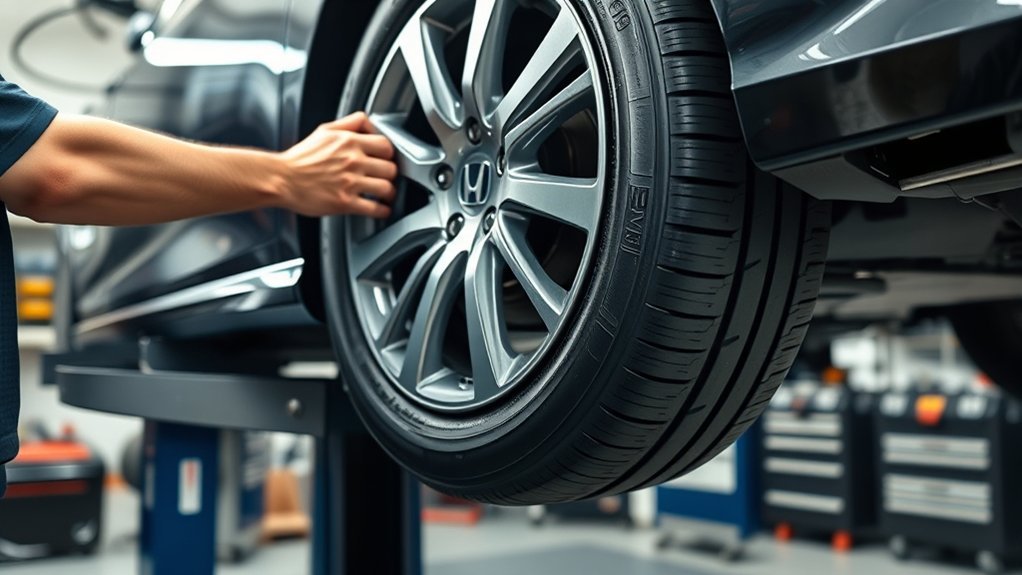
Wheel balancing corrects uneven weight distribution in the tire-and-wheel assembly. Even a small heavy spot can make the wheel bounce or wobble as speed increases. In a Honda Accord, that often shows up as a steering-wheel shake, seat vibration, or a rougher ride than usual.
Balanced tires help the tread stay in more consistent contact with the road. That can reduce cupping, vibration-related wear, and extra stress on steering and suspension components. It also helps your Accord feel smoother on the highway, especially after installing new tires or rotating tires during routine maintenance.
Honda’s Accord owner guidance says new tires and tires that have been removed and reinstalled should be properly balanced, and it also recommends having a dealer check the tires if you feel a consistent vibration while driving. You can review Honda’s current tire-check guidance here: Honda Accord tire checking guidance.
Note: Balance is only one part of tire care. Tire pressure, alignment, tread depth, tire age, wheel condition, and suspension health can all affect how your Accord rides and wears tires.
Signs Your Tires Need Balancing: Identifying the Symptoms
The clearest sign of a tire balance problem is vibration that changes with speed. It may feel mild at city speeds, stronger around highway speeds, and different again as you speed up or slow down.
| What You Notice | Most Likely Meaning | What to Do |
|---|---|---|
| Steering wheel vibration at highway speed | Often a front wheel/tire balance issue | Schedule a balance check and tire inspection. |
| Seat or floor vibration | Possible rear wheel/tire imbalance or tire uniformity issue | Ask the shop to check all four wheels, not just the front pair. |
| Cupped, scalloped, or patchy tread wear | Possible imbalance, worn shocks/struts, alignment issue, or pressure problem | Have the tires, suspension, pressure, and alignment inspected together. |
| Vehicle pulls left or right | More likely alignment, tire pressure mismatch, brake drag, road crown, or tire damage | Check cold tire pressure first, then request an alignment and tire inspection if it continues. |
Uneven wear does not always mean balance is the only problem. Bridgestone notes that uneven tread wear can also point to improper inflation, misalignment, or other issues, so the best fix is a full tire and front-end inspection instead of guessing. Learn more from Bridgestone’s tread-depth and wear guidance.
Warning: Do not ignore strong vibration, a sudden pull, a bulge in the sidewall, exposed cords, repeated pressure loss, or a tire-pressure warning light. Slow down, avoid hard braking, and have the tire inspected before normal driving continues.
Tire Balancing vs. Alignment vs. Tire Pressure
These services are often mentioned together, but they fix different problems.
- Tire balancing corrects uneven weight distribution around the tire-and-wheel assembly. It mainly fixes vibration at speed.
- Wheel alignment adjusts the wheel angles so the tires point and contact the road correctly. It mainly fixes pulling, crooked steering wheel position, and edge wear.
- Tire pressure affects tread wear, fuel economy, comfort, heat buildup, and handling. Honda says to measure pressure when the tires are cold and use the specified pressure from the driver’s doorjamb label or specifications page.
Michelin explains that balancing controls how the tire rotates, while alignment controls where the tire points and how it contacts the road. If your Accord vibrates, start with balance and tire condition. If it pulls, wanders, or wears one edge faster, include an alignment check. See Michelin’s explanation here: wheel alignment and balancing differences.
Pro Tip: Before paying for diagnostics, check cold tire pressure on all four tires. A low tire can mimic handling problems, and Honda says the TPMS should be calibrated after tire pressure is adjusted on applicable Accord models.
[Products Worth Considering]

Protect tire valves from water, dust, and sand to help prevent leaks and support safe driving. These universal stem caps install quickly by hand and feature durable aluminum alloy construction with an inner sealing ring for better air retention. Compatible with cars, SUVs, trucks, motorcycles, and bicycles for everyday convenience.

Monitor tire tread wear with a smart, color-coded depth gauge that shows clear condition ranges at a glance. The bar is range marked for fast, easy readings, helping you maintain safer traction and performance. Each gauge is portable with a pocket clip, and the set includes 20 units for daily use and sharing.

Steelman white tire marking crayons provide high-contrast, semi-permanent marks for repairing and inspecting tires and equipment. They write on wet or dry, smooth or coarse surfaces including rubber, metal, glass, and wood, making them ideal for puncture location and damage outlining. The lead- and zinc-free crayons resist weather and fading yet wipe away when you no longer need the marks.
What Happens When You Get Your Tires Balanced?
During tire balancing, a technician removes the wheel assembly and mounts it on a balancing machine. The machine spins the wheel, measures where the assembly is heavy or light, and tells the technician where to install correction weights.
| Step | What the Technician Checks | Why It Matters |
|---|---|---|
| Visual inspection | Tire damage, bent wheel, missing weights, uneven tread, debris | A damaged tire or wheel may vibrate even after balancing. |
| Machine spin | Where weight correction is needed | This identifies the imbalance that causes vibration. |
| Weight installation | Clip-on or adhesive weights placed on the rim | The weights offset heavy spots so the assembly spins evenly. |
| Repeat spin | Whether the correction is stable | Confirms the wheel was centered correctly on the balancer. |
Some shops also offer road-force balancing. This uses a roller to press against the tire while it spins, helping detect tire stiffness variation, wheel runout, or a tire-and-wheel match problem. If your Accord still vibrates after a standard balance, road-force testing can help find problems that a normal spin balance may miss.
Tire Review describes wheel balancing as correcting uneven weight distribution so the tire rotates smoothly, with the balancer identifying where corrective weights should be installed. You can read the technical overview here: Tire Review wheel balancing guide.
When to Balance Your Tires: Key Timing Tips

For a Honda Accord, the best time to balance tires is when the tires or driving symptoms call for it. A common service habit is to check balance around tire-rotation visits, but symptoms and tire service events matter more than mileage alone.
Schedule a balance check when:
- You install new tires.
- A tire has been removed and reinstalled on a wheel.
- You feel consistent vibration while driving.
- You rotate tires and notice new vibration afterward.
- A wheel weight falls off.
- You hit a pothole, curb, or road debris hard enough to worry about wheel damage.
- You repair a puncture or replace a valve stem or TPMS service kit.
- You switch seasonal tire-and-wheel sets.
- You see cupped, scalloped, or patchy tread wear.
Honda’s Accord tire rotation guidance says to rotate tires according to the maintenance messages on the driver information interface and to calibrate the TPMS after rotation on applicable models. Review Honda’s rotation guidance here: Honda Accord tire rotation guidance.
Continental recommends regular balancing as part of tire maintenance and lists vibration, uneven wear, and increased fuel consumption as common imbalance signs. It also recommends balancing after refitting a tire to a wheel. See Continental’s guide here: Continental tire balancing guidance.
Benefits of Professional Tire Balancing vs. DIY Methods
DIY inspection is useful, but DIY tire balancing is not the best choice for most Honda Accord owners. You can check pressure, inspect tread, look for missing wheel weights, and note when vibration happens. The actual correction should be done with a calibrated wheel balancer.
A professional tire balance offers several advantages:
- More accurate results: A computerized balancer measures small imbalances you cannot see by eye.
- Safer tire handling: Tire mounting and balancing involve high pressure, heavy assemblies, and proper clamping procedures.
- Better diagnosis: A shop can spot bent wheels, tire runout, cupping, uneven wear, and failed suspension parts.
- Correct torque: The wheel should be reinstalled using the correct lug-nut torque pattern and specification.
- Road-force options: If standard balancing does not solve the vibration, a road-force balancer can check tire-and-wheel uniformity.
Tire Rack warns that improper tire/rim mounting can cause serious injury and says only specially trained people should mount tires. That is why home checks are smart, but actual tire mounting and balancing should be left to a qualified shop. Read Tire Rack’s mounting and balancing procedure here: Tire Rack mounting and balancing guidance.
[Products Worth Considering]

Measure tire tread depth quickly and accurately with this LUMITECO dial gauge that reads in 1/32" increments up to 14/32". The color-coded green/yellow/red zones make it easy to judge tire wear and know when replacement is needed. A rugged, compact design with a protective pouch helps keep the gauge ready for use on cars, trucks, motorcycles, and more.

Accurately measure tire tread depth with a calibrated gauge marked from 0 to 1 inch in 1/32 inch increments. The color-coded bar helps you quickly identify tread condition ranges, supporting safe driving for trucks, motorcycles, automobiles, and passenger vehicles.

Keep your tires properly inflated with this analog VONDIOR tire pressure gauge, designed for fast, easy readings without batteries. The swiveling, two-axis hose and large glow dial help you measure at any tire angle with instant visibility. Built with a protective rubber shield, it supports durable, low-maintenance use for cars and trucks.
What to Do If Vibration Continues After Balancing
If your Accord still vibrates after the tires are balanced, do not assume the shop “missed it” right away. Balance is one cause of vibration, but not the only one.
- Recheck tire pressure cold. Set all four tires to the pressure shown on the driver’s doorjamb label.
- Ask for a repeat spin. A wheel that was not centered correctly on the balancer can produce inconsistent readings.
- Inspect for a bent wheel. Pothole impacts can bend the rim and cause vibration even with correct balance.
- Check tire runout or road force. A tire may be balanced but not perfectly round under load.
- Inspect suspension and steering parts. Worn shocks, struts, tie rods, bearings, or bushings can amplify vibration.
- Check alignment if the car pulls or wears one edge. Pulling is not solved by balance alone.
Note: If vibration started right after tire installation, rotation, or repair, return to the shop promptly. It may be a balance issue, a mounting issue, a missing weight, or a tire that needs to be remounted and rechecked.
[Products Worth Considering]

AstroAI’s heavy-duty digital tire pressure gauge delivers quick, accurate readings with 0.1 increments and a secure valve-stem seal. It features a green backlit LCD and built-in flashlight for easy use in low light, plus an ergonomic non-slip stainless-steel design. The wide 0–230 PSI range works across common vehicle tires, with unit selection and an auto shut-off to save battery.

This heavy-duty tire pressure gauge combines measurement, inflation, and deflation in one compact tool for quick roadside and garage use. Its dual-head chuck helps reach inner and outer dual-wheel positions, while the clear indicator bar makes readings easy to see. Built for durability, it supports a wide pressure range and works across cars, trucks, RVs, SUVs, and motorcycles.

The Trivd Frol 1/2" air impact wrench delivers high performance torque up to 1500 ft-lbs with a twin hammer impact mechanism for strong, balanced blows. It features an ergonomic grip, compact lightweight design, and quick-stop control with 3 forward speeds up to 8000 RPM plus a reverse speed. Built for demanding automotive repair and tire shop work, the rear exhaust helps keep debris away from the surface.
Frequently Asked Questions
How often should I check my Honda Accord tire balance?
Check balance whenever you feel speed-related vibration, install new tires, remount a tire, repair a puncture, rotate tires and notice a new shake, hit a pothole, or see cupped tread wear. Many drivers check balance around normal rotation visits, but Honda-specific guidance focuses on vibration and proper balancing after new or remounted tires.
Can tire imbalance affect my car’s alignment?
Tire imbalance does not directly change alignment angles, but vibration and uneven tire wear can make the car feel unstable and may add stress to steering and suspension parts. Alignment and balancing are separate services. If your Accord pulls to one side, has a crooked steering wheel, or wears one tire edge faster, ask for an alignment check too.
Is tire balancing necessary for all vehicles?
Yes. Any vehicle with wheel-and-tire assemblies can develop imbalance. The symptoms may feel different depending on tire size, suspension design, and speed, but balancing is a normal part of tire installation and vibration diagnosis for passenger cars, SUVs, trucks, and hybrids.
What tools are required for DIY tire balancing?
For safe DIY checks, use a tire pressure gauge, tread-depth gauge, flashlight, and the tire pressure listed on your Accord’s driver’s doorjamb label. Actual balancing requires a wheel balancer, proper adapters, wheel weights, and correct wheel installation tools. For most owners, the actual balance correction should be done by a tire shop or Honda dealer.
How much does professional tire balancing typically cost?
Pricing varies by location, shop type, wheel size, and whether the service is a standard spin balance or road-force balance. Some shops include balancing with new tire installation, while others charge per wheel. Ask for the total out-the-door price and confirm whether TPMS service kits, valve stems, disposal, mounting, and rotation are included.
Should I balance my Accord tires every time I rotate them?
Not always. Rotation moves tires to new positions to even out wear, while balancing corrects weight imbalance. If the car was smooth before rotation and remains smooth afterward, a balance may not be needed. If vibration appears after rotation, or if you see uneven wear, have the balance checked.
Do I need to reset or calibrate TPMS after balancing?
Balancing alone may not require TPMS calibration, but Honda says TPMS calibration is needed after tire pressure is adjusted and after tire rotation on applicable Accord models. Check your owner’s manual for the exact TPMS process for your model year and trim.
Conclusion
Balancing your Honda Accord’s tires is a small service that can make a big difference in ride comfort, tread wear, and vibration control. The main warning sign is speed-related shaking in the steering wheel, seat, or floor. New tires, remounted tires, puncture repairs, pothole impacts, seasonal swaps, and rotation-related vibration are all good reasons to schedule a balance check.
Just as important, do not blame every tire problem on balance. Pulling, edge wear, low pressure, tire damage, alignment problems, and worn suspension parts can create similar complaints. Start with cold tire pressure, inspect the tread, follow Honda’s tire and TPMS guidance, and use a qualified shop when your Accord needs true wheel balancing.
Sources
- Honda Accord Checking Tires — backs cold pressure checks, TPMS calibration after pressure adjustment, vibration inspection, and balancing new/remounted tires.
- Honda Accord Tire Rotation — backs rotation according to maintenance messages and TPMS calibration after rotation.
- Continental Tires: Balancing Tires — backs imbalance symptoms, balancing intervals, and balancing after refitting tires.
- Tire Review Wheel Balancing Guide — backs professional balancing steps, wheel weights, repeat checks, and vibration diagnosis.
- Michelin: Wheel Alignment and Balancing — backs the difference between alignment and balancing symptoms.
- Bridgestone Tire Tread Depth Guide — backs tread-depth checks and uneven-wear inspection advice.