Last updated: July 7, 2026
To rotate Honda Accord tires safely, identify the tire setup first. Most same-size, non-directional tires on a front-wheel-drive Accord can use a forward-cross pattern: front tires move straight back, and rear tires cross to the opposite front. Directional tires move only front to back on the same side. Always confirm the rotation pattern, jacking points, tire pressure, TPMS steps, and wheel nuts torque in your model-year owner’s manual before you lift the car.
Quick Answer
Rotate your Honda Accord tires every 5,000 to 7,500 miles, or follow the interval shown by your maintenance minder, owner’s manual, or tire warranty schedule. Use a forward-cross pattern for most same-size, non-directional tires, and use a straight front-to-rear pattern for directional tires. After rotation, tighten the wheel nuts with a calibrated torque wrench, set cold tire pressure to the door-jamb label, and reset or calibrate TPMS if your model requires it.
Key Takeaways
- Check your owner’s manual before choosing a tire rotation pattern.
- Rotate most Honda Accord tires every 5,000 to 7,500 miles, unless your manual or tire warranty says otherwise.
- Use a calibrated torque wrench for final tightening; do not guess the torque value.
- Check tire pressure after the rotation while the tires are cold.
- Reset or calibrate TPMS when your Accord model requires it.
How to Rotate Tires on Your Honda Accord

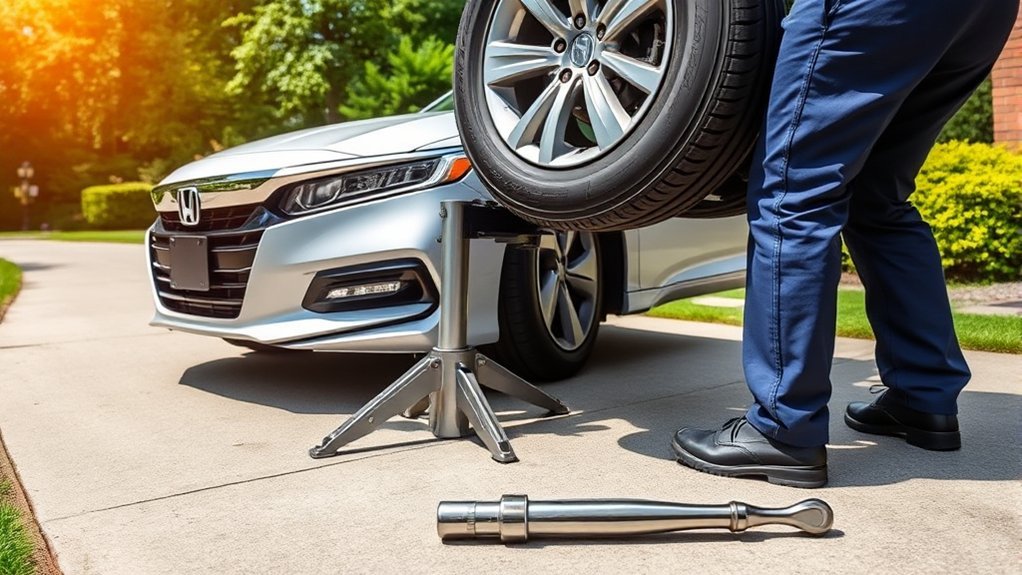
Before you start, park your Honda Accord on a flat, firm surface. Set the parking brake, turn the engine off, and place wheel chocks behind the tires that stay on the ground.
Estimated total time: about 30 to 60 minutes, depending on your tools and experience. You should also check the owner’s manual for the rotation pattern, lift points, TPMS steps, and any model-specific warnings.
[Products Worth Considering]

This TPMS sensor training and relearn reset tool is customized for Ford, Lincoln, and Mercury vehicles to help activate tire pressure programming after sensor replacement or tire rotation. It can activate individual tire pressure sensors with one-button operation, helping prevent TPMS warning light illumination. It is not a sensor programming tool and cannot program replacement sensors—use it to trigger/activate sensors only.

The VEHLIVE SU-50448 II TPMS relearn tool provides a fast activation reset to restore accurate tire pressure monitoring after sensor replacement or tire rotation. It supports 315 MHz and 433 MHz GM series sensors and helps clear dashboard pressure warnings. With simple two-button operation and horn-confirmed relearning order, you can reprogram sensors conveniently at home.
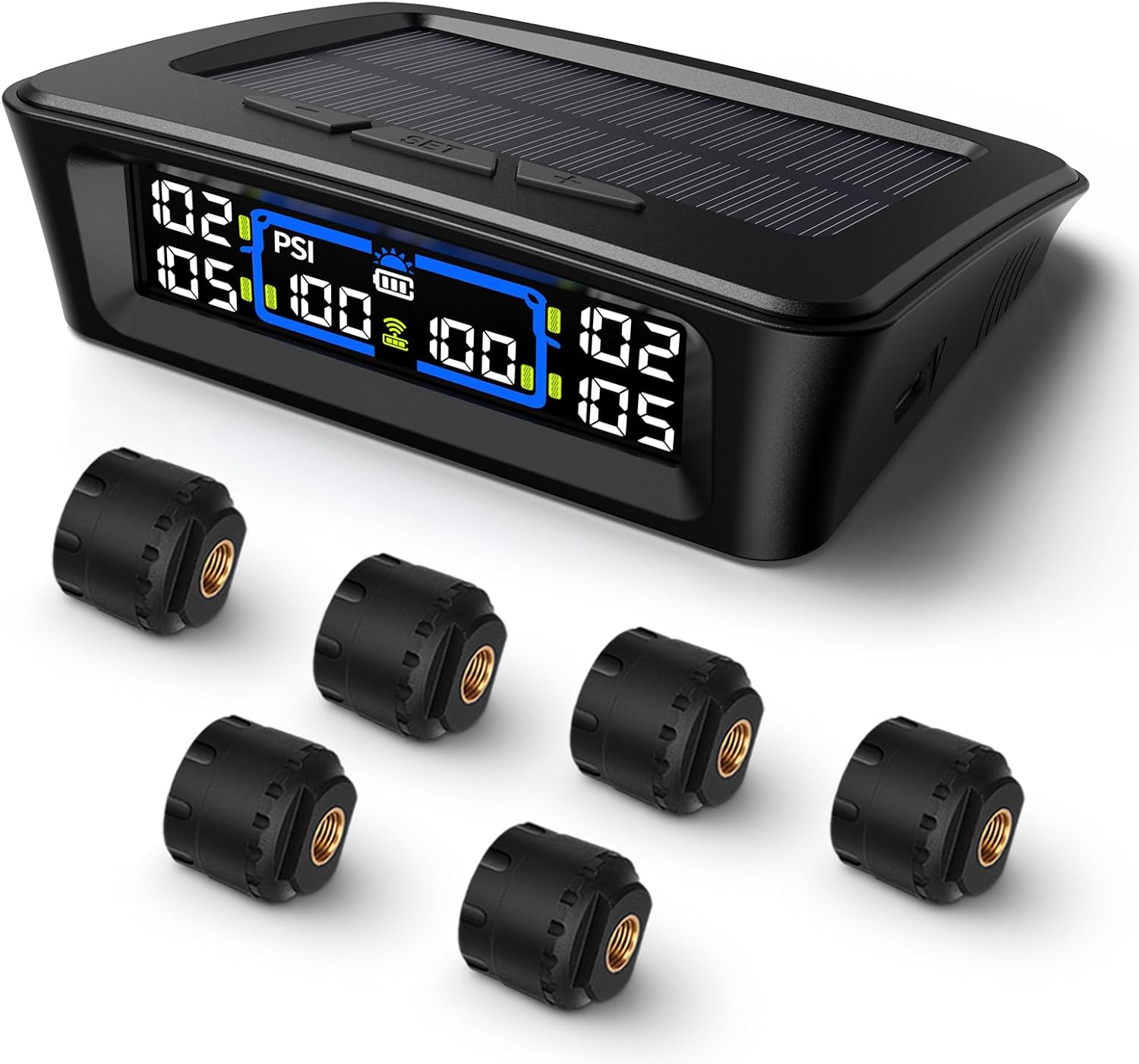
The Tymate TM12 RV TPMS delivers real-time tire pressure and temperature monitoring with a stable 433Hz display for safer long-distance driving. It supports simultaneous monitoring across vehicle and trailer zones, includes six alarm modes for pressure, temperature, leakage, battery, and signal loss, and features easy DIY installation with auto calibration. Power is supplied via USB-C charging or solar recharging, with a wide 0–144 PSI range and up to 50 ft signal coverage for RVs and towable trailers.
Choose the Right Rotation Pattern First
Do not move the wheels until you know whether your tires are directional, non-directional, staggered, or the same size at all four corners. A wrong pattern can create noise, poor wet grip, or uneven wear.
| Tire Setup | Typical Pattern | Before You Use It |
|---|---|---|
| Same-size, non-directional tires | Forward cross | Front tires move straight back; rear tires cross to the opposite front. |
| Directional tires | Front to rear on the same side | Sidewall arrows must point forward when the car drives ahead. |
| Staggered tire sizes | Usually side-to-side only, if allowed | Do not move front tires to the rear if sizes differ. |
What You’ll Need Before You Begin
- Owner’s manual for your Honda Accord
- Jack and jack stands rated for your vehicle
- Lug wrench or breaker bar
- Calibrated torque wrench
- Tire pressure gauge
- Wheel chocks
- Gloves and a flat work area
Steps to Rotate the Tires
- Check the tire type. Look for directional arrows on the sidewall. Directional tires must stay on the same side and move only front to back.
- Loosen the wheel nuts. Break the wheel nuts loose slightly before lifting the car. Don’t remove them yet.
- Lift and support the vehicle. Use the factory jacking points and support the Accord with jack stands. Never rely on the jack alone.
- Remove the wheels. Take off each wheel and inspect the tread, sidewalls, bead area, and valve stems for damage.
- Move the tires into position. Follow the pattern in your owner’s manual. If the tires are directional, move the front tires to the rear and the rear tires to the front on the same side.
- Reinstall the wheels. Hand-thread the wheel nuts first so each wheel seats evenly and you avoid cross-threading.
- Lower the car and torque the nuts. Tighten the wheel nuts in a crisscross pattern to the exact specification for your Accord and wheel type.
- Check tire pressure and TPMS. Set all tires to the recommended cold pressure, then reset or calibrate the Tire Pressure Monitoring System (TPMS) if needed.
Warning: Never work under a vehicle supported only by a jack, because the car can slip or fall.
Regular tire rotations help improve handling stability and traction, especially when road conditions change. They also help you spot tire damage before it becomes a bigger problem.
What to Do Right After Rotating Your Tires
Once you’ve finished the rotation, take a few minutes to check the details that affect safety and ride quality. Start with tire pressure, because moving tires can reveal a slow leak or an underinflated tire.
Next, inspect the tread direction and sidewall markings. Directional tread arrows must point forward when the vehicle moves ahead. Also confirm that no staggered-size tire was moved to the wrong axle.
Here’s a quick checklist for your post-rotation tasks:
| Task | Why It Matters | Action Required |
|---|---|---|
| TPMS Calibration | Helps keep pressure alerts accurate | Reset or calibrate the system if your model requires it |
| Tread Inspection | Helps protect traction and handling | Check tread direction, depth, and visible damage |
| Record Maintenance Date | Helps you stay on schedule | Log the date, mileage, and tire positions |
| Torque Recheck | Helps catch a wheel that did not seat evenly | Recheck if your manual, tire shop, or wheel maker recommends it |
Finish by taking a short, careful test drive. Listen for vibration, knocking, or pulling, and recheck your work if anything feels wrong.
Ensuring Proper Torque for Wheel Security
Proper wheel-nut torque keeps each wheel seated securely against the hub. Too little torque can let a wheel loosen, while too much can stretch studs, damage threads, or make future removal difficult.
- Use the correct spec. Check the wheel-nut torque in your model-year owner’s manual. If you use aftermarket wheels, also check the wheel maker’s instructions.
- Use a calibrated torque wrench. Do final tightening by hand with the wrench set to the correct value, not by feel.
- Tighten in a crisscross pattern. This pattern helps the wheel seat flat and reduces uneven pressure.
- Recheck after installation. Confirm each wheel nut meets the correct torque after the vehicle rests on the ground.
Pro tip: Keep your torque wrench in its case and return it to its lowest setting after use.
Don’t use an impact wrench for final tightening unless you confirm the torque with a torque wrench. An impact wrench can overtighten wheel nuts quickly.
[Products Worth Considering]

The Trivd Frol 1/2" air impact wrench delivers high performance torque up to 1500 ft-lbs with a twin hammer impact mechanism for strong, balanced blows. It features an ergonomic grip, compact lightweight design, and quick-stop control with 3 forward speeds up to 8000 RPM plus a reverse speed. Built for demanding automotive repair and tire shop work, the rear exhaust helps keep debris away from the surface.

The TYAMATE TM8 solar-powered wireless TPMS delivers real-time tire pressure and temperature monitoring with six alarm modes for safer driving. A vibrant color LCD display shows readings clearly while windshield mounting keeps it hands-free and easy to read. With a wide 0–87 PSI range, strong 433.92 MHz signal transmission, and quick sensor pairing, it’s ideal for RV, sedan, SUV, MPV, and truck use.

The SEESII cordless impact wrench delivers high tightening and loosening power for fast wheel bolt and industrial bolt work. Its brushless motor and variable-speed 3 forward/2 reverse modes help you control precision installs and stubborn nut removal. A dual-battery system with rapid charging and an included storage case make it ready for home, car, and jobsite use.
Key Benefits of Regular Tire Rotation for Your Honda Accord

Front and rear tires often wear at different rates. On many front-wheel-drive cars, the front tires carry steering, braking, and much of the drive load.
Regular tire rotation helps spread wear more evenly across all four tires. That can extend tire life, improve traction, and help your Accord ride more smoothly.
Rotations also give you a chance to catch problems early. Uneven wear can point to low tire pressure, poor alignment, worn suspension parts, or a tire that needs replacement.
How Often Should You Rotate Your Tires?
Most Honda Accord drivers should rotate their tires every 5,000 to 7,500 miles. Your owner’s manual, maintenance minder, and tire warranty schedule give the best interval for your model, tire type, and driving conditions.
You may need earlier rotations if you drive on rough roads, carry heavy loads, brake hard often, or notice uneven tread wear. You should also rotate tires sooner if the front and rear tread depths differ a lot.
- Follow the maintenance schedule. Use your Honda Accord owner’s manual as the main guide.
- Watch tread wear. Rotate sooner if one pair wears faster than the other.
- Check after seasonal changes. Tire pressure and tread wear can shift when temperatures change.
Properly inflated tires can also support better fuel economy and tire life. Check pressure when the tires are cold for the most useful reading.
Common Mistakes to Avoid When Rotating Honda Accord Tires
Small tire-rotation mistakes can cause noise, vibration, or uneven wear. Avoid guessing the rotation pattern if your tires have directional tread or staggered sizes.
- Skipping the owner’s manual: Your model may have specific tire, torque, jacking, or TPMS instructions.
- Ignoring directional tires: Directional tires must face the correct rolling direction.
- Crossing staggered tires: Front and rear tires with different sizes usually cannot swap axles.
- Forgetting tire pressure: Tire pressure should match the door-jamb label after the rotation.
- Overtightening wheel nuts: Too much torque can damage studs or make future removal hard.
- Using only a jack: Jack stands help protect you while the vehicle is raised.
When to Get Professional Help
Get help from a tire shop or mechanic if you see cords, bulges, cracks, deep sidewall cuts, bent wheels, or a tire that keeps losing air. These signs can mean the tire or wheel is unsafe to use.
You should also schedule service if the car pulls to one side, shakes at speed, or shows fast uneven wear after rotation. Those symptoms can point to alignment, balance, suspension, or wheel problems.
[Products Worth Considering]

Replace worn or missing TPMS sensors with a pre-programmed 4-pack designed for compatible GM vehicles. These 315MHz sensors provide real-time tire pressure monitoring and alert you if pressure is too high, too low, or if a rapid air leak occurs. Most installations are ready with minimal relearn effort after mounting, helping improve safety and driving confidence.

This manual duck head tire changer kit makes tire installation and removal simpler by letting you embed the duck head into the tire with applied pressure. The integrated design and durable steel construction help reduce friction and improve efficiency and safety during use. Suitable for 16–21 inch wheels, it’s convenient for cars, trucks, SUVs, and ATV tires, with 24-hour after-sales support.
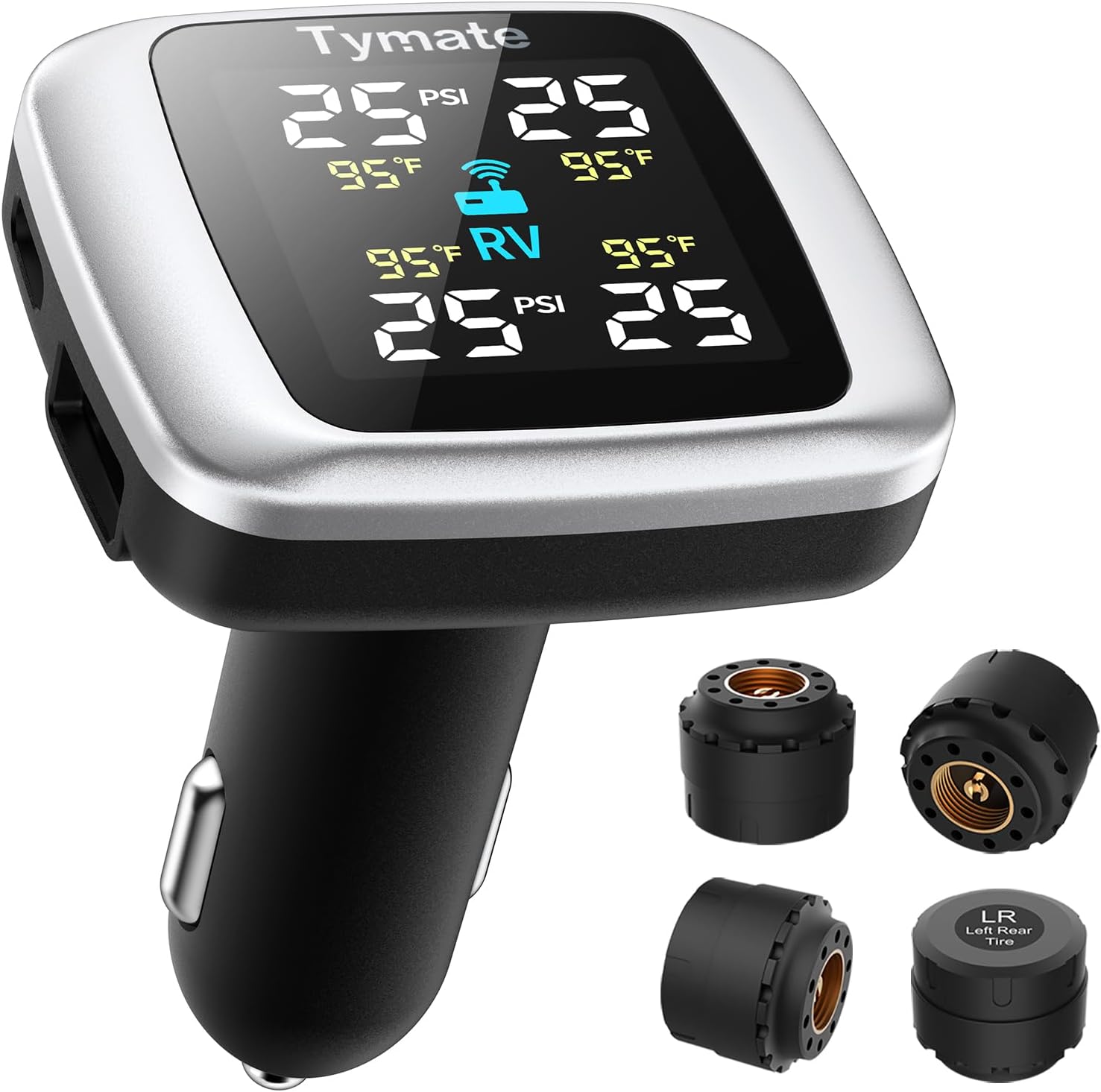
Tymate TM7 is a wireless tire pressure monitoring system that delivers real-time pressure and temperature readings for safer driving. It includes four external sensors, a bright color LCD display with adjustable backlight, and six alarm modes for high/low pressure, fast leakage, high temperature, and sensor signal or battery issues. The system covers a wide 0–144 PSI range and plugs into your vehicle’s cigarette lighter socket for quick DIY setup.
Frequently Asked Questions
What Is the Proper Order to Rotate Your Tires?
The proper order depends on your tire type and your Honda Accord’s drivetrain. Same-size, non-directional tires often use a forward-cross pattern, while directional tires move only front to back on the same side.
What Does Honda Recommend for Tire Rotation?
Honda Accord tire rotation guidance depends on the model year, tire setup, and maintenance system. Use the owner’s manual, maintenance minder, or tire warranty schedule for the exact interval and rotation pattern.
Do I Need to Reset TPMS After Rotating Tires on a Honda Accord?
Some Honda Accord models need a TPMS calibration or reset after tire rotation. Use the owner’s manual or the vehicle settings menu to follow the correct reset steps for your model.
Can I Rotate Honda Accord Tires Myself?
You can rotate the tires yourself if you have safe lifting equipment, jack stands, and a torque wrench. If you don’t have those tools, a tire shop or mechanic can rotate and inspect the tires quickly.
Should I Balance My Tires When I Rotate Them?
You don’t always need balancing during every rotation. Balance the tires if you feel vibration, see uneven tread wear, install new tires, or your tire shop finds a wheel-and-tire assembly out of balance.
What If My Tires Wear Unevenly After Rotation?
Uneven wear after rotation can point to low pressure, poor alignment, wheel imbalance, or worn suspension parts. Have the tires and suspension checked if the wear pattern keeps coming back.
Conclusion
Regular tire rotation helps your Honda Accord handle better and get more life from each tire. Check the owner’s manual, choose the right pattern, and tighten the wheel nuts with a torque wrench. After the rotation, set cold tire pressure and reset or calibrate TPMS if your model requires it. If you see damage, vibration, pulling, or fast uneven wear, get the tires and suspension checked before your next long drive.