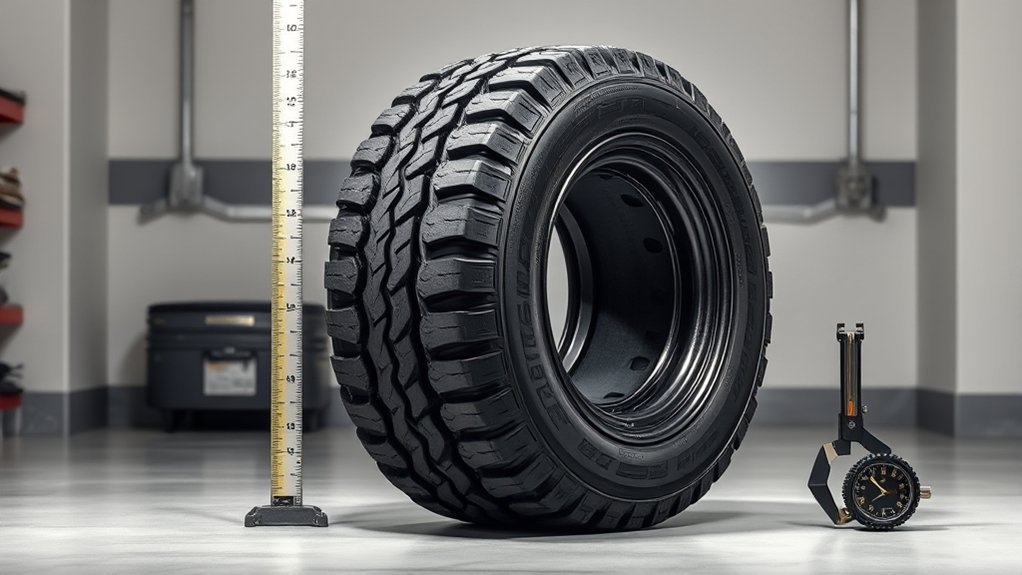
A 245/75R16 tire is about 30.5 inches tall, about 9.6 inches wide, and has a sidewall height of about 7.2 inches. Those numbers are nominal calculations from the tire-size code, so the exact mounted size can vary slightly by tire model, tread design, rim width, inflation, and load.
Last updated: August 18, 2026
Quick Answer
A 245/75R16 tire measures about 30.5 inches in overall diameter, 9.6 inches in section width, and 7.2 inches in sidewall height. It fits a 16-inch wheel. Use these as nominal sizing numbers, then confirm the exact tire model’s specs before buying.
Key Takeaways
- A 245/75R16 tire is roughly 30.5 inches tall, or about 774 mm.
- The section width is 245 mm, which equals about 9.6 inches.
- The sidewall is 75% of 245 mm, or about 7.2 inches.
- The “R” means radial construction, and the “16” means it mounts on a 16-inch wheel.
- Do not choose PSI from tire size alone. Use the vehicle tire placard, owner’s manual, and the tire’s load rating.
- A close-diameter size such as 265/70R16 is still wider, so diameter alone does not prove fitment.
What Does 245/75R16 Mean?
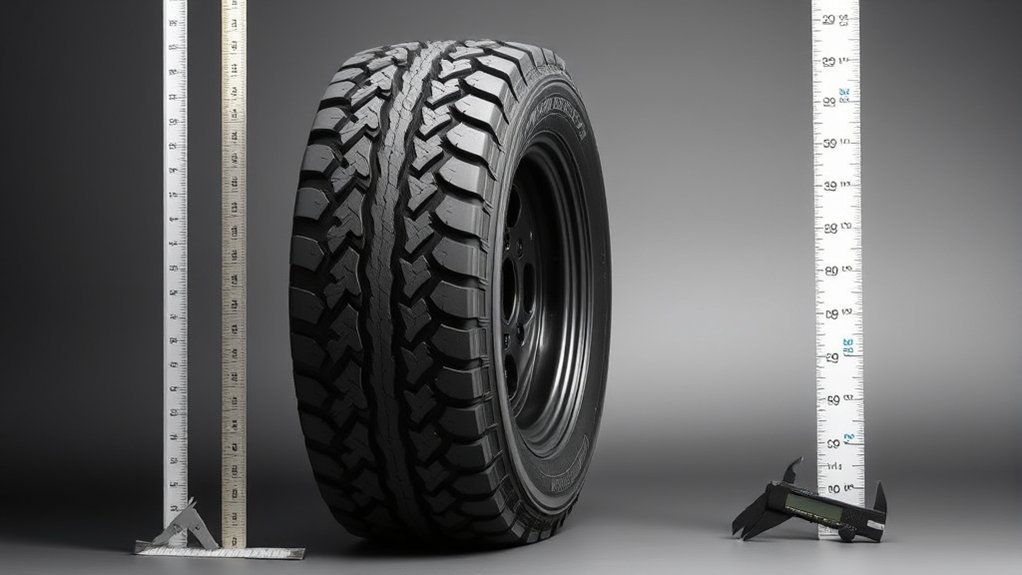
The tire code 245/75R16 tells you the tire’s basic size and construction. The first number, 245, is the tire’s section width in millimeters. The second number, 75, is the aspect ratio, meaning the sidewall height is 75% of the section width. The letter R means radial construction, and 16 means the tire fits a 16-inch wheel.
This format is the standard way to read many metric passenger, SUV, and light-truck tire sizes. Tire Rack explains that section width is listed in millimeters, the aspect ratio is the sidewall height as a percentage of that width, “R” identifies radial construction, and the final wheel number identifies the matching wheel diameter. Tire Rack’s tire-sidewall guide is a useful reference for decoding these markings.
245/75R16 Size in Inches and Millimeters
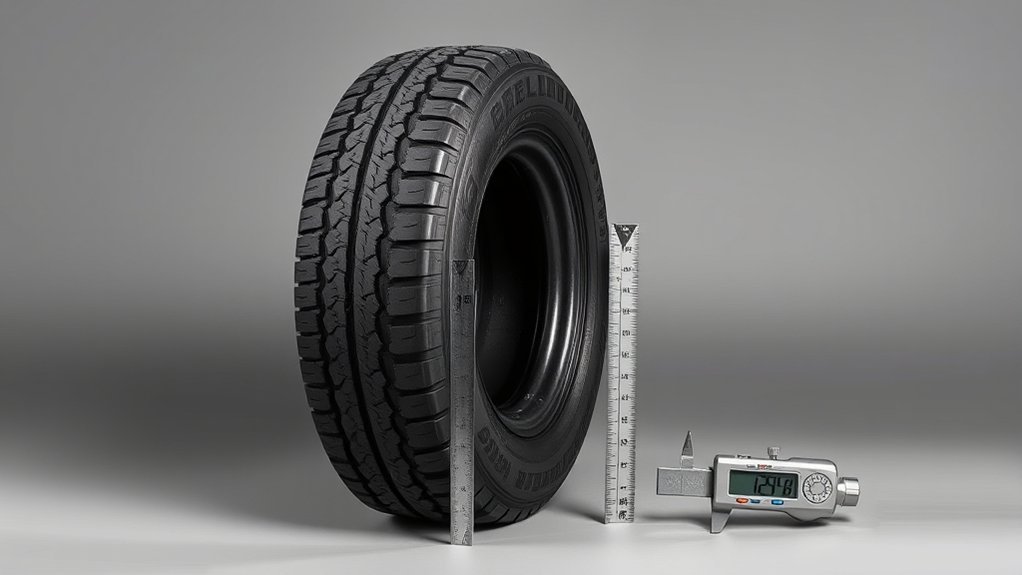
A nominal 245/75R16 tire has an overall diameter of about 30.47 inches, which rounds to 30.5 inches. The section width is about 9.65 inches, which rounds to 9.6 inches. The sidewall height is about 7.23 inches, which rounds to 7.2 inches.
245/75R16 Dimensions at a Glance
| Overall Diameter | 30.47 inches / 773.9 mm |
| Section Width | 9.65 inches / 245 mm |
| Sidewall Height | 7.23 inches / 183.75 mm |
| Wheel Diameter | 16 inches |
| Circumference | About 95.7 inches, unloaded theoretical |
| Theoretical Revs Per Mile | About 662, unloaded theoretical |
These numbers are calculated from the size code. Real tire specifications can be slightly different. For example, Cooper’s LT245/75R16 Discoverer AT3-LT specification lists a 9.7-inch section width and a 30.35-inch overall diameter, showing why you should check the exact tire model when clearance is tight. Cooper Tire’s specification table is a real-world example of model-specific sizing.
How to Calculate a 245/75R16 Tire Size
You can calculate the main dimensions with simple tire-size math. General Tire explains that, for metric tire sizes, you convert the section width to inches, multiply by the aspect ratio to get sidewall height, double that sidewall height, and add the wheel diameter. General Tire’s sidewall guide outlines this calculation method.
- Width: 245 mm ÷ 25.4 = 9.65 inches
- Sidewall: 245 mm × 0.75 = 183.75 mm, or 7.23 inches
- Overall diameter: 7.23 + 7.23 + 16 = 30.47 inches
- Metric diameter: 30.47 × 25.4 = 773.9 mm
A 245/75R16 tire is commonly rounded to 30.5 inches tall, but the exact measured diameter depends on the tire model, rim width, inflation pressure, and load.
Will a 245/75R16 Tire Fit My Vehicle?
A 245/75R16 tire fits only when the vehicle, wheel, load requirement, and available clearance are compatible with that exact tire. The “16” confirms the required wheel diameter, but a 16-inch wheel by itself does not guarantee safe fitment. Start with the driver-door tire placard or owner’s manual, then match the original-equipment size requirements, load index, speed rating, and cold inflation guidance.
Next, check the exact tire model’s approved rim-width range and measured dimensions. For example, Cooper lists its LT245/75R16 Discoverer AT3-LT for 6.5- to 8-inch rims, with a 9.7-inch section width and 30.35-inch overall diameter on its specified measuring rim. Other 245/75R16 models can measure differently. Finally, verify fender, suspension, brake, and steering clearance through full steering lock and suspension travel before treating any alternate size as compatible.
[Products Worth Considering]

These M14x1.5 closed-end chrome lug nuts are a one-piece replacement designed for secure fitment on compatible GM, Ford, and select Chrysler/Dodge models. Featuring a 60-degree conical seat and anti-rust chrome plating, they help resist corrosion and maintain a bright look for everyday driving. Built for long-term durability, they include OEM-style part references and are backed by 12 months of support.

The Ziopetru adjustable magnetic wheel alignment tool helps you check and restore camber and caster positioning after removing and reinstalling undercarriage components. With a clear leveling/bubble measurement system and an easy zeroing adjustment knob, it supports precise horizontal angle checking. The strong magnetic base mounts to metal surfaces for convenient use at home on cars, motorcycles, trucks, vans, and SUVs.

These aluminum alloy tire valve stem caps with an O-ring seal help protect valve stems from corrosion while adding a clean, stylish look to your vehicle. The universal fit works across cars, trucks, motorcycles, bicycles, and more, making them an easy upgrade for everyday driving and off-road use. Installation is quick, and the included four-pack keeps all your tires dressed and protected.
How 245/75R16 Tires Affect Fitment and Handling
A 245/75R16 tire is common on trucks, SUVs, and some light-duty utility vehicles because it offers a useful mix of sidewall height, ground clearance, and load-carrying options. The taller sidewall can improve ride comfort and help absorb rough surfaces, but it can also feel less sharp than a lower-profile tire during quick steering inputs.
On-Road Handling
On pavement, a 245/75R16 tire usually feels stable and comfortable when it is matched correctly to the vehicle, wheel width, load rating, and pressure. The 9.6-inch nominal width gives a practical contact patch, while the 7.2-inch sidewall adds cushioning. Steering response, braking feel, and road noise still depend heavily on the tire’s tread pattern, casing construction, rubber compound, and inflation pressure.
Off-Road Traction
Off-road, the 30.5-inch diameter can add useful clearance compared with smaller tires. The taller sidewall can also flex more over rocks, ruts, and uneven trails when the tire is used within safe pressure and load limits. Tread design matters more than size alone, so an all-terrain 245/75R16 will behave very differently from a highway-terrain tire in mud, snow, gravel, or rock.
Speedometer and Clearance
Changing tire diameter changes how far your vehicle travels per wheel revolution. A taller tire can make the speedometer read slower than your actual road speed, while a shorter tire can make it read faster. Larger tires can also affect fender clearance, suspension clearance, ABS, traction control, gearing, and transmission shift behavior.
Pro Tip: Before changing from your factory tire size, compare overall diameter, load index, speed rating, rim-width range, and clearance at full steering lock and full suspension compression.
Recommended PSI and Wear Patterns for 245/75R16
There is no single correct PSI for every 245/75R16 tire. The right pressure depends on the vehicle, axle load, tire load range, tire construction, and use. A standard-load 245/75R16 and an LT245/75R16 Load Range E tire can have very different inflation requirements.
Warning: Do not use the tire’s sidewall maximum pressure as your everyday target unless your vehicle manufacturer or a proper load/inflation calculation calls for it. Use the vehicle tire placard and owner’s manual as the starting point.
NHTSA advises using the vehicle manufacturer’s recommended cold tire inflation pressure, found on the tire information placard or certification label. Cold pressure means the tire has not been driven for at least three hours. NHTSA’s TireWise guidance is the safest reference for pressure basics.
Common Wear Pattern Clues
- Both outer edges wearing faster: often points to under-inflation, overloading, or aggressive cornering.
- Center wearing faster: often points to over-inflation for the load being carried.
- One edge wearing faster: often suggests alignment, camber, or suspension issues.
- Feathering or sawtooth wear: can indicate toe alignment problems, worn suspension parts, or missed rotations.
- Cupping or scalloping: may point to worn shocks, imbalance, or suspension problems.
Chalk Test: A Rough Check, Not a PSI Specification
A chalk test is only a rough visual check of tread contact. It cannot determine the vehicle manufacturer’s approved cold pressure and should not replace the tire placard, owner’s manual, or applicable load/inflation data. If the chalk pattern looks uneven, use that as a reason to re-check cold pressure, vehicle load, alignment, tire condition, and suspension rather than changing PSI from the chalk pattern alone.
What Tire Sizes Are Close to 245/75R16?
The sizes below are dimensional comparisons, not universal replacements. A safe substitute still depends on your vehicle’s factory size, load rating, wheel width, clearance, drivetrain, and intended use. Keep rolling circumference close to the original equipment size unless the vehicle manufacturer, tire manufacturer, or a qualified tire professional confirms the change is suitable.
Continental’s plus-sizing guidance says replacement tires should have equal or greater load capacity and speed rating compared with the original equipment tires, and the original rolling circumference should be maintained as closely as possible. Continental’s plus-sizing bulletin also notes that changes in rolling circumference can affect the speedometer, ABS, and stability-control systems.
| Size | Approx. Diameter | Difference vs. 245/75R16 | What Changes | If Speedometer Shows 60 mph |
|---|---|---|---|---|
| 235/75R16 | 29.9 inches | About 1.9% smaller | Slightly narrower and shorter | About 58.8 mph actual |
| 255/70R16 | 30.1 inches | About 1.4% smaller | Wider but slightly shorter | About 59.2 mph actual |
| 265/70R16 | 30.6 inches | About 0.5% larger | Wider and nearly the same height | About 60.3 mph actual |
| 265/75R16 | 31.6 inches | About 3.9% larger | Wider and about 1.2 inches taller | About 62.3 mph actual |
Speedometer note: These are theoretical values assuming the vehicle was calibrated for a nominal 30.47-inch 245/75R16. Real tire revolutions per mile vary by model, load, inflation, and wear.
Continental notes that, under most circumstances, a rolling-circumference change within about ±3% does not require adjustment to systems such as the speedometer, ABS, or stability control, but the vehicle manufacturer’s guidance still controls. That puts the nominal 265/75R16 comparison outside that ±3% window at about 3.9% larger.
The closest alternatives in diameter are usually 255/70R16 and 265/70R16, but width and clearance still matter. The 235/75R16 is narrower and slightly shorter. The 265/75R16 is significantly taller, so it needs extra clearance and may change speedometer accuracy more noticeably.
If you are checking this size on a Toyota Tacoma, use the vehicle-specific guides for finding the correct Tacoma tire size and Tacoma tire clearance with stock suspension before moving to a wider or taller option.
[Products Worth Considering]

This universal wheel alignment tool helps you accurately restore tire tilt angles after tire or suspension repairs using an adjustable camber gauge. It features a powerful magnetic base that firmly attaches to brake rotors for stationary, slip-free readings, improving consistency during measurement. Built from durable PC plastic, it resists wear and corrosion and is compact enough for car, truck, RV, and motorcycle alignment tasks.

The Tymate TM12 RV TPMS delivers real-time tire pressure and temperature monitoring with a stable 433Hz display for safer long-distance driving. It supports simultaneous monitoring across vehicle and trailer zones, includes six alarm modes for pressure, temperature, leakage, battery, and signal loss, and features easy DIY installation with auto calibration. Power is supplied via USB-C charging or solar recharging, with a wide 0–144 PSI range and up to 50 ft signal coverage for RVs and towable trailers.

The ETENWOLF T600 digital tire pressure gauge delivers precise, manually calibrated readings to ANSI B40.7 Grade 2A standards with ±0.5% PSI accuracy. Its 360° rotating nozzle and display hold make it easy to check pressures from any angle, while a bleed button helps dial tires to the perfect level. With a 0–250 PSI range and support for PSI, BAR, and KPA, it’s a convenient tool for maintaining tire performance across many vehicles and seasons.
Load Range and Speed Ratings for 245/75R16 Tires
A 245/75R16 tire can come in different load ranges and service descriptions. For example, some are standard-load SUV tires, while others are LT tires with higher load capacity for trucks, towing, or heavier work. Always match or exceed the original equipment load index and speed rating unless the vehicle or tire manufacturer gives different guidance.
Speed ratings are the letter at the end of the service description, such as 111T or 120/116R. Continental explains that speed symbols identify the tire’s tested maximum speed capability under specified conditions. Continental’s speed-index chart gives the mph and km/h values. The table below is a general speed-index reference; not every rating is offered in every 245/75R16 tire model.
| Speed Rating | Maximum Speed |
|---|---|
| Q | 99 mph / 160 km/h |
| R | 106 mph / 170 km/h |
| S | 112 mph / 180 km/h |
| T | 118 mph / 190 km/h |
| H | 130 mph / 210 km/h |
Speed rating is not a recommended driving speed. It is a tested capability under specific conditions. Follow posted speed limits, keep tires properly inflated, and do not downgrade below the vehicle manufacturer’s required rating.
[Products Worth Considering]

Measure tire tread depth quickly and accurately with this LUMITECO dial gauge that reads in 1/32" increments up to 14/32". The color-coded green/yellow/red zones make it easy to judge tire wear and know when replacement is needed. A rugged, compact design with a protective pouch helps keep the gauge ready for use on cars, trucks, motorcycles, and more.

This car D-wheel lock nut key provides an anti-theft solution for D-shaped wheel lock bolts, helping keep your wheels secure. It features a flower-shaped internal pattern that resists micro-adjustment theft while allowing removal and mounting of compatible locking nuts. Made for reliable performance under high torque, it’s easy to use with standard socket wrench turning for quick tire maintenance and emergency repairs.

The TYAMATE TM8 solar-powered wireless TPMS delivers real-time tire pressure and temperature monitoring with six alarm modes for safer driving. A vibrant color LCD display shows readings clearly while windshield mounting keeps it hands-free and easy to read. With a wide 0–87 PSI range, strong 433.92 MHz signal transmission, and quick sensor pairing, it’s ideal for RV, sedan, SUV, MPV, and truck use.
Frequently Asked Questions
Is a 245 tire taller than a 225?
It can be, but only if the aspect ratio and wheel diameter are similar. For example, a 245/75R16 is about 30.5 inches tall, while a 225/75R16 is about 29.3 inches tall. A 225/70R16 is shorter again, at about 28.4 inches. Always compare the full size code, not just the first number.
How many inches tall is a 265/75R16 tire?
A 265/75R16 tire is about 31.6 inches tall. It is roughly 10.4 inches wide and has a sidewall height of about 7.8 inches. Compared with a 245/75R16, it is about 1.2 inches taller and about 0.8 inch wider, so clearance matters.
How many inches is a 245/75R16 tire?
A 245/75R16 tire is about 30.5 inches tall and 9.6 inches wide. Its sidewall height is about 7.2 inches, and it fits a 16-inch wheel.
Is 245/75R16 the same as 30.5×9.5R16?
It is close, but not exactly the same labeling system. A 245/75R16 converts to about 30.5 inches tall and 9.6 inches wide, so people often compare it to a 30.5×9.5R16-style size. Always use the manufacturer’s actual specs before buying.
Can I replace 245/75R16 with 265/70R16?
Often it is a close diameter match, because 265/70R16 is about 30.6 inches tall. However, it is wider, so you still need to confirm rim-width range, fender clearance, suspension clearance, load index, speed rating, and vehicle manufacturer guidance.
What PSI should I run in 245/75R16 tires?
Use the vehicle tire placard or owner’s manual as your starting point, not the tire size alone. Check pressure cold. If you changed tire type, load range, or load index, ask a tire professional to confirm the correct pressure for your vehicle and load.
What rim width fits a 245/75R16 tire?
The approved rim-width range depends on the exact tire model, so check the manufacturer’s specification sheet before mounting. As one example, Cooper lists its LT245/75R16 Discoverer AT3-LT for 6.5- to 8-inch-wide rims. Do not assume every 245/75R16 tire has the same approved rim-width range.
Conclusion
A 245/75R16 tire is approximately 30.5 inches tall, 9.6 inches wide, and built for a 16-inch wheel. Use those nominal dimensions to compare sizes, not to approve a fitment by themselves. Before buying or installing a tire, check the exact model’s measured dimensions and approved rim-width range, then confirm the vehicle’s load index, speed rating, clearance, and cold pressure requirements on the tire placard or in the owner’s manual.
Sources
- Tire Rack — How to read tire size on a sidewall — backs up section width, aspect ratio, radial construction, wheel diameter, load index, and speed rating definitions.
- General Tire — How to read your tire sidewall — backs up metric tire diameter calculation method.
- Cooper Tire — Discoverer AT3-LT specifications — backs up real-world LT245/75R16 measured section width and overall diameter variation.
- NHTSA TireWise — Tire safety and pressure guidance — backs up cold tire pressure and vehicle placard guidance.
- Continental Tire — Plus sizing bulletin — backs up replacement-size guidance for load capacity, speed rating, rolling circumference, clearance, and vehicle systems.
- Continental Tires — Speed index chart — backs up Q, R, S, T, and H speed-rating values.
- Tire Rack — How to check tire specs — explains why measured section width can change with rim width and why model-specific specs matter.