
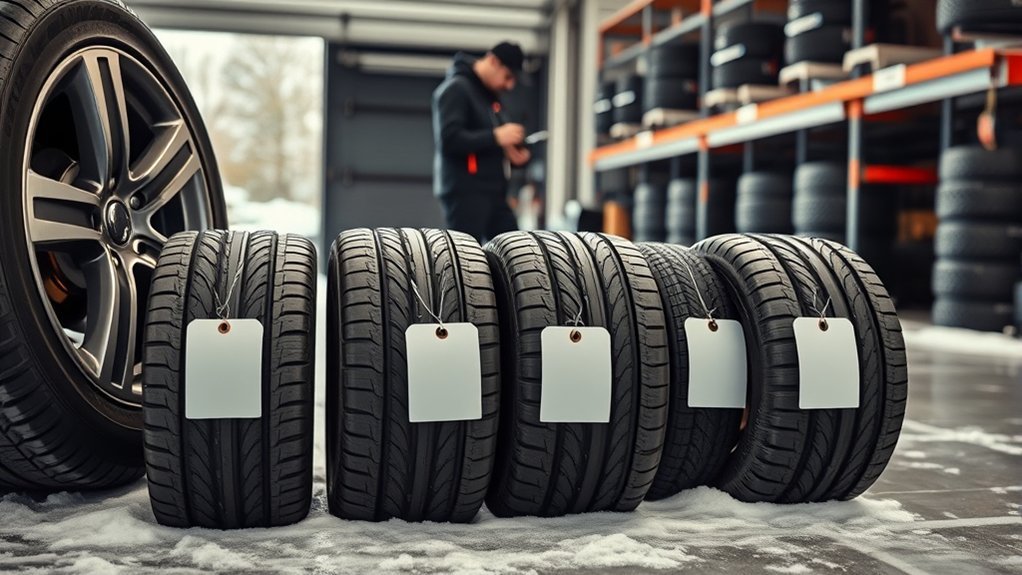
Winter tires can cost anywhere from the low hundreds to several hundred dollars per tire, and the exact price depends heavily on your tire size, vehicle requirements, brand, and performance category. For many drivers, the tires are only part of the bill. Mounting, balancing, TPMS service, storage, and seasonal changeovers can also affect what you spend each year.
Quick Answer
For 2026 budgeting, many small 12- to 15-inch winter tires fall around $100 to $150 each, while many 16- to 20-inch sizes fall around $200 to $400 each. Premium and specialized fitments can cost more than $400 per tire. Installation, TPMS work, storage, and optional winter wheels can raise the total.
Key Takeaways
- Current winter-tire pricing is wider than a simple $100-to-$300 range; common sizes can reach $400 each, and premium fitments can cost substantially more.
- Exact tire size and specification usually affect price more than whether the vehicle is simply labeled a sedan, SUV, or truck.
- Budget for mounting, balancing, TPMS-related work, disposal, storage, and seasonal changeovers when those services are not included.
- For balanced winter handling, use appropriate winter tires on all four wheel positions and follow your vehicle manufacturer’s fitment requirements.
- Compare winter traction, tread life, warranty, fit, and total seasonal cost instead of choosing only by the lowest sticker price.
How Much Do Winter Tires Cost?
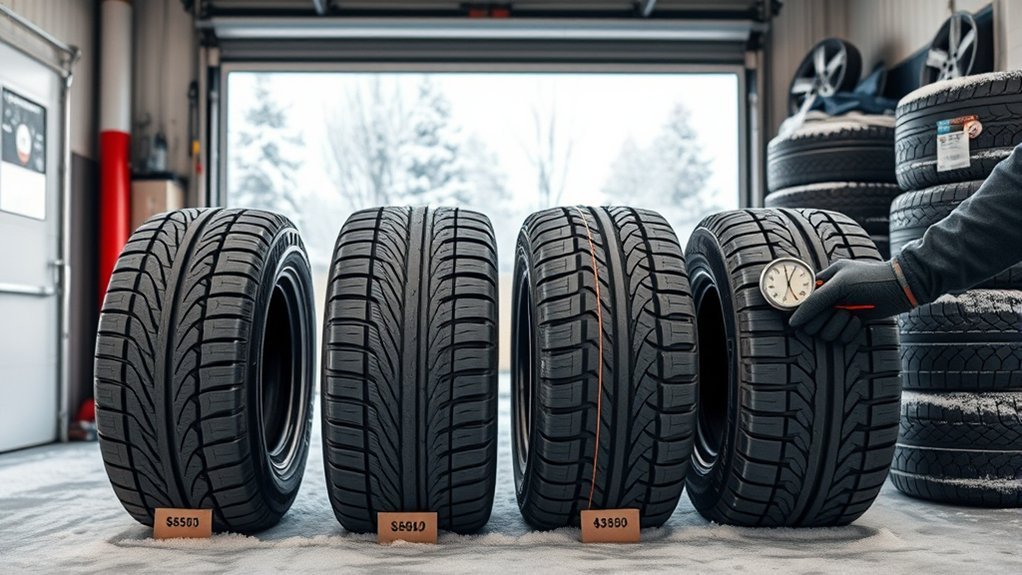
Winter tire prices vary widely, so a single nationwide number can be misleading. A useful starting point is current size-based retail guidance. Discount Tire’s tire pricing guide places many small 12- to 15-inch winter tires around $100 to $150 each and many 16- to 20-inch winter tires around $200 to $400 each.
| Typical category | Planning price per tire | Four tires before service |
| Small 12–15″ fitments | About $100–$150 | About $400–$600 |
| Many 16–20″ fitments | About $200–$400 | About $800–$1,600 |
| Premium, performance, or unusual fitments | Can exceed $400 | Vehicle-specific quote is best |
These are planning ranges, not guaranteed prices. Your actual cost depends on the exact size printed on the tire sidewall, load requirements, speed rating, brand, local inventory, and current rebates. A live retailer catalog can also contain unusually inexpensive closeouts or premium tires costing far more than the typical range.
If you drive a compact car with a common smaller size, you may stay near the lower end. SUVs, trucks, EVs, luxury cars, and performance vehicles often use larger, higher-load, wider, run-flat, or specialized tires that cost more.
A $300-per-tire ceiling is no longer a reliable rule. Current winter-tire catalogs include many common options below that price, but also premium fitments well above it.
What Drives Winter Tire Prices?
Several factors push winter tire prices up or down. Tire size is one of the biggest. Larger wheel diameters, wider sizes, higher load requirements, low-profile fitments, and less-common specifications tend to give you fewer low-cost choices.
Tire Size and Vehicle Requirements
Start with the tire size and specifications required by your vehicle rather than shopping by vehicle type alone. Your driver’s-door placard and owner’s manual are the best starting points for the original size and inflation information.
The U.S. Tire Manufacturers Association recommends following vehicle and tire manufacturer requirements for size, load capacity, inflation, speed capability, and replacement fitment.
Tread Design and Winter Compound
Winter tires use tread patterns, sipes, and cold-weather rubber compounds designed to maintain traction when temperatures fall. Some models focus heavily on ice and packed snow, while performance-winter tires also emphasize steering response and higher-speed cold-road handling.
Those design goals can affect price. Studdable designs, run-flat construction, high-performance winter tires, and uncommon sizes may cost more than basic studless winter tires for a common passenger car.
Brand, Availability, and Seasonal Demand
Premium brands often charge more for engineering, testing, warranty coverage, distribution, and specialized tire lines. Budget brands can cost less, but price alone does not tell you how a tire performs on ice, snow, wet pavement, or as it wears.
Availability matters too. A common 16-inch size may have many competing options, while an uncommon staggered or high-performance fitment may have only a few.
Pro Tip: Shop before the first major cold snap if possible. You will usually have more sizes and models to compare, and you can check rebates before seasonal demand reduces local inventory.
Winter Tire Costs by Vehicle Type
Your vehicle type can influence winter tire cost, but the label on the vehicle is not what sets the price. The real drivers are tire size, load capacity, speed requirement, construction, and available models.
- Compact cars and small sedans: Common smaller wheel sizes often have the lowest purchase price and the widest selection of value-focused winter tires.
- Midsize cars and crossovers: Many use 16- to 20-inch fitments, where the price range becomes much broader.
- SUVs and light trucks: Heavier vehicles may need higher load capacity, larger sizes, or light-truck-specific construction, which can raise the price.
- Performance and luxury vehicles: Wide, low-profile, staggered, run-flat, or high-speed winter fitments can be among the most expensive choices.
- EVs: Vehicle weight, torque, load requirements, noise targets, and manufacturer-approved fitments can narrow your options. Do not assume a tire is suitable simply because its diameter matches.
Warning: Do not choose a cheaper size, lower load capacity, or different fitment only to reduce cost. Follow the vehicle placard, owner’s manual, and approved tire-manufacturer fitments. If a winter tire uses a different speed rating from the original equipment tire, follow the vehicle and tire manufacturer’s instructions and never exceed the tire’s rated capability.
For balanced winter control, winter tires should normally be fitted on all four wheel positions. USTMA guidance says applying winter tires to all wheel positions is preferable for maintaining vehicle mobility and control, and it specifically warns against installing winter tires only on the front axle.
[Products Worth Considering]

The TYAMATE TM8 solar-powered wireless TPMS delivers real-time tire pressure and temperature monitoring with six alarm modes for safer driving. A vibrant color LCD display shows readings clearly while windshield mounting keeps it hands-free and easy to read. With a wide 0–87 PSI range, strong 433.92 MHz signal transmission, and quick sensor pairing, it’s ideal for RV, sedan, SUV, MPV, and truck use.

The 22800 wheel stud installer makes replacing wheel studs quick and secure, saving time and effort during tire service. It uses a ratchet or impact wrench to pull new studs firmly into place, helping when existing studs are too long. Compatible with most automotive wheels and light-duty truck wheel studs, it’s designed for easy, tool-assisted installation.
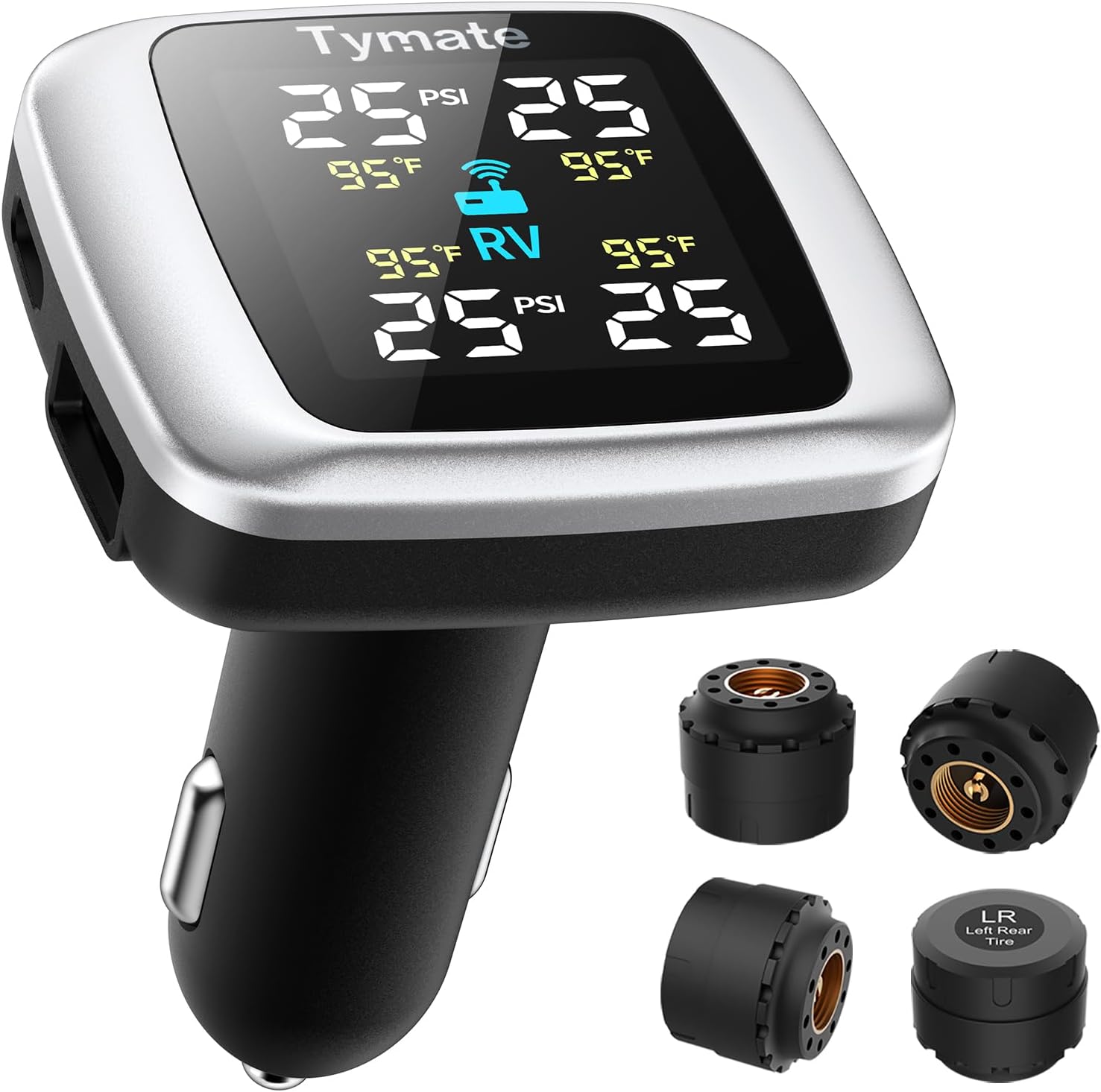
Tymate TM7 is a wireless tire pressure monitoring system that delivers real-time pressure and temperature readings for safer driving. It includes four external sensors, a bright color LCD display with adjustable backlight, and six alarm modes for high/low pressure, fast leakage, high temperature, and sensor signal or battery issues. The system covers a wide 0–144 PSI range and plugs into your vehicle’s cigarette lighter socket for quick DIY setup.
Winter Tire Installation and Extra Costs
Even after you buy the tires, installation and seasonal service can add to your total winter tire budget. Shops structure their pricing differently, so ask for an itemized out-the-door quote rather than assuming every service is included.
Possible charges include:
- Mounting and balancing: Required when the winter tires are installed on a wheel.
- Valve stems or service kits: These may be replaced during tire service when appropriate.
- TPMS service: Vehicles with tire-pressure monitoring systems may need compatible sensors, service kits, programming, or relearning when a separate wheel set is used.
- Old-tire disposal: A disposal or recycling fee may apply when old tires are removed from service.
- Seasonal changeovers: You may pay again each spring and fall if a shop switches your seasonal sets.
- Storage: Tire hotels and shops may charge to store the off-season set.
The cheapest tire is not always the cheapest winter setup. Compare the purchase price plus every service you expect to pay for over several seasons.
[Products Worth Considering]

Steelman white tire marking crayons provide high-contrast, semi-permanent marks for repairing and inspecting tires and equipment. They write on wet or dry, smooth or coarse surfaces including rubber, metal, glass, and wood, making them ideal for puncture location and damage outlining. The lead- and zinc-free crayons resist weather and fading yet wipe away when you no longer need the marks.

The Kurgo Seasonal Tire Tote helps protect your car interior, clothes, and garage from tire grime, brake dust, and residue during seasonal tire changes. Its universal design fits most passenger tires between 22" and 31" in diameter, making storage and transport simpler with less mess. Built for rugged, repeated use, it’s machine washable for easy care and comes with a lifetime warranty.

This 100-piece set of snap-in tubeless tire valve stems is designed for standard 0.453 in (11.5 mm) rim holes and helps maintain reliable, steady tire pressure. Made with ozone-resistant rubber and brass cores, the valves are built for durability and long-term use. Easy to install by hand, they support safe driving and are suitable for cars, light trucks, trailers, and more.
Should You Buy a Separate Set of Winter Wheels?
A second set of wheels raises your upfront cost, but it can simplify seasonal swaps. Once the winter tires are mounted and balanced on their own wheels, future changeovers may involve swapping complete wheel-and-tire assemblies rather than mounting and demounting the tires every season.
That can reduce repeated mounting work, but you still need to consider wheel cost, compatible TPMS sensors where required, storage space, and the shop’s seasonal swap fee. Ask for both scenarios before deciding:
- Winter tires remounted on your existing wheels twice a year.
- Winter tires kept permanently mounted on a dedicated winter wheel set.
The cheaper option depends on how long you plan to keep the vehicle, local labor rates, wheel and sensor prices, and whether you can store and change complete wheel assemblies yourself.
How to Get the Best Winter Tire Value
To get the best winter tire value, focus on total cost over the tire’s useful life instead of the sticker price alone.
[Products Worth Considering]

A concentrated tire and tube mounting compound designed to help simplify mounting rubber tires and tubes on passenger, semi truck, construction, and OTR applications. Its ultra-thick formula packs beads effectively and includes rust inhibitors to help protect against corrosion during use.

Protect tire valves from water, dust, and sand to help prevent leaks and support safe driving. These universal stem caps install quickly by hand and feature durable aluminum alloy construction with an inner sealing ring for better air retention. Compatible with cars, SUVs, trucks, motorcycles, and bicycles for everyday convenience.

Marsflex brand TPMS replacement sensors help restore tire pressure monitoring for compatible Toyota, Lexus, Scion, and Pontiac models. Each sensor is pre-programmed for the vehicle application and includes a long-life battery for up to 8 years of normal use. Designed to replace common OE numbers and requires relearning using a TPMS scan tool after installation.
Look for the Right Winter Rating
Do not rely only on an M+S marking. USTMA explains that tires meeting its severe-snow definition carry the mountain-and-snowflake symbol, commonly called the three-peak mountain snowflake or 3PMSF. That marking is commonly found on dedicated winter tires and is also used on some all-weather tires.
Compare Real Winter Performance
Compare braking, acceleration, and handling tests in the conditions you actually face. A tire designed primarily for deep snow may not have the same strengths as one optimized for ice, wet winter roads, or cold dry pavement.
Michelin’s seasonal-tire guidance explains that winter compounds are designed to remain flexible in cold conditions, while all-season and summer compounds become less suitable as temperatures fall.
Know When to Install and Remove Them
A practical rule is to switch to winter tires when daily temperatures consistently fall below about 45°F (7°C), rather than waiting for the first snowfall. Michelin uses this temperature threshold in its current winter guidance.
When temperatures consistently rise above roughly 45°F again, change back to your warm-weather or all-season set. Continental notes that winter compounds can wear faster in warm weather and may provide less precise warm-road handling and efficiency than tires intended for those conditions.
Judge Tread Life by Condition, Not Just Seasons
A fixed “three years” or “five seasons” replacement rule is too simple. Winter tire life depends on winter mileage, road surface, alignment, inflation, driving style, vehicle weight, storage, and the tire itself.
Michelin Canada’s updated 2026 guidance says many winter tires last about four to six seasons under normal Canadian use, but it also stresses that tread depth and condition must be checked regularly. Treat that as an example, not a guarantee for every tire or driver.
Inspect the tires for tread loss, cracking, cuts, bulges, uneven wear, vibration, or a noticeable decline in winter grip. Also check the DOT date code so you know how old each tire is.
Consider Studded Versus Studless Tires Carefully
Studded winter tires can offer useful traction in some icy conditions, but they are not automatically the best choice for every driver. They can be restricted or prohibited because studs can damage road surfaces.
USTMA notes that some states prohibit studded tires and many others limit them to certain seasons. Check your state and local rules before buying them.
Compare Warranty, Rolling Resistance, and Rebates
Warranty coverage and expected tread life can help you compare long-term value. If two tires have similar winter performance for your conditions, you can also compare rolling resistance, road noise, ride quality, and available rebates.
Do not let fuel economy or a long treadwear warranty outweigh the main job of a winter tire: giving you predictable grip in the winter conditions you actually drive through.
Note: If your winters are mild and you rarely face sustained ice or deep snow, a quality 3PMSF-rated all-weather tire may be worth comparing with a dedicated winter set. Drivers who regularly face severe winter conditions will usually get more specialized cold-weather performance from dedicated winter tires.
Frequently Asked Questions
Do winter tires improve braking on ice?
Dedicated winter tires are designed to provide better cold-weather traction than tires intended mainly for warmer conditions. That can improve braking and control on snow and ice, but the exact stopping-distance advantage depends on the tire, temperature, surface, vehicle, tread condition, and speed. Winter tires do not make icy roads safe at normal dry-road speeds.
Can I use winter tires year-round?
You can physically drive on many winter tires in warm weather, but it is generally a poor long-term choice. Their softer cold-weather compounds can wear faster as temperatures rise, and warm-road handling and efficiency may be worse than with tires designed for warmer conditions. Change them when temperatures consistently stay above about 45°F.
How long do winter tires last?
There is no universal number of seasons. Michelin Canada says roughly four to six seasons is common under normal Canadian use, but mileage, storage, pressure, alignment, vehicle weight, driving style, tread depth, and tire age can shorten or extend that period. Inspect the tires regularly and replace them when wear, damage, age, or declining performance makes continued use unsuitable.
Are studded winter tires legal everywhere?
No. Studded-tire rules vary by state, province, country, and sometimes season. Some jurisdictions prohibit them, while others allow them only during specified winter months. Check the current state and local rules where you drive before buying or installing studded tires.
When should I switch to winter tires?
A widely used manufacturer guideline is to install winter tires when daily temperatures consistently fall below about 45°F (7°C). You do not need to wait for the first snow. Switch back when temperatures consistently rise above that range so you do not expose the winter compound to unnecessary warm-weather wear.
Do I need four winter tires?
Using appropriate winter tires on all four wheel positions is the preferred setup for balanced traction and control. Mixing winter tires with substantially different tire types or traction levels between the front and rear can create unpredictable handling. Follow your vehicle manufacturer’s requirements, especially on AWD and 4WD vehicles.
Is a separate set of winter wheels worth the cost?
It can be if you keep the vehicle for several winters. A dedicated wheel set costs more upfront and may require another set of TPMS sensors, but future seasonal changes can be simpler because the tires stay mounted on their winter wheels. Compare the wheel-and-sensor cost with several years of local mounting, balancing, and changeover fees.
Conclusion
Winter tires are not automatically inexpensive, but their cost makes more sense when you compare the complete setup instead of focusing on one advertised tire price. Many smaller fitments remain close to the low hundreds per tire, while common larger sizes can reach $200 to $400 each and specialized premium tires can go higher.
Before buying, confirm the correct fitment, compare winter performance, check for the 3PMSF marking when severe-snow capability matters, and price the full set with installation and seasonal service. If you regularly drive in snow, ice, and sustained cold, dedicated winter tires can be a practical safety investment. If your winters are mild, compare a suitable all-weather option before paying for two complete seasonal tire setups.
Sources
- Discount Tire — Tire Pricing Guide — current planning ranges by wheel size and tire category.
- Michelin USA — Differences in Seasonal Tires — cold-temperature behavior and winter-tire performance guidance.
- Michelin Canada — Winter Tire Lifespan — lifespan, tread, storage, and replacement considerations.
- Continental — Winter Tires in Summer — warm-weather wear and seasonal changeover guidance.
- U.S. Tire Manufacturers Association — Care and Service of Passenger and Light Truck Tires — 3PMSF identification, fitment, four-tire guidance, speed/load considerations, and studded-tire restrictions.
- Michelin USA — Winter Tire Timing and Pressure — 45°F seasonal-switch guidance and cold-weather tire considerations.

![[2026NEW] 5000A Jump Starter with Air Compressor (150PSI)](https://m.media-amazon.com/images/I/71oG4PFNsmL._AC_SL1500_.jpg)