You can have more than one puncture repaired in the same tire, but the safe answer is not based on a simple plug count. Each injury must be small, confined to the repairable tread area, non-overlapping, and accepted under the tire manufacturer’s policy. An outside-in plug by itself is only an emergency measure, not a proper permanent repair.
Quick Answer
There is no universal maximum number of repairs for every tire. A trained technician must inspect each puncture with the tire removed. Repairable injuries are generally limited to the tread area, no larger than 1/4 inch (6 mm), and unable to overlap an earlier repair. A plug alone is not a permanent repair.
Key Takeaways
- Industry guidance does not set one repair-count limit that applies to every passenger or light-truck tire.
- A proper repair fills the injury with a rubber stem and seals the inner liner with a patch or one-piece combination unit.
- The tire must come off the wheel so a technician can inspect the inside for hidden damage.
- Punctures larger than 1/4 inch (6 mm), overlapping repairs, and shoulder or sidewall damage generally require replacement.
- Tire-maker policies may be stricter for run-flat, high-speed-rated, foam-lined, or other specialty tires.
At a Glance
| Time Required | A roadside leak check takes a few minutes; professional inspection and repair time varies by shop and damage. |
| Difficulty | Professional service recommended for any permanent repair. |
| Tools Needed | Pressure gauge and spare or approved emergency kit at roadside; demounting, inspection, repair, and balancing equipment at the shop. |
| Cost | Varies by tire, vehicle, location, and whether repair or replacement is required. |
Warning: Do not plug or patch a sidewall, shoulder, bulge, exposed cord, or puncture larger than 1/4 inch. Do not keep driving on a tire that is losing pressure, visibly deformed, or damaged from being driven flat. Install the spare or arrange roadside service.
How Many Tire Plugs Can You Use?
There is no single industry-wide number of plugs or repairs that is safe for every tire. The U.S. Tire Manufacturers Association (USTMA) says repair decisions must account for the injury’s size and location, previous repairs, internal condition, and the tire manufacturer’s own restrictions.
For a passenger or light-truck tire to qualify for a standard puncture repair, the injury generally must meet all of these conditions:
- It is confined to the repairable tread area.
- It is no larger than 1/4 inch (6 mm) in diameter.
- It does not extend into the shoulder or belt-edge area.
- It does not overlap an earlier repair.
- The tire has not suffered hidden structural damage from being driven underinflated or flat.
- The tire maker and repair shop permit the repair.
That means a tire may sometimes have two or more separate repairs, but “two,” “three,” or any other count is not a universal safety guarantee. A technician must evaluate the whole tire each time.
The number of repairs matters less than whether every injury is small, properly located, non-overlapping, and professionally repaired after an internal inspection.
What Counts as a Proper Tire Repair?
A proper permanent repair is not an outside-in string plug by itself. USTMA guidance requires the tire to be removed from the wheel, inspected inside and out, filled through the injury with a rubber stem, and sealed at the inner liner with a patch. A one-piece patch-plug combination unit can perform both functions.
- Remove the tire from the wheel. This exposes damage that cannot be seen from outside.
- Inspect the casing and inner liner. The technician checks for run-flat damage, cracking, separation, exposed cords, moisture, and an unsafe puncture path.
- Confirm repair eligibility. The injury must be within the repairable tread zone, no larger than 1/4 inch, and separate from previous repairs.
- Fill and seal the injury. A rubber stem fills the puncture channel while a patch seals the inner liner.
- Remount, inflate, balance, and leak-test the tire. Pressure should match the vehicle placard, not the maximum pressure molded on the tire sidewall.
Pro Tip: Ask the shop whether it follows USTMA puncture-repair procedures and whether your tire brand places additional limits on repairs, speed rating, run-flat use, or warranty coverage.
When One Emergency Tire Plug May Be Enough
An external plug from a roadside kit may temporarily slow or stop a leak from a small tread puncture so you can reach a safe location or repair facility. It should not be treated as a permanent repair because the tire remains on the wheel and its inner liner and casing cannot be fully inspected.
Use an emergency plug only when the kit instructions allow it and all of the following are true:
- The hole appears to be in the central tread, not the shoulder or sidewall.
- There is no bulge, split, exposed cord, severe cut, or wheel damage.
- The tire can hold the vehicle manufacturer’s recommended pressure.
- You follow the kit’s stated speed, distance, and vehicle restrictions.
- You arrange an off-wheel professional inspection as soon as practical.
Do not insert several plugs into one hole to stop a larger leak. A puncture that will not seal with the kit as directed is not a candidate for more material; use the spare or roadside assistance.
Why Multiple Plug-Only Repairs Are Risky
Multiple outside-in plugs can hide the tire’s true condition and create a false sense of security. The main problem is not simply the count. It is that plug-only work skips the internal inspection and inner-liner patch required for a proper repair.
Risk increases when repairs:
- overlap or enter the same damaged area;
- sit near the shoulder or belt edge;
- fill a hole larger than 1/4 inch;
- are placed in a tire that was driven while flat;
- cover damage caused by a cut, impact, separation, or exposed cord; or
- conflict with the tire manufacturer’s repair policy.
If a tire already contains an improper repair, USTMA guidance says it should not receive another repair. A tire professional should determine whether it must be removed from service.
Where Tire Repairs Are Allowed
Repairable Tread Area Only
Standard puncture repairs are limited to the tread area shown in the repair procedure for that tire. Do not rely on a blanket “1/2 inch from the edge” rule. Tire shapes and belt packages vary, and the injury path can angle toward the shoulder even when the entry point looks acceptable from outside.
A trained technician should confirm that the entire puncture remains inside the repairable tread zone and does not reach the shoulder or belt edge.
Avoid the Shoulder and Sidewall
Sidewall and shoulder damage requires replacement rather than a plug or patch. These areas flex heavily and carry structural loads. A puncture, cut, bulge, or exposed cord there can indicate casing damage that a surface repair cannot restore.
Do not drive on a tire with a sidewall bulge or rapidly falling pressure. Move to a safe location, install the spare if conditions allow, or call roadside assistance.
When to Patch, Plug, or Replace
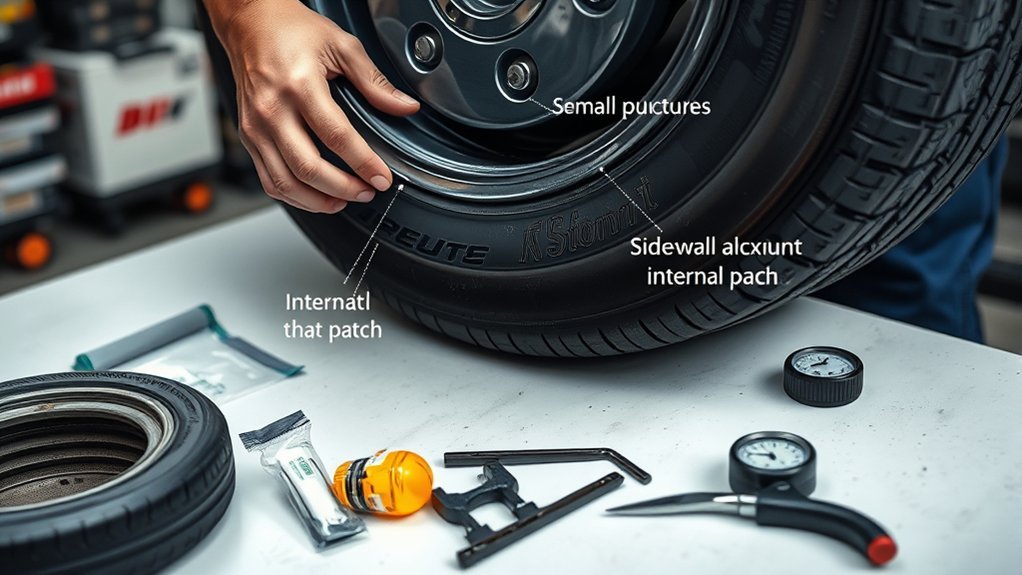
The correct choice depends on the damage, not on which repair product is easiest to install. A patch alone seals the inner liner but may leave the puncture channel open to moisture. A plug alone fills the channel but does not seal the inner liner or permit a full internal inspection. The preferred permanent method combines both functions.
| Condition | Best Action |
| Small puncture, no larger than 1/4 inch, fully inside the repairable tread area | Off-wheel inspection followed by a stem-and-patch or one-piece combination repair, if approved. |
| Outside-in roadside plug in a small tread puncture | Treat as temporary and arrange professional inspection promptly. |
| Puncture larger than 1/4 inch, overlapping repair, or damage entering the shoulder | Replace the tire. |
| Sidewall cut, puncture, bulge, exposed cord, separation, or severe run-flat damage | Replace the tire and inspect the wheel. |
Note: A hole larger than 1/4 inch is not made repairable by using a bigger patch or several plugs. Standard passenger and light-truck guidance treats it as a replacement condition.
[Products Worth Considering]
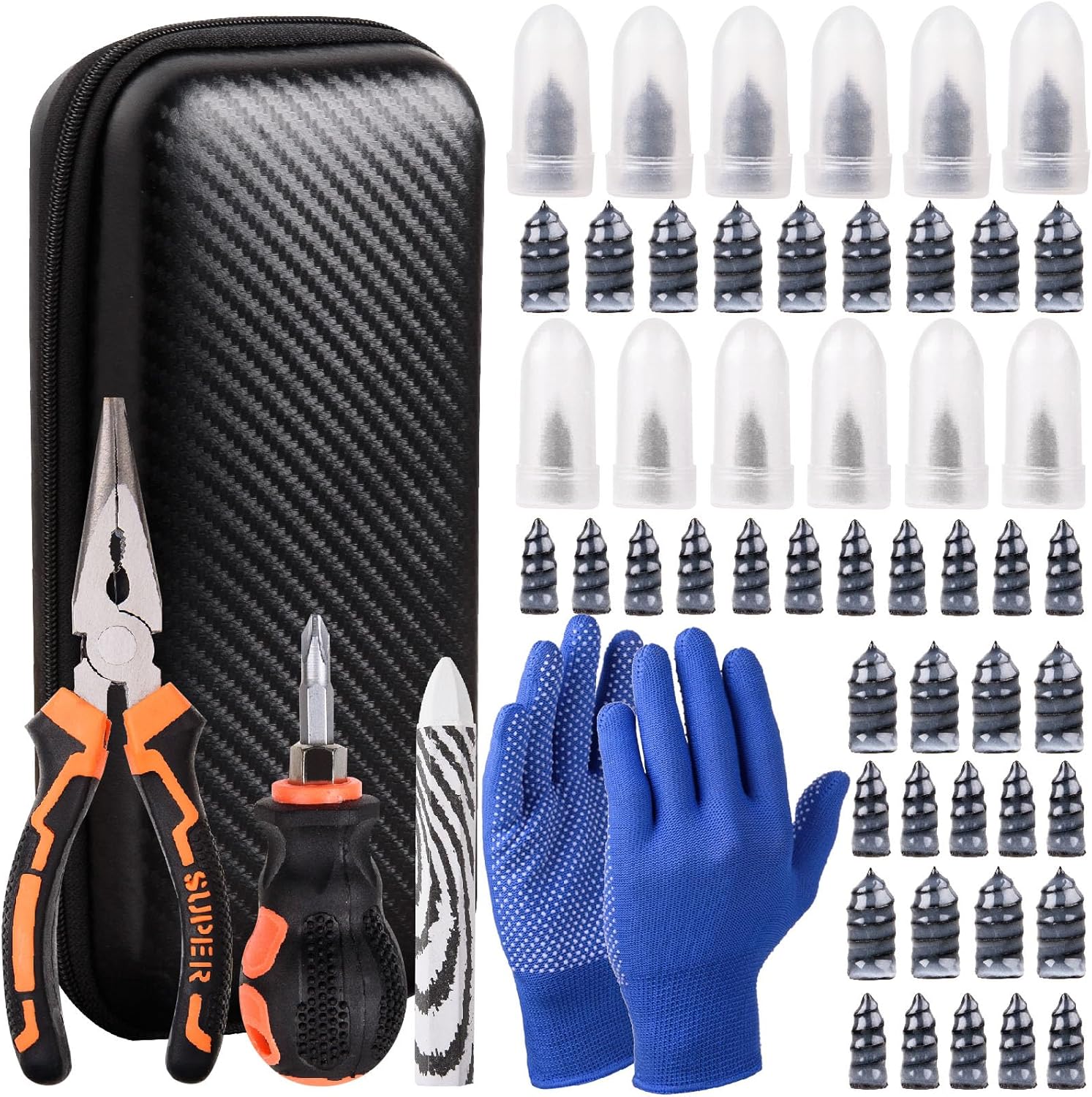
This tire sidewall puncture repair kit fixes flats fast without removing the tire, helping you get back on the road in minutes. It includes self-tapping repair nails, essential tools, gloves, and a portable storage bag for convenient roadside use. Designed for tubeless tires, it helps create a tight, leak-resistant seal for cars, motorcycles, trucks, SUVs, and ATVs.

AUTOWN’s 68-piece tire repair kit helps you fix punctures and plug flats quickly and effectively. It includes a T-handle and spiral probe tool for easy insertion, while the steel patch and plug materials are designed for strong adhesion and long-lasting airtight performance. The compact case makes it convenient for roadside repairs across a wide range of vehicles.

Vigorder rubber cement glue delivers superior adhesion and cures quickly within about 30 seconds for seamless rubber bonding. Once cured, it helps provide a strong, durable, waterproof seal that holds up to vehicle weight, pressure, and heat. Suitable for cars, motorcycles, trucks, bicycles, and off-road tires, it’s designed for emergency patch and maintenance repairs.
Why Sidewall Damage Means Replace It
A sidewall repair cannot restore damaged cords or casing strength. Even when a plug appears to hold air, the sidewall continues flexing under load and heat. That can allow hidden damage to grow and can lead to rapid air loss or tire failure.
[Products Worth Considering]

This AUTOWN flat tire repair kit is designed for quick, reliable puncture repairs using a plug kit and spiral probe tool to simplify installation. Built for durability and safe handling, it offers strong adhesion and flexibility to help maintain tire air tightness. With a portable storage case and a multi-vehicle approach, it’s suitable for cars, motorcycles, ATVs, tractors, lawn mowers, RVs, jeeps, and trucks.

TP-M13W combination repair unit kit includes wrapped stems with matching patches for fast, reliable tire repairs. It’s suitable for both radial and bias ply tires and is designed for chemical or heat vulcanization. Gray vulcanizing gum with blue backing helps create a strong bond, with the stem portion wrapped for added effectiveness.

Wykodra tire plugs provide quick vulcanizing repairs for tubeless tires, helping you seal punctures and get back on the road. The industrial-strength rubber creates a long-lasting, leak-resistant bond and is designed for emergency fixes without removing the tire. Choose between two standard plug sizes with color-matched options for small to larger damage across many vehicles and off-road uses.
Sidewall Repair Risks
- The sidewall is a high-flex, load-carrying part of the tire.
- Cuts and punctures can damage cords beneath the rubber.
- Bulges indicate internal structural damage, not a simple air leak.
- A surface patch or plug cannot rebuild the original casing.
Tread Versus Sidewall Damage
A small puncture in the repairable tread area may qualify for a professional combination repair. A puncture in the shoulder or sidewall does not. If you cannot clearly tell which area is damaged, do not guess from the outside; have the tire removed and inspected.
Replace, Don’t Patch
Replace the tire when damage reaches the sidewall or shoulder, exceeds the repairable size, overlaps an earlier repair, exposes cords, creates a bulge, or has caused internal damage from being driven flat. The technician should also follow any stricter tire-maker rule for your model.
When a Tire Cannot Be Repaired
A tire should be taken out of service when any of these conditions apply:
- The puncture is larger than 1/4 inch (6 mm).
- The injury is in or extends into the shoulder, belt edge, or sidewall.
- The new repair would overlap an existing repair.
- An earlier repair was improper and the tire no longer qualifies under industry procedures.
- The tire was driven flat and internal inspection shows heat, abrasion, liner, cord, or casing damage.
- There is a bulge, separation, exposed cord, deep cut, bead damage, or wheel damage.
- The tread is worn to the treadwear indicators or the tire is otherwise unserviceable.
- The tire manufacturer prohibits the repair because of its construction, speed rating, run-flat design, foam liner, sealant system, or warranty policy.
Michelin’s current repair guidance likewise limits repairable damage to small tread punctures and warns that on-wheel plug-only repairs are not reliable.
[Products Worth Considering]

The AUTOWN tire repair kit is designed to quickly fix punctures and plug flats with professional-quality steel components. It includes a T-handle and spiral probe tool for easy tire access, plus a compact storage case for convenient carry. Suitable for many vehicles including cars, motorcycles, ATVs, RVs, trailers, and trucks, it helps restore airtight performance for reliable roadside repairs.

This ETENWOLF tire plug repair kit helps you quickly fix punctures for reliable rides. It includes two plug sizes to match different damage widths, plus essential tools and lubricant for a smoother repair process. Designed for tubeless tires, it’s a convenient on-the-go solution for cars, motorcycles, ATVs, trucks, jeeps, and tractors.

ATQYZLM’s screw-in tire plug kit provides quick self-service emergency puncture repair for tubeless tires without removing the tire. Choose a suitable plug nail, align it to the puncture, and tighten with the included screwdriver for minute-level roadside use. The rubber and metal plugs help form a durable airtight seal to reduce air loss and water seepage for reliable short-term travel.
Safety Checks Before You Drive Away
After any emergency inflation or plug attempt, make a careful check before moving the vehicle. These checks do not turn a temporary plug into a permanent repair, but they can help you recognize when the tire must not be driven.
| Check | What to Confirm |
| Leak test | No hissing, bubbling, or continuing pressure loss. |
| Tire shape | No bulge, split, exposed cord, severe cut, or bead distortion. |
| Pressure | Matches the vehicle placard when measured according to the owner’s manual. |
| Repair location | The injury appears confined to the tread and away from the shoulder and sidewall. |
| Kit limits | You can follow every stated speed, distance, load, and vehicle restriction. |
The National Highway Traffic Safety Administration advises using the vehicle manufacturer’s recommended pressure from the door placard or owner’s manual and inspecting tires for cuts, punctures, bulges, cracks, and other damage.
Frequently Asked Questions
How many plugs can I put in one tire?
There is no universal number that makes a tire safe. Each puncture must be inspected and must meet size, location, overlap, internal-condition, and manufacturer-policy limits. An outside-in plug alone is not a permanent repair.
What is the three-tire-repair rule?
There is no general U.S. industry rule requiring replacement after exactly three puncture repairs. Some tire manufacturers set their own repair-count or spacing limits, so the tire’s service policy must be checked.
Can two separate punctures in one tire be repaired?
Sometimes. Both injuries must be small, entirely inside the repairable tread area, non-overlapping, and acceptable under the tire manufacturer’s policy. The tire must be removed and inspected before either repair is approved.
Can I put two plugs in the same hole?
No. Do not stack plugs to fill an oversized or irregular injury. If one emergency plug will not seal the hole as the kit directs, use the spare or roadside service and have the tire professionally inspected.
How far apart must tire repairs be?
There is no universal half-inch spacing rule for every tire. Repairs cannot overlap, and some manufacturers require greater separation or limit the total number of repairs. A technician must apply the policy for that specific tire.
Can a sidewall puncture be plugged or patched?
No. Sidewall and shoulder injuries are outside the standard repairable area and require tire replacement.
How long can I drive on an emergency tire plug?
Only as allowed by the repair kit’s instructions and only long enough to obtain professional service. Do not assume a plug-only repair is safe for normal or highway use.
Conclusion
A tire does not become safe or unsafe at a magic number of plugs. What matters is whether every puncture is small, fully inside the repairable tread area, separate from earlier repairs, and free of hidden internal damage. Treat an outside-in plug as an emergency measure. For a lasting repair, have the tire removed, inspected, and repaired with a stem-and-patch combination—or replace it when any repair limit is exceeded.
Sources
- U.S. Tire Manufacturers Association — Puncture Repair Procedures — repairable area, 1/4-inch maximum injury size, off-wheel inspection, non-overlapping repairs, and combined stem-and-patch method.
- U.S. Tire Manufacturers Association — Tire Repair Basics — why plug-only repairs are unacceptable and why the inner liner must be sealed.
- Michelin — Damage That Requires Repair — manufacturer guidance on tread punctures, sidewall damage, and plug-only repairs.
- NHTSA — Tire Safety and Inflation Guidance — vehicle-placard pressure and routine damage checks.