
Low-profile tires can make your Toyota Camry feel sharper and more responsive, but they usually do not make the ride more comfortable. Their shorter sidewalls flex less than taller sidewalls, so more vibration and impact can reach the cabin on broken pavement. The best choice depends on your Camry’s factory specifications, local roads, climate, and whether you value comfort or handling more.
Quick Answer
Low-profile tires are generally less comfortable on a Toyota Camry because their shorter sidewalls absorb less impact from bumps and potholes. They can provide quicker steering response and a sportier look, but comfort, noise, grip, and tread life still depend heavily on the specific tire model, pressure, construction, and road conditions.
Key Takeaways
- A shorter sidewall usually improves steering response but transmits more road impact into the cabin.
- Confirm the correct tire size, load index, speed rating, and cold pressure on your driver-door placard.
- Low profile does not automatically mean better braking, poor tread life, or high performance.
- Do not change from a 45-series tire to a 55-series tire without checking overall diameter, wheel size, clearance, and vehicle compatibility.
- Inspect the tire and wheel after a hard pothole impact, even when the tire does not immediately lose air.
Last reviewed: July 17, 2026. Fitment guidance applies generally to U.S.-market Camry models, but your vehicle’s tire placard remains the final reference.
The Impact of Low-Profile Tires on Ride Comfort
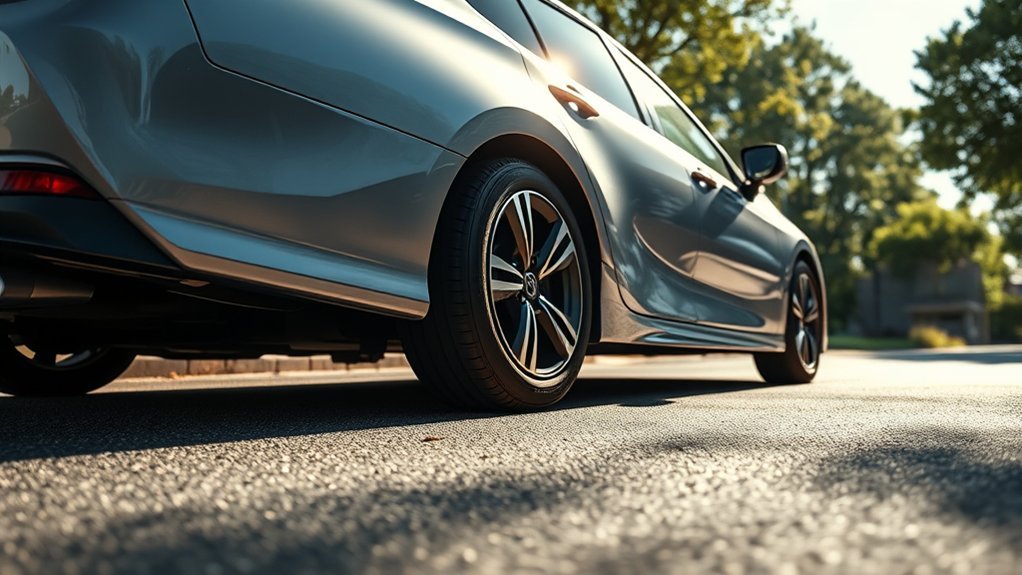
A low-profile tire has a relatively short sidewall compared with its width. On a tire marked 235/45R18, the number 45 means the sidewall height is 45% of the tire’s nominal 235 mm section width. That works out to approximately 106 mm before normal manufacturing and loading variations.
The shorter sidewall has less room to flex over sharp road edges. As a result, expansion joints, broken pavement, potholes, and raised manhole covers may feel more noticeable than they would with a compatible taller-sidewall setup.
A 2019 Toyota Camry XLE is commonly listed with 235/45R18 tires in the U.S. market. However, you should confirm the size on the driver-door placard or through the Toyota owner’s manual portal. Model year, trim, market, option package, and previous modifications can change the correct specification.
Why the Ride May Feel Firmer
Your tire acts as part of the Camry’s suspension system. A taller sidewall can deform around small bumps, while a shorter sidewall generally passes more of that impact to the wheel and suspension.
Sidewall height is not the only factor. Ride comfort also depends on:
- Tire construction: Touring tires often emphasize comfort and noise control, while performance tires may use stiffer structures.
- Cold inflation pressure: Excessive or insufficient pressure can change ride quality, handling, wear, and impact resistance.
- Tread design: Aggressive blocks and grooves may create more road noise than a comfort-oriented pattern.
- Wheel weight: A heavy wheel-and-tire package can make the suspension less effective over repeated bumps.
- Road quality: Smooth highways may hide the comfort difference, while damaged city roads make it obvious.
- Suspension condition: Worn shocks, struts, bushings, or mounts can make any tire feel harsh or unsettled.
Pro Tip: Check pressure when the tires are cold and inflate them to the pressure on the vehicle placard, not the maximum pressure molded into the tire sidewall. NHTSA recommends checking all tires at least once a month and before long trips.
Benefits of Low-Profile Tires for Performance
Low-profile tires can suit Camry drivers who prefer a more direct steering feel. Their shorter sidewalls typically flex less during steering and cornering, which can make the car respond more quickly to your inputs.
Improved Handling Response
Reduced sidewall movement can make turn-in feel more immediate and help the tire maintain a more consistent shape during cornering. Many low-profile fitments are also paired with wider wheels and performance-oriented tire designs, which can further change steering response and grip.
However, the profile alone does not guarantee shorter braking distances or greater traction. Braking and cornering performance depend on the specific tire’s compound, tread design, temperature range, inflation, wear, and the road surface. A high-quality touring tire may outperform a low-quality performance tire in rain or cold conditions.
Sporty Aesthetic Appeal
A shorter sidewall exposes more of the wheel, creating the sporty appearance many drivers want. Toyota also uses larger wheel-and-tire packages on several sport-oriented or higher-trim Camry models.
The visual upgrade comes with a trade-off. More wheel and less sidewall normally leave less rubber between a pothole and the rim, increasing the importance of correct pressure and careful inspection after an impact.
What Are the Downsides of Low-Profile Tires?
The main disadvantages involve comfort, impact protection, cost, and road-noise potential. The severity depends on the tire model and where you drive.
- Firmer impacts: Sharp bumps may feel stronger because the sidewall has less room to flex.
- Greater wheel-damage exposure: A deep pothole can pinch the tire or bend, crack, or scrape the wheel.
- Possible sidewall damage: Bulges, cuts, or internal cord damage can appear after a hard impact.
- More noticeable noise: Some performance-focused tread patterns and stiff casings produce more cabin noise.
- Higher replacement cost: Larger wheel sizes and performance-oriented tires can cost more than basic touring sizes.
- Reduced winter suitability: A wide or summer-focused tire may perform poorly in snow or freezing temperatures, regardless of its profile.
Low-profile tires do not have a universal 25,000-to-30,000-mile lifespan. Tire wear depends on the compound, treadwear design, wheel alignment, inflation, rotation, road surface, vehicle load, and driving habits. Check the tire manufacturer’s warranty and specifications for the exact model you are considering.
Warning: Do not install a different aspect ratio or wheel diameter based only on appearance. An incorrect overall diameter or service rating can affect wheel-well clearance, speedometer accuracy, braking-system behavior, traction control, stability control, and safe load capacity.
Comparing Low-Profile vs. Standard Tires
| Factor | Lower-Profile Tire | Taller-Profile Tire |
|---|---|---|
| Steering feel | Usually quicker and more direct | Usually softer and less immediate |
| Ride comfort | Firmer over sharp bumps | More sidewall cushioning |
| Pothole protection | Less space between road and rim | More rubber available to absorb impact |
| Appearance | Sportier, with more visible wheel | More traditional sedan appearance |
| Road noise | May be higher with stiff or aggressive designs | Often quieter when paired with a touring design |
| Braking and grip | Depends on the specific tire, not profile alone | Also depends on compound, tread, condition, and weather |
| Best suited for | Drivers prioritizing response and appearance | Drivers prioritizing comfort and rough-road tolerance |
You should compare complete tires rather than relying only on aspect ratio. A comfort-focused 45-series touring tire may ride better than a stiff 50-series performance tire. Tire construction and intended use matter as much as the numbers on the sidewall.
[Products Worth Considering]

The Ziopetru adjustable magnetic wheel alignment tool helps you check and restore camber and caster positioning after removing and reinstalling undercarriage components. With a clear leveling/bubble measurement system and an easy zeroing adjustment knob, it supports precise horizontal angle checking. The strong magnetic base mounts to metal surfaces for convenient use at home on cars, motorcycles, trucks, vans, and SUVs.

Monitor tire tread wear with a smart, color-coded depth gauge that shows clear condition ranges at a glance. The bar is range marked for fast, easy readings, helping you maintain safer traction and performance. Each gauge is portable with a pocket clip, and the set includes 20 units for daily use and sharing.

Measure tire tread depth quickly and accurately with this LUMITECO dial gauge that reads in 1/32" increments up to 14/32". The color-coded green/yellow/red zones make it easy to judge tire wear and know when replacement is needed. A rugged, compact design with a protective pouch helps keep the gauge ready for use on cars, trucks, motorcycles, and more.
Understanding Low-Profile Tires on Your Camry

A tire code such as 235/45R18 94V contains more information than sidewall height:
- 235: Nominal section width in millimeters.
- 45: Sidewall height as a percentage of the nominal width.
- R: Radial tire construction.
- 18: Wheel diameter in inches.
- 94: Load index.
- V: Speed rating.
The load index and speed rating are part of the tire’s service description. Replacement tires should meet the vehicle manufacturer’s required load capacity and speed specification.
An H-rated tire is not automatically a long-lasting tire, just as a V-rated tire is not automatically short-lived. These letters describe speed capability under defined conditions. Tread life must be evaluated separately through the tire model’s warranty, treadwear design, owner feedback, and independent testing.
The best Camry tire is not necessarily the one with the lowest profile. It is the tire that matches the vehicle’s specifications and your real driving conditions.
How to Pick the Right Low-Profile Tire for Your Camry
[Products Worth Considering]

This professional wheel and rim cleaning brush set lifts brake dust, grime, and dirt with soft, scratch-free microfiber and synthetic wool fibers. The rim brush bends up to 360 degrees for easy access to hard-to-reach areas around spokes, lips, and faces. Ideal for thorough cleaning of car, truck, motorcycle, bicycle, RV, and more wheel and tire surfaces.

This universal wheel alignment tool helps you accurately restore tire tilt angles after tire or suspension repairs using an adjustable camber gauge. It features a powerful magnetic base that firmly attaches to brake rotors for stationary, slip-free readings, improving consistency during measurement. Built from durable PC plastic, it resists wear and corrosion and is compact enough for car, truck, RV, and motorcycle alignment tasks.

These universal tire valve stem caps help protect valve cores from dust, debris, and moisture while helping maintain stable tire pressure. The corrosion-resistant metal construction and sealed design provide reliable protection in road grime, mud, and winter conditions. Twist-on installation makes them quick to fit on cars, SUVs, trucks, and motorcycles.
1. Confirm Your Factory Specification
Check the Tire and Loading Information label on the driver-door jamb. It identifies the original tire size and recommended cold inflation pressure for your vehicle. You can also check the owner’s manual and the specifications molded into the current tires.
Do not assume every Toyota Camry uses 235/45R18 tires. Camry tire sizes vary by trim, model year, market, powertrain, and wheel package.
2. Match the Load and Speed Ratings
Choose a replacement with a load index that meets or exceeds the required specification. The speed rating should also match or exceed the original requirement unless your owner’s manual and tire professional approve a specific exception, such as certain winter-tire applications.
Installing a higher load or speed rating does not increase the Camry’s legal payload or maximum safe vehicle speed. Those limits remain controlled by the vehicle manufacturer’s specifications.
3. Choose a Tire Category That Matches Your Priorities
- Grand-touring all-season: Usually a strong choice for comfort, low noise, wet traction, and everyday mileage.
- Performance all-season: Often provides more responsive handling while retaining moderate cold-weather capability.
- Summer performance: Designed for warm-weather grip and response, but unsuitable for freezing conditions.
- Winter tire: Uses a cold-weather compound and winter-focused tread for snow, ice, and low temperatures.
A product such as the Michelin CrossClimate 2 may appear in the correct 18-inch size, but you must still verify the exact load index, speed rating, availability, and fitment for your Camry before purchase. A model name alone does not confirm compatibility.
4. Do Not Change Only the Aspect Ratio
Changing from 235/45R18 to 235/55R18 is not a simple comfort upgrade. The calculated overall diameter rises from approximately 26.3 inches to 28.2 inches, an increase of about 7%. That change may create clearance problems and make the speedometer read lower than the vehicle’s actual speed.
If you want more sidewall cushioning, a properly engineered smaller-wheel package may be a better approach. The new tire must preserve an appropriate overall diameter while providing correct wheel width, offset, brake clearance, load rating, speed rating, and TPMS compatibility.
Note: Michelin advises that changing tire or wheel diameter can affect gearing, speedometer readings, braking, traction control, and stability-control systems. Have a qualified tire professional verify any non-factory package before installation.
5. Compare Real Performance Data
Look beyond star ratings. Compare wet braking, hydroplaning resistance, noise, winter capability, ride comfort, treadwear warranty, and tested handling. Customer reviews can reveal patterns, but they should not replace vehicle fitment information or controlled testing.
What Camry Drivers May Notice in Daily Use
Drivers switching from a taller-sidewall touring setup to a lower-profile package often notice quicker steering response and more impact harshness. The difference may be subtle on smooth roads and pronounced on cracked pavement or sharp potholes.
Back-seat passengers may notice vertical movement more because they sit closer to the rear axle, but the result varies with the road, suspension condition, vehicle load, seat design, tire pressure, and tire construction.
When comparing an old tire with a new one, remember that tread depth and age also affect the result. A worn, hardened tire may feel noisy or harsh even when it has a taller profile. A new comfort-oriented low-profile tire may therefore feel better than the worn tire it replaces.
If a new tire package creates unexpected vibration, pulling, steering-wheel shake, or humming, do not assume the low-profile design is the only cause. Incorrect balancing, wheel runout, a bent rim, alignment problems, uneven lug torque, or tire defects may be responsible.
Essential Maintenance Tips for Low-Profile Tires
Low-profile tires need the same basic care as other tires, but their reduced impact cushion makes pressure and damage inspections especially important.
| Maintenance Task | When to Do It | What to Check |
|---|---|---|
| Check cold pressure | At least monthly and before long trips | Use the driver-door placard pressure, not the tire’s maximum sidewall pressure. |
| Inspect tread and sidewalls | Monthly and after a hard impact | Look for cuts, cracks, bulges, exposed cords, punctures, and irregular wear. |
| Measure tread depth | Monthly and before severe-weather seasons | NHTSA says tires should be replaced when worn to 2/32 inch. Replace sooner when required by local law or the tire manufacturer. |
| Rotate the tires | Follow Toyota’s maintenance schedule and the tire manufacturer’s instructions | Confirm that the rotation pattern suits directional, staggered, or asymmetric fitments. |
| Check alignment | When the car pulls, the steering wheel sits off-center, or wear becomes uneven | Inspect toe, camber, suspension parts, and wheel condition. |
| Check wheel balance | When vibration appears at road speed | Check balance, wheel runout, bent rims, and tire uniformity. |
[Products Worth Considering]

This 3-piece wheel brush set makes it easy to clean wheels and tires with soft, scratch-free brushes designed for lifting brake dust and grime. The flexible rim brush bends up to 360 degrees to reach hard-to-access areas for a thorough clean, while the comfortable grip helps control during detailing. A dedicated detailing brush supports gentle cleaning for sensitive surfaces, including interior use.
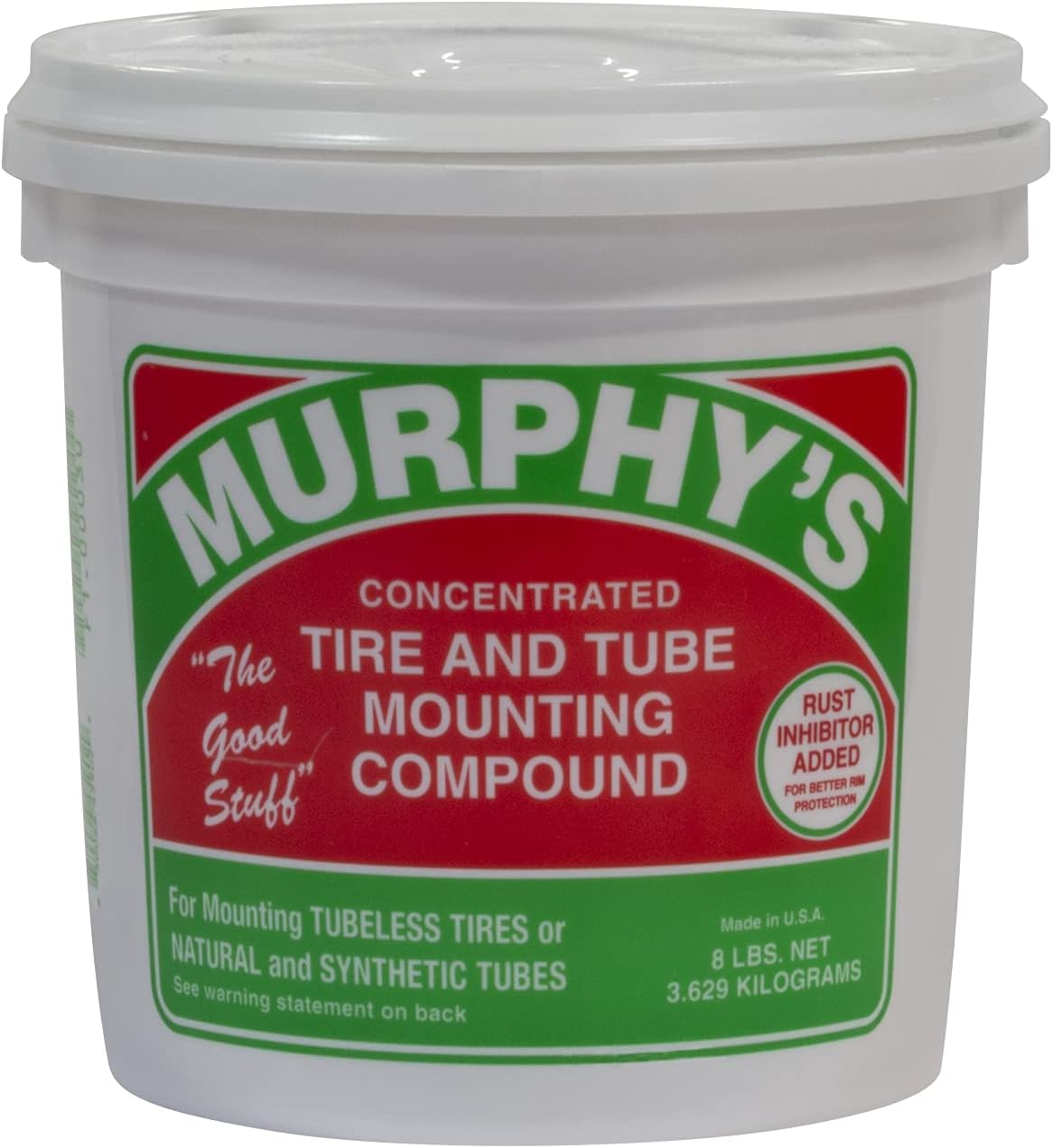
A concentrated tire and tube mounting compound designed to help simplify mounting rubber tires and tubes on passenger, semi truck, construction, and OTR applications. Its ultra-thick formula packs beads effectively and includes rust inhibitors to help protect against corrosion during use.

Adam’s Pro Tire Hex Grip applicators are molded foam sponges designed for precise, even tire dressing application. The ergonomic grip helps you spread product without overapplying, reducing sling that can splash onto paint and helping keep your hands clean during wheel and trim detailing. They’re durable, washable, and reusable for repeated detailing sessions.
What to Check After Hitting a Pothole
- Pull over safely if you feel vibration, hear repeated thumping, or see a pressure warning.
- Inspect the sidewall for a bulge, cut, split, scrape, or exposed material.
- Look at the inner and outer wheel edges for bending or cracking.
- Check the tire pressure with a gauge after the tire has cooled.
- Watch for continued pressure loss during the following days.
- Have the tire and wheel professionally inspected if the impact was severe or symptoms continue.
A sidewall bulge can indicate damaged internal cords. Do not continue normal driving on a tire with a bulge, exposed cords, a deep cut, or rapid air loss.
When to Replace the Tires
Replace a tire when it reaches its wear limit, develops non-repairable damage, cannot maintain pressure, or shows severe irregular wear. NHTSA also advises drivers to watch for changes in noise, vibration, and handling and to consult a tire professional when performance changes unexpectedly.
Age matters even when tread remains. Check the DOT Tire Identification Number on the sidewall to determine the manufacturing week and year, then follow the vehicle and tire manufacturers’ age-inspection and replacement guidance.
Frequently Asked Questions
Are low-profile tires more comfortable on a Toyota Camry?
Usually not. A shorter sidewall generally absorbs less impact than a taller compatible sidewall, so bumps and broken pavement may feel firmer. However, a comfort-oriented low-profile touring tire can ride better than a stiff or worn tire of another size.
Can I replace 235/45R18 tires with 235/55R18 tires?
You should not treat them as direct replacements. A 235/55R18 tire is approximately 7% larger in calculated diameter than a 235/45R18. That difference can affect clearance, speedometer accuracy, gearing, ABS, traction control, and stability control.
Can I switch from 18-inch wheels to 17-inch wheels for more comfort?
A correctly designed 17-inch wheel-and-tire package may provide more sidewall cushioning while maintaining a similar overall diameter. A professional must confirm brake clearance, wheel width, offset, load rating, speed rating, TPMS compatibility, and vehicle fitment before installation.
What tire pressure should I use with low-profile Camry tires?
Use the cold inflation pressure printed on the Tire and Loading Information label inside the driver-door area. Do not use the maximum pressure molded into the tire sidewall as your normal inflation target.
Do low-profile tires wear out faster?
Not automatically. Some low-profile tires use performance compounds that trade tread life for grip, but profile alone does not determine lifespan. Inflation, alignment, rotation, road conditions, tire construction, and driving style all affect wear.
Do low-profile tires improve Camry braking?
A specific performance tire may improve braking, but a lower aspect ratio alone does not guarantee a shorter stopping distance. Compound, tread design, temperature, surface conditions, pressure, and tread depth have major effects on braking performance.
Conclusion
Low-profile tires can give your Toyota Camry more immediate steering response and a sportier appearance, but you will usually feel more road impact than you would with a compatible taller-sidewall setup. The exact result depends on the complete tire design, not the aspect ratio alone.
Start with the driver-door placard, match the required size and service ratings, and choose a tire category that suits your roads and climate. When comfort is your priority, consider a comfort-focused touring tire or a professionally verified smaller-wheel package rather than installing a taller tire on the existing wheel without checking compatibility.
Sources
- Toyota 2019 Camry Manuals and Warranties — official model-specific manual and maintenance resources.
- Goodyear 2019 Toyota Camry XLE Tire Fitment — supports the listed 235/45R18 factory fitment.
- NHTSA TireWise — tire pressure, tread, damage inspection, size selection, and maintenance guidance.
- Michelin Tire Markings Explained — explains width, aspect ratio, wheel diameter, load index, and speed rating.
- Michelin Choosing the Right Tire Size — explains placard verification and the risks of changing tire dimensions.
- Michelin Performance Tire and Plus-Sizing Guidance — supports wheel-size, sidewall, overall-diameter, and vehicle-system guidance.