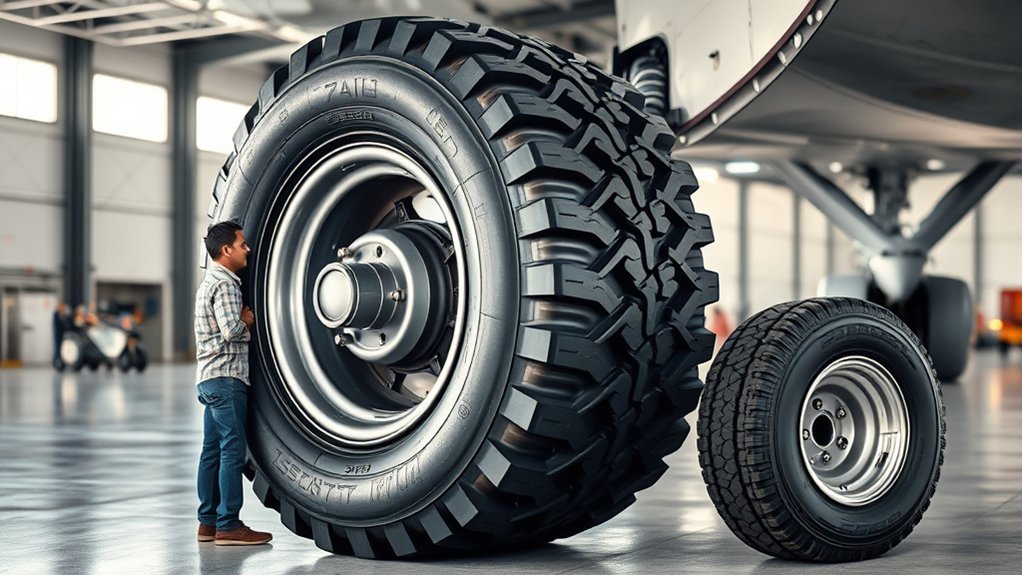
An airplane tire is much stronger than a car tire, but its size depends on the aircraft. A small general aviation tire may be under 20 inches tall, while a large jet main-gear tire can be around 4 to 5 feet tall. Airliner tires also run at very high pressure, often near 200 psi, and are inspected, changed, and retreaded under strict aviation maintenance rules.
Quick Answer
Airplane tires range from small 15 to 20 inch tires on light aircraft to main-gear tires around 50 inches or more on large jets. A commonly cited Boeing 737 tire example is 27 x 7.75 R15, while Airbus A380 main tires are about 1.4 m, or roughly 55 inches, in diameter.
Key Takeaways
- Airplane tire size varies by aircraft type, gear position, aircraft weight, and approved tire model.
- A tire size such as 27 x 7.75 R15 usually means outside diameter, tire width, and wheel rim diameter.
- Large airliners often use tire pressures near 200 psi, far higher than most passenger cars.
- Many transport-category aircraft tires are filled with dry nitrogen or another inert gas for safety.
- Aircraft tire tread usually uses straight circumferential grooves to move water and improve stability.
- Airplane tires are inspected often and may be retreaded several times if the casing passes inspection.
How Big Is an Airplane Tire?
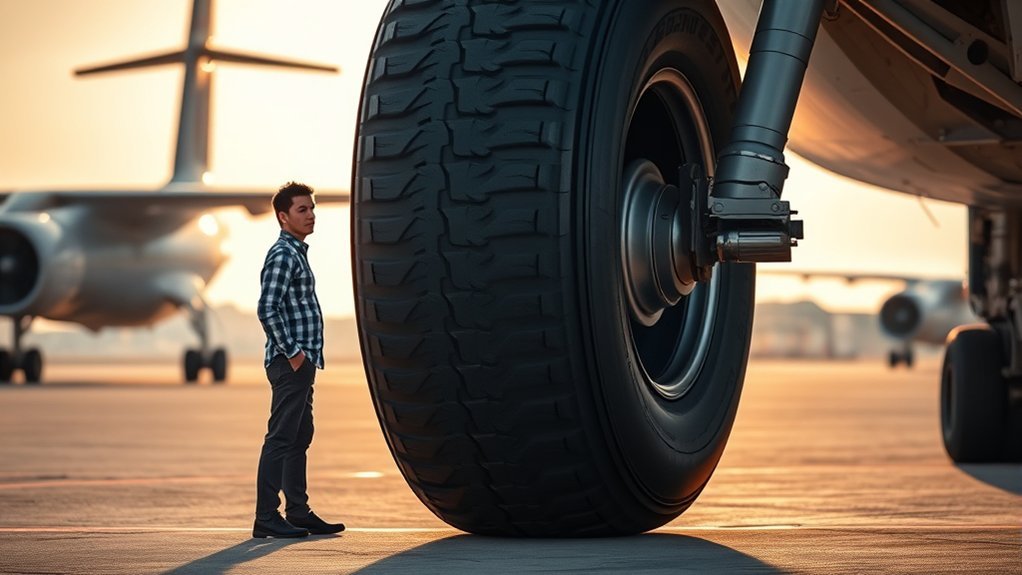
There is no single airplane tire size. A small training aircraft may use a tire marked 5.00-5 or 6.00-6, while an airline jet may use a tire that is several feet tall. Even on the same aircraft, the nose tires and main landing gear tires are not always the same size.
A common aircraft tire marking has three useful numbers. In a size such as 27 x 7.75 R15, the first number is the approximate outside diameter in inches, the second number is the tire width, and the last number is the rim diameter. The letter R means radial construction. Some aircraft tires use other formats, so the approved tire data plate, aircraft maintenance manual, or tire manufacturer data should always be the final source.
Note: A blog article can explain common sizes, but it cannot replace the aircraft maintenance manual. Exact tire size, pressure, speed rating, and service limits must come from approved aircraft documents.
Airplane Tire Size by Aircraft Type
Aircraft tire size increases with aircraft weight, landing speed, braking demand, and runway loading limits. Bigger aircraft also spread the load across more wheels. That is why a very large aircraft may not use only one huge tire. It may use many large tires across several landing gear assemblies.
| Aircraft Type | Typical Tire Size Range | What It Means |
|---|---|---|
| Light general aviation aircraft | Often around 15 to 20 inches tall | Used on small trainers, private aircraft, and light utility aircraft. |
| Regional jets and business jets | Often around 22 to 35 inches tall | Higher speeds and heavier loads require stronger casings and higher pressure. |
| Boeing 737 class | A commonly cited example is 27 x 7.75 R15 | Exact tire size depends on model, gear position, and approved equipment. |
| Boeing 747 and 777 class | Often roughly 4 feet or more for main tires | Widebody aircraft use many main-gear tires to spread the load safely. |
| Airbus A380 | About 1.4 m, or roughly 55 inches, for main gear tires | The A380 uses 22 wheels, which helps distribute its weight across the runway. |
For exact aircraft planning data, operators use official aircraft-characteristics documents such as Boeing airport planning resources and Airbus aircraft information.
[Products Worth Considering]

The SAFELIFE dial tire tread depth gauge measures tread depth in 1/32 inch increments with clear, easy-to-read 2-inch dial face. Color zones using a traffic light system help you quickly judge whether tread is low, marginal, or ample for safer driving. Built with a durable zinc cast body and a metal detect probe for precise, comfortable use across cars, motorcycles, trucks, and buses.

Monitor tire tread wear with a smart, color-coded depth gauge that shows clear condition ranges at a glance. The bar is range marked for fast, easy readings, helping you maintain safer traction and performance. Each gauge is portable with a pocket clip, and the set includes 20 units for daily use and sharing.

Measure tire tread depth quickly and accurately with this LUMITECO dial gauge that reads in 1/32" increments up to 14/32". The color-coded green/yellow/red zones make it easy to judge tire wear and know when replacement is needed. A rugged, compact design with a protective pouch helps keep the gauge ready for use on cars, trucks, motorcycles, and more.
Why Airplane Tires Are So Strong
Airplane tires are built to handle heavy loads for short, intense periods. During landing, they must go from not spinning to runway speed almost instantly. During takeoff, they carry a heavy aircraft while accelerating at high speed. That job requires high pressure, strong casing materials, controlled heat behavior, and careful maintenance.
High-Pressure Construction
Many airliner tires are inflated near 200 psi, though the exact pressure depends on aircraft type, tire model, load, and maintenance requirements. That pressure gives the tire enough stiffness to carry the aircraft without excessive flexing. Too little pressure can create heat, casing stress, shoulder wear, and a higher failure risk.
Aircraft tires must also meet demanding certification and testing rules. Federal aircraft tire requirements are covered in 14 CFR § 25.733, and tire manufacturers perform additional tests for overload, speed, and pressure resistance.
A modern airliner tire is not strong because it is thick like a truck tire. It is strong because the pressure, casing cords, bead area, tread, and wheel assembly all work as one controlled system.
Reinforced Landing Design
Under the tread, aircraft tires use strong reinforcing plies made from materials such as nylon or aramid. These cords help the tire hold its shape under load, resist deformation, and survive high-speed spin-up at touchdown. The bead area also has to lock firmly against the wheel so the tire can carry load without slipping or separating.
The wheel assembly may include safety features such as fusible plugs. If braking heat becomes extreme, these plugs can release pressure in a controlled way instead of allowing a dangerous pressure buildup.
Warning: Aircraft tire pressure is a safety-critical maintenance item. Never use general online pressure numbers to service an aircraft tire. Use only the approved aircraft maintenance manual, tire data, and certified maintenance procedures.
How Much an Airplane Tire Weighs
An airplane tire can weigh anywhere from a few dozen pounds on a small aircraft to well over 200 pounds on a large jet. The number depends on tire size, radial or bias construction, load rating, and whether you are weighing only the tire or the full wheel-and-tire assembly.
This distinction matters. The tire alone is lighter than the complete wheel, brake, and tire assembly. On large jets, the complete wheel assembly can be extremely heavy because it includes the tire, wheel halves, bearings, brake-related hardware, pressure sensors, and other components.
Aircraft Tire Pressure and Inflation
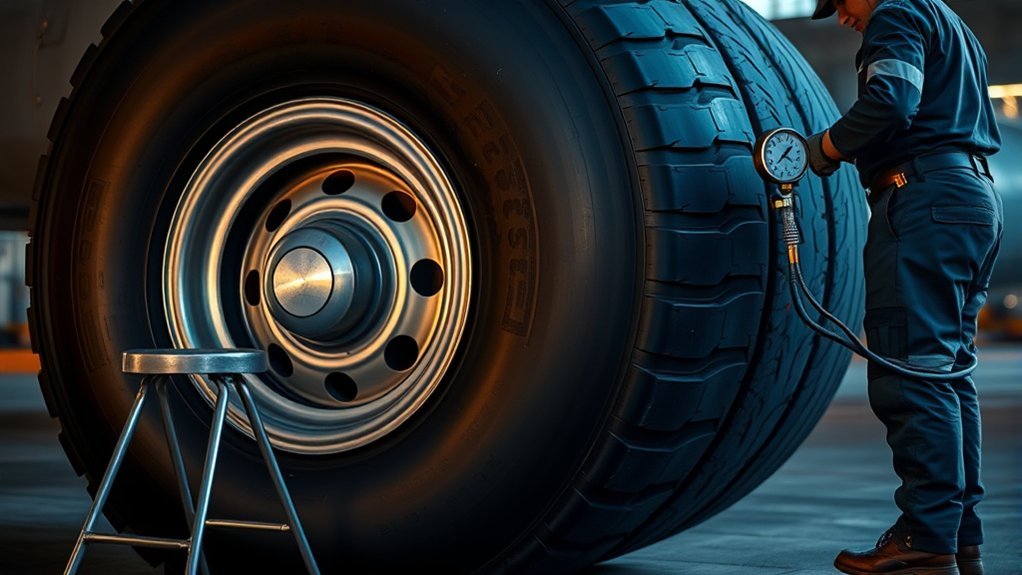
Aircraft tire pressure is far higher than car tire pressure. A car tire may run around 30 to 40 psi, while many airliner tires run near 200 psi. Some aircraft use even higher pressure, depending on load, tire size, and runway requirements.
Many transport-category aircraft tires are filled with dry nitrogen or another inert gas instead of ordinary compressed air. Nitrogen helps reduce moisture, pressure variation, and fire risk around overheated brakes. It also helps avoid a dangerous oxygen-rich mixture inside a hot tire.
- High pressure supports weight: It helps the tire carry heavy loads without excess flex.
- Dry nitrogen improves safety: It reduces moisture and lowers the risk of internal combustion under extreme heat.
- Pressure checks are frequent: Underinflation can create heat, stress, and premature tire removal.
[Products Worth Considering]

Accurately measure tire tread depth with a calibrated gauge marked from 0 to 1 inch in 1/32 inch increments. The color-coded bar helps you quickly identify tread condition ranges, supporting safe driving for trucks, motorcycles, automobiles, and passenger vehicles.

Steelman white tire marking crayons provide high-contrast, semi-permanent marks for repairing and inspecting tires and equipment. They write on wet or dry, smooth or coarse surfaces including rubber, metal, glass, and wood, making them ideal for puncture location and damage outlining. The lead- and zinc-free crayons resist weather and fading yet wipe away when you no longer need the marks.

Get precise tire readings with the ETENWOLF T300 Plus digital gauge, calibrated to ANSI B40.7 Grade 2A for reliable accuracy. It measures across a wide 3–200 PSI range and includes thermal compensation for dependable performance from extreme cold to heat. The bright LED display, LED illumination, and replaceable AAA batteries make it easy to check pressures quickly, even in low light.
Airplane Tire Tread Patterns
Airplane tire tread usually looks simpler than car tire tread. Instead of many blocks and sipes, aircraft tires often use straight circumferential ribs and grooves. This design helps the tire roll smoothly, resist tread chunking, and move water away from the contact patch.
Rib Tread Designs
Rib tread designs help with directional stability during takeoff, landing, and taxi. Straight ribs also wear more evenly under high-speed runway contact. For aircraft, the goal is not aggressive cornering like a car tire. The goal is stable rolling, strong braking support, and predictable behavior on wet pavement.
- Center rib tread: Helps maintain directional stability and even wear.
- Rib deflector tread: Uses rib shapes to help move water and improve wet-runway behavior.
- Grooved tread: Helps reduce hydroplaning risk by giving water a path away from the tire contact area.
Water-Channeling Grooves
Water-channeling grooves are important during wet landings. When a tire meets a wet runway at high speed, water must move out from under the tire quickly. The grooves help preserve contact between rubber and runway, which supports braking and directional control.
How Airplane Tires Handle Landings
At touchdown, aircraft tires are not yet spinning at runway speed. For a brief moment, the tire skids and then spins up to match the aircraft’s ground speed. That is why you often see a puff of smoke when a jet lands. Most visible tire wear happens during this spin-up moment.
Large aircraft also have redundancy. For example, a Boeing 777 has six tires on each of its two main landing gear assemblies. That layout helps distribute load and gives the aircraft more safety margin if a tire is damaged.
Pro Tip: When comparing aircraft tires, compare the same position. A nose tire, main tire, and full wheel assembly can have very different sizes and weights on the same aircraft.
Aircraft Tire Maintenance and Retreading
Aircraft tire maintenance is strict because tire condition affects takeoff, landing, taxiing, braking, and runway safety. Technicians inspect tire pressure, tread depth, cuts, exposed cord, sidewall damage, flat spots, bead condition, and signs of overheating.
| Check | Why It Matters | Common Action |
|---|---|---|
| Pressure check | Underinflation creates heat and casing stress. | Adjust only to approved maintenance data. |
| Tread inspection | Worn tread reduces water evacuation and service margin. | Remove when wear limits are reached. |
| Cut and cord check | Cuts can expose reinforcing cords or weaken the casing. | Remove any tire outside approved limits. |
| Retread review | A sound casing can often receive a new tread. | Retread only after approved inspection and processing. |
Many aircraft tire casings can be retreaded several times if they pass inspection. Retreading is not a shortcut. It is a controlled aviation process that removes the worn tread, inspects the casing, and applies a new tread under approved conditions.
[Products Worth Considering]

The Big Rig Defense Tire Thumper is a truck tire pressure checker that lets you quickly check multiple tires by giving them a firm whack. Listen for a reassuring thump and feel the stick bounce when a tire is fully inflated, helping you get back on the road safely. It features a comfortable, glove-friendly handle and a secure wrist strap for confident use on busy routes.

AZUNO’s digital tire inflator delivers stable, accurate pressure readings with a bright LCD and a 0.1 resolution display for confident inflation. It supports one-handed operation for inflating and quick deflating, and it’s built with rugged steel and brass components for reliable shop or garage use. With multi-unit pressure display and compatibility across cars, SUVs, motorcycles, and trucks, it’s a convenient accessory for everyday tire maintenance.

The Tymate TM2 RV tire pressure monitoring system keeps you informed with a color LCD display, automatic backlight, and solar charging for dependable operation. It supports up to 10 tire positions with four pre-paired sensors, while offering multiple alarm modes for fast leak detection, pressure extremes, temperature alerts, and low-signal warnings. Built-in monitoring uses accurate readings and reliable 433.92MHz communication to help protect your RV, trailer, truck, or SUV.
Frequently Asked Questions
What size are airplane tires?
Airplane tires can range from under 20 inches tall on small aircraft to about 50 inches or more on large jet main landing gear. A size such as 27 x 7.75 R15 means the tire is about 27 inches tall, 7.75 inches wide, and fits a 15 inch wheel rim.
Why do not most planes fly much above 40,000 feet?
That question is not mainly about tires. Most passenger jets cruise below or near 40,000 feet because engine efficiency, cabin pressurization, aircraft weight, air traffic rules, and emergency oxygen margins all matter. Some aircraft can fly higher, but routine airline cruising is chosen for safety and efficiency.
How big are the tires on a Boeing 777?
A Boeing 777 uses large widebody main landing gear tires, with six tires on each of its two main gear assemblies. The exact tire size depends on the 777 variant, tire maker, and approved wheel position, so the aircraft maintenance manual or Boeing planning data should be used for exact numbers.
How big is a Boeing 747 airplane tire?
A Boeing 747 main landing gear tire is much larger than a 27 inch small-aircraft or narrowbody example. Exact tire size varies by 747 model and approved tire fitment, but the aircraft uses multiple main landing gear tires to spread load and improve redundancy.
Why are airplane tires filled with nitrogen?
Many transport aircraft tires use dry nitrogen because it contains little moisture and does not support combustion the way oxygen-rich air can. This matters near hot brakes, where tire and wheel temperatures can rise sharply after heavy braking.
How often are airplane tires replaced?
Replacement depends on aircraft type, runway conditions, braking, tire position, tread wear, cuts, pressure history, and maintenance limits. Some airliner tires last hundreds of landings before removal, and suitable casings may be retreaded several times.
Conclusion
Airplane tires may look simple from a terminal window, but they are highly engineered parts. Their size ranges from small general aviation tires to widebody main-gear tires several feet tall. Their strength comes from high pressure, reinforced casing materials, ribbed tread, nitrogen inflation, strict inspection, and controlled retreading. For general understanding, size ranges are useful. For maintenance, only approved aircraft and tire manufacturer data should be used.
Sources
- eCFR, 14 CFR § 25.733 — federal aircraft tire certification requirements.
- Boeing Airport Compatibility — aircraft characteristics and airport planning resources.
- Airbus A380 aircraft information — A380 aircraft context and official manufacturer information.
- Associated Press, United Airlines Boeing 777 tire-loss report — 777 main landing gear tire redundancy context.
- Wired interview with Michelin Aircraft Tires engineer — airliner tire pressure, retreading, spin-up, and durability context.