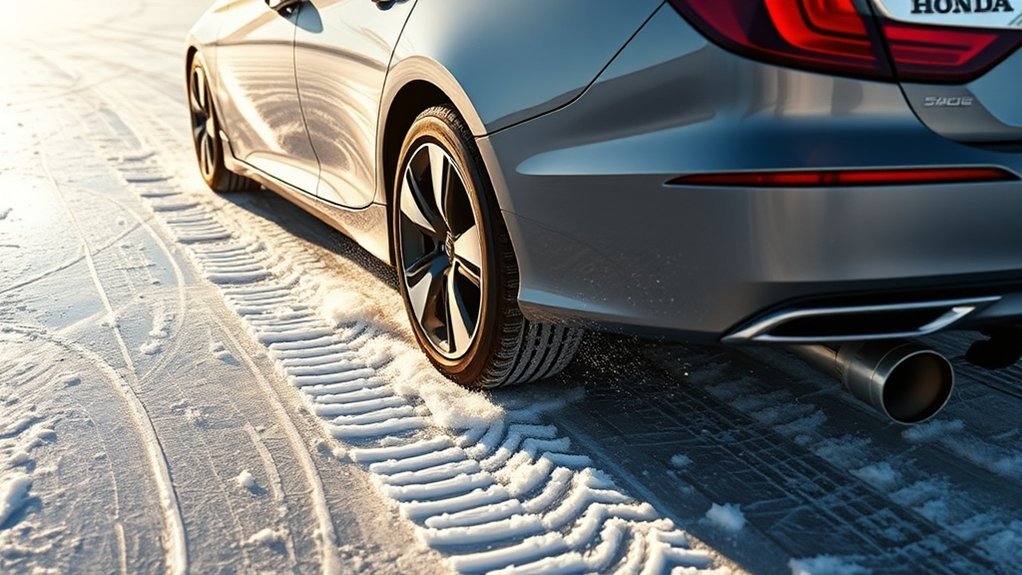
Winter tires can make a Honda Accord much more predictable on icy, snowy, and slushy roads, but they are not magic. The real benefit comes from using the right tire size, installing a matching set of four, keeping the tires properly inflated, and driving more slowly than you would on dry pavement.
Quick Answer
Winter tires help a Honda Accord on ice because their cold-weather rubber, deeper tread blocks, and small biting edges stay more flexible and grip better than regular all-season tires in freezing conditions. For best control, use a matching set of four tires in the correct Accord size and load rating.
Key Takeaways
- Winter tires improve traction, braking feel, and steering control in cold, icy, snowy, and slushy conditions.
- Choose tires with the three-peak mountain snowflake symbol if you need true severe-snow performance.
- Always match your Accord’s tire size, load range, speed rating, and cold tire pressure to the door-jamb label or owner’s manual.
- Install winter tires on all four wheels. Mixing winter tires with all-season tires can make the car less stable.
- Winter tires still need slow speeds, longer following distance, and gentle steering, braking, and throttle inputs.
At a Glance
| Time Required | About 30–60 minutes at a tire shop; longer if wheels need TPMS service or balancing corrections. |
| Difficulty | Easy if a shop mounts them; moderate if you swap a pre-mounted wheel-and-tire set at home. |
| Tools Needed | Tire pressure gauge, tread-depth gauge, torque wrench if swapping wheels, and the tire size from your driver-door label. |
| Cost | Varies by tire size, brand, wheel package, mounting, balancing, valves, and TPMS service. |
How Winter Tires Enhance Honda Accord Performance on Ice
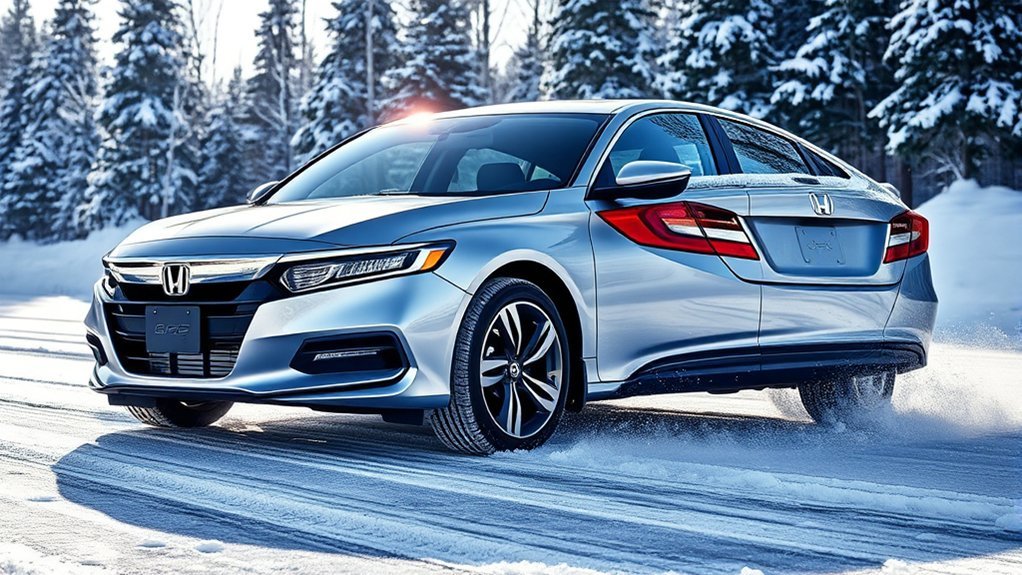
Winter tires help your Honda Accord because they are built for the exact conditions where regular all-season tires start to struggle: low temperatures, packed snow, slush, and polished ice. Their rubber compound stays more flexible in the cold, so the tread can conform to the road instead of becoming stiff and slippery.
The tread also matters. Winter tires use deeper grooves and many small cuts, called sipes, to create biting edges. These edges help the tire grip uneven snow and ice while the grooves move slush away from the contact patch.
That does not mean you can drive normally on ice. Even with good winter tires, your Accord needs more stopping distance than it would on dry pavement. The advantage is that the car feels more controlled, responds more predictably, and gives the ABS and stability systems a better tire contact patch to work with.
Warning: Winter tires reduce risk, but they do not eliminate black ice, poor visibility, or excessive speed. Slow down, increase following distance, and make gentle steering and braking inputs.
Winter Tires vs. All-Season Tires: Key Differences Explained
All-season tires are a compromise. They are designed to work across many conditions, including dry pavement, rain, mild cold, and light snow. Winter tires are more specialized. They are made for cold pavement, snow, slush, and ice.
- Rubber compound: Winter tires stay flexible in cold weather, while many all-season and summer tires lose elasticity as temperatures drop.
- Tread depth: Winter tires usually have deeper grooves to move snow and slush out from under the tire.
- Siping: Small cuts in the tread blocks create extra biting edges on snow and ice.
- Severe-snow rating: Tires with the three-peak mountain snowflake symbol meet a snow-traction performance requirement for severe snow conditions.
- Driving feel: On ice, winter tires usually feel less nervous and more predictable than standard all-season tires.
Transport Canada notes that at temperatures below 7°C, all-season and summer tires begin to lose elasticity, while winter tires keep their elasticity and grip at much lower temperatures. Learn more from Transport Canada’s winter tire guidance.
For a Honda Accord, the safest setup is a matching set of four winter tires. Honda’s owner guidance also says winter tires should be selected in the same size and load range as the original tires and mounted to all four wheels. See Honda’s Accord winter tire guidance.
[Products Worth Considering]

These universal tire valve stem caps help protect valve cores from dust, debris, and moisture while helping maintain stable tire pressure. The corrosion-resistant metal construction and sealed design provide reliable protection in road grime, mud, and winter conditions. Twist-on installation makes them quick to fit on cars, SUVs, trucks, and motorcycles.

Keep your tires properly inflated with this analog VONDIOR tire pressure gauge, designed for fast, easy readings without batteries. The swiveling, two-axis hose and large glow dial help you measure at any tire angle with instant visibility. Built with a protective rubber shield, it supports durable, low-maintenance use for cars and trucks.

The Kurgo Seasonal Tire Tote helps protect your car interior, clothes, and garage from tire grime, brake dust, and residue during seasonal tire changes. Its universal design fits most passenger tires between 22" and 31" in diameter, making storage and transport simpler with less mess. Built for rugged, repeated use, it’s machine washable for easy care and comes with a lifetime warranty.
Understanding the Importance of Tread Design for Winter Tires
Tread design is one of the biggest reasons winter tires work better on icy roads. A good winter tread does three jobs at once: it creates biting edges, clears slush, and keeps more rubber in useful contact with the road.
On packed snow, the small edges in the tread grab into the surface. On wet slush, the wider grooves help channel water and snow away. On ice, the tire still has limited grip, but the softer compound and siping help the tire hold on longer before it slides.
Look for the 3PMSF symbol, which stands for three-peak mountain snowflake. This symbol means the tire meets a defined snow-traction performance requirement. It is a stronger winter signal than an M+S marking alone.
Note: A 3PMSF tire is tested for snow traction, not for every type of ice. Glare ice and black ice still require very slow speed and extra stopping distance.
Cold Weather’s Impact on Winter Tire Grip
Cold weather changes how tires behave. Rubber that feels fine in mild weather can harden when temperatures drop. Once a tire stiffens, it cannot flex into the small rough areas of ice and pavement as well, so grip falls.
Winter tires are made with rubber compounds designed to stay pliable in the cold. That flexibility helps the tread blocks keep working, especially during braking and turning.
Tire Rubber Flexibility
Flexible rubber is important because the contact patch is small. Each tire only touches the road through a patch of rubber roughly the size of your hand. In winter, that small contact patch must deal with water, ice, packed snow, and road salt.
When the rubber stays flexible, the tread can press into the surface more effectively. When it hardens, the tire is more likely to slide across the surface instead of gripping it.
Tread Design Advantages
Winter tires use tread blocks, grooves, and sipes differently than touring all-season tires. The goal is not just comfort or long tread life. The goal is cold-weather traction.
- Wide grooves help move slush and loose snow.
- Zig-zag sipes add biting edges for packed snow and ice.
- Open shoulder patterns can help the tire dig through deeper snow.
- Directional patterns may improve slush evacuation, depending on the tire model.
Temperature Effects on Grip
A useful rule is to start thinking about winter tires when temperatures regularly fall near 45°F or 7°C. That does not mean every driver needs winter tires on one cold morning, but it does mean all-season tire performance can start to drop as winter weather becomes consistent.
If your area gets regular snow, freezing rain, mountain passes, lake-effect storms, or shaded icy roads, winter tires are usually the safer choice for an Accord than standard all-seasons.
Expectations for Your Honda Accord in Winter
The Honda Accord is a front-wheel-drive sedan, and front-wheel drive can help with straight-line traction because the engine and drivetrain weight sit over the front tires. That helps the car get moving, but it does not replace winter tires, all-wheel drive, or careful driving.
Modern Accords also include systems such as ABS, traction control, and Vehicle Stability Assist. These systems can help manage wheel slip, but they cannot create traction that the tires do not have. Better tires give those systems more grip to work with.
Be careful with claims about “Snow Mode.” Current U.S.-market 2026 Accord trims list Econ/Normal drive modes on LX and SE, while hybrid trims list Econ/Normal/Sport/Individual. Honda does not list a dedicated Snow mode for those trims. You can verify the current drive-mode and tire-size details on Honda’s official Accord specifications page.
In winter, expect longer warm-up times, reduced fuel economy, slower tire-pressure response, and more cautious braking. If the road looks shiny, shaded, or wet near freezing, treat it like ice.
Key Features of Winter Tires for Improved Safety
When shopping for Honda Accord winter tires, focus on features that actually help in cold weather:
- Correct size and rating: Match the tire size, load range, and speed rating shown on your Accord’s door-jamb tire label or owner’s manual.
- 3PMSF marking: Choose the three-peak mountain snowflake symbol if you drive in real snow and ice.
- Good winter tread depth: Do not wait until winter tires are nearly bald. Transport Canada warns against using tires worn close to 4 mm, or 5/32 inch, on snow-covered roads.
- Full set of four: A matching set helps the Accord brake, turn, and recover from slips more evenly.
- Cold-weather compound: Choose a tire designed specifically for winter, not just an all-season tire with an aggressive-looking pattern.
The best winter tire for your Accord is not the most aggressive-looking tire. It is the tire that matches your exact size, load rating, climate, road type, and winter-driving needs.
[Products Worth Considering]

Milton S-921 pencil tire pressure gauge helps you maintain optimal tire pressure for passenger cars with accurate readings in PSI and kPa. It features a built-in deflator valve for convenient pressure adjustments, plus a single chuck head and nylon indicator bar for easy use on the go. Built from durable plated brass and designed for reliable performance, it’s a practical road trip and cold-weather maintenance tool.

The Trivd Frol 1/2" air impact wrench delivers high performance torque up to 1500 ft-lbs with a twin hammer impact mechanism for strong, balanced blows. It features an ergonomic grip, compact lightweight design, and quick-stop control with 3 forward speeds up to 8000 RPM plus a reverse speed. Built for demanding automotive repair and tire shop work, the rear exhaust helps keep debris away from the surface.

The 22800 wheel stud installer makes replacing wheel studs quick and secure, saving time and effort during tire service. It uses a ratchet or impact wrench to pull new studs firmly into place, helping when existing studs are too long. Compatible with most automotive wheels and light-duty truck wheel studs, it’s designed for easy, tool-assisted installation.
How to Choose the Right Winter Tire for Your Accord
Choosing the right winter tire starts with fitment. Do not guess based on trim names or online charts alone. Check the tire information label on the driver’s door edge or door post. That label is the final authority for your vehicle’s original tire size and recommended cold inflation pressure.
For current U.S. 2026 Accord trims, Honda lists examples such as 225/50R17 94V and 235/40R19 96V, depending on trim. Your own Accord may differ by model year, trim, market, or wheel package, so verify before buying.
[Products Worth Considering]

Monitor tire tread wear with a smart, color-coded depth gauge that shows clear condition ranges at a glance. The bar is range marked for fast, easy readings, helping you maintain safer traction and performance. Each gauge is portable with a pocket clip, and the set includes 20 units for daily use and sharing.

Vigorder rubber cement glue delivers superior adhesion and cures quickly within about 30 seconds for seamless rubber bonding. Once cured, it helps provide a strong, durable, waterproof seal that holds up to vehicle weight, pressure, and heat. Suitable for cars, motorcycles, trucks, bicycles, and off-road tires, it’s designed for emergency patch and maintenance repairs.

This AstroAI 2-pack pencil tire pressure gauge delivers accurate tire readings across common vehicle types, with a precision nozzle that seals on valve stems for reliable results. It measures PSI, kPa, and BAR within a 10–75 PSI range, includes an integrated deflator valve, and features an ABS indicator bar for easier pressure checks. A compact, pocket-friendly design and battery-free operation make it ideal for road trips and everyday maintenance.
Tire Types Comparison
Not every winter-looking tire is the same. Use this quick comparison before you buy:
| Tire Type | Best For | Accord Notes |
|---|---|---|
| Studless ice and snow | Frequent ice, packed snow, freezing rain | Usually the best choice for harsh winter commuting. |
| Performance winter | Cold dry roads with occasional snow | Good for drivers who want sharper handling, but may trade away some deep-snow grip. |
| Studded winter | Severe ice where studs are legal | Can be noisy and restricted by local laws. Check your state or province rules first. |
| All-weather 3PMSF | Milder winters and drivers who do not want seasonal swaps | Better winter rating than standard all-season tires, but not always equal to dedicated winter tires on ice. |
Size and Fitment Considerations
When you compare winter tires, match more than the numbers on the sidewall. You also need the correct load index, speed rating, wheel diameter, and clearance.
- Check the door-jamb tire label: Confirm size and cold PSI before ordering.
- Match the load rating: Do not choose a tire with a lower load capacity than Honda specifies.
- Use the same size on all four wheels: This supports proper ABS, traction control, and stability-system operation.
- Ask before downsizing wheels: Some Accord owners use a winter wheel package, but brake clearance and correct overall diameter must be verified.
- Buy four tires together: Mixed tread patterns or different wear levels can make the car less stable in slippery conditions.
Pro Tip: If you plan to keep the Accord for several winters, ask your tire shop about a dedicated winter wheel-and-tire set. It can make seasonal swaps faster and reduce wear from repeated mounting and dismounting.
Installing Winter Tires and Driving on Ice
Install winter tires before the first major storm, not after the roads are already icy. A good timing rule is to install them when temperatures are consistently cold and winter precipitation is likely.
After installation, check the cold tire pressure, then recheck it after the next major temperature drop. NHTSA explains that tire pressure should be checked cold, meaning the vehicle has not been driven for at least three hours, and it should be set to the vehicle manufacturer’s recommended pressure, not the maximum pressure printed on the tire sidewall. See NHTSA TireWise for tire pressure and maintenance guidance.
When driving your Accord on ice:
- Accelerate gently to avoid front-wheel spin.
- Brake earlier than usual and apply steady pressure if ABS activates.
- Look far ahead so you can slow down gradually.
- Avoid sudden lane changes, hard steering, and late braking.
- Leave extra space behind snowplows and large trucks.
- Postpone non-essential travel when roads are not cleared.
NHTSA’s winter-driving guidance also recommends inspecting tires monthly, checking tread and sidewalls for damage, and preparing the vehicle before winter weather. Review the full guidance at NHTSA Winter Weather Driving Tips.
Warning: If you use tire chains or cables on an Accord, follow Honda’s owner manual and the chain manufacturer’s instructions. Honda specifies front-tire installation for chains on the Accord and warns that the wrong chains or poor installation can damage the vehicle and cause a crash.
Caring for Your Winter Tires in the Cold
- Check pressure cold: Cold weather lowers tire pressure. Use the PSI on the driver-door label or owner’s manual.
- Inspect monthly: Look for cuts, cracks, punctures, bulges, uneven wear, and embedded objects.
- Measure tread depth: For snow-covered roads, do not wait until the legal minimum. Replace or retire winter tires before their winter grip is gone.
- Rotate as recommended: NHTSA notes that rotation can reduce irregular wear and, when recommended by the manufacturer, is often done every 5,000 to 8,000 miles.
- Clean packed snow: Snow and ice buildup in wheels can cause vibration and imbalance.
- Store properly: Keep off-season tires in a cool, dry place away from direct sunlight, ozone sources, and petroleum products.
- Remove them in warm weather: Winter tires wear faster and handle less precisely when used through warm months.
If your Accord starts vibrating after a snowstorm, check for ice packed inside the wheels before assuming the tires are defective. If the vibration remains after the wheels are clean, have the tires and wheels inspected.
The Benefits of Upgrading to Winter Tires for Your Honda Accord
Upgrading to winter tires is one of the most useful winter safety changes you can make to a Honda Accord. The car’s front-wheel-drive layout, ABS, traction control, and stability systems all work better when the tires have enough grip to respond.
| Benefit | What It Means for Accord Drivers |
|---|---|
| Better cold-weather grip | More flexible rubber helps the tire stay usable in freezing temperatures. |
| More predictable braking | The Accord can feel more controlled when slowing on snow and ice. |
| Improved steering response | The front tires are less likely to wash wide when turning gently on slippery roads. |
| Better stability-system support | ABS and Vehicle Stability Assist have more tire grip to work with. |
Frequently Asked Questions
Does Honda Snow Mode work on ice?
Most current U.S.-market Honda Accord trims do not list a dedicated Snow mode. Current Accord drive modes are Econ/Normal on LX and SE, and Econ/Normal/Sport/Individual on hybrid trims. On ice, winter tires, slow speed, smooth inputs, ABS, and Vehicle Stability Assist matter more than a drive-mode label.
Are Honda Accords good in snow and ice?
A Honda Accord can handle moderate winter driving well when it has the right tires and the driver is cautious. Front-wheel drive helps the car get moving, but it does not shorten stopping distance by itself. Winter tires, proper pressure, good tread depth, and slower driving make the biggest difference.
Do winter tires make a big difference on ice?
Yes. Winter tires can make the car feel more stable and predictable on ice because they use cold-weather rubber and tread designs made for slippery surfaces. The improvement depends on the tire model, temperature, road surface, speed, and tread depth, so you still need to drive carefully.
What size winter tires does a Honda Accord need?
It depends on model year, trim, market, and wheel package. Current U.S. 2026 Accord examples include 225/50R17 94V and 235/40R19 96V, but you should always use the tire size and cold pressure listed on your driver-door tire label or owner’s manual.
Can I put only two winter tires on my Accord?
No, that is not recommended. Honda says winter tires should be mounted to all four wheels, and Transport Canada also recommends installing winter tires in sets of four to maintain control and stability. Mixing tire types can make the car less predictable in a skid.
When should I replace winter tires?
Replace winter tires when tread is too low for snow, when there is cracking or damage, or when the tires have aged out. NHTSA notes that some vehicle manufacturers recommend replacing tires every six years regardless of use, and Transport Canada warns not to use tires worn close to 4 mm, or 5/32 inch, on snow-covered roads.
Conclusion
Winter tires are one of the most practical upgrades for a Honda Accord that regularly sees ice, snow, slush, or freezing rain. They improve cold-weather grip, make braking and steering more predictable, and help the car’s safety systems work with a better contact patch.
The key is choosing the right tire, not just any tire labeled “snow.” Confirm your Accord’s size on the door-jamb label, choose a proper winter or 3PMSF-rated tire for your climate, install a matching set of four, check pressure cold, and replace tires before winter tread depth becomes too low. With the right setup and careful driving, your Accord will be much better prepared for winter roads.
Sources
- Honda Accord Owner’s Manual: Winter Tires — backs up matching tire size/load range, installing winter tires on all four wheels, and tire-chain guidance.
- Honda Accord Owner’s Manual: Tire and Wheel Replacement — backs up using the correct tire size, load range, speed rating, and cold pressure rating.
- Honda 2026 Accord Sedan Specifications — backs up current Accord drive modes and example current tire sizes.
- Transport Canada: Using Winter Tires — backs up 3PMSF, cold-temperature elasticity, four-tire installation, and 5/32-inch winter tread guidance.
- NHTSA TireWise — backs up tire pressure, tire-size label, rotation, and tire maintenance guidance.
- NHTSA Winter Weather Driving Tips — backs up winter tire inspections, cold tire pressure, vehicle preparation, and safe winter-driving advice.