
All-season tires are a practical choice for many Honda Accord drivers because they balance comfort, tread life, wet-road grip, and light-snow capability in one set of tires. The right choice depends on your Accord’s model year, trim, factory tire size, local weather, and how you drive. Start with the tire size and cold PSI on your driver-door placard, then compare tires by traction, comfort, warranty, and winter needs.
Quick Answer
For most Honda Accord owners, the best all-season tire is one that matches the factory size, meets or exceeds the original load index and speed rating, and fits your climate. Choose a comfort touring tire for quiet daily driving, a grand touring all-season for balanced performance, or a 3PMSF-rated all-weather tire if you regularly see light snow.
Key Takeaways
- Always confirm your exact tire size on the driver-door Tire and Loading Information Label before buying.
- Many current Accord trims use either 225/50 R17 or 235/40 R19, but model year and trim matter.
- Standard all-season tires are good for mild year-round use, but winter tires are still best for heavy snow, ice, and sustained freezing weather.
- Replace tires at 2/32 inch tread at the latest, and inspect sooner if wet traction drops, cracking appears, or vibration develops.
- Check tire pressure cold at least monthly; the correct PSI is the vehicle placard value, not the maximum number printed on the tire sidewall.
Key Benefits of All-Season Tires for the Honda Accord

For a daily-driven Honda Accord, all-season tires offer a strong mix of ride comfort, predictable handling, and year-round convenience. They are designed for dry pavement, rain, and light winter conditions, which makes them a sensible choice for commuters who do not want to swap between summer and winter tires.
The biggest advantages are:
- Convenience: You can use one set of tires through most of the year in mild and moderate climates.
- Ride comfort: Touring and grand touring all-season tires usually ride more quietly than aggressive performance tires.
- Wet-road control: Good all-season tread patterns include grooves and siping that help move water away from the contact patch.
- Tread life: Many all-season replacement tires carry mileage warranties, though actual life depends on alignment, pressure, rotation, road surface, and driving style.
- Fuel economy support: Properly inflated tires and lower rolling resistance designs can help preserve fuel efficiency.
Warning: “All-season” does not mean “safe in every winter condition.” If you drive on packed snow, ice, mountain roads, or in long freezing winters, use dedicated winter tires or a severe-snow-rated all-weather tire with the three-peak mountain snowflake symbol.
Understanding All-Season Tires: What You Need to Know
All-season tires are built to balance several jobs instead of specializing in one. That balance is why they work well on a Honda Accord used for commuting, errands, highway driving, and occasional wet or chilly weather.
Here is how the main tire categories compare:
| Tire Type | Best For | Main Limitation |
| Touring all-season | Quiet ride, long tread life, daily commuting | Not ideal for aggressive driving or severe snow |
| Grand touring all-season | Balanced comfort, handling, wet traction, and highway stability | Usually costs more than basic touring tires |
| Performance all-season | Sportier steering response and grip | May ride firmer and wear faster |
| All-weather / 3PMSF | Drivers who want one tire with better light-snow capability | May be louder or less smooth than comfort touring tires |
| Winter tire | Snow, ice, and cold-weather braking | Not meant for year-round warm-weather use |
| Summer tire | Warm-weather dry and wet performance | Not suitable for freezing temperatures, snow, or ice |
That last point matters because some sporty tires are easy to mistake for all-season tires. For example, the Kumho Ecsta PS31 is commonly sold as an ultra-high-performance summer tire, so it should not be chosen if your goal is true year-round all-season use.
How to Choose the Right All-Season Tire Size
The safest way to choose a tire size is to check the Tire and Loading Information Label on the driver-side doorjamb. That label lists the original tire size and recommended cold inflation pressure for your specific Accord. The owner’s manual is the next best source.
For the 2026 U.S. Honda Accord lineup, Honda lists these factory tire sizes:
| 2026 Accord Trim | Factory Tire Size | Best Match |
| LX | 225/50 R17 | Comfort or grand touring all-season |
| EX-L Hybrid | 225/50 R17 | Quiet, efficient touring all-season |
| SE | 235/40 R19 | Grand touring or performance all-season |
| Sport Hybrid | 235/40 R19 | Responsive all-season with strong wet grip |
| Sport-L Hybrid | 235/40 R19 | Grand touring or performance all-season |
| Touring Hybrid | 235/40 R19 | Premium grand touring all-season |
Note: Older Accord model years and non-U.S. models may use different sizes. Never buy tires from a generic chart alone. Verify the door-jamb placard, wheel size, load index, and speed rating before ordering.
[Products Worth Considering]

Measure tire tread depth quickly and accurately with this LUMITECO dial gauge that reads in 1/32" increments up to 14/32". The color-coded green/yellow/red zones make it easy to judge tire wear and know when replacement is needed. A rugged, compact design with a protective pouch helps keep the gauge ready for use on cars, trucks, motorcycles, and more.

Keep your tires properly inflated with this analog VONDIOR tire pressure gauge, designed for fast, easy readings without batteries. The swiveling, two-axis hose and large glow dial help you measure at any tire angle with instant visibility. Built with a protective rubber shield, it supports durable, low-maintenance use for cars and trucks.

Monitor tire tread wear with a smart, color-coded depth gauge that shows clear condition ranges at a glance. The bar is range marked for fast, easy readings, helping you maintain safer traction and performance. Each gauge is portable with a pocket clip, and the set includes 20 units for daily use and sharing.
Understand Tire Specifications
A size like 225/50R17 is not random. Each part tells you how the tire fits and performs:
- 225: tire width in millimeters.
- 50: aspect ratio, meaning the sidewall height is 50% of the tire width.
- R: radial construction.
- 17: wheel diameter in inches.
- Load index: the weight the tire can carry. Match or exceed the original specification.
- Speed rating: the maximum speed category. Match or exceed the original specification unless a tire professional confirms otherwise.
Consider Driving Conditions
Your climate should guide the type of all-season tire you choose:
- Mostly highway driving: choose a quiet grand touring all-season tire.
- Rainy climate: prioritize wet braking, hydroplaning resistance, and a high traction rating.
- Light snow: consider an all-weather tire with 3PMSF certification.
- Sport trims with 19-inch wheels: choose a tire with strong steering response and good rim protection.
- Rough roads: a 17-inch tire setup usually gives more sidewall cushion than a 19-inch setup.
Comparative Review of Top All-Season Tires for the Honda Accord
The “best” tire depends on your priorities. Use this table as a practical starting point, then confirm availability in your exact Accord size.
| Tire | Best For | Why It Fits the Accord |
| Michelin Primacy MXM4 | Premium comfort and original-equipment-style ride | A refined grand touring all-season option for drivers who want quiet road manners. |
| Michelin CrossClimate2 | One-tire convenience with stronger winter capability | Michelin lists it as an all-season tire with 3PMSF certification and a 60,000-mile warranty. |
| BFGoodrich Advantage Control | Value-focused all-season commuting | BFGoodrich positions it as an all-season, all-purpose tire with smooth ride and tread-life focus. |
| Continental PureContact LS | Wet-road confidence and efficient touring | A luxury touring all-season style tire that suits Accord drivers who value comfort and rain performance. |
| Goodyear Assurance ComfortDrive | Quiet ride and daily comfort | A commuter-friendly all-season choice for drivers who want a smooth, relaxed ride. |
| Vredestein Quatrac | All-weather balance | A good direction for drivers who want stronger seasonal range than a basic all-season tire. |
Pro Tip: Before comparing prices, filter by your exact tire size first. A tire that performs well in 225/50R17 may not be sold in 235/40R19, and pricing can change sharply between sizes.
[Products Worth Considering]

The Continental Grand Prix 5000 is an allround road bike tire engineered for faster rolling, improved ride comfort, and enhanced puncture protection. It features a Vectran Breaker cut-protection layer, Lazer Grip micro-profile tread for confident cornering control, and Active Comfort Technology to damp vibration for smoother rides. BlackChili compound optimizes grip and speed for everyday performance and long-lasting confidence.

This professional wheel and rim brush kit makes it easy to lift brake dust, grime, and dirt from wheels and tires without scratching finishes. The brushes feature soft, metal-free wool heads and a flexible 360-degree rim brush design for reaching hard-to-clean areas. Includes multiple brush types plus accessories for thorough car, motorcycle, and general vehicle detailing.

The SAFELIFE dial tire tread depth gauge measures tread depth in 1/32 inch increments with clear, easy-to-read 2-inch dial face. Color zones using a traffic light system help you quickly judge whether tread is low, marginal, or ample for safer driving. Built with a durable zinc cast body and a metal detect probe for precise, comfortable use across cars, motorcycles, trucks, and buses.
Understanding Performance Ratings and UTQG Standards
The UTQG system, short for Uniform Tire Quality Grading, compares passenger-car tires in three areas: treadwear, traction, and temperature resistance. It is helpful, but it is not a complete ranking of every tire’s real-world performance.
UTQG Rating Breakdown
- Treadwear: A comparative number. Higher usually suggests longer wear, but compare within similar tire categories.
- Traction: A wet-stopping grade. AA is highest, followed by A, B, and C.
- Temperature: A tire’s ability to resist and dissipate heat. A is highest, followed by B and C.
A rating such as 600 A A can be attractive for a daily driver because it suggests strong treadwear, good wet traction, and strong heat resistance. Still, do not choose by UTQG alone. Ride comfort, road noise, snow performance, warranty, and verified size availability matter too.
Performance Tire Considerations
Performance all-season tires can make an Accord Sport or Touring feel sharper, especially with 19-inch wheels. The trade-off is that some performance-focused tires may ride firmer, create more road noise, or wear faster than comfort touring tires. If you mostly commute, a grand touring tire is usually the better fit. If you enjoy responsive steering and drive on curvy roads, a performance all-season may be worth the trade-off.
The Impact of All-Season Tires on Ride Quality
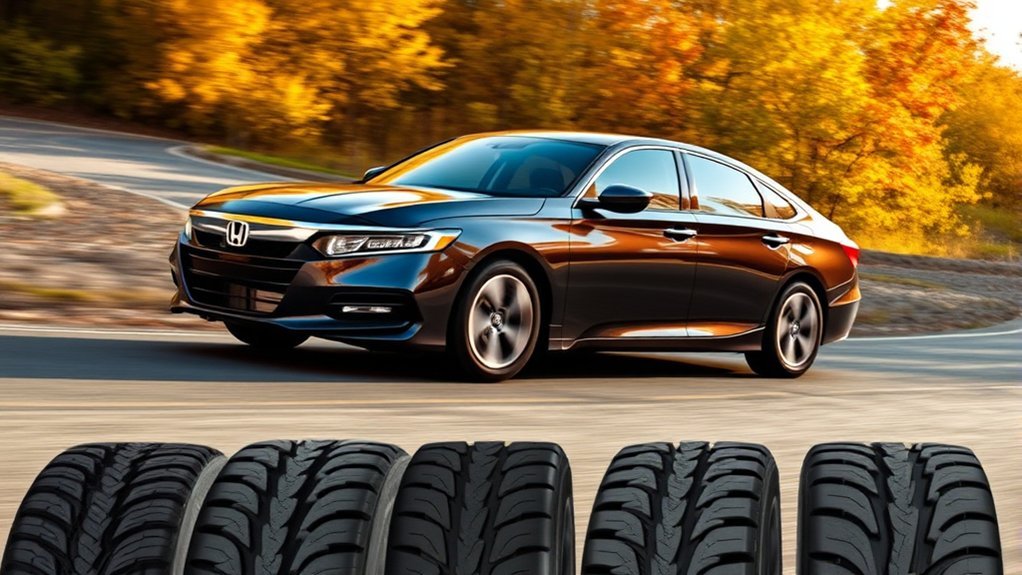
All-season tires can strongly affect how your Honda Accord feels from the driver’s seat. A comfort touring tire can make the cabin quieter and soften small road impacts. A performance all-season can improve steering response but may feel firmer over potholes and broken pavement.
Wheel size also matters. Accord trims with 17-inch wheels usually have more sidewall than trims with 19-inch wheels. More sidewall can improve bump absorption, while the 19-inch setup often feels sportier and more direct. If comfort is your top priority, choose a tire known for low noise and ride quality rather than chasing the sportiest rating.
The best Accord tire is not always the most expensive one. It is the tire that matches your factory size, climate, driving style, and safety needs.
How to Know When It’s Time to Replace Your Tires
Do not wait until your tires look bald. Tire performance can drop before the legal minimum, especially in rain. Use these checks:
- Tread depth: Replace tires when tread reaches 2/32 inch at the latest. For wet-weather confidence, start shopping earlier if tread is near 4/32 inch.
- Penny test: Place a penny into the tread with Lincoln’s head upside down. If you can see the top of Lincoln’s head, the tire is at the replacement point.
- Wear bars: Built-in treadwear indicators become flush with the tread when replacement is due.
- Age: Tires can age out even with tread remaining. Check the DOT date code and inspect older tires more carefully.
- Damage: Replace or inspect immediately if you see cracks, cuts, bulges, exposed cords, or repeated air loss.
- Driving feel: New vibration, thumping, pulling, or unusual noise can signal tire damage, imbalance, or alignment trouble.
Warning: A tire can be unsafe even if it still holds air. Bulges, exposed cords, sidewall cracking, and vibration after an impact should be checked by a tire professional before more driving.
Essential Tire Maintenance Tips for Longevity
Good maintenance helps your all-season tires last longer and keeps your Accord safer in rain, heat, and emergency braking.
Tire Pressure Monitoring
Check all four tires at least once a month when they are cold, meaning the car has been parked for several hours. Use the PSI on the driver-door placard or owner’s manual. Do not use the maximum PSI printed on the tire sidewall as your target pressure.
Your Accord’s TPMS is helpful, but it is not a replacement for a gauge. TPMS warnings usually appear only after pressure is already significantly low.
Regular Rotation Schedule
Follow the owner’s manual first. If your manual does not give a specific interval, a common rotation range is every 5,000 to 8,000 miles, or sooner if uneven wear appears. Tire rotation helps even out front-to-rear wear and can protect treadwear warranty coverage.
Tread Wear Inspection
Inspect tread monthly while checking pressure. Look for:
- More wear on one edge, which can point to alignment problems.
- Cupping or scalloping, which can point to worn suspension parts or imbalance.
- Center wear, which can come from overinflation.
- Both-edge wear, which can come from underinflation.
- Cracks, nails, glass, or sidewall bubbles.
Debunking Common Misconceptions About All-Season Tires
Myth: All-season tires are just as good as winter tires in snow.
Reality: All-season tires are a compromise. They can handle light winter conditions, but winter tires are designed for cold, snow, and ice.
Myth: The tire sidewall PSI is the pressure I should use.
Reality: The sidewall number is a maximum pressure, not your Accord’s recommended cold pressure. Use the door-jamb placard.
Myth: If tread looks okay, the tire is safe.
Reality: Age, cracking, punctures, bulges, and internal damage can make a tire unsafe even before it looks worn out.
Myth: Any tire in the right size will work.
Reality: You also need the correct load index, speed rating, tire type, and clearance.
Where to Buy All-Season Tires for Your Honda Accord
You can buy Accord all-season tires from tire retailers, Honda dealers, local tire shops, warehouse clubs, and online tire stores. The best retailer is the one that confirms fitment, offers clear installation pricing, provides road-hazard or mileage warranty details, and can handle rotation and balancing after the sale.
Before buying, compare:
- Out-the-door price: Include mounting, balancing, valve stems, TPMS service, disposal fees, and taxes.
- Warranty terms: Check mileage warranty, road-hazard coverage, and rotation requirements.
- Manufacture date: Ask for recent DOT date codes when possible.
- Installation quality: Choose a shop that torques lug nuts properly and checks TPMS.
- Return policy: Some premium brands and retailers offer short ride-trial periods.
[Products Worth Considering]

Accurately measure tire tread depth with a calibrated gauge marked from 0 to 1 inch in 1/32 inch increments. The color-coded bar helps you quickly identify tread condition ranges, supporting safe driving for trucks, motorcycles, automobiles, and passenger vehicles.

TIRESHIELD PRO RV tire covers in a set of four deliver year-round protection against UV rays, cracking, fading, water, and snow. The StormLock-System helps keep the covers securely fastened through high wind, while heavy-duty, double-stitched construction supports long-lasting performance. Designed for universal fit, they’re intended for RV, camper, truck, car, and trailer tires within the 26–28.75 inch diameter range, with easy wipe-clean care and storage in the included bag.

Measure tyre tread depth precisely with a digital gauge that reads in both MM and inches, helping you monitor safe driving conditions. The large LCD screen is easy to operate, and the compact tool fits for cars, trucks, and motorcycles. It provides high accuracy with a 0-25.4mm range and includes a 1-year warranty for added peace of mind.
Frequently Asked Questions
Does the Honda Accord come with all-season tires?
Many Honda Accord trims come with all-season tires from the factory, especially late-model U.S. Accords. For example, Honda lists 225/50 R17 all-season tires on some 17-inch-wheel trims and 235/40 R19 tires on several 19-inch-wheel trims. Always verify your exact vehicle’s door-jamb tire label.
What is the best all-season tire size for a Honda Accord?
The best size is the factory size listed on your Accord’s Tire and Loading Information Label. Many current models use 225/50 R17 or 235/40 R19, but the correct answer depends on model year, trim, wheel size, and market.
Are all-season tires enough for snow?
They can work in light snow, but they are not the best choice for heavy snow, ice, mountain passes, or long freezing winters. For those conditions, choose dedicated winter tires or a severe-snow-rated all-weather tire with the 3PMSF symbol.
What tire pressure should I use for Honda Accord all-season tires?
Use the cold PSI on the driver-door placard or in the owner’s manual. Many Accords are around 32–33 PSI cold, but the exact value can vary by year, trim, tire size, and load. Check pressure monthly with a gauge.
What billionaire drives a Honda Accord?
Jeff Bezos has been reported as a billionaire associated with driving a used Honda Accord. Warren Buffett is often mentioned in frugal-car stories, but he has been associated with Cadillac models, including a Cadillac XTS, not a Honda Accord.
Conclusion
All-season tires can be an excellent fit for a Honda Accord when you match the tire to your exact size, climate, and driving style. Use the door-jamb placard as your starting point, choose a tire category that fits your needs, and do not treat standard all-season tires as a substitute for winter tires in harsh conditions. With proper pressure checks, rotation, alignment, and tread inspections, the right set of all-season tires can keep your Accord comfortable, efficient, and confident through everyday driving.
Sources
- Honda Info Center — 2026 Accord Wheels and Tires — factory tire sizes by trim.
- NHTSA TireWise — tire pressure, tread depth, rotation, aging, TPMS, and safety guidance.
- eCFR 49 CFR §575.104 — Uniform Tire Quality Grading standards.
- Michelin CrossClimate2 — all-season tire features, 3PMSF certification, and mileage warranty information.
- BFGoodrich Advantage Control — all-season tire positioning, warranty, and benefits.
- Tire Rack Kumho Ecsta PS31 — classification as a summer tire, not an all-season tire.