
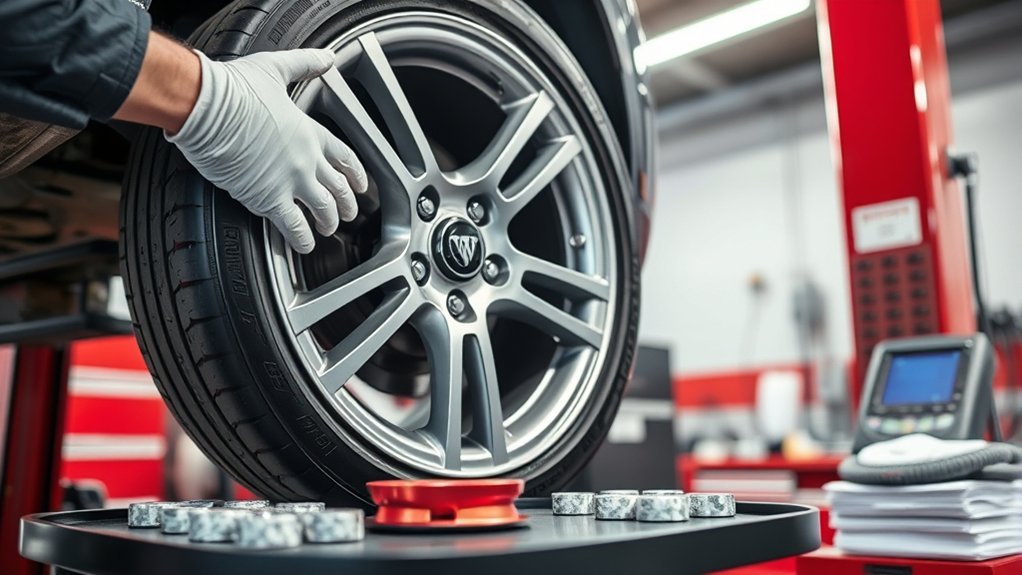
If your car starts shaking at highway speed, wheel balance is one of the first things worth checking. The Firestone wheel balancing cost depends on the store, vehicle, wheel type, and service package, so the final bill can vary even for the same basic job. Knowing what balancing actually includes also helps you avoid paying for an alignment or other service you do not need.
Quick Answer
Firestone wheel balancing is commonly budgeted at about $15 to $25 per wheel, or $60 to $100 for four wheels before taxes or added fees. Firestone does not publish one nationwide standalone rate, so your local quote may differ. New-tire installation includes balancing, and Firestone also offers a lifetime balance option.
Key Takeaways
- Firestone says balancing is generally recommended every 5,000 to 6,000 miles, although your vehicle owner’s manual takes priority.
- Vibration through the steering wheel, seat, or floor can point to an imbalance, especially when it becomes more noticeable at highway speed.
- A rotation does not automatically mean the wheels must be rebalanced, but it can be a convenient time to do both when balancing is due or symptoms are present.
- Balancing corrects weight distribution; alignment changes wheel angles. They address different problems.
- Persistent vibration after a normal balance can justify checking for a bent wheel, tire uniformity problem, or another mechanical cause.
Firestone Wheel Balancing Cost
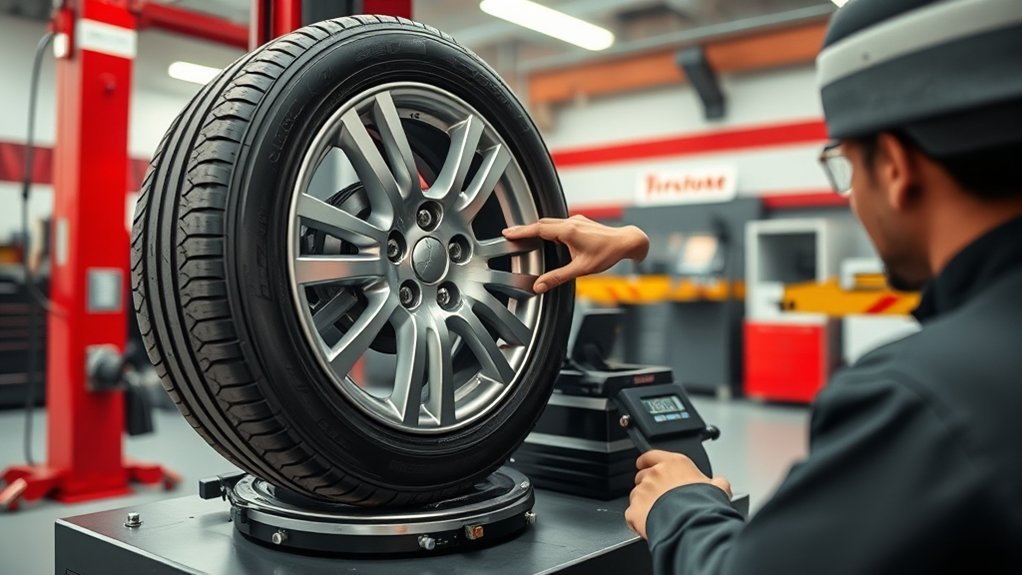
A practical estimate for Firestone wheel balancing is $15 to $25 per wheel, putting a four-wheel service at roughly $60 to $100 before tax or other charges. However, this should be treated as a budgeting range rather than a nationwide Firestone price.
Firestone’s own service quote system explains that some services may not cost the same at every store and that location information is used to provide more accurate pricing. Your vehicle, wheel setup, and selected services can therefore change the final quote.
| Service | Typical Planning Cost | What to Know |
|---|---|---|
| One-wheel balance | $15–$25 estimate | Actual store pricing may vary. |
| Four-wheel balance | $60–$100 estimate | Before applicable tax, fees, or additional work. |
| New-tire installation | Varies by quote | Firestone says each newly installed tire is balanced. |
| Lifetime wheel balance | Varies by store | Available as a Firestone service option, subject to warranty terms. |
As one current comparison point, a Tire Rack listing for a Firestone Complete Auto Care installer shows $23 per tire for mounting and balancing. That is not the same as a standalone rebalancing price, but it shows why a figure in the low-$20 range per tire can be realistic at some locations.
What’s Included in the Service?
Wheel balancing corrects uneven weight around the tire-and-wheel assembly. The technician places the assembly on a balancing machine, spins it to measure the imbalance, and adds small wheel weights in the locations needed to help the assembly rotate smoothly.
Firestone’s tire balancing guidance says technicians use the machine to determine the amount of imbalance and then install the appropriate wheel weights. Firestone also recommends balancing all of the tires at the same time when balancing is required.
The main benefit is reduced vibration. Correct balance can also support more even tread wear and reduce unnecessary strain caused by a wheel-and-tire assembly that is not rotating smoothly.
If you are having new tires installed, the process is broader. Firestone’s new-tire installation procedure includes removing the wheels and old tires, inspecting the wheels and related hardware, mounting and inflating the replacement tires, balancing each one, and reinstalling the wheels.
Firestone says a balancing appointment typically takes 45 minutes to two hours. Newer tires may take less time, while a vibration complaint after a pothole impact can require more investigation.
[Products Worth Considering]

The Tymate TM12 RV TPMS delivers real-time tire pressure and temperature monitoring with a stable 433Hz display for safer long-distance driving. It supports simultaneous monitoring across vehicle and trailer zones, includes six alarm modes for pressure, temperature, leakage, battery, and signal loss, and features easy DIY installation with auto calibration. Power is supplied via USB-C charging or solar recharging, with a wide 0–144 PSI range and up to 50 ft signal coverage for RVs and towable trailers.

Steelman white tire marking crayons provide high-contrast, semi-permanent marks for repairing and inspecting tires and equipment. They write on wet or dry, smooth or coarse surfaces including rubber, metal, glass, and wood, making them ideal for puncture location and damage outlining. The lead- and zinc-free crayons resist weather and fading yet wipe away when you no longer need the marks.

The TYAMATE TM8 solar-powered wireless TPMS delivers real-time tire pressure and temperature monitoring with six alarm modes for safer driving. A vibrant color LCD display shows readings clearly while windshield mounting keeps it hands-free and easy to read. With a wide 0–87 PSI range, strong 433.92 MHz signal transmission, and quick sensor pairing, it’s ideal for RV, sedan, SUV, MPV, and truck use.
What Affects the Price?
Your final wheel balancing bill can differ because not every vehicle or wheel setup takes the same amount of work. Store-level labor rates and the exact services included in your quote also matter.
Common factors include:
- Number of wheels: Balancing one or two wheels normally costs less than servicing all four.
- Wheel and tire design: Larger wheels, low-profile tires, specialty wheels, or setups that need adhesive weights may require more care.
- Additional tire work: Mounting, tire repair, valve or TPMS-related work, and other services can appear separately on the estimate.
- Service package: A one-time balance and a lifetime balancing option are different products.
- Location: Firestone specifically notes that some services do not cost the same at every store.
Firestone lists Lifetime Wheel Balance in its service warranty options. Its terms state that lifetime balance coverage continues while the originally balanced tire remains on that wheel. An additional charge can apply if the Tire Pressure Monitoring System needs to be reset.
That makes it worth comparing the complete quote rather than looking only at the headline balancing charge. Ask whether the price covers all four wheels, wheel weights, TPMS-related work, and any added shop charges.
[Products Worth Considering]
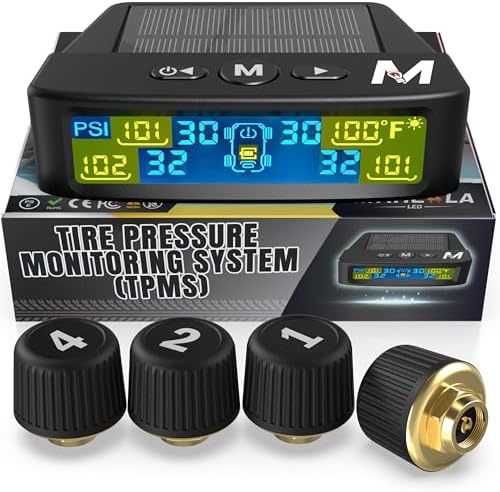
Marcala’s TPMS set of four sensors helps you monitor tire pressure and temperature in real time while driving, with updates every second. The bright color LCD uses auto-dimming for easy viewing, powered by dual solar and USB charging, and offers six alarm modes. Built for trailers, RVs, campers, trucks, and towing setups, the sensors support monitoring 1-4 wheels up to 98 PSI with IP67 waterproof protection.

This professional wheel and rim cleaning brush set lifts brake dust, grime, and dirt with soft, scratch-free microfiber and synthetic wool fibers. The rim brush bends up to 360 degrees for easy access to hard-to-reach areas around spokes, lips, and faces. Ideal for thorough cleaning of car, truck, motorcycle, bicycle, RV, and more wheel and tire surfaces.

Malco tire mounting and demounting lubricant is a ready-to-use tire lube formulated to reduce friction during tire installation for passenger cars, light trucks, farm tires, and heavy-duty equipment. It provides rust-inhibiting protection to help reduce corrosion on rims and wheels, and helps support proper tire bead seating during inflation to reduce air leakage. The silicone-free, soap-free formula is whitewall safe to help prevent discoloration on whitewall tires and sensitive sidewall markings.
Wheel Balancing vs. Wheel Alignment
Balancing and alignment can both improve how a car feels on the road, but they correct different problems. Balancing fixes uneven weight in the rotating wheel-and-tire assembly, while alignment corrects the angles at which the wheels sit relative to the vehicle and road.
| Issue | Wheel Balancing | Wheel Alignment |
|---|---|---|
| What it corrects | Uneven weight distribution | Incorrect wheel angles |
| Common symptom | Speed-related vibration or shaking | Pulling, off-center steering, or uneven wear |
| How it is corrected | Weights are added to the assembly | Suspension alignment angles are adjusted |
A car can have both problems at once. If you have vibration together with pulling or unusual tread wear, asking the technician to inspect both can prevent you from fixing only part of the problem.
When You Need Wheel Balancing
The clearest reason to check wheel balance is a new vibration that becomes noticeable as speed increases. Firestone says imbalance can be felt through the steering wheel, floorboard, or seat, with the vibration often most noticeable around highway speeds.
Other reasons to schedule balancing include:
- Installing new tires.
- Reaching the normal balancing interval recommended for your vehicle.
- Noticing new vibration after hitting a pothole or curb.
- Having a flat tire repaired.
- Seeing irregular or uneven tread wear that needs diagnosis.
- Having a wheel weight come loose or fall off.
Firestone generally recommends balancing tires every 5,000 to 6,000 miles, while also advising drivers to follow the interval in their owner’s manual when the vehicle manufacturer gives a specific recommendation.
The National Highway Traffic Safety Administration’s tire guidance also says new tires should be balanced at installation and explains that balancing helps keep the wheels rotating without creating shaking or vibration.
Note: If severe vibration appears suddenly, continues after balancing, or follows a hard impact, have the wheel, tire, suspension, and related components inspected instead of assuming balance is the only problem.
Do You Need Balancing After a Tire Rotation?
You do not automatically need a wheel balance every time the tires are rotated. Rotation changes each tire’s position on the vehicle, while balancing corrects weight distribution within each tire-and-wheel assembly.
However, Firestone says balancing can be performed during a tire rotation, and the service intervals are close enough that combining them can make sense. If you are already near the 5,000-to-6,000-mile balance interval or you notice vibration after a rotation, checking the balance is reasonable.
If the car remains smooth and the wheels were recently balanced, rotation alone does not necessarily mean anything has changed in the wheel’s weight distribution.
When Road-Force Balancing May Help
A standard spin balance is designed to correct weight imbalance. A road-force balance goes further by applying a load to the tire while measuring the assembly, which can help identify problems that a conventional balancer may not reveal.
Hunter Engineering’s Road Force system says its diagnostic equipment can identify issues such as tire uniformity problems, rim runout from a bent wheel, improper bead seating, and some tire-pull conditions.
This type of test can be useful when the wheels have already been balanced but the car still shakes. Availability is not universal, though, so do not assume every Firestone location has road-force equipment or charges the same amount for the service.
Firestone Vs. Other Shops
Firestone is worth comparing with tire stores, independent repair shops, and dealerships based on the complete service package, not only the initial balance price. A slightly higher upfront charge can still be competitive if it includes future rebalancing or other useful coverage.
Compare these points before choosing a shop:
- Total price: Ask for the out-the-door amount for the number of wheels you want balanced.
- One-time vs. lifetime service: Confirm whether future rebalancing is included.
- Equipment: If you have a stubborn vibration, ask whether road-force diagnosis is available.
- Extra charges: Clarify TPMS, mounting, valve, disposal, and other possible fees.
- Warranty terms: Find out exactly how long the balancing work or service plan is covered.
Coupons can also change the calculation. Firestone maintains a current coupons and offers page, although the offers displayed on October 5, 2026 did not include a nationwide coupon specifically labeled for standalone wheel balancing. Promotions can change by date and participating location.
[Products Worth Considering]

Measure tire tread depth quickly and accurately with this LUMITECO dial gauge that reads in 1/32" increments up to 14/32". The color-coded green/yellow/red zones make it easy to judge tire wear and know when replacement is needed. A rugged, compact design with a protective pouch helps keep the gauge ready for use on cars, trucks, motorcycles, and more.

This TPMS sensor training and relearn reset tool is customized for Ford, Lincoln, and Mercury vehicles to help activate tire pressure programming after sensor replacement or tire rotation. It can activate individual tire pressure sensors with one-button operation, helping prevent TPMS warning light illumination. It is not a sensor programming tool and cannot program replacement sensors—use it to trigger/activate sensors only.

Replace worn or missing TPMS sensors with CARORAV pre-programmed GM-compatible sensors for a smoother installation experience. These 315MHz replacement sensors help monitor tire pressure in real time with long battery life, and they are designed to withstand harsh temperatures. Manual or OBDII relearn may be required to reset the system for proper recognition.
Frequently Asked Questions
Do Firestone Locations Offer Wheel Balancing Coupons?
Firestone does offer rotating tire and auto-service promotions, but a balancing-specific coupon is not always available. The national offers displayed on October 5, 2026 did not show a standalone wheel-balancing coupon, so the available discount may depend on the date, store, and other services you purchase.
How Often Should Wheel Balancing Be Checked?
Firestone generally recommends balancing tires every 5,000 to 6,000 miles. Follow your owner’s manual if the vehicle manufacturer specifies a different interval, and have the balance checked sooner if you develop vibration, lose a wheel weight, or hit a significant pothole or curb.
Can Uneven Tire Wear Mean a Bent Rim?
A bent rim can contribute to vibration or abnormal tire behavior, but uneven wear alone does not prove the wheel is bent. Alignment, tire pressure, suspension condition, tire damage, and imbalance can also affect wear, so the wheel and tire should be inspected before replacing parts.
Is Wheel Balancing Needed After Tire Rotation?
Wheel balancing is not automatically required after every tire rotation. It makes sense to combine the services when balancing is due, when you notice vibration, or when inspection suggests an imbalance, but simply moving a balanced wheel to another position does not necessarily make it unbalanced.
Will Balancing Fix Steering Wheel Vibrations?
Balancing can fix steering-wheel vibration when wheel or tire imbalance is the cause. If the vibration remains afterward, possible causes include a bent wheel, tire uniformity problem, improper mounting, suspension issue, brake-related vibration, or another mechanical problem that needs further diagnosis.
How Long Does Wheel Balancing Take at Firestone?
Firestone says tire balancing typically takes about 45 minutes to two hours. The appointment can be shorter with newer tires and longer when the technician is investigating vibration after a pothole impact or dealing with other tire or wheel issues.
Does Firestone Offer Lifetime Wheel Balancing?
Yes, Firestone lists Lifetime Wheel Balance as a service option. Its warranty terms say the coverage remains valid while the originally balanced tire remains on that wheel, and an additional charge may apply if the Tire Pressure Monitoring System needs to be reset.
Conclusion
Firestone wheel balancing is a relatively small maintenance service that can make a noticeable difference when imbalance is causing vibration. Budget about $15 to $25 per wheel as a starting estimate, but get the local out-the-door quote before booking because Firestone does not publish one nationwide standalone rate. If vibration remains after balancing, have the tire, wheel, and related components inspected rather than repeatedly rebalancing the same assembly.
Sources
- Firestone Complete Auto Care — Tire Balancing: balancing process, symptoms, interval, and typical service time.
- Firestone Complete Auto Care — Request a Quote: confirms service pricing may vary by store and location.
- Firestone Complete Auto Care — Tire Installation: confirms balancing during new-tire installation and lifetime balance availability.
- Firestone Complete Auto Care — Service Warranty Options: lifetime wheel-balance coverage and TPMS terms.
- Firestone Complete Auto Care — Coupons and Offers: current national promotion availability.
- National Highway Traffic Safety Administration — Tire Safety: tire balancing, vibration, new-tire balancing, and maintenance guidance.
- Hunter Engineering — Road Force Wheel Balancing: diagnostic road-force balancing and problems it can identify.
- Tire Rack — Firestone Complete Auto Care Installer Listing: current mounting-and-balancing pricing example.

