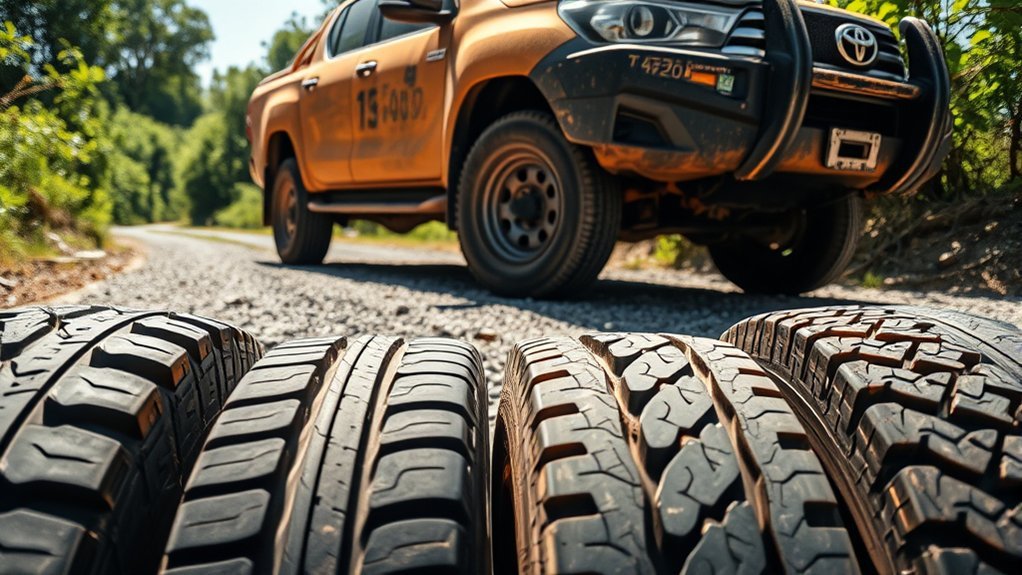
Choosing the right tire for your daily Toyota Hilux is not about picking the toughest-looking tread. The safest choice starts with the tire size, load index, speed rating, and pressure shown on your Hilux tire placard or owner’s manual. After that, match the tread type to how you actually drive: commuting, towing, gravel roads, job sites, or regular off-road use.
Quick Answer
For a daily Toyota Hilux, choose tires that match the factory size, load index, speed rating, and recommended cold pressure. Use highway-terrain tires for mostly road driving, all-terrain tires for mixed road and gravel use, and light-truck or commercial-rated tires if you regularly tow, haul, or work on rough surfaces.
Key Takeaways
- Start with the tire placard or owner’s manual, not a random online size chart.
- The load index and speed rating must meet or exceed Toyota’s specification for your exact Hilux.
- All-terrain tires are useful for gravel, wet tracks, and light off-road driving, but highway-terrain tires are usually quieter and smoother for city use.
- Check cold tire pressure monthly and inspect tread, sidewalls, and the spare tire before long trips.
- Replace tires when tread reaches the legal minimum, damage appears, grip drops, or age becomes a concern.
At a Glance
| Time Required | 10–20 minutes to check your placard, current tires, tread, and driving needs |
| Difficulty | Easy for basic checks; ask a tire professional for towing, wheel changes, or non-standard sizes |
| Tools Needed | Owner’s manual, tire placard, tire pressure gauge, tread depth gauge, and a flashlight |
| Cost | Free for inspection; replacement cost varies by size, construction, brand, and tire type |
Start With Your Hilux’s Factory Tire Size
The correct Toyota Hilux tire size depends on the model year, market, trim, body style, and wheel package. For example, Toyota Australia’s current HiLux specification table lists sizes such as 265/65R17 and 265/60R18 on several grades, but your exact Hilux may be different. Always confirm the size on the tire placard, usually on the driver’s door edge or doorjamb, and cross-check the owner’s manual before buying.
Using the wrong size can affect steering feel, braking, speedometer accuracy, ground clearance, electronic stability systems, fuel economy, ride comfort, and tire wear. A wider or taller tire may look better, but it can rub the guards, overload the tire, change gearing, or make the vehicle less stable under cargo or towing load.
Warning: Never choose a tire only because it fits the wheel diameter. The full size, load index, speed rating, construction type, and pressure requirement must be suitable for your Hilux.
How to Read the Tire Size on Your Hilux
Tire markings look complicated, but they follow a simple pattern. A Hilux tire may show a code such as 265/65R17 112S. Here is what each part means:
| Marking | Meaning | Why It Matters |
|---|---|---|
| 265 | Tire width in millimeters | Affects grip, clearance, rolling resistance, and steering feel |
| 65 | Aspect ratio, or sidewall height as a percentage of width | Affects comfort, impact protection, and handling |
| R | Radial construction | Standard construction for modern passenger and light-truck tires |
| 17 | Wheel diameter in inches | Must match the wheel size |
| 112 | Load index | Shows the maximum load the tire can carry when properly inflated |
| S | Speed rating | Shows the tire’s rated speed capability under specified conditions |
You may also see markings such as LT, C, XL, or a load range letter. These relate to tire construction and load capacity. If your Hilux is used for work, towing, or regular rough-road driving, do not downgrade from the tire construction specified for your vehicle.
Load Index and Speed Rating
The load index and speed rating are part of the tire’s service description. They are not optional extras. They help ensure the tire can carry the vehicle, passengers, cargo, accessories, and towing load safely when inflated to the correct pressure.
For a Hilux, the load index is especially important because many owners carry tools, camping gear, canopy systems, roof racks, bull bars, trailers, or work equipment. A tire with a higher load rating can be acceptable if it fits correctly, but it does not increase your legal payload, axle rating, towing rating, or gross vehicle mass. Those limits are set by Toyota and local regulations.
The speed rating also matters even if you do not drive fast. It reflects heat resistance and structural capability under load. Replacing factory-rated tires with a lower speed rating can reduce safety margin and may affect insurance or roadworthiness rules in some regions.
Note: On 4×4 Hilux models, keep all four tires closely matched in size, type, tread depth, and rolling circumference. Large differences can affect handling and may stress drivetrain components.
[Products Worth Considering]

Steelman white tire marking crayons provide high-contrast, semi-permanent marks for repairing and inspecting tires and equipment. They write on wet or dry, smooth or coarse surfaces including rubber, metal, glass, and wood, making them ideal for puncture location and damage outlining. The lead- and zinc-free crayons resist weather and fading yet wipe away when you no longer need the marks.

Measure tire tread depth quickly and accurately with this LUMITECO dial gauge that reads in 1/32" increments up to 14/32". The color-coded green/yellow/red zones make it easy to judge tire wear and know when replacement is needed. A rugged, compact design with a protective pouch helps keep the gauge ready for use on cars, trucks, motorcycles, and more.

Monitor tire tread wear with a smart, color-coded depth gauge that shows clear condition ranges at a glance. The bar is range marked for fast, easy readings, helping you maintain safer traction and performance. Each gauge is portable with a pocket clip, and the set includes 20 units for daily use and sharing.
Choose the Right Tire Type for Your Daily Driving
The best daily tire for a Toyota Hilux depends on where the vehicle spends most of its time. Use this guide to narrow the choice before comparing brands.
| Tire Type | Best For | Tradeoff |
|---|---|---|
| Highway-terrain / touring | City driving, highway commuting, school runs, long road trips | Quieter and smoother, but less grip in mud, loose gravel, and rutted tracks |
| All-terrain | Daily driving plus gravel roads, wet worksites, farms, camping, light off-road use | More versatile, but usually heavier and slightly noisier than highway tires |
| Mud-terrain | Frequent mud, rocks, ruts, and serious off-road driving | Noisier, heavier, less refined on wet pavement, and often less efficient for daily use |
| Commercial / light-truck construction | Work use, towing, heavy accessories, rough job sites, long-distance touring with load | Stronger casing, but ride can feel firmer when unloaded |
If your Hilux is mainly a commuter, a good highway-terrain tire may be the most comfortable option. If you regularly drive on broken pavement, gravel, dirt tracks, or wet job sites, an all-terrain tire is often the better balance. Reserve aggressive mud-terrain tires for owners who genuinely need off-road traction more than quiet daily comfort.
[Products Worth Considering]

Accurately measure tire tread depth with a calibrated gauge marked from 0 to 1 inch in 1/32 inch increments. The color-coded bar helps you quickly identify tread condition ranges, supporting safe driving for trucks, motorcycles, automobiles, and passenger vehicles.

Measure tyre tread depth precisely with a digital gauge that reads in both MM and inches, helping you monitor safe driving conditions. The large LCD screen is easy to operate, and the compact tool fits for cars, trucks, and motorcycles. It provides high accuracy with a 0-25.4mm range and includes a 1-year warranty for added peace of mind.

Keep your tires properly inflated with this analog VONDIOR tire pressure gauge, designed for fast, easy readings without batteries. The swiveling, two-axis hose and large glow dial help you measure at any tire angle with instant visibility. Built with a protective rubber shield, it supports durable, low-maintenance use for cars and trucks.
Recommended Tire Brands for Your Hilux
Brand matters, but fitment matters more. Compare tires only after confirming the size, load index, speed rating, and construction your Hilux needs. These brands and tire families are worth comparing depending on how you use the vehicle:
| Driving Need | Good Tire Style | Brands or Families to Compare |
|---|---|---|
| Mostly highway and town driving | Highway-terrain or touring light-truck tire | Michelin Defender LTX M/S2, Bridgestone Dueler H/T, Yokohama Geolandar H/T, Continental TerrainContact H/T |
| Daily use with gravel, rain, and light off-road tracks | Balanced all-terrain tire | BFGoodrich All-Terrain T/A KO3 or KO2, Bridgestone Dueler A/T, Goodyear Wrangler All-Terrain Adventure, Falken Wildpeak A/T |
| Budget daily replacement | Value highway-terrain or mild all-terrain tire | Hankook Dynapro, Kumho Road Venture, Falken Wildpeak, selected Yokohama Geolandar options |
| Workload, towing, and rough surfaces | LT/commercial-rated tire with suitable load index | Compare load-rated options from Michelin, Bridgestone, Goodyear, BFGoodrich, Yokohama, Falken, Hankook, and Kumho |
Pro Tip: Ask the tire shop to quote the full service description, not just the size. “265/65R17” alone is incomplete; you also need the load index, speed rating, and construction type.
[Products Worth Considering]

The SAFELIFE dial tire tread depth gauge measures tread depth in 1/32 inch increments with clear, easy-to-read 2-inch dial face. Color zones using a traffic light system help you quickly judge whether tread is low, marginal, or ample for safer driving. Built with a durable zinc cast body and a metal detect probe for precise, comfortable use across cars, motorcycles, trucks, and buses.

Orange Seal regular formula tubeless sealant quickly seals punctures and forms a durable bond inside your tire to help reduce flats. Made with natural latex, it adheres effectively to rubber and seals from the inside out, including the critical bead-to-rim interface for a reliable ride. It seals punctures up to 1/4 inch, slices up to 3/4 inch, and performs in temperatures as low as 11°F across MTB, road, cyclocross, gravel, and e-bike applications.

Milton S-921 pencil tire pressure gauge helps you maintain optimal tire pressure for passenger cars with accurate readings in PSI and kPa. It features a built-in deflator valve for convenient pressure adjustments, plus a single chuck head and nylon indicator bar for easy use on the go. Built from durable plated brass and designed for reliable performance, it’s a practical road trip and cold-weather maintenance tool.
Pre-Purchase Checklist Before You Buy
Before ordering tires for your Hilux, run through this checklist:
- Confirm the factory size: Check the tire placard and owner’s manual.
- Match or exceed the load index: This is critical for towing, payload, accessories, and work use.
- Match the speed rating: Do not downgrade unless a tire professional confirms it is legal and safe for your application.
- Choose the right tread type: Highway for comfort, all-terrain for mixed use, mud-terrain for serious off-road driving.
- Check construction: Do not replace a required LT or commercial tire with a weaker passenger-style tire.
- Consider wet grip and noise: Daily drivers need predictable wet braking and acceptable road noise.
- Inspect the spare: A worn, flat, cracked, or old spare can leave you stranded.
- Plan alignment and balancing: New tires should be balanced, and an alignment check is smart if the old tires wore unevenly.
How to Maintain Your Tires for Longevity
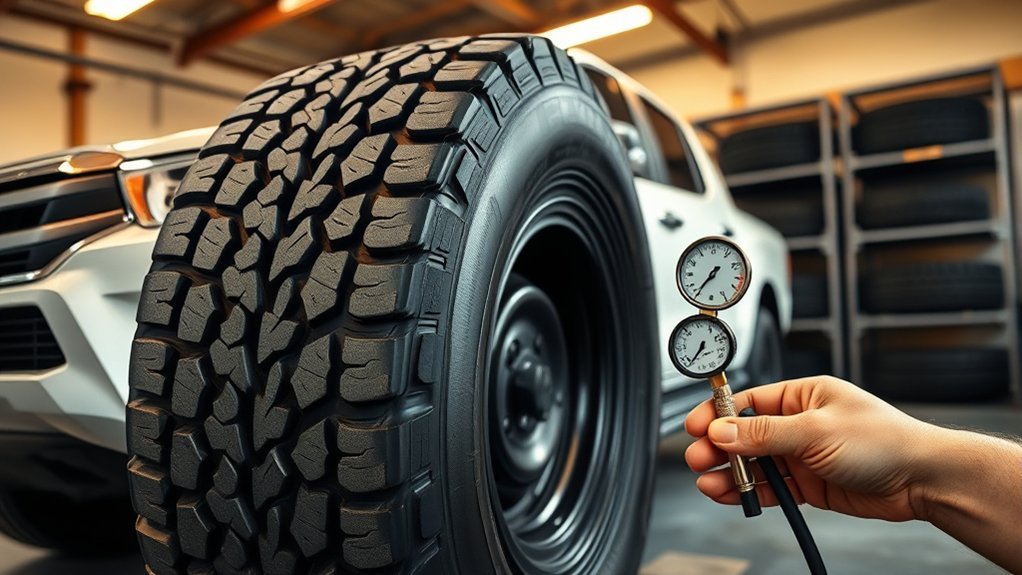
Good tires still need regular care. The NHTSA TireWise guidance explains that proper inflation pressure affects safety, durability, and fuel consumption. Use the cold pressure listed by Toyota on the placard or in the manual, not the maximum pressure molded into the tire sidewall.
- Check cold pressure monthly: Check all tires, including the spare, before driving or after the vehicle has been parked for several hours.
- Inspect tread monthly: Look for low tread, uneven wear, cuts, cracks, punctures, stones, or bulges.
- Rotate as recommended: If Toyota recommends rotation for your setup, many vehicles use a 5,000–8,000 mile interval, but your manual is the rule.
- Balance new tires: Balancing helps prevent vibration and uneven wear.
- Check alignment: If the Hilux pulls, the steering wheel sits off-center, or the tread wears unevenly, have the alignment checked.
- Do not overload: Stay within payload, axle, and towing ratings even if your tires have a high load index.
NHTSA reported 511 U.S. traffic fatalities in tire-related crashes in 2024, which is a reminder that tire care is a safety issue, not just a maintenance task.
Signs It’s Time to Replace Your Tires
Replace your Hilux tires when they are worn, damaged, too old, or no longer performing safely. Tread depth is the obvious check, but it is not the only one.
- Low tread depth: In the U.S., tires should be replaced when tread reaches 2/32 inch. Many regions use 1.6 mm as the legal minimum. Wet, winter, off-road, and towing use may require replacement earlier.
- Visible damage: Replace tires with sidewall bulges, deep cuts, exposed cords, major cracks, or damage from driving while flat.
- Uneven wear: Feathering, cupping, shoulder wear, or one-sided wear can point to alignment, balance, suspension, or pressure problems.
- Vibration or pulling: Persistent vibration, new road noise, or pulling should be inspected quickly.
- Age: Michelin recommends professional inspection after five years of service and replacement by ten years from the date of manufacture; Bridgestone and Continental also recommend replacing tires over ten years old, including spares.
- Poor wet grip: If braking feels longer or the rear steps out more easily in rain, do not wait for the tread to reach the legal minimum.
You can check age by finding the DOT date code on the tire sidewall. The last four digits show the week and year of manufacture. For example, a code ending in 3520 means the tire was made in the 35th week of 2020.
Warning: Do not repair a tire with a sidewall puncture, exposed cords, a bulge, or damage from being driven flat. Replace it and have the wheel checked.
Frequently Asked Questions
What is the best tire for a Toyota Hilux?
The best tire is the one that matches your Hilux’s factory size, load index, speed rating, construction type, and driving conditions. For mostly road use, choose a quality highway-terrain tire. For mixed road, gravel, and light off-road use, choose a balanced all-terrain tire.
Can I use high-performance tires for daily driving?
You can, but they are rarely the best match for a Hilux. High-performance tires may improve dry-road grip, but they can reduce comfort, load durability, rough-road protection, tread life, and off-road traction. For daily Hilux use, highway-terrain or all-terrain tires usually make more sense.
What tyres should I put on my Hilux?
Put on tires that match your placard first. Then choose the tread type by use: highway-terrain for comfort and commuting, all-terrain for mixed daily and gravel use, mud-terrain for serious off-road use, and LT/commercial construction for heavier loads or work conditions.
Are all-terrain tires good for daily driving?
Yes, a modern all-terrain tire can be good for daily driving if you also need gravel-road, campsite, farm, or worksite traction. Expect a little more road noise, weight, and rolling resistance than a highway-terrain tire.
Can I fit bigger tires on a Toyota Hilux?
Sometimes, but bigger tires can affect clearance, gearing, speedometer accuracy, braking, insurance, and road legality. Check local regulations and ask a qualified tire professional before changing from the factory size.
How often should I rotate Hilux tires?
Follow your owner’s manual. If rotation is recommended for your setup, a common interval is every 5,000–8,000 miles or sooner if uneven wear appears. Do not rotate tires in a pattern that conflicts with directional tread, staggered sizes, or Toyota’s guidance.
Does load index matter when towing?
Yes. Towing and payload add heat and stress to tires, so the load index must meet or exceed the vehicle specification. However, a higher load-index tire does not increase the Hilux’s legal towing capacity, payload, axle rating, or gross vehicle mass.
Conclusion
The right Toyota Hilux tire is the one that fits the vehicle first and your lifestyle second. Start with the factory size, load index, speed rating, and pressure. Then choose a highway-terrain tire for quiet road comfort, an all-terrain tire for mixed daily and gravel use, or a stronger light-truck tire for work and towing. Maintain pressure, inspect tread, watch tire age, and replace damaged or worn tires before they become a safety problem.
Sources
- Toyota Australia HiLux specifications — current example tire sizes and model variation
- NHTSA TireWise — tire pressure, tread depth, rotation, alignment, and safety guidance
- Michelin load rating and speed rating guide — service description, load index, and speed rating explanation
- Michelin tire replacement guide — tire age, inspection, damage, and replacement timing
- Bridgestone tire replacement guidance — inspection after five years and ten-year replacement guidance
- Continental tire replacement guide — tread depth, tire age, DOT date code, and replacement signs