
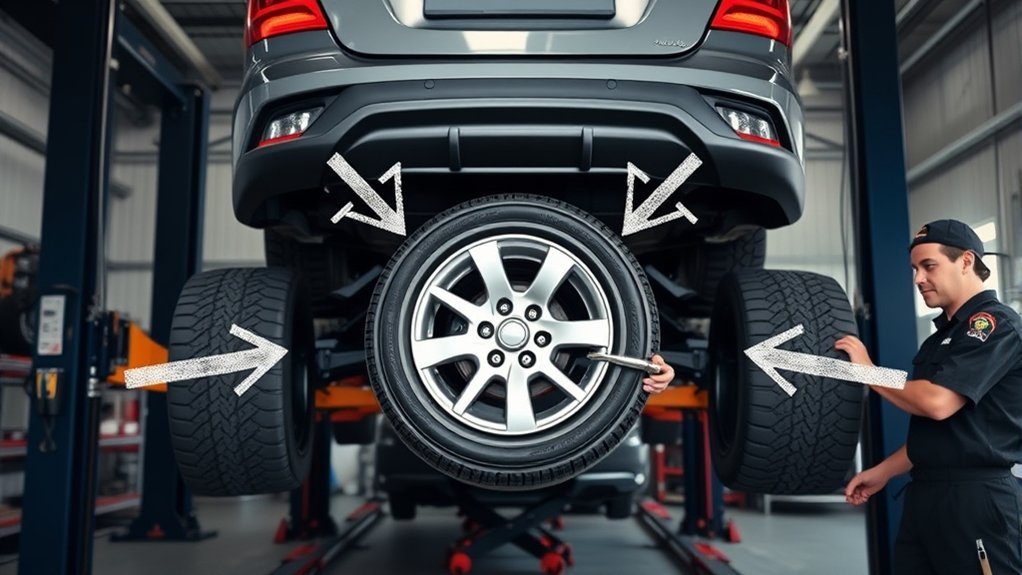
There is no single AWD tire rotation pattern that works for every all-wheel-drive vehicle. If all four tires are the same size and non-directional, a crisscross pattern is common. Directional tires normally move front to rear on the same side, while staggered wheel and tire sizes may limit rotation further. Your vehicle owner’s manual always takes priority.
Quick Answer
For AWD tire rotation, first check your owner’s manual and tire type. Same-size, non-directional tires can often use a crisscross pattern. Directional tires normally stay on the same side and move front to rear. Rotate at the manufacturer’s interval, commonly around 5,000 to 8,000 miles, while keeping all four tires closely matched.
Key Takeaways
- There is no universal Double X pattern for every AWD vehicle; follow the pattern listed in the owner’s manual.
- Same-size, non-directional tires can commonly be cross-rotated, while directional tires usually move front to rear on the same side.
- Follow the vehicle maker’s rotation interval. NHTSA notes that 5,000 to 8,000 miles is a common range when rotation is recommended.
- Keep all four AWD tires closely matched in size, type, wear, and rolling circumference according to the vehicle manufacturer’s limits.
- Replace a tire at 2/32 inch of tread or sooner if it has unsafe damage, and investigate abnormal wear instead of trying to fix severe wear through rotation alone.
- When rotating tires yourself, use approved lifting points, properly support the vehicle, and tighten the wheel fasteners to the vehicle manufacturer’s torque specification.
At a Glance
| Time Required | About 30–60 minutes for a typical DIY four-wheel rotation; shop time varies. |
| Difficulty | Moderate DIY maintenance; safe lifting and correct wheel torque are essential. |
| Tools Needed | Wheel chocks, lug wrench or socket, suitable jack, approved vehicle supports, torque wrench, pressure gauge, and preferably a tread-depth gauge. |
| Cost | No service charge if you already own the required tools; professional rotation pricing varies, and some tire-service plans include rotations. |
What Is the AWD Tire Rotation Pattern?

The correct AWD tire rotation pattern depends on the vehicle, wheel sizes, and tire design. The safest starting point is the pattern shown in your owner’s manual. NHTSA recommends checking the owner’s manual for both the rotation interval and the correct pattern.
For an AWD vehicle with four identical-size, non-directional tires, a cross-rotation pattern is commonly allowed. Depending on the manufacturer’s instructions, that may be an X-pattern or another approved cross pattern.
The drivetrain alone does not determine the rotation pattern. Tire direction, front-to-rear sizing, and the vehicle manufacturer’s instructions matter too.
Michelin’s tire-rotation guidance notes that AWD and 4WD vehicles commonly use a crisscross rotation when the vehicle manufacturer permits it. Directional tires are different because their designed direction of travel must be maintained.
AWD Rotation Pattern by Tire Type
| Tire Setup | Typical Rotation | Important Check |
| Same-size, non-directional tires | Cross-rotation is commonly permitted. | Use the exact pattern in the owner’s manual. |
| Directional tires | Front to rear on the same side. | Keep the sidewall rotation arrow pointing in the correct direction. |
| Staggered front/rear sizes | Front-to-rear rotation may not be possible. | Check whether side-to-side rotation is allowed. |
| Directional and staggered | Rotation may be severely limited or unavailable without tire remounting. | Follow the vehicle and tire manufacturer instructions. |
Note: An asymmetric tire is not automatically directional. If the sidewall only says “Outside” and “Inside,” it may still be cross-rotated after proper mounting. If it also has a directional arrow, that arrow must continue pointing in the correct direction of travel.
How Often Should You Rotate AWD Tires?
Follow the rotation interval in your vehicle owner’s manual first. As a general reference, NHTSA notes a 5,000-to-8,000-mile interval when tire rotation is recommended by the vehicle manufacturer, or sooner if irregular wear appears.
Your tire warranty may also specify a required rotation schedule. Keeping dated service records can help document that the tires were maintained correctly.
AWD Rotation Intervals
AWD vehicles benefit from consistent rotations because maintaining similar wear across all four tires also helps keep their rolling diameters close. The exact schedule still varies by vehicle.
- Follow the owner’s manual if it gives a specific mileage or time interval.
- Check the tire warranty for any separate rotation requirement.
- Inspect the tires before the normal interval if you notice uneven wear, vibration, pulling, or unusual road noise.
- Measure all four tread depths rather than judging wear only by appearance.
Pro Tip: Record the mileage, date, tread depth, and wheel position at every rotation. A simple record makes it much easier to spot one position wearing faster than the others.
Driving Conditions Impact
Severe use can produce irregular wear before the scheduled rotation. Inspect the tires more often if your driving regularly includes rough roads, heavy loads, repeated hard acceleration or braking, frequent towing within the vehicle’s rated limits, or extensive stop-and-go driving.
Do not assume that rotation alone will correct a mechanical problem. If one shoulder or one wheel position is wearing much faster than the rest, investigate inflation, alignment, suspension, or wheel-balance problems.
Maintenance and Inspection
Pair each rotation with a complete tire check. Measure tread depth, inspect the sidewalls and tread for damage, and check inflation when the tires are cold.
NHTSA recommends checking tire pressure and tread condition regularly. Use the pressure listed on the vehicle’s tire-information placard or in the owner’s manual rather than the maximum pressure molded into the tire sidewall.
- Measure tread at several points across each tire.
- Look for cuts, cracks, bulges, exposed cords, nails, or other damage.
- Compare inner, center, and outer tread wear.
- Check cold inflation pressure.
- Investigate vibration, pulling, or cupping instead of simply rotating the symptom to another position.
Why AWD Tire Rotation Matters
Regular AWD tire rotation can reduce irregular wear and help the four tires remain closer in tread depth. That supports predictable braking, cornering, wet-road grip, and overall tire life.
Tire matching has an additional importance on AWD vehicles. Different rolling circumferences can make wheels rotate at slightly different speeds even when the vehicle is traveling straight.
Even Wear and Safety
Front and rear tire positions do not experience identical loads. Steering, braking, suspension geometry, vehicle weight distribution, and power delivery all affect wear. Rotation changes those positions so one pair does not consistently carry the same wear pattern.
- More uniform tread depth helps preserve consistent traction.
- Regular inspection can reveal alignment or inflation problems earlier.
- Keeping the set evenly worn can extend the useful life of the tires.
Rotation cannot repair a tire that already has severe shoulder wear, structural damage, exposed cords, or tread at the replacement limit.
AWD Drivetrain Protection
AWD systems are designed around tires with compatible rolling dimensions. How much difference is allowed varies by vehicle, so there is no safe universal rule such as “1/32 inch for every AWD system.”
For example, Mazda warns in its AWD guidance that unevenly worn or mismatched tires can differ in size enough to limit AWD operation or potentially damage the system. Other manufacturers may specify their own allowable tread-depth or circumference difference.
Warning: Do not apply a generic tread-depth tolerance to every AWD vehicle. Before replacing only one or two tires, check the owner’s manual or manufacturer guidance for the maximum permitted difference in tread depth or rolling circumference.
How to Rotate AWD Tires
Before removing a wheel, confirm that your AWD vehicle actually allows the intended rotation pattern. Check the owner’s manual, all four tire sizes, and the sidewalls for directional arrows or inside/outside markings.
[Products Worth Considering]

This TPMS sensor training and relearn reset tool is customized for Ford, Lincoln, and Mercury vehicles to help activate tire pressure programming after sensor replacement or tire rotation. It can activate individual tire pressure sensors with one-button operation, helping prevent TPMS warning light illumination. It is not a sensor programming tool and cannot program replacement sensors—use it to trigger/activate sensors only.

Measure tire tread depth quickly and accurately with this LUMITECO dial gauge that reads in 1/32" increments up to 14/32". The color-coded green/yellow/red zones make it easy to judge tire wear and know when replacement is needed. A rugged, compact design with a protective pouch helps keep the gauge ready for use on cars, trucks, motorcycles, and more.

This TPMS relearn tool helps you quickly activate, match, and reset GM tire pressure sensors to keep the vehicle monitoring system working properly. It clears tire pressure alarms and dashboard warning lights after sensor replacement or tire rotation, and supports learning for common 315/433 MHz TPMS sensors. Designed for simple one-button operation, it can help you avoid unnecessary trips to repair shops.
1. Confirm the Tire Setup
Make sure the four tires are the correct sizes for their positions. Determine whether they are directional and whether the front and rear wheels use the same dimensions.
If the vehicle has staggered front and rear sizes, do not move a rear wheel to the front merely to follow a generic AWD diagram.
2. Measure and Record Tread Depth
Measure each tire before rotation. Check the inner, center, and outer portions of the tread and record each wheel position.
If one tire is substantially different from the others, determine why before rotating it. An AWD vehicle may have a manufacturer-specific maximum allowable difference.
3. Prepare the Vehicle
Park on a firm, level surface. Place the transmission in Park or in gear as appropriate, apply the parking brake, and use wheel chocks so the vehicle cannot roll.
Before lifting, loosen the wheel fasteners slightly while the tires are still on the ground. Do not fully remove them yet.
4. Lift and Support the Vehicle Correctly
Use only the lifting and support points specified by the vehicle manufacturer. A floor jack or factory jack is a lifting device, not a substitute for proper support when the procedure requires the vehicle to remain raised.
Warning: Never place any part of your body underneath a vehicle that is supported only by a jack. Follow the vehicle manufacturer’s lifting instructions and use equipment rated for the vehicle’s weight.
5. Remove and Inspect the Wheels
Remove each wheel and inspect the tire before moving it. Look for:
- Uneven shoulder or center wear.
- Cuts, cracks, bulges, exposed cords, or punctures.
- Foreign objects in the tread.
- Abnormal cupping or scalloped wear.
- Wheel damage or unusual corrosion at mounting surfaces.
6. Move the Tires to the Correct Positions
Use the exact rotation sequence approved for your setup.
- Same-size, non-directional tires: use the cross pattern specified by the vehicle manufacturer.
- Directional tires: normally move front to rear on the same side so the rotation arrow remains correct.
- Staggered tires: front-to-rear movement may be impossible; follow the manufacturer’s permitted side-to-side procedure, if any.
7. Reinstall and Tighten the Wheels
Position each wheel correctly and start the wheel fasteners by hand to reduce the chance of cross-threading. Snug them progressively in the sequence recommended for the wheel.
Lower the vehicle as required by the manufacturer’s procedure, then use a calibrated torque wrench to tighten the fasteners to the vehicle manufacturer’s specified torque. Do not guess the torque value.
8. Check Pressure and TPMS
Set all four cold tire pressures to the vehicle placard specification. If your vehicle’s TPMS tracks individual wheel positions, the system may require a relearn or initialization after rotation. Follow the owner’s manual.
After driving, investigate any new vibration, pulling, warning light, or unusual noise rather than assuming it is a normal result of rotation.
Directional Tire Rotation Tips
A directional tire has an arrow or other sidewall marking that identifies its intended forward rotation. When all four tires are the same size, the usual rotation is front to rear on the same side.
Crossing a directional wheel from one side of the vehicle to the other would reverse its direction of travel unless the tire is professionally demounted and remounted in a way approved for that tire and wheel setup.
| Check | What to Verify | Action |
| Sidewall arrow | Arrow points in the forward rolling direction | Keep the tire’s direction correct |
| Tire size | Front and rear sizes match | Do not move staggered sizes to the wrong axle |
| Tread depth | Wear remains within manufacturer limits | Investigate excessive differences |
| Owner’s manual | Vehicle-specific pattern | Use it instead of a generic diagram |
[Products Worth Considering]

Monitor tire tread wear with a smart, color-coded depth gauge that shows clear condition ranges at a glance. The bar is range marked for fast, easy readings, helping you maintain safer traction and performance. Each gauge is portable with a pocket clip, and the set includes 20 units for daily use and sharing.

The VEHLIVE SU-50448 II TPMS relearn tool provides a fast activation reset to restore accurate tire pressure monitoring after sensor replacement or tire rotation. It supports 315 MHz and 433 MHz GM series sensors and helps clear dashboard pressure warnings. With simple two-button operation and horn-confirmed relearning order, you can reprogram sensors conveniently at home.

This professional wheel and rim cleaning brush set lifts brake dust, grime, and dirt with soft, scratch-free microfiber and synthetic wool fibers. The rim brush bends up to 360 degrees for easy access to hard-to-reach areas around spokes, lips, and faces. Ideal for thorough cleaning of car, truck, motorcycle, bicycle, RV, and more wheel and tire surfaces.
What If Your AWD Vehicle Has Staggered Tires?
A staggered setup uses different tire or wheel sizes on the front and rear axles. In that case, a normal front-to-rear AWD rotation may not be possible.
If the tires are non-directional and the vehicle manufacturer permits it, you may be able to move the left and right tires across the same axle. Some staggered or directional combinations cannot be rotated meaningfully without demounting the tires.
Never place a wheel or tire size on an axle for which the vehicle manufacturer did not approve it.
Can You Include a Spare in AWD Tire Rotation?
A temporary-use spare should not be included in the normal rotation. A matching full-size spare may sometimes be included in a five-tire rotation, but only when its size, construction, wheel, and tire specifications are suitable and the vehicle manufacturer permits it.
Because AWD systems can be sensitive to rolling-diameter differences, a full-size spare that has remained unused while the road tires have worn substantially may no longer be a close enough match for unrestricted use. Check the vehicle manufacturer’s guidance before adding it to the set.
When to Replace Tires Instead of Rotating
Rotation cannot restore worn-out or damaged tread. NHTSA states that tires should be replaced when tread reaches 2/32 inch. A tire may need replacement sooner because of structural damage, exposed cords, severe cracking, bulges, or another unsafe condition.
At 2/32 inch of remaining tread, the answer is replacement, not another rotation.
With AWD, another question is whether one new tire can be safely matched to the remaining three. Do not rely on a universal 1/32-inch, 2/32-inch, or circumference rule unless that number comes from your vehicle manufacturer.
If one tire is damaged but the others still have useful tread:
- Check the owner’s manual for the maximum allowable tread-depth or rolling-circumference difference.
- Use the same approved size and compatible tire type.
- Ask a qualified tire professional whether the replacement can meet the manufacturer’s matching requirement.
- Replace additional tires if required to keep the AWD system within specification.
[Products Worth Considering]

Replace worn or missing TPMS sensors with CARORAV pre-programmed GM-compatible sensors for a smoother installation experience. These 315MHz replacement sensors help monitor tire pressure in real time with long battery life, and they are designed to withstand harsh temperatures. Manual or OBDII relearn may be required to reset the system for proper recognition.

Steelman white tire marking crayons provide high-contrast, semi-permanent marks for repairing and inspecting tires and equipment. They write on wet or dry, smooth or coarse surfaces including rubber, metal, glass, and wood, making them ideal for puncture location and damage outlining. The lead- and zinc-free crayons resist weather and fading yet wipe away when you no longer need the marks.

Measure tyre tread depth precisely with a digital gauge that reads in both MM and inches, helping you monitor safe driving conditions. The large LCD screen is easy to operate, and the compact tool fits for cars, trucks, and motorcycles. It provides high accuracy with a 0-25.4mm range and includes a 1-year warranty for added peace of mind.
Tire Age and Replacement
Age also matters, but there is no universal rule saying every passenger tire must automatically be discarded at six years. NHTSA notes that some vehicle manufacturers recommend six-year replacement intervals.
Michelin recommends increased professional inspection after five years and replacement by ten years from manufacture as a precaution, even if tread remains. Your vehicle or tire manufacturer may require earlier replacement, so follow the shorter applicable limit.
What Uneven Tire Wear Can Tell You
Rotation spreads normal position-related wear, but it should not be used to hide an underlying problem.
| Wear Pattern | Possible Cause | Next Step |
| Both shoulders wearing faster | Possible underinflation | Check cold pressure and inspect the tire |
| Center wearing faster | Inflation or application issue | Confirm placard pressure and tire fitment |
| One edge wearing faster | Possible alignment or suspension issue | Have alignment and suspension inspected |
| Cupping or scalloping | Possible balance, suspension, or alignment problem | Have the vehicle and wheel assembly inspected |
How Long Tire Rotation Takes
An AWD tire rotation commonly takes about 30 to 60 minutes as a DIY task once the vehicle is positioned safely and the correct pattern has been confirmed. A professional shop may complete the physical rotation more quickly, although total visit time depends on workload and any additional inspections or maintenance.
| Task | What It Includes |
| Preparation | Confirm the rotation pattern, park safely, chock wheels, and prepare tools. |
| Lift and wheel removal | Use approved lifting points and safely support the vehicle. |
| Inspection and rotation | Measure tread, inspect damage, and move each wheel to its approved position. |
| Reinstallation | Hand-start fasteners, lower the vehicle as directed, and torque to specification. |
| Final checks | Set cold pressure and complete any required TPMS relearn or initialization. |
Common AWD Tire Rotation Mistakes
The most common mistake is following a generic AWD diagram without checking the actual vehicle and tire setup.
- Assuming every AWD vehicle uses an X-pattern: directional or staggered setups may require a different procedure.
- Ignoring tread-depth differences: AWD tolerances are vehicle-specific.
- Mixing incompatible tires: differences in size, construction, model, or wear can change rolling dimensions and handling.
- Cross-rotating directional tires: this can leave the tread running backward.
- Putting staggered sizes on the wrong axle: never move a wheel to a position for which it was not approved.
- Using tire-sidewall maximum pressure as the target: use the vehicle placard pressure.
- Guessing wheel torque: use the manufacturer’s specification and a torque wrench.
- Using only a jack for support: follow the vehicle maker’s safe lifting and support procedure.
- Ignoring abnormal wear: alignment, suspension, balance, or inflation problems may need correction.
- Forgetting TPMS requirements: some vehicles need position relearning or initialization after rotation.
What If the Vehicle Drives Differently After Rotation?
A major vibration, strong pull, warning light, or sudden handling change after a rotation deserves attention.
- Vibration: check wheel seating, torque, balance, and tire condition.
- Vehicle pulls to one side: inspect pressure first, then consider alignment or a tire-related issue.
- TPMS warning: confirm cold pressures and complete the required relearn or initialization procedure.
- AWD warning: stop relying on generic tread-matching assumptions and consult the vehicle manufacturer’s guidance, especially if a replacement tire was recently installed.
- New rhythmic noise: inspect the tread for irregular or cupped wear that became more noticeable in the new position.
If a wheel was recently removed and something feels seriously wrong, avoid continued high-speed driving until the installation and tire condition have been checked.
Frequently Asked Questions
How often should I rotate tires on an AWD vehicle?
Follow your vehicle owner’s manual first. NHTSA notes that 5,000 to 8,000 miles is a common interval when the manufacturer recommends rotation. Rotate or inspect sooner if irregular wear appears, and also follow any rotation requirement in the tire warranty.
What is the best tire rotation pattern for AWD?
There is no single best pattern for every AWD vehicle. Same-size, non-directional tires can commonly use a manufacturer-approved cross pattern. Directional tires normally move front to rear on the same side, while staggered front and rear sizes may prevent normal front-to-rear rotation.
Can I rotate my own AWD tires?
Yes, if you can safely lift and support the vehicle and have the correct tools, including a torque wrench. Check the approved lifting points, rotation pattern, cold tire pressures, wheel-fastener torque, and any TPMS relearn procedure in the owner’s manual.
What happens if you do not rotate AWD tires?
The tires may develop larger differences in wear between wheel positions, shortening tire life and reducing consistency in traction and handling. On AWD vehicles, excessive differences in rolling dimensions can also conflict with manufacturer requirements for a closely matched set.
How much tread-depth difference is allowed on AWD tires?
There is no universal tread-depth limit that applies to every AWD system. Automakers can specify different limits based on tread depth, tire circumference, or another measurement. Check the owner’s manual or vehicle manufacturer before replacing only one or two tires.
Can directional AWD tires be cross-rotated?
Not while remaining mounted normally on the same wheels if crossing them would reverse their intended direction. With four same-size directional tires, the usual rotation is front to rear on the same side. Follow the sidewall arrow and tire manufacturer instructions.
Can staggered AWD tires be rotated?
Sometimes, but not front to rear when the axle sizes differ. Non-directional tires may allow side-to-side rotation on the same axle if the manufacturer permits it. A directional and staggered setup may have very limited rotation options.
Conclusion
The safest AWD tire rotation starts with your vehicle’s actual specifications rather than a universal diagram. Same-size, non-directional tires can often use a cross pattern, but directional and staggered setups require different treatment.
Follow the manufacturer’s rotation interval, measure tread depth across all four tires, keep the set within the AWD maker’s matching limits, inspect for abnormal wear, and use the correct wheel-fastener torque. Replace tires at 2/32 inch of tread or whenever damage makes continued service unsafe.
Consistent rotation can extend tire life and preserve predictable handling, but it cannot correct damaged tires, serious alignment problems, or an AWD set that no longer meets the vehicle manufacturer’s tire-matching requirements.
Sources
- NHTSA TireWise — tire rotation intervals, owner-manual guidance, tread inspection, tire pressure, and the 2/32-inch replacement threshold.
- Michelin USA: Tire Rotation Guide — AWD/4WD rotation guidance, directional-tire rotation, and manufacturer-specific rotation patterns.
- Michelin USA: When to Replace Tires — tire-age inspections and service-life recommendations.
- Mazda USA: 2025 CX-5 AWD Tire Guidance — manufacturer example showing why AWD tire size, type, and wear matching matter.

