
Toyota Hilux Tire Performance in Deep Mud Explained
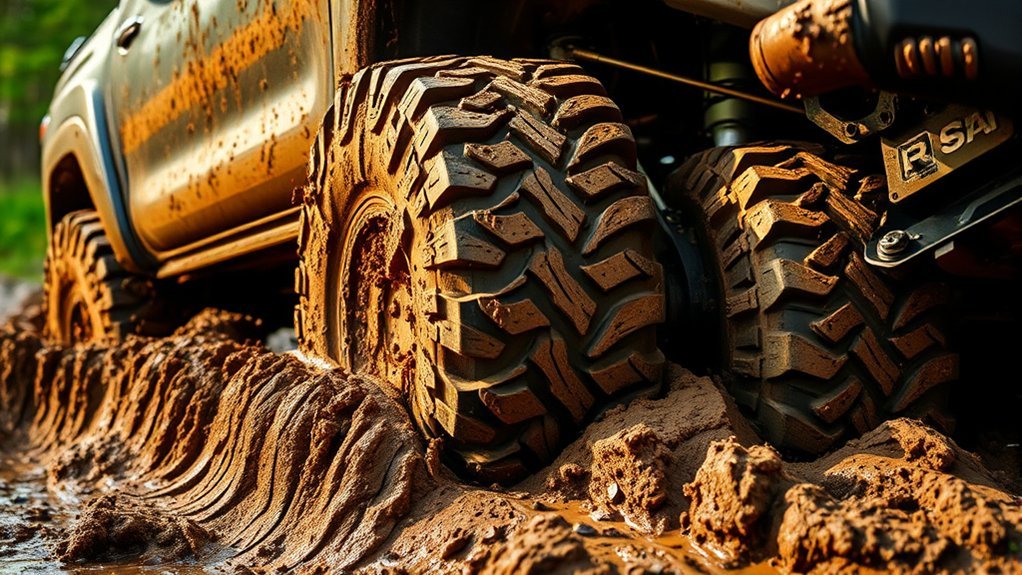
Deep mud can stop a Toyota Hilux quickly if the tyres are wrong, the pressure is wrong, or the driver relies on wheelspin instead of control. The best setup starts with mud-terrain or aggressive all-terrain tyres in the correct size and load rating, then adds safe pressure adjustment, steady momentum, and proper recovery gear.
Quick Answer
For deep mud, a Toyota Hilux works best on mud-terrain tyres with large voids, strong sidewalls, and a self-cleaning tread pattern. Airing down can improve grip, but 15–20 PSI should be treated as an off-road starting range only. Reinflate to the door-placard pressure before road-speed driving.
Key Takeaways
- Choose mud-terrain tyres if your Hilux regularly sees deep, sticky mud; choose all-terrain tyres if you still drive mostly on road.
- Look for wide voids, staggered shoulder lugs, reinforced sidewalls, LT construction, and a load rating suitable for your Hilux.
- Lower tyre pressure only for slow off-road driving, then reinflate before highway use.
- Use 4WD before entering the mud, keep momentum steady, and avoid sudden throttle or braking.
- Carry recovery boards, a shovel, a compressor, a pressure gauge, and rated recovery gear before attempting deep mud.
At a Glance
| Time Required | 10–20 minutes to inspect tyres, adjust pressure, and prepare recovery gear before entering mud |
| Difficulty | Moderate; easy to prepare, but deep mud recovery can be difficult and dangerous |
| Tools Needed | Tyre pressure gauge, portable air compressor, recovery boards, shovel, gloves, rated recovery points, and recovery strap or winch kit |
| Cost | Low if adjusting current tyres; higher if upgrading to LT mud-terrain tyres, wheels, lift, or recovery equipment |
Why Tyre Selection Is Crucial for Mud Performance
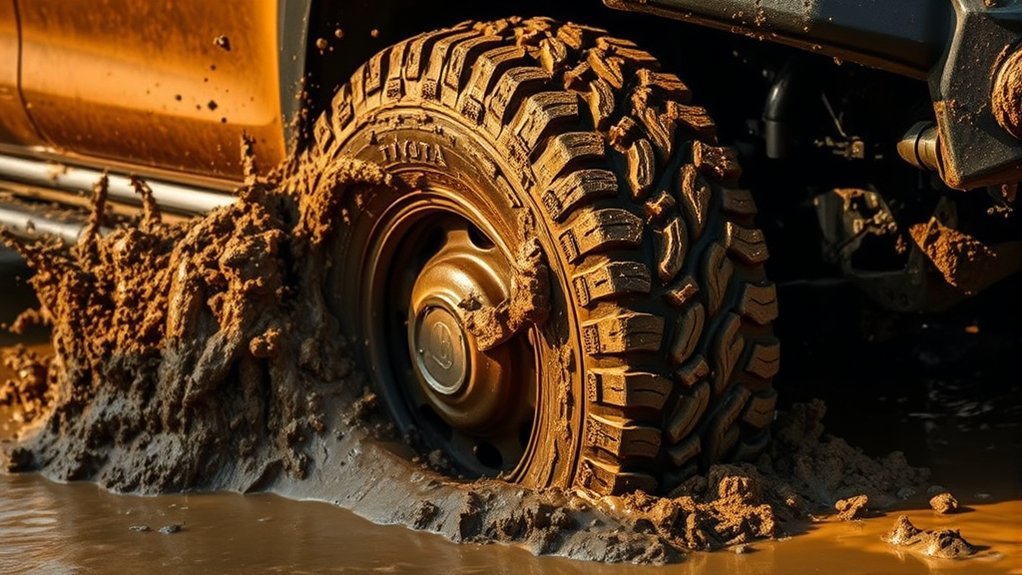
Your tyres are the only part of the Hilux touching the ground, so mud performance starts there. In deep mud, a highway tyre or mild all-terrain tyre can pack its tread with clay and turn slick. A proper mud-terrain tyre uses open tread voids, shoulder lugs, and a stronger casing to keep biting as the tyre rotates.
A good example is the BFGoodrich Mud-Terrain T/A KM3, which uses shoulder features designed to release compacted mud and large tread blocks for grip from different approach angles. Other quality mud-terrain tyres use similar ideas: open channels, staggered edges, side-biting lugs, and tougher sidewalls.
That said, mud-terrain tyres are not perfect for every Hilux. They can be noisier on the road, wear faster than highway tyres, and reduce wet-road comfort if you choose an extreme pattern. The best tyre is the one that matches how often you drive in mud, how much road driving you do, how heavy your Hilux is, and what local laws allow.
Note: Hilux specifications vary by country, generation, cab style, trim, and tyre package. Check your tyre placard, owner’s manual, wheel clearance, and local modification rules before changing tyre size or load rating.
Mud-Terrain vs All-Terrain Tyres for a Hilux
The right choice depends on how much mud you actually drive through. A weekend trail Hilux that sees deep ruts and clay needs a different tyre from a work ute that spends most of its life on bitumen, gravel roads, and wet job sites.
| Tyre Type | Best For | Main Trade-Off |
|---|---|---|
| Highway Terrain | Daily driving, towing on sealed roads, light gravel | Poor self-cleaning in deep mud |
| All-Terrain | Mixed road, gravel, mild mud, touring | Can clog in sticky clay or deep ruts |
| Rugged-Terrain / Hybrid | Drivers wanting stronger off-road bite without full mud-tyre noise | Not as aggressive as a true mud-terrain tyre |
| Mud-Terrain | Deep mud, ruts, clay, rocky tracks, low-speed off-road use | More road noise, weight, rolling resistance, and possible wear compromise |
Key Features of Mud-Terrain Tyres for the Hilux
When choosing mud-terrain tyres for a Toyota Hilux, do not shop by tread appearance alone. The important details are tread void, shoulder design, casing strength, sidewall protection, tyre construction, and the correct load rating for your vehicle.
Tread Design Advantages
Deep mud needs a tread pattern that can bite, empty itself, and bite again. If the voids are too small, mud packs between the blocks and the tyre becomes smooth. A good mud-terrain pattern gives mud somewhere to escape as the tyre rotates.
| Key Feature | Why It Helps in Mud |
|---|---|
| Deep, aggressive tread blocks | Bite into soft ground instead of skating over the surface |
| Large voids between lugs | Help the tread clear mud and regain grip each rotation |
| Staggered shoulder lugs | Add side bite when the Hilux is leaning in ruts |
| Stone and mud ejectors | Reduce clogging and help protect the tread base |
| Siped tread blocks | Improve wet-road and slippery-surface edges, depending on tyre design |
Sidewall Durability Features
In deep ruts, the sidewall often hits mud banks, roots, buried rocks, and sticks. That is why sidewall strength matters on a Hilux used off-road. Look for light-truck construction, a suitable load index, strong shoulder protection, and sidewall lugs that add grip without exposing the casing to unnecessary damage.
Do not choose the tallest or widest tyre just because it looks tough. A tyre that rubs the body, fouls the mudflaps, overloads the spare-wheel space, or changes gearing too much can make the Hilux worse to drive. A slightly smaller tyre with the correct construction and pressure can outperform a larger tyre that does not fit properly.
Finding the Right Tyre Pressure for Mud
Lowering tyre pressure can improve mud traction because the tyre lengthens its contact patch and conforms better to uneven ground. It can also make the ride smoother over ruts. But pressure is not a magic number, and too little air can cause bead loss, sidewall damage, heat build-up, rim strikes, and poor steering response.
Warning: Airing down is for slow off-road driving only. Before driving at road speed, reinflate to the cold tyre pressure shown on the Hilux tyre placard or owner’s manual. Do not use the maximum PSI printed on the tyre sidewall as your normal road-pressure setting.
| Mud Condition | Off-Road Starting Point | What to Watch |
|---|---|---|
| Firm base with slippery top layer | Moderate reduction from road pressure | You may want the tyre to cut through to the firm base rather than float |
| Deep, soft mud | Around 15–20 PSI as a cautious starting range for many 4WD setups | Avoid sharp steering, high speed, and heavy throttle that can unseat a bead |
| Rocky mud or hidden roots | Stay higher than you would in soft mud | Protect the rim and sidewall from impact damage |
| Loaded Hilux or towing near the trail | Use more pressure than an empty ute | Extra weight increases heat and sidewall stress |
Use a quality pressure gauge and make small changes. If the Hilux starts floating and gripping better, stop there. If the steering becomes vague, the sidewalls bulge heavily, or the tyre starts rolling under the rim, add pressure back.
Pro Tip: Air down before the hard section, not after you are already buried. Then reinflate with a compressor as soon as you return to faster gravel or paved roads.
How Tread Patterns Affect Mud Performance
Tread pattern matters because mud is not one surface. Wet clay, black soil, peat, rutted forest tracks, and muddy river approaches all behave differently. Some mud needs the tyre to dig. Some mud needs the tyre to float. Some mud hides rocks and roots that can tear a sidewall.
For most Hilux owners, the best mud tyre has three traits: open centre voids to clear muck, strong shoulder lugs to grip rut walls, and enough tread depth to keep working after partial wear. If the tread blocks are too close together, the tyre may look aggressive when clean but perform poorly once packed with clay.
A clean mud-terrain tread grips. A clogged mud-terrain tread becomes a slick. Self-cleaning ability is what separates a real mud tyre from a tyre that only looks aggressive.
How to Read Mud Before Driving In
Before entering deep mud, stop and inspect it. The best tyre cannot fix a bad decision if the ruts are deeper than your clearance or the mud hides water, holes, rocks, or tree roots.
- Check depth first. Use a stick, shovel handle, or visible tyre tracks to judge how deep and soft the section is.
- Look for a firm base. If there is a hard base under the slime, a controlled line may work. If there is no base, recovery risk rises fast.
- Watch rut height. If the centre hump is higher than your clearance, you may belly out even with good tyres.
- Plan your exit. Do not enter unless you can see where the Hilux will climb out.
- Turn around if needed. Avoiding a bad mud hole is better than damaging tyres, driveline parts, or recovery gear.
Driving Technique for a Hilux in Deep Mud
Tyres do the gripping, but technique keeps them working. Engage 4WD before entering the mud, not halfway through. Use 4H for moderate slippery tracks and 4L for thick mud, steep exits, or slow technical sections where torque control matters.
BFGoodrich’s mud-driving advice is simple: assess the terrain, engage 4WD early, use lower gears when conditions are thick, maintain steady momentum, and avoid rapid acceleration or braking. That approach suits the Hilux because it reduces wheelspin and keeps the tread clearing instead of digging holes.
- Keep momentum steady. Too slow and you sink; too fast and you lose control.
- Use smooth throttle. Spinning tyres polish the mud and dig the Hilux deeper.
- Keep the wheels mostly straight. Heavy steering angle adds drag and can pull you into ruts.
- Avoid sudden braking. Let engine braking and low-range control help where safe.
- Do not fight every rut. Sometimes following the rut is safer than climbing out of it sideways.
Essential Tyre Maintenance Tips for Off-Roading
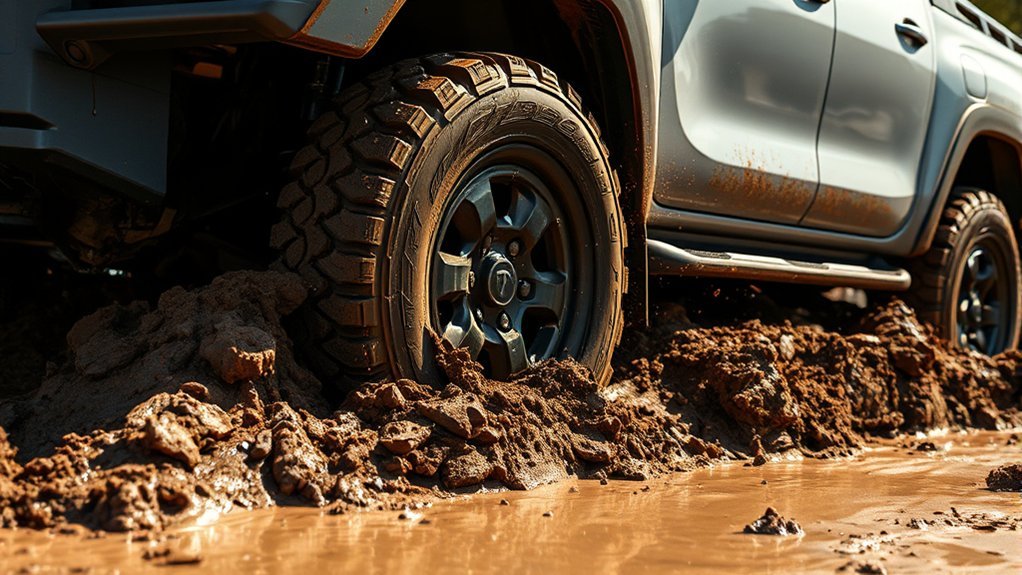
Tyre maintenance matters before, during, and after a mud trip. Mud hides damage, throws wheels out of balance, and can pack into tread voids, brakes, and wheel wells.
Before the Trail
- Check tyre pressure while tyres are cold.
- Inspect tread depth, sidewalls, valve stems, and spare tyre condition.
- Confirm wheel nuts are tight and there is no obvious cracking or bulging.
- Pack a compressor, gauge, puncture repair kit, and valve-core tool.
- Make sure your spare tyre matches the rolling diameter closely enough for safe 4WD use.
After the Trail
- Reinflate to road pressure before highway speeds.
- Wash mud from tread blocks, wheel barrels, brakes, and suspension components.
- Inspect sidewalls for cuts, bubbles, exposed cords, or impact marks.
- Check for mud trapped between the tyre bead and rim.
- Rebalance wheels if vibration appears after the trip.
- Rotate tyres according to your Hilux maintenance schedule and tyre pattern.
The NHTSA tyre safety guide also recommends regular pressure checks, tread inspection, rotation where appropriate, and using the vehicle manufacturer’s recommended cold pressure rather than the number printed on the tyre sidewall.
Upgrading Your Hilux: What to Consider for Tyres
When upgrading Hilux tyres for mud, the goal is not just “bigger.” The goal is more usable traction without ruining clearance, gearing, braking, legal compliance, or road safety.
- Confirm the correct tyre size range. Start with the tyre placard and owner’s manual, then compare legal upgrade limits in your region.
- Choose the right construction. Light-truck tyres are usually better suited to loaded off-road work than passenger-construction tyres.
- Check load rating. Your tyres must support the Hilux, passengers, canopy, tools, camping gear, and towing load if applicable.
- Watch wheel offset. Poor offset can create rubbing, heavy steering, bearing stress, or guard contact.
- Check spare fitment. A larger tyre may not fit in the factory spare location.
- Plan for mud clearance. Mud builds up around guards and suspension, so a tyre that barely clears when clean may rub badly off-road.
Can You Fit 33-Inch Tyres on a Hilux?
Many Hilux owners run 33-inch tyres, but it is not a universal bolt-on upgrade. Depending on the model, wheel offset, suspension height, body mount clearance, mudflaps, guards, and local rules, 33s may require a lift, trimming, different wheels, speedometer correction, engineering approval, or a different spare-wheel plan.
If your Hilux is still a daily driver, a smaller aggressive mud-terrain tyre that clears properly can be a better choice than a larger tyre that rubs, adds weight, and strains the driveline.
Recovery Gear You Should Carry in Mud
Even with the right tyres, a Hilux can still get stuck. Mud recovery is safer when you prepare before the trip and know how to use the equipment.
- Recovery boards: Useful for self-recovery before calling in another vehicle.
- Long-handled shovel: Clears mud from in front of tyres and under the chassis.
- Portable compressor: Lets you air down and reinflate safely.
- Accurate pressure gauge: Prevents guessing.
- Rated recovery points: Essential for safe vehicle recovery.
- Recovery strap or kinetic rope: Use only with proper rated points and correct technique.
- Winch and damper: Better for deeply bogged vehicles when fitted and used correctly.
- Gloves and communication: Keep hands protected and drivers coordinated.
Warning: Never recover from a tow ball, bumper hitch, unrated tie-down point, or damaged strap. Keep bystanders away from loaded recovery lines, use a damper where appropriate, and avoid strap recovery if the vehicle is deeply buried in mud. A winch or professional recovery may be safer.
For recovery technique and safety basics, BFGoodrich’s off-road recovery guide explains strap recovery, winching, rated points, dampers, and common mistakes to avoid.
Real-World Performance of Hilux in Mud
The Toyota Hilux is a capable off-road ute, especially in 4×4 form with low range, suitable tyres, good clearance, and the right driver inputs. Toyota has highlighted Hilux features such as ladder-frame construction, off-road tuning, ground clearance, and wading capability on some models, while newer variants in some markets add systems such as Multi-Terrain Select.
But real-world mud performance still depends on setup and judgment. A stock Hilux on road-biased tyres can struggle in clay. A modified Hilux on heavy 33-inch mud tyres can still get stuck if the driver enters deep ruts too fast, runs the wrong pressure, or has no recovery plan.
| Factor | Why It Matters | Best Practice |
|---|---|---|
| Tyres | Tread and sidewall design control grip and durability | Use mud-terrain or aggressive all-terrain tyres suited to your driving |
| Pressure | Affects footprint, steering, bead security, and rim protection | Air down carefully off-road, then reinflate before road speed |
| 4WD mode | Improves control and torque delivery in slippery terrain | Engage 4WD before the mud; use 4L for slow, thick, technical sections |
| Driver technique | Wheelspin digs holes and reduces control | Use smooth throttle, steady momentum, and gentle steering |
| Recovery plan | Mud recovery can become dangerous without proper gear | Carry rated gear and try self-recovery before snatch or winch recovery |
Frequently Asked Questions
What is the weakness of the Toyota Hilux in mud?
The Hilux is capable, but its weaknesses in mud usually come from setup and conditions: road-biased tyres, too much tyre pressure, limited underbody clearance in deep ruts, extra vehicle weight, and poor recovery planning. Some leaf-spring rear setups can also feel firm when unloaded, so smooth throttle and correct pressure matter.
Is the Toyota Hilux good for off-road driving?
Yes, a 4×4 Hilux can be very capable off-road when it has suitable tyres, correct pressure, enough clearance, and a careful driver. Model features vary by market and trim, so check whether your Hilux has low range, rear differential lock, traction modes, or other off-road aids.
How do you get better traction in mud?
Use tyres with open tread voids, engage 4WD before entering the mud, reduce pressure carefully for slow off-road driving, keep momentum steady, and avoid aggressive throttle. If the Hilux starts digging down instead of moving forward, stop early and recover before it sinks deeper.
Can you fit 33s on a Hilux?
Often, yes, but not always as a simple bolt-on. Many Hilux builds need a suspension lift, suitable wheel offset, trimming, mudflap changes, alignment correction, and legal approval. Check clearance at full steering lock and suspension compression before committing to 33-inch tyres.
Are mud-terrain tyres bad on the road?
They are not bad when used correctly, but they usually have more road noise, more weight, and different wet-road feel than highway or all-terrain tyres. If your Hilux spends most of its time on sealed roads, an aggressive all-terrain or hybrid tyre may be the better compromise.
Should I use 4H or 4L in mud?
Use 4H for moderate slippery tracks where you need momentum at a reasonable trail speed. Use 4L for thick mud, steep exits, slow ruts, or technical sections where controlled torque matters more than speed. Engage the correct mode before entering the mud.
Conclusion
The best Toyota Hilux tyre setup for deep mud is not just the most aggressive tread you can buy. It is a complete system: mud-ready tread, strong sidewalls, correct load rating, safe off-road pressure, smooth 4WD technique, and proper recovery gear. Choose tyres that match your real driving, air down carefully when conditions call for it, and always reinflate before returning to road speed. With the right preparation, your Hilux will have a far better chance of driving through mud instead of digging into it.
Sources
- BFGoodrich Mud-Terrain T/A KM3 — supports mud-terrain tread features and mud-clearing shoulder design.
- BFGoodrich Mud Driving Tips — supports terrain assessment, 4WD use, lower gears, momentum, and recovery basics.
- BFGoodrich Off-Road Recovery Techniques — supports recovery safety, strap technique, rated recovery points, and winching cautions.
- NHTSA Tire Safety — supports tyre pressure, tread inspection, rotation, and cold pressure guidance.
- Toyota Europe Hilux Off-Road Information — supports Hilux off-road design, ground clearance, and wading capability for specified models.
- Toyota Europe All-New Hilux 2026 — supports current Hilux variant and market-specific capability context.

Related Articles
What Toyota Hilux Tires Work Best on Sand
Looking for the best tires for your Toyota Hilux on sand? Discover the top choices and essential tips to enhance your off-road experience.
Read More
Key Tire Features for Toyota Hilux Rock Crawling
As you explore key tire features for rock crawling with your Toyota Hilux, discover how the right choices can transform your off-road adventures.
Read More
Choosing Toyota Hilux Tires for Desert Conditions
Aiming for optimal performance in desert conditions? Discover the best tire options and essential maintenance tips to conquer the sand with your Toyota Hilux.
Read More