
How to Change a Flat Tire on a Toyota Hilux Step by Step
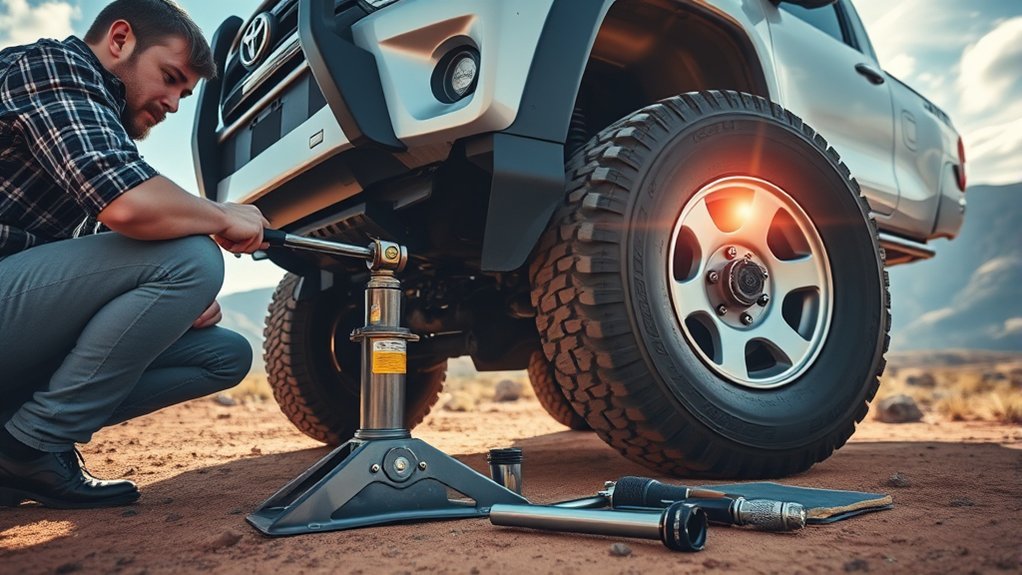
A flat tire on a Toyota Hilux is frustrating, but the safest fix is a calm, ordered process: get out of traffic, secure the vehicle, loosen the wheel nuts before lifting, use the correct jack point, fit the spare, then tighten and check everything before driving away. Always follow your Hilux owner’s manual for your exact model year, trim, jack points, tire pressure, and wheel nut torque.
Quick Answer
To change a flat tire on a Toyota Hilux, park on solid level ground, switch on the hazard lights, set the parking brake, chock the wheels, loosen the wheel nuts, lift the Hilux at the correct jack point, install the spare, tighten the nuts in a star pattern, lower the vehicle, and check the spare tire pressure.
Key Takeaways
- Do not change a tire in a live lane, on a slope, or on soft ground. Call roadside assistance if the location is unsafe.
- Loosen the wheel nuts while the flat tire is still on the ground, then lift the Hilux using the jack point shown in your owner’s manual.
- Tighten the wheel nuts in a star pattern. Many recent Hilux manuals list 105 N·m (77 ft·lbf), but your exact model-year manual is the final authority.
- Check the spare tire’s pressure, tread, sidewall condition, and age before driving far.
At a Glance
| Time Required | 20–45 minutes in a safe, well-lit location |
| Difficulty | Beginner to moderate, depending on wheel nut tightness and roadside conditions |
| Tools Needed | Spare tire, Hilux jack, lug wrench or wheel nut wrench, wheel wedges, tire pressure gauge, gloves, flashlight, warning triangle, and wheel lock key if fitted |
| Cost | Usually $0 at the roadside if your spare and tools are usable; tire repair or replacement costs come afterward |
Warning: Never work under a Hilux supported only by the jack, and never change a tire where passing traffic could hit you. If you cannot get to a stable, well-lit, traffic-free spot, call roadside assistance.
What Tools Do You Need?
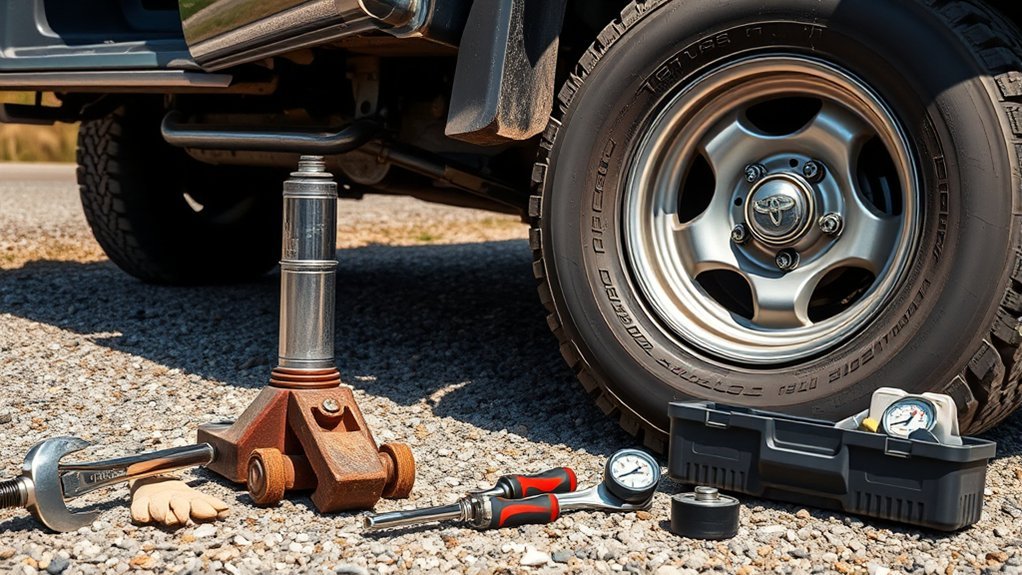
Before you start, gather every tool so you are not searching around while the Hilux is raised. Your Toyota Hilux should have a jack, a wheel nut wrench, and a spare tire, but the storage location can vary by model year, body style, and market. Check your Toyota owner’s manual if you are unsure where the spare, jack, or tools are stored.
- Spare tire: Make sure it is inflated, undamaged, and suitable for your Hilux.
- Hilux jack: Use the supplied jack only at the approved jack points shown in your manual.
- Lug wrench or wheel nut wrench: This is used to loosen and tighten the wheel nuts.
- Wheel wedges or chocks: These help stop the vehicle from rolling.
- Tire pressure gauge: Use this to check the spare before driving away.
- Gloves and flashlight: Helpful at night or in poor weather.
- Warning triangle or reflective marker: Use it where local rules allow and where it can be placed safely.
- Wheel lock key: Needed if your Hilux has locking wheel nuts.
Note: Toyota Hilux wheel and tire sizes vary by trim and market. Toyota UK technical specifications list 17-inch steel, 17-inch alloy, and 18-inch alloy wheel options on recent Hilux models, so do not assume every Hilux uses the same spare, pressure, or torque specification.
[Products Worth Considering]

Universal magnetic jack pad with aluminum grooved design to protect vehicle pinch welds during lifting. Durable nylon pad inserts are upgraded and secured with screws to resist damage and keep in place. Designed to fit most single vehicle pinpoint welds for safer, stable jacking when changing tires, repairs, or performing oil changes.

This car emergency kit keeps essential roadside tools organized in a durable, portable bag so you can respond quickly during common driving emergencies. It includes battery jumper cables, a bright LED headlight, first aid supplies, a tire pressure gauge, and safety essentials like gloves and an emergency poncho. Designed for trunk or storage use, it helps you be prepared for dead batteries, minor malfunctions, and unexpected roadside issues.

This roadside assistance kit helps drivers and passengers in urgent situations after an accident or breakdown, providing practical support while waiting for help. It includes a lightweight, compact tire inflator for fast inflation of standard vehicle tires, plus reinforced jumper cable protection for safer handling. Ideal for winter weather, road trips, camping, and travel, with everything stowed neatly in a trunk bag.
Find a Safe Location to Change Your Tire
The safest tire change starts before you touch the tools. If you feel a blowout or flat tire while driving, hold the steering wheel firmly, avoid sudden braking, slow down gradually, and move away from traffic when it is safe.
Safe Parking Areas
Look for a flat, solid, wide area such as a parking lot, service station, driveway, or broad shoulder well away from traffic. Avoid curves, hills, soft sand, mud, gravel shoulders, and narrow roads where other drivers may not see you.
Turn on your hazard lights as soon as you are slowing down. If passengers are inside, move them to a safe place away from the vehicle and traffic before you begin.
Avoiding Traffic Hazards
Do not change a tire in an active lane. If the Hilux is in a dangerous position, move only the shortest safe distance needed to clear traffic, then stop. Driving on a standard flat tire can damage the tire and wheel and reduce control, so do not continue toward home or a repair shop on the flat.
Ground Stability Considerations
The jack must sit on firm, level ground. A jack can sink, tilt, or slip on soft ground, which can drop the vehicle without warning. If the ground is unstable, do not lift the Hilux there. Call for help or move to a safer place if it can be done without creating a bigger hazard.
Secure Your Vehicle Before Starting
Once stopped, secure the Hilux before loosening anything:
- Switch on the hazard lights.
- Set the parking brake.
- Put an automatic transmission in Park. For a manual transmission, select Reverse or 1st gear according to your manual’s guidance.
- Place wheel wedges on the opposite end of the vehicle: in front of the front tires when changing a rear tire, or behind the rear tires when changing a front tire.
- Place a warning triangle only if it is safe and legal to do so.
Pro Tip: Put the removed wheel nuts inside the hubcap, a small container, or your pocket so they cannot roll under the vehicle or into traffic.
Loosening Lug Nuts: A Step-By-Step Guide
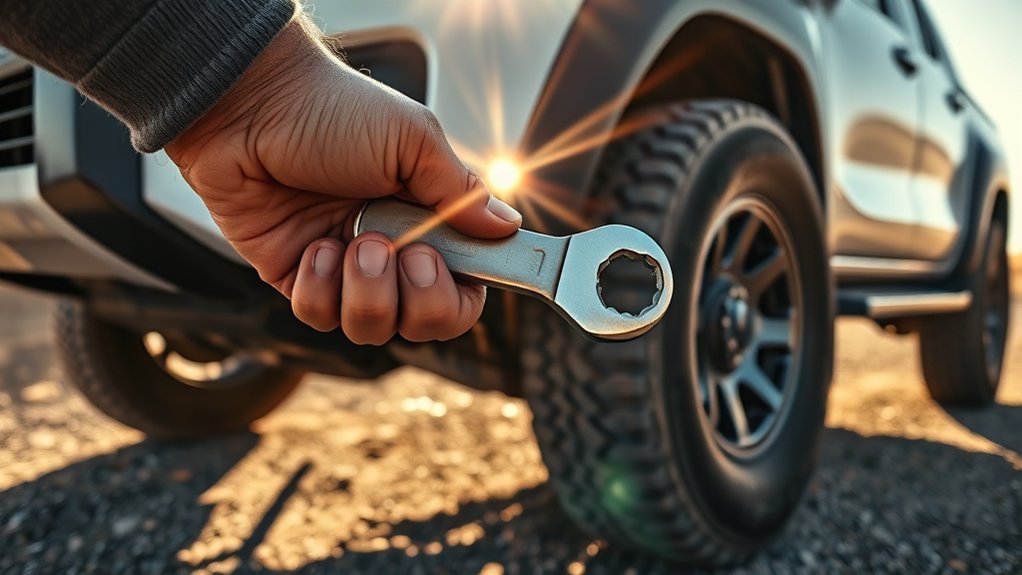
Loosen the wheel nuts before lifting the vehicle. The tire’s contact with the ground helps stop the wheel from spinning while you break the nuts free.
Proper Tool Selection
Use the correct wheel nut wrench or a properly sized socket. A loose-fitting tool can round the wheel nuts, making the tire change much harder. If the Hilux has locking wheel nuts, fit the wheel lock key carefully and keep it straight while applying pressure.
Correct Loosening Technique
Turn each wheel nut counterclockwise about ¼ to ½ turn. Do not remove the nuts yet. Work in a star or crisscross pattern so the wheel stays evenly seated.
If a nut will not move, do not jump on the wrench or use unsafe extensions beside traffic. Try steady body weight with controlled pressure. If the nut still will not loosen, call roadside assistance.
Safety Precautions Required
Keep your body out of the traffic side of the vehicle when possible. If you need to work on the traffic-facing side and there is not enough room, stop and call for help. A flat tire is not worth risking a roadside strike.
How to Properly Use a Car Jack
Place the jack only under the correct Hilux jacking point shown in your owner’s manual. Do not lift from thin body panels, steps, suspension arms, or plastic trim unless your manual specifically identifies that point for jacking.
- Position the jack squarely under the approved jack point.
- Check that the jack base is flat and stable.
- Raise the Hilux slowly until the flat tire is just clear of the ground.
- Stop immediately if the jack leans, shifts, sinks, or makes the vehicle unstable.
Warning: A vehicle jack is for lifting during a wheel change, not for supporting a person underneath the vehicle. Never place any part of your body under the Hilux while it is supported only by the jack.
[Products Worth Considering]

This spare tire tool kit is designed for the 2004 to 2018 Ford F-150 to help you loosen and tighten wheel lug nuts and manage the spare tire and provided jack functions from underneath the vehicle. It includes the lug nut wrench and extension pieces plus a convenient storage carrying case for organized transport. The jack itself is not included.

Keep RV, trailer, or truck dual-axle tires protected with waterproof, UV-resistant covers that help guard against sunlight, snow, rust, and dirt. The dual tire covers are easy to install with a rope/bungee fastener for a stable fit that won’t easily slip. Designed for 27–30 inch diameter wheels, they help maintain tire condition through harsh weather.

1. SOLID 2-TON LIFTING POWER – Industrial steel construction safely lifts 4000lb vehicles. Locking gear prevents drops—trusted for roadside emergencies on any terrain
Best Practices for Removing the Flat Tire
With the Hilux raised and stable, finish removing the wheel nuts by hand. Pull the flat tire straight toward you. If it sticks, check that all nuts are fully removed, then gently rock the wheel from the sides. Do not kick the vehicle or shake it hard while it is on the jack.
Before fitting the spare, quickly inspect the wheel hub and mounting surface. Remove loose dirt, stones, or debris that could stop the spare from sitting flat. If you see severe damage to the studs, wheel, hub, or brake area, do not continue driving after the tire change; arrange a professional inspection.
Installing the Spare Tire With Care
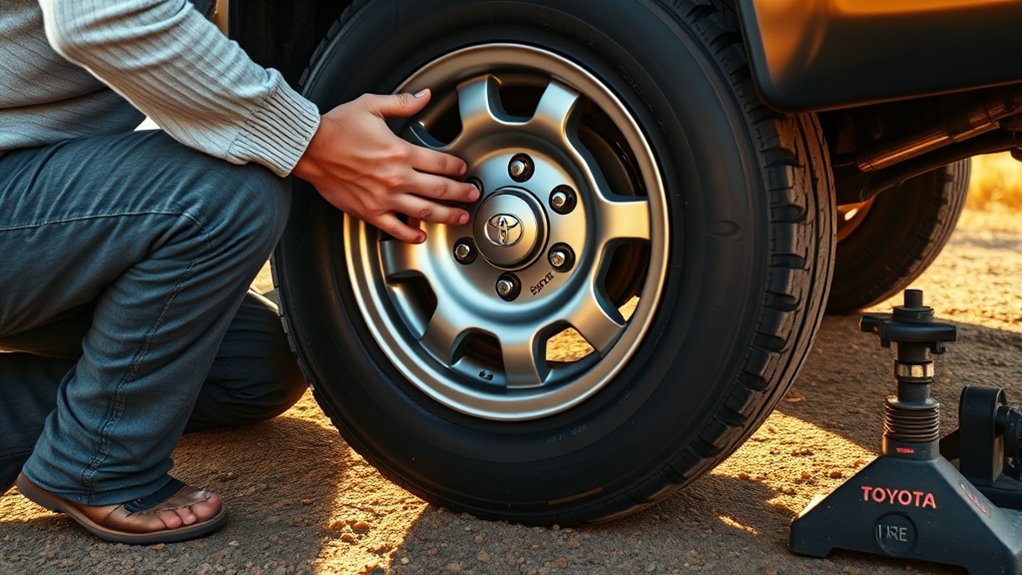
Lift the spare tire onto the wheel studs and push it flush against the hub. The wheel should sit flat with no gap between the wheel and mounting surface.
[Products Worth Considering]
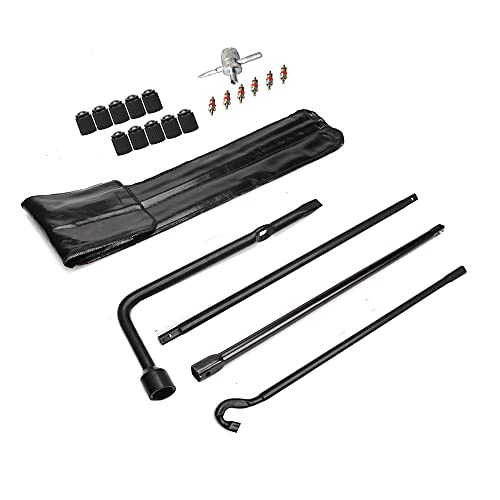
Premium OEM Upgraded Quality Spare tire tool: Stable strong rustproof automotive grade steel,tubing instead of soil designed made it more light,not only stong but also convenient.

Wrench Size:The Socket Size is 21mm,pls kindly confirm if the size is the same before order.

Wrench Size:The Socket Size is 21mm,pls kindly confirm if the size is the same before order.
Proper Alignment Techniques
Line up the spare tire with the studs before pushing it into place. If the wheel does not slide on smoothly, do not force it at an angle. Reposition it until the holes and studs line up cleanly.
Secure Lug Nut Tightening
Install each wheel nut by hand first. This reduces the risk of cross-threading. Tighten the nuts by hand in a star pattern until the spare is seated, but do not fully tighten while the wheel is still in the air.
Many recent Toyota Hilux owner manual excerpts list a wheel nut tightening torque of 105 N·m (77 ft·lbf). However, torque can vary by model year, market, wheel type, and equipment, so the safest rule is to use the exact figure in your Hilux owner’s manual or on the vehicle’s service information.
Safety Checks Post-Installation
Before lowering the vehicle fully, confirm that every nut is threaded correctly and the spare sits flat. If a nut feels rough, crooked, or stuck, remove it and start again by hand.
Tighten Lug Nuts and Lower the Vehicle
Lower the Hilux until the spare tire just touches the ground and cannot spin. Tighten the wheel nuts in a star pattern. Lower the vehicle fully, remove the jack, then tighten the nuts again in the same star pattern with a torque wrench if one is available.
| Step | Action | Why It Matters |
| 1 | Hand-thread all nuts | Prevents cross-threading |
| 2 | Tighten in a star pattern | Seats the wheel evenly |
| 3 | Use the manual’s torque spec | Avoids loose or overtightened nuts |
| 4 | Recheck after a short drive if advised | Confirms the wheel remains secure |
How to Check Spare Tire Condition?
Before driving away, check the spare tire carefully. The National Highway Traffic Safety Administration advises drivers to check all tires, including the spare, and to use the vehicle manufacturer’s recommended cold inflation pressure from the tire placard or owner’s manual.
- Pressure: Use a tire pressure gauge. Inflate to the pressure listed for your Hilux, not the maximum pressure molded on the tire sidewall.
- Tread: Replace a tire when tread reaches 2/32 inch, and consider replacing earlier for wet or off-road use.
- Damage: Look for cracks, cuts, bulges, exposed cords, punctures, or tread separation.
- Age: Check the DOT/TIN date code. The U.S. Tire Manufacturers Association explains that the last four digits show the week and year of manufacture.
Michelin recommends professional inspection after five years of service and replacement at ten years from the manufacturing date, including spare tires, even if the tread looks usable. Follow the most conservative guidance from your vehicle manual and tire manufacturer.
Driving After Installing the Spare
Drive carefully after fitting the spare. Avoid hard braking, fast cornering, heavy loads, towing, and off-road driving until the flat tire has been repaired or replaced. If your Hilux uses a temporary spare, follow the speed and distance limits printed on the spare tire or listed in your owner’s manual. Temporary spares are meant to get you to a repair facility, not to replace a regular tire for daily driving.
A spare tire is an emergency solution. The real finish line is a properly repaired or replaced road tire, checked wheel hardware, and a safe return to normal driving.
Common Tire Change Mistakes to Avoid
- Changing the tire too close to traffic: Move to a safer place or call for help.
- Skipping wheel wedges: A Hilux can roll even when it looks stable.
- Lifting before loosening the wheel nuts: This can make the wheel spin and can destabilize the vehicle.
- Using the wrong jack point: This can damage the vehicle or cause the jack to slip.
- Removing nuts while the wheel is unsupported: Loosen first, lift, then remove fully.
- Overtightening or guessing torque: Use the owner’s manual and a torque wrench whenever possible.
- Driving away without checking pressure: An underinflated spare can fail quickly.
- Forgetting the flat tire: Secure the removed tire, jack, tools, and warning triangle before leaving.
When to Call Roadside Assistance
Call roadside assistance instead of changing the tire yourself if:
- You are on a motorway, highway shoulder, blind curve, bridge, or narrow road.
- The ground is soft, sloped, muddy, sandy, or unstable.
- The spare tire is flat, damaged, missing, or the wrong size.
- The wheel nuts are stuck, rounded, missing, or fitted with a lock key you cannot find.
- The jack is damaged or cannot be placed securely.
- You see damage to the wheel studs, hub, suspension, or brake parts.
- You feel unsafe for any reason.
Frequently Asked Questions
How do you take a Toyota Hilux tire off?
Park on solid level ground, set the parking brake, chock the wheels, loosen the wheel nuts slightly while the tire is on the ground, lift the Hilux at the approved jack point, remove the nuts fully, and pull the wheel straight off the hub.
Should I loosen the lug nuts before jacking up my Hilux?
Yes. Loosen the wheel nuts about ¼ to ½ turn while the flat tire is still on the ground. This keeps the wheel from spinning and reduces movement while the vehicle is on the jack.
Where should I place the jack on a Toyota Hilux?
Use only the approved jack point shown in your Hilux owner’s manual. Do not lift from plastic trim, side steps, thin body panels, or suspension parts unless the manual specifically identifies that point for jacking.
What is the Toyota Hilux wheel nut torque?
Many recent Hilux owner manual excerpts list 105 N·m, or 77 ft·lbf, but the correct torque can vary by model year, wheel type, and market. Use the value in your own Hilux owner’s manual or service information.
Can I drive on a flat tire to reach a better location?
Avoid driving on a flat tire. If staying where you are is immediately dangerous, move only the shortest safe distance needed to clear traffic, then stop. Driving on a standard flat can damage the tire and rim and reduce control.
How far can I drive on a Toyota Hilux spare tire?
It depends on the spare type. A matching full-size spare may allow normal short-term driving if it is properly inflated and in good condition. A temporary spare must follow the speed and distance limits on the tire and in the owner’s manual. In all cases, repair or replace the flat tire as soon as possible.
What should I do after changing the tire?
Check the spare tire pressure, secure the flat tire and tools, drive cautiously, and go to a tire shop or Toyota service center. Have the flat tire repaired or replaced and ask for the wheel nuts to be checked with a torque wrench.
Conclusion
Changing a flat tire on a Toyota Hilux is manageable when you put safety first and follow the right order. Stop in a safe place, secure the vehicle, loosen the wheel nuts before lifting, use the correct jack point, install the spare carefully, and tighten the nuts to the correct specification. Afterward, treat the spare as a temporary solution until the flat tire and wheel hardware have been professionally checked.
Sources
- Toyota UK Owner’s Manuals — model-specific Hilux owner manual lookup for jack points, tool locations, and vehicle-specific instructions.
- Toyota UK Hilux Technical Specifications — wheel and tire size variations by trim.
- NHTSA TireWise — tire pressure, spare tire checks, tread depth, and tire safety guidance.
- AAA Club Alliance: How to Change a Tire — safe tire-change sequence and roadside guidance.
- U.S. Tire Manufacturers Association: Tire Facts — tire age, DOT/TIN date code, and regular tire inspection guidance.
- Michelin: When to Replace Tires — tire aging, treadwear indicators, and spare tire replacement guidance.

Related Articles

Toyota Hilux Run-Flat Tires: What You Need to Know
Take control of your safety with Toyota Hilux run-flat tires; discover their benefits and hidden costs that could change your driving experience forever.
Read More
Effects of Underinflated Tires on the Toyota Hilux
Inadequate tire pressure in your Toyota Hilux can lead to serious safety issues and costly repairs; discover how to avoid these pitfalls.
Read More
The Risks of Overinflating Toyota Hilux Tires
Overinflating your Toyota Hilux tires can lead to dangerous blowouts and uneven wear, but understanding the risks is crucial for your safety.
Read More