
Effects of Underinflated Tires on the Toyota Hilux
Underinflated tires can make your Toyota Hilux less stable, less efficient, and more vulnerable to tire damage. The risk grows when you drive fast, carry a heavy load, tow, or continue driving with a tire that is losing air. You can prevent most pressure-related problems by checking every tire cold, using the pressure listed on your Hilux’s placard, and investigating repeated pressure loss promptly.
Quick Answer
Underinflated Toyota Hilux tires can build excess heat, wear unevenly, reduce steering precision, increase rolling resistance, and raise the chance of tire failure. Check pressure when the tires are cold and inflate them to the driver-side placard or owner’s manual specification, which may change with tire size, market, and vehicle load.
Key Takeaways
- Use the cold-pressure figure on your Hilux’s tire placard or owner’s manual, not the maximum pressure molded into the tire sidewall.
- Check all road tires and the spare at least monthly, before long trips, and before carrying heavy loads or towing.
- Low pressure can increase sidewall flex, heat, rolling resistance, irregular wear, and the risk of internal tire damage.
- A tire that repeatedly loses pressure may have a puncture, leaking valve, bead leak, damaged wheel, or another fault that needs inspection.
- Do not treat TPMS as a replacement for a manual pressure check with an accurate gauge.
At a Glance
| Time Required | About 5 to 10 minutes |
| Difficulty | Easy |
| Tools Needed | Accurate tire-pressure gauge and an air source |
| Cost | Usually minimal if you already own a gauge |
Warning: Do not continue driving on a visibly flat tire or a tire with a bulge, exposed cord, severe cut, rapid air loss, or strong vibration. Stop in a safe place and arrange repair or replacement. Continued driving can damage the tire and wheel and may cause loss of control.
What Causes Tire Underinflation and Why It Matters?
Tires do not need a large puncture to lose pressure. Air can escape slowly through the tire casing, valve, valve core, bead area, or a small object lodged in the tread. A bent or corroded wheel can also prevent the bead from sealing correctly. According to Michelin’s tire-pressure guidance, tires can lose up to about 1 PSI per month, which is why a visual inspection alone is not enough.
Temperature changes also affect the gauge reading. Pressure normally falls as the surrounding air gets colder and rises as it gets warmer. The U.S. Tire Manufacturers Association advises that pressure may change by roughly 1 to 2 PSI for each 10°F change in temperature. This does not always mean the tire has a puncture, but you should still correct it to the vehicle’s specified cold pressure.
[Products Worth Considering]

EVOULTES heavy duty tire inflator with an integrated gauge delivers accurate pressure readings from 10–120 PSI, helping you inflate, deflate, and check tires in one tool. The 16.5-inch extended dual-head air chuck with swivel base reaches hard-to-access dual wheel valves on trucks and RVs. A brass trigger core and side-mounted air release valve make operation smooth, with standard 1/4" NPT threading and quick-connect compatibility for easy setup.

This portable cordless tire inflator delivers up to 160 PSI with fast 17 L/min airflow to help you quickly top up tires and get back on the road. It features dual power mode, running on a 21V rechargeable battery or a 12V DC adapter for convenient roadside use. An automatic shut-off with digital pressure gauge helps prevent overinflation, and a built-in LED light improves visibility in low-light conditions.

The JACO FlowPro Tire Inflator measures, inflates, and airs down tires up to 100 PSI with battery-free operation and ±2% accuracy after calibration. It features a glowing pressure dial for night visibility, a heavy-duty steel build with a hybrid hose, and a precision push-to-inflate thumb trigger. The patented Lightning Air Chuck locks on for a secure seal, and the kit includes quick-connect hardware for easy inline use with your air compressor.
Common Causes of Repeated Pressure Loss
- Natural air loss: Small molecules gradually pass through the tire materials.
- Temperature change: Colder weather lowers the measured pressure.
- Tread puncture: Nails, screws, and sharp debris can create a slow leak.
- Valve leakage: A loose or damaged valve core, stem, seal, or missing cap can allow air to escape.
- Bead or wheel damage: Corrosion, dents, or debris where the tire meets the rim can break the seal.
- Impact damage: Potholes, rocks, and curb strikes can damage the tire internally even when the exterior looks acceptable.
Pro Tip: Record each tire’s cold pressure for several mornings. If one tire loses noticeably more air than the others, have it inspected instead of repeatedly topping it up.
How Underinflation Raises Heat and Tire-Failure Risk
An underinflated tire flexes more as it rolls. That repeated flexing creates heat and stress inside the casing. The National Highway Traffic Safety Administration warns that poor tire maintenance and insufficient inflation can contribute to flats, blowouts, and tread separation. The risk becomes more serious during sustained high-speed driving, hot weather, heavy loading, or towing because these conditions add heat and load.
A small pressure error does not guarantee immediate failure. However, continuing to drive after a tire becomes significantly low can damage its internal structure. Inflating it later may not reverse that damage. A tire professional should inspect any tire that has been driven while visibly low, especially if you noticed heat, odor, vibration, sidewall distortion, or a TPMS warning.
The correct pressure is the vehicle manufacturer’s cold-pressure specification for your tire size and load, not the maximum pressure printed on the tire sidewall.
Underinflated Tires: Effects on Handling, Stability, and Braking
Your Hilux depends on each tire maintaining its intended shape under load. When pressure is too low, the sidewall bends more and steering response may feel slow or vague. The truck may feel less settled during lane changes, cornering, crosswinds, or sudden avoidance maneuvers.
Compromised Steering Response
Low pressure can change how quickly the tire responds to steering input. You may notice heavier steering, delayed turn-in, wandering, or a pull if one side is lower than the other. These signs can also come from alignment, suspension, brake, or tire-damage problems, so confirm the pressure with a gauge before assuming underinflation is the only cause.
Decreased Cornering Stability
Excess sidewall flex can make the vehicle feel less precise during turns. Wet roads, loose gravel, a high center of gravity, cargo, and abrupt steering can make the problem more noticeable. Correct pressure helps the tire support the vehicle as designed, but it cannot overcome worn tread, unsuitable tires, excessive speed, or unsafe loading.
Longer or Less Consistent Stopping
Incorrect pressure can alter the tire’s contact shape, temperature, and response during braking. The exact change in stopping distance cannot be predicted from a simple PSI-to-percentage table because it depends on tire design, tread depth, road surface, speed, load, temperature, and the vehicle’s braking systems. Treat any change in braking feel as a reason to slow down and inspect the tires.
| Condition | What You May Notice | Recommended Action |
|---|---|---|
| One tire slightly low | Possible pull, TPMS alert, or no obvious symptom | Measure all tires cold, correct the pressure, and monitor for leakage |
| Several tires low | Slower steering response, more rolling resistance, or softer ride | Inflate to the placard specification and recheck after the next cold soak |
| Rapid pressure loss or visible deformation | Strong pull, vibration, noise, heat, or an obviously low tire | Stop safely and do not continue driving on the damaged tire |
Fuel Efficiency and Tire Wear
Underinflation increases rolling resistance, so the engine must use more energy to move the truck. The effect varies with the size of the pressure loss, tire construction, vehicle speed, load, road, and driving style. The U.S. Department of Energy reports that underinflated tires can lower fuel economy by about 0.2% for every 1 PSI drop in the average pressure of all tires. It also states that correct inflation can improve fuel economy by an average of about 0.6% and by as much as 3% in some cases.
Low pressure can also cause extra wear near the shoulders of the tread, although wear patterns are not a perfect diagnosis by themselves. Alignment errors, worn suspension parts, overloading, hard cornering, and incorrect rotation can produce similar damage. Check pressure first, then have the vehicle inspected if irregular wear continues.
Why Fuel-Cost Claims Need Context
You cannot accurately predict an annual fuel cost from tire pressure alone without knowing your mileage, fuel price, engine, tire type, pressure deficit, and driving conditions. The practical point is simpler: maintaining the specified pressure reduces avoidable rolling resistance and helps the tires wear as intended.
Key Signs of Underinflated Tires
A tire can look normal while still being low, especially on a pickup with stiff sidewalls. Use a gauge rather than relying on appearance. Possible warning signs include:
- A low-pressure or TPMS warning on the instrument panel
- One tire looking flatter than the others
- Steering that feels heavy, vague, or uneven
- The Hilux pulling to one side
- New vibration, thumping, or tire noise
- Excessive shoulder wear on the tread
- Repeated need to add air to the same tire
- A tire that feels unusually hot after a short drive
- Lower fuel economy without another clear cause
Vibration alone does not prove that a tire is underinflated. It may also signal imbalance, a separated belt, wheel damage, mud inside a wheel, worn suspension parts, or driveline trouble. Slow down and arrange inspection if the vibration is severe or sudden.
How to Check and Correct Toyota Hilux Tire Pressure
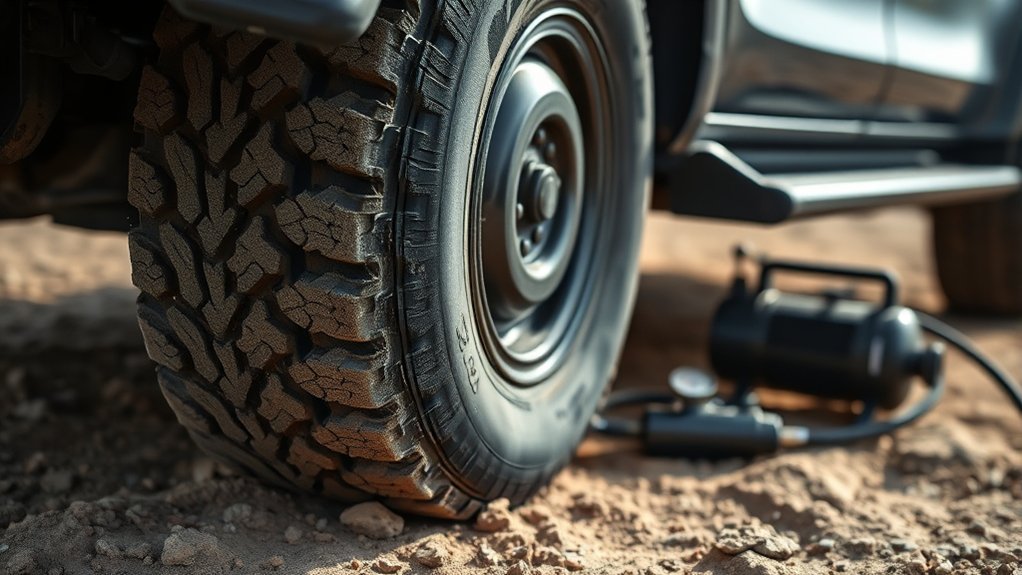
Check the pressure when the tires are cold, ideally before driving or after the vehicle has been parked for at least three hours. Toyota’s current Hilux guidance also says to inspect pressure when the tires are cold. A warm tire normally reads higher, so do not release air merely because the reading rose during a drive.
- Find the correct specification. Read the tire-pressure label on the driver-side door area or the correct owner’s manual for your Hilux’s year, market, tire size, and load condition.
- Check every tire. Remove the valve cap, press the gauge firmly onto the valve, and record the reading. Include the spare if it is designed to be checked and used at a specified pressure.
- Compare front and rear values separately. Your Hilux may use different pressures front to rear or different values when loaded.
- Add air when low. Inflate in small steps, checking the gauge between steps.
- Release air when high. Briefly press the valve core, then measure again. Do this only when setting a genuine cold-pressure reading.
- Refit the valve caps. Caps help keep dirt and moisture away from the valve components.
- Recheck a suspect tire. If one tire falls again, arrange a leak and damage inspection.
Note: TPMS warns about pressure loss, but it may not alert you until a tire is significantly low. Toyota also states that its tire-pressure warning system does not replace routine tire inspection.
| Maintenance Tool | Purpose |
|---|---|
| Accurate pressure gauge | Measures cold tire pressure |
| Portable air compressor | Adds air where a service-station pump is unavailable |
| Valve-core tool and leak solution | Helps a trained person identify simple valve leaks |
| Tread-depth gauge | Checks remaining tread and uneven wear |
| Professional tire inspection | Finds punctures, internal damage, bead leaks, valve faults, and wheel damage |
[Products Worth Considering]

The AstroAI L7 Air Tire Inflator refills car tires quickly with up to 150PSI max pressure and a fast 1-minute inflation claim. It includes 5 preset modes for car, motorcycle, bicycle, balls, and manual use, along with an auto shutoff to help prevent overinflation. Designed for convenience, it features a digital gauge with unit switching, a top LED light with multiple modes, and USB-C/USB ports for backup power.
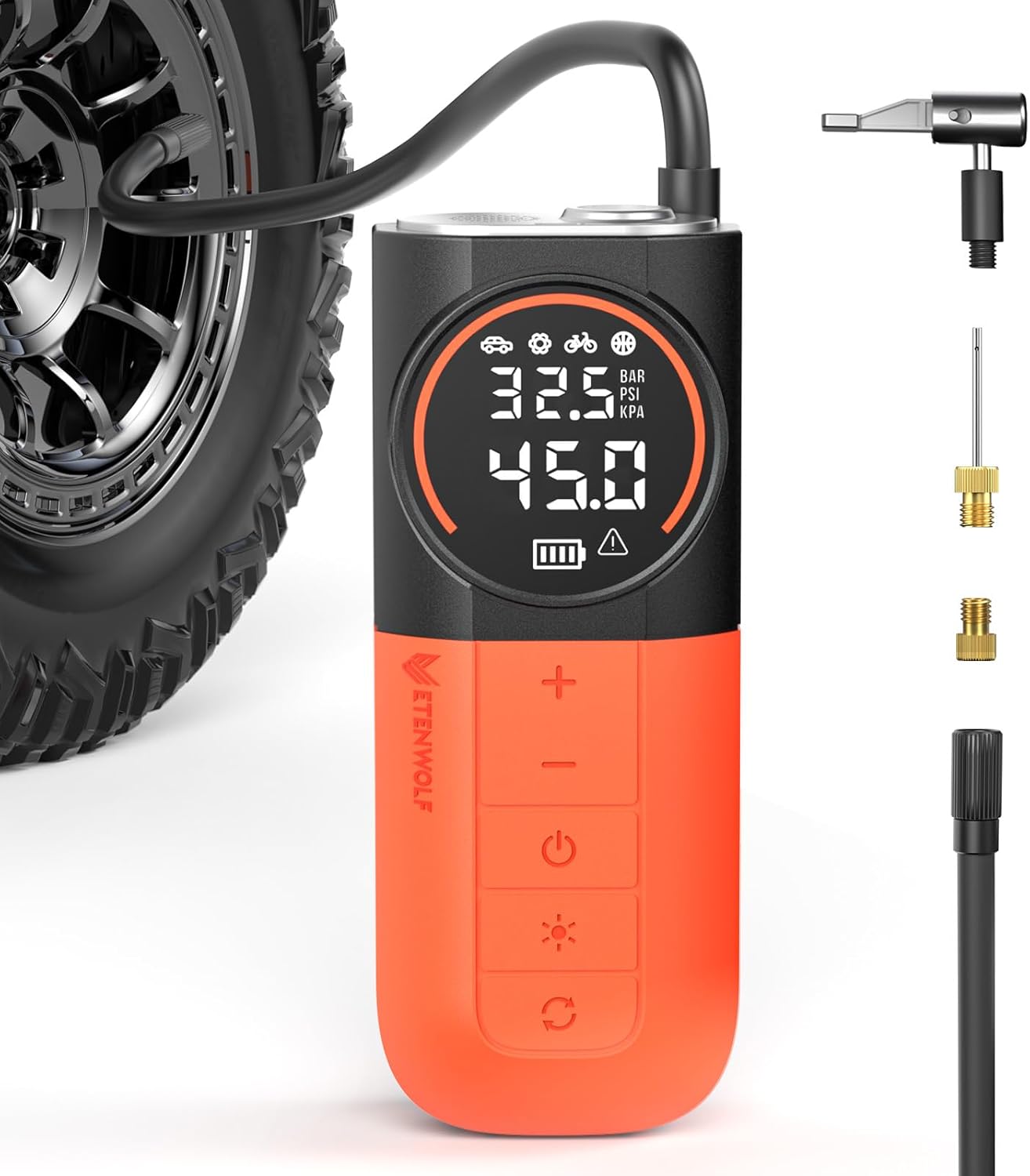
The ETENWOLF S1 cordless tire inflator delivers ultra-fast inflation with up to 160 PSI and a 20 L/min airflow for quicker tire top-offs. Its 5200mAh battery and cooling system support inflating many tires and sports balls on a single charge, while the digital pressure gauge and multi-unit display help you reach the right pressure accurately. With preset modes, pressure memory, an auto-stop feature, and an LED flashlight, it’s built for easy roadside and everyday use.
Pressure for Loads, Towing, and Off-Road Use
Do not assume one pressure suits every Hilux. Toyota specifications can vary by model year, market, wheel and tire size, and load. For example, the official 2026 Japan-market Hilux manual lists 220 kPa, about 32 PSI, front and rear when unladen for its specified 265/60R18 tires. It lists 230 kPa, about 33 PSI, at the front and 250 kPa, about 36 PSI, at the rear when loaded. That is an example for one configuration, not a universal setting for every Hilux.
Before towing or carrying a heavy payload, use the loaded-pressure guidance for your exact vehicle and confirm that the tires’ size, load index, condition, and axle loads are suitable. The U.S. Tire Manufacturers Association recommends checking pressure before long trips, heavy loads, or towing.
Some drivers reduce pressure for low-speed travel on soft sand or other off-road surfaces. A universal off-road PSI is unsafe because the correct choice depends on tire construction, load, terrain, speed, and wheel design. Avoid sharp turns and high speed at reduced pressure, watch for sidewall or bead damage, and reinflate to the correct road pressure before returning to normal paved-road speeds.
When to Seek Professional Help
Arrange a tire inspection when any of the following occurs:
- The same tire loses pressure more than once
- You find a nail, screw, cut, bulge, crack, exposed cord, or damaged valve
- The tire was driven while visibly flat or severely low
- Pressure drops rapidly after inflation
- The steering pulls, vibration continues, or irregular wear develops
- The wheel is bent, cracked, or heavily corroded
- The TPMS warning remains on after the pressures are corrected
Do not use an external plug or liquid sealant as a permanent repair. A qualified technician should remove the tire from the wheel when needed, inspect the inside, and decide whether the damage is safely repairable.
Frequently Asked Questions
What is the correct tyre pressure for a Toyota Hilux?
Use the cold-pressure figures on your Hilux’s driver-side tire placard or the owner’s manual for its exact year, market, tire size, and load. A generic 30 to 35 PSI range is not reliable for every Hilux because some versions use different front, rear, loaded, or towing values.
Is 40 PSI too high for a 4WD Hilux?
Not automatically. Compare 40 PSI with the vehicle’s specified cold pressure for the current load and tire size. It may be above the correct setting for one Hilux and appropriate for a different loaded configuration. Never use the tire sidewall’s maximum pressure as the normal target.
How often should I check Hilux tire pressure?
Check at least once a month when the tires are cold. Also check before a long trip, before carrying a heavy load, before towing, and after a large temperature change or hard impact.
Why does one Hilux tire keep losing air?
Common causes include a tread puncture, leaking valve or valve core, bead leak, wheel corrosion, impact damage, or an unsafe previous repair. Repeatedly adding air does not fix the fault, so have the tire and wheel inspected.
Can I rely on the TPMS warning light?
No. TPMS is a warning system, not a substitute for routine checks. A tire may be below its ideal pressure before the warning appears, and some rapid failures may not produce enough warning time. Measure the tires monthly with a gauge.
Conclusion
Correct tire pressure helps your Toyota Hilux handle, brake, carry loads, and use fuel as intended. Check every tire cold, follow the vehicle placard rather than a universal PSI range, and act quickly when one tire repeatedly loses air. A few minutes of routine inspection can prevent irregular wear, internal damage, roadside trouble, and avoidable safety risks.
Sources
- Toyota Hilux 2026 tire inspection and pressure guidance — cold-pressure checks, placard location, loaded pressures, TPWS limitations, and safety warnings
- Toyota Hilux 2026 maintenance specifications — example tire size and unladen/loaded cold-pressure values for the listed Japan-market configuration
- NHTSA TireWise — monthly cold checks, placard guidance, TPMS limitations, tire-failure risks, and maintenance steps
- U.S. Department of Energy fuel-efficiency guidance — corrected fuel-economy effect of underinflated tires
- U.S. Tire Manufacturers Association tire-care essentials — heat, pressure changes, monthly checks, heavy-load and towing checks, and TPMS limitations
- Michelin tire-pressure guide — normal monthly air loss and step-by-step pressure checking

Related Articles
Toyota Hilux Run-Flat Tires: What You Need to Know
Take control of your safety with Toyota Hilux run-flat tires; discover their benefits and hidden costs that could change your driving experience forever.
Read More
The Risks of Overinflating Toyota Hilux Tires
Overinflating your Toyota Hilux tires can lead to dangerous blowouts and uneven wear, but understanding the risks is crucial for your safety.
Read More
Toyota Hilux Tire Safety Tips Every Driver Should Know
Just ensuring your Toyota Hilux tires are safe can enhance performance; discover essential tips every driver should know to keep you rolling smoothly.
Read More