
Toyota Tundra Tire Size Calculator: How to Figure Upsize Limits Safely
To safely determine tire upsize limits for your Toyota Tundra, start by knowing your current tire specs, including width and diameter. Stick to the 3% rule, ensuring new tires don’t exceed this limit for ideal performance. Consider lift kits, which can allow larger tires. Wheel offset is important too, helping prevent rubbing. Exploring these factors can enhance your Tundra’s capabilities. Keep going to uncover more essential tips for a smooth upgrade.
What You Need to Know About Tire Specs for Your Tundra
When you’re choosing tires for your Toyota Tundra, understanding the specifications is essential to guarantee peak performance and safety. Pay close attention to tire width, aspect ratio, and rim diameter. For instance, a width of 265mm and an aspect ratio of 60% can greatly influence ride comfort and handling.
You’ll also want to take into account the load index and speed rating, as they tell you how much weight your tires can carry and their maximum safe speed. Keeping tire size within 3% of the original diameter helps maintain performance and avoids sensor calibration issues.
Don’t overlook the wheel offset, which affects tire positioning and prevents rubbing against fenders. Finally, always monitor tire pressure and choose tread patterns suited for your driving conditions to guarantee ideal traction and safety on the road. Your Tundra deserves tires that fit perfectly!
Why You Need a Tire Size Calculator
Using a tire size calculator is essential for making sure new tires fit your Toyota Tundra properly. It helps you compare sizes accurately and assess how changes might impact performance, like speedometer readings and handling. By understanding these factors, you can make informed choices that enhance both safety and functionality.
Accurate Size Comparison
Understanding tire sizes can be tricky, especially if you’re considering upgrades. A tire size calculator simplifies this by converting metric tire dimensions to inches, allowing you to easily compare your current tires with potential new ones. It highlights tire dimension variations and offers essential specifications like diameter, width, and sidewall height, ensuring a proper fit. By inputting your current tire data alongside proposed sizes, you can assess compatibility and avoid issues like speedometer inaccuracies. Plus, it helps you adhere to the recommended 3% diameter variance for safety and performance. With these metric conversion tips, you’ll make informed decisions, ensuring your Toyota Tundra remains both stylish and functional on the road.
Performance Impact Assessment
Tire size calculators are essential tools for any Toyota Tundra owner looking to upgrade their tires while maintaining ideal performance. By using a calculator, you can determine the maximum safe increase in tire diameter—typically no more than 3%—to avoid compromising handling and fuel efficiency. Understanding the interplay between tire width, aspect ratio, and overall diameter is vital, as even slight adjustments can lead to significant performance trade-offs. Larger tires might affect your speedometer accuracy, requiring ECU recalibration for precise metrics. Furthermore, using a tire size calculator helps you identify potential rubbing issues with suspension components. Ultimately, it guarantees that your upgraded tires strike the right balance between tire aesthetics and functionality, enhancing your Tundra’s look without sacrificing performance.
Safe Upsize Limits: The 3% Rule
When considering an upgrade to your Toyota Tundra’s tires, it’s essential to follow the 3% rule, which guarantees your new tire size remains safe and effective. This rule dictates that any increase shouldn’t exceed 3% of your original tire’s overall diameter. For instance, if your stock tire diameter is 30 inches, the maximum you should go is 30.9 inches. Sticking to this guideline helps prevent tire rubbing and keeps your speedometer accurate.
Moreover, adhering to the 3% limit is critical for maintaining the functionality of safety sensors, particularly in newer models. You’ll want to verify your tire durability and performance metrics stay intact, so calculating that 3% increase is key. Use the tire size formula or a tire size calculator to determine your current diameter and make informed decisions for a smooth, safe ride.
How Lift Kits Affect Tire Size Options
Installing a lift kit can greatly expand your tire size options, allowing for a more aggressive look and improved off-road performance. Lift kit benefits include accommodating larger tires, with the common rule that 1 inch of lift typically allows for a 1-inch increase in tire height. For a 2–3 inch leveling kit, you can often fit 33- or 35-inch tires, while a 6-inch lift can enable tires up to 37 inches—but be prepared for potential modifications to avoid rubbing.
When selecting tires, it’s essential to evaluate tire fitment, as wheel width and offset play significant roles in clearance. You might need aftermarket wheels for wider tires, ensuring proper backspacing and preventing suspension interference. By understanding these factors, you can maximize your lift kit’s potential and enhance your Tundra’s performance and aesthetics on and off the road.
Why Wheel Offset Matters for Tire Fitment
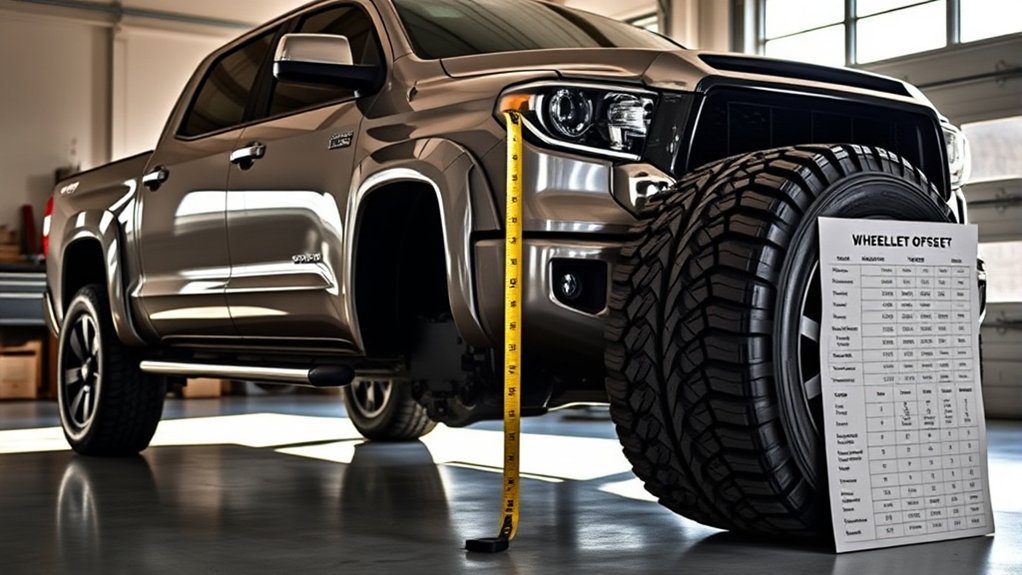
Understanding wheel offset is essential for achieving the right tire fitment on your Toyota Tundra. Offset adjustments play an important role in determining how your wheels interact with the suspension, affecting clearance considerations and stability. A positive offset pulls the wheel closer to the suspension, while a negative offset pushes it away, potentially enhancing tire poke for aesthetic improvements.
If you’re upsizing your tires, proper offset is critical to prevent rubbing against fenders or suspension components. For lifted Tundras, a negative offset is often recommended to improve stance without compromising handling dynamics. Each adjustment can greatly impact performance tuning, as a larger negative offset can increase tire poke by approximately 3/4 inch for every -18 change.
Ultimately, your wheel selection should balance aesthetic desires with suspension compatibility, ensuring a safe and visually appealing fit for your Tundra.
Calculating Tire Size: A Step-by-Step Guide
To calculate tire size upgrades, you first need to understand the dimensions of your current tires. You’ll input this data into a tire size calculator, which will then provide you with options and results for potential upgrades. This process guarantees you make informed decisions for compatibility and performance.
Understanding Tire Dimensions
Tire dimensions play a crucial role in your vehicle’s performance and safety. Understanding how tire construction works is key; for instance, the numbers like 265/70 R18 convey important information. The “265” refers to the tire’s width in millimeters, while “70” is the aspect ratio, indicating the sidewall height as a percentage of that width. This height impacts ride comfort and handling considerably. When you’re considering upgrading tires, remember to keep the new diameter within 3% of the original to maintain speedometer accuracy and handling. To calculate overall diameter, use the formula: Diameter = (Width × Aspect Ratio × 2 / 100) + Rim Diameter. A tire size calculator can help you make informed choices about width implications and fitment.
Inputting Current Tire Data
When it comes to selecting the right tires for your Toyota Tundra, knowing how to input your current tire data is crucial. Start by locating the specifications on the tire sidewall, which include width, aspect ratio, and rim diameter. Input these values into the tire size calculator to get your baseline measurements.
| Specification | Example | Description |
|---|---|---|
| Width | 265 mm | The tire’s width in mm |
| Aspect Ratio | 70 | Height as a percentage of width |
| Rim Diameter | 18 inches | Diameter of the wheel rim |
These metrics will help you determine your tire’s overall diameter and circumference. Always check the calculator’s results with a professional to verify compatibility with your vehicle’s suspension and wheel well clearance.
Analyzing Calculator Output Results
Understanding the output from your tire size calculator is essential for making informed decisions about upgrading your Toyota Tundra’s tires. Start by reviewing the current tire specifications the calculator provides—like diameter, width, and sidewall height. Pay close attention to the recommended limit of a 3% increase in tire diameter to avoid negative impacts on tire performance, such as inaccurate speedometer readings.
Remember the calculator limitations; it can’t account for every variable, such as changes in handling or fuel efficiency. Larger tires can also affect suspension geometry, so consider these factors carefully. After analyzing the results, it’s wise to consult a professional for verification and installation, ensuring your new tires fit perfectly and perform effectively.
Common Tire Sizes for Different Tundra Generations
If you’re looking to upgrade your Toyota Tundra’s tires, knowing the common sizes for different generations is essential. Tire size trends vary considerably between the second-generation Tundra (2007–2021) and the third-generation (2022–present). For the 2007–2021 models, you’ll typically find sizes like 265/70R18, 275/65R18, and 285/70R17, allowing for a maximum of about 33 inches without modifications. In contrast, the 2022–present Tundra features factory sizes including 35×12.50R20 and 285/55R22, accommodating larger tires thanks to lifts and leveling kits.
When making generation comparisons, remember that bolt patterns differ: 5×150 mm for the older models and 6×139.7 mm for the newer ones. Center bore sizes also vary, with older Tundras needing a 110.1 mm bore, and newer ones requiring 95.2 mm. Staying within a 3% diameter increase is key to maintaining performance and avoiding issues.
How to Address Rubbing Issues When Upsizing Tires
Upsizing your Toyota Tundra’s tires can enhance its performance and appearance, but you might run into rubbing issues if you’re not careful. First, verify the new tire diameter doesn’t exceed a 3% increase over the original size. Consider suspension upgrades like a leveling kit for extra clearance, reducing contact with fenders. If rubbing occurs, trimming fender liners or adding wheel spacers can help create the necessary space. Keep an eye on wheel offset; negative offsets can push tires outward, increasing rubbing risk. Regularly check your wheel alignment—improper alignment can worsen rubbing and affect handling, tire wear, and even tire pressure. Finally, remember that your tire’s tread pattern and load rating should match your driving conditions and aesthetic preferences. This way, you can maintain your performance tires’ off-road capabilities without voiding your tire warranty.
Choosing TRD and TRD Pro Wheels After Upgrading
When you upgrade your Toyota Tundra’s tires, choosing TRD or TRD Pro wheels can greatly enhance your truck’s performance and look. These wheels are engineered to handle stress and weight, ensuring peak performance upgrades. Plus, they fit various Tundra generations, guaranteeing TRD wheel compatibility with factory specifications.
Here’s a quick comparison of TRD and TRD Pro wheels:
| Feature | TRD Wheels |
|---|---|
| Design | Aggressive styling |
| Offset | Positive for clearance |
| Availability | Competitive pricing |
Investing in genuine TRD wheels not only boosts your Tundra’s aesthetic appeal but also enhances durability. With their design reducing the risk of rubbing against suspension components, you can confidently choose wider tires. Explore online options to find the perfect match for your Tundra and enjoy the liberation that comes with upgraded performance!
Expert Tips for Professional Tire Installation and Calibration
When upgrading your Toyota Tundra’s tires, using the right tools is essential for a secure installation. After you’ve installed the new tires, don’t forget to recalibrate your speedometer and safety sensors to guarantee everything’s functioning correctly. This attention to detail will enhance your vehicle’s performance and safety on the road.
Proper Tool Usage
Installing new tires on your Toyota Tundra requires the right tools and techniques to verify safety and performance. To secure a successful installation, keep these tips in mind:
- Tire Size Calculator: Use tools like Les Schwab’s calculator to compare dimensions and confirm upgrades align with manufacturer specs, especially during seasonal changes.
- Monitor Tire Pressure: Regularly check tire pressure to maintain peak performance and safety.
- Professional Installation: Consider expert help for alignment and calibration, especially after modifications.
Calibration After Installation
Once you’ve successfully installed your new tires, recalibrating your vehicle becomes a top priority. Oversized tires can throw off your speedometer and odometer, leading to inaccurate readings. To address this, consider professional calibration methods that involve specialized diagnostic tools to adjust your vehicle’s ECU settings for the new tire size. Don’t forget about sensor verification; check the functionality of safety systems like Toyota Safety Sense, as they depend on precise measurements affected by tire size changes. After installation, get an alignment to prevent uneven tire wear and maintain peak handling. Consulting a tire installation expert can help you understand necessary adjustments, ensuring you keep your vehicle’s performance and safety in check.
Frequently Asked Questions
How Much Bigger Can I Go on Tire Size?
You can go up to a 3% increase in tire diameter from your stock size. For tread width, make certain your new tires fit without rubbing, considering wheel backspacing for maximum performance and safety.
Conclusion
When upgrading your Toyota Tundra’s tires, remember that nearly 60% of owners experience improved handling with the right size. By using a tire size calculator and following the 3% rule, you can safely enhance your vehicle’s performance. Don’t forget to take into account lift kits and wheel offset for a perfect fit. With a little research and the right tools, you’ll be ready to tackle any terrain with confidence. Happy driving!

Related Articles
How Tire Size Affects Speedometer Accuracy on a Toyota Tundra
Knowing how tire size influences speedometer accuracy on your Toyota Tundra could save you from costly mistakes—discover what adjustments are necessary.
Read More
Toyota Tundra Aftermarket Wheel Fitment Guide: Offset, Bore, and Bolt Pattern
Wondering how to choose the perfect aftermarket wheels for your Toyota Tundra? Discover essential specs and tips to elevate your ride!
Read More
305/55R20 on a Toyota Tundra With No Lift: Will It Fit?
Not sure if 305/55R20 tires fit your Toyota Tundra without a lift? Discover the surprising truths and tips that could change your ride!
Read More