
2012 Hyundai Sonata Tire Size: OEM Specs & Replacement Options
The right tire for a 2012 Hyundai Sonata depends on the tire-and-loading label on your driver-side center pillar, not a generic trim guess. Most 2012 Sonata models use one of three factory full-size tire specifications: P205/65R16 94H, P215/55R17 93V, or 225/45R18 95V. Match the size, wheel diameter, load index, speed rating, and cold tire pressure to keep the ride, handling, ABS, ESC, and TPMS working as designed.
Quick Answer
A 2012 Hyundai Sonata can use P205/65R16 94H, P215/55R17 93V, or 225/45R18 95V tires, depending on the wheel package. Use the tire size printed on your driver-door placard. Hyundai lists 33 psi for the 16- and 17-inch tires and 35 psi for the 18-inch tires.
Key Takeaways
- Check the driver-side door placard first; it is the best source for your Sonata’s original tire size and pressure.
- Factory full-size options are P205/65R16 94H, P215/55R17 93V, and 225/45R18 95V.
- Use the same tire size on all four wheels unless a qualified tire professional verifies a safe factory-equivalent setup.
- Rotate tires every 7,500 miles or sooner if uneven wear appears.
- Replace tires when the wear bars show, when damage appears, or when age-related cracking makes them unsafe.
At a Glance
| Time Required | 5 minutes to check the placard and sidewall; longer if comparing tire quotes |
| Difficulty | Easy for identifying the tire size; professional help recommended for upsizing or wheel changes |
| Tools Needed | Flashlight, tire pressure gauge, tread depth gauge or penny, and your door placard |
| Cost | Varies by tire size, brand, rebates, installation, TPMS service, and alignment needs |
OEM Tire Sizes for the 2012 Hyundai Sonata
The 2012 Hyundai Sonata owner’s manual lists three full-size tire and wheel combinations. Your exact car may have 16-, 17-, or 18-inch wheels, so the safest move is to match the tire-and-loading label on the driver-side center pillar.
| Factory tire size | Wheel size | Cold pressure | Notes |
|---|---|---|---|
| P205/65R16 94H | 6.5J×16 | 33 psi front / 33 psi rear | Common comfort-oriented 16-inch setup |
| P215/55R17 93V | 6.5J×17 | 33 psi front / 33 psi rear | Common 17-inch touring setup |
| 225/45R18 95V | 7.5J×18 | 35 psi front / 35 psi rear | Sportier 18-inch setup with a shorter sidewall |
| T125/80D16 97H compact spare | 4.0T×16 | 60 psi | Temporary-use spare only |
Hyundai also lists a wheel lug nut torque range of 65–79 lb-ft, or 88–107 N·m. If a shop installs your tires, ask them to torque the lug nuts to specification and recheck if they recommend a follow-up.
Note: The door placard wins over online fitment charts. Packages, previous-owner wheel swaps, and regional equipment can change what is on your car.
[Products Worth Considering]

This portable cordless tire inflator delivers up to 160 PSI with fast 17 L/min airflow to help you quickly top up tires and get back on the road. It features dual power mode, running on a 21V rechargeable battery or a 12V DC adapter for convenient roadside use. An automatic shut-off with digital pressure gauge helps prevent overinflation, and a built-in LED light improves visibility in low-light conditions.

The JACO FlowPro Tire Inflator measures, inflates, and airs down tires up to 100 PSI with battery-free operation and ±2% accuracy after calibration. It features a glowing pressure dial for night visibility, a heavy-duty steel build with a hybrid hose, and a precision push-to-inflate thumb trigger. The patented Lightning Air Chuck locks on for a secure seal, and the kit includes quick-connect hardware for easy inline use with your air compressor.

This portable cordless tire inflator delivers fast, efficient inflation for cars, motorcycles, bikes, and sports balls with a digital pressure gauge. Use the one-click PSI preset with auto shut-off for accurate, hands-free topping to your target pressure up to 150 PSI. It’s compact and rechargeable with a built-in emergency LED light plus valve adapters and accessories for quick, ready-to-go use.
Which Trims Use 215/55R17 vs 205/65R16
Trim names help narrow the search, but they should not be your final proof. A base or comfort-focused Sonata is more likely to have the 16-inch P205/65R16 setup, while 17- and 18-inch wheels are more common on higher or sport-oriented packages. Still, the tire label and the current wheels on the car are what matter when buying replacements.
| What you see on the car | Likely factory tire size | What to verify |
|---|---|---|
| 16-inch wheels | P205/65R16 94H | Door placard, sidewall, load index, and H or higher speed rating |
| 17-inch wheels | P215/55R17 93V | Door placard, 33 psi cold pressure, and V or higher speed rating |
| 18-inch wheels | 225/45R18 95V | Door placard, 35 psi cold pressure, rim width, and clearance |
Read Tire Sidewall Numbers and the Driver-Door Placard
Before ordering tires, compare two places: the sidewall of the tire currently on the car and the tire-and-loading label on the driver-side center pillar. If they disagree, use the placard as the starting point and ask a tire shop whether the current wheels are original or an aftermarket swap.
Decode Sidewall Markings
A tire marked P205/65R16 94H breaks down like this:
- P means passenger-vehicle tire.
- 205 is the tire width in millimeters.
- 65 is the aspect ratio, meaning the sidewall height is 65% of the tire width.
- R means radial construction.
- 16 is the wheel diameter in inches.
- 94 is the load index.
- H is the speed rating.
Check Door Jamb Sticker
The driver-door placard gives the original tire size and recommended cold inflation pressure for your Sonata. Check pressure when the tires are cold, meaning the car has been parked for at least three hours or driven less than about one mile. The NHTSA TireWise guide also recommends using the vehicle placard pressure rather than the maximum pressure molded into the tire sidewall.
Warning: Do not inflate tires to the sidewall maximum unless that number matches a specific service instruction. The sidewall maximum is not the Sonata’s recommended everyday pressure.
What Load Index and Speed Rating Your 2012 Sonata Needs
Use tires that match or exceed the load index and speed rating Hyundai lists for your factory tire size. The speed rating is not a suggestion to drive that fast; it is a tire capability rating that helps preserve the handling and heat-resistance level the car was designed around.
| Factory tire size | Minimum service description | What it means when shopping |
|---|---|---|
| P205/65R16 | 94H | Choose 94H or higher, such as 95H, if the size and fitment are correct. |
| P215/55R17 | 93V | Choose 93V or higher. Do not drop to a lower speed rating without professional guidance. |
| 225/45R18 | 95V | Choose 95V or higher and confirm the tire is suitable for the 7.5-inch wheel. |
If a tire listing shows a higher load index or speed rating in the correct size, that is usually acceptable. A lower load index or speed rating is the problem because it can reduce carrying capacity, heat resistance, and intended handling performance.
Safe Alternate Tire Sizes and Fitment Rules (Can You Mix Sizes?)
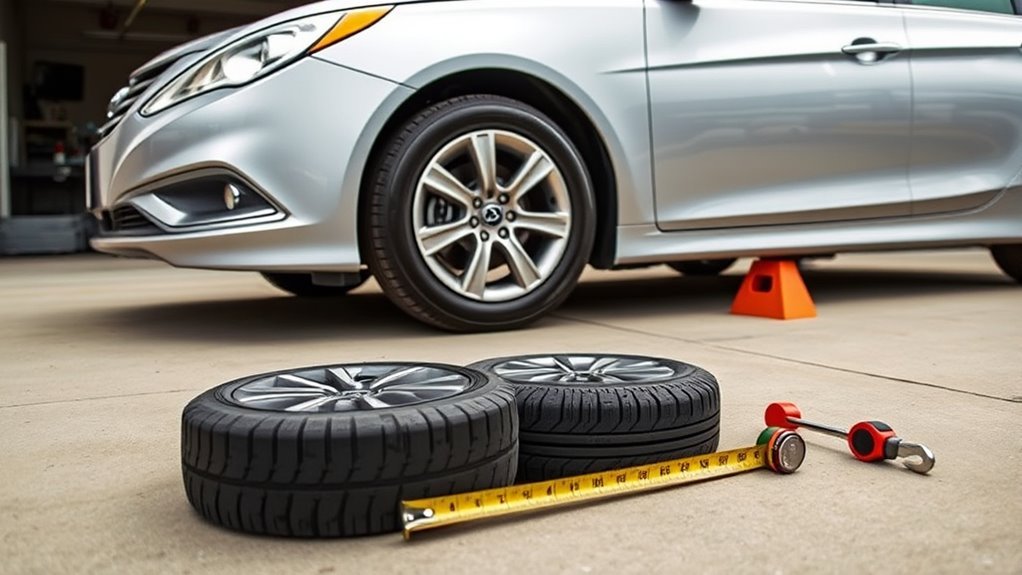
The safest replacement is the same size, load index, and speed rating shown on the door placard. If you want to change wheel diameter, stay within Hyundai’s factory-listed combinations and have a tire professional confirm wheel width, offset, hub fitment, brake clearance, overall diameter, load rating, speed rating, and TPMS compatibility.
Compatible Alternate Sizes
The factory-listed full-size options are P205/65R16, P215/55R17, and 225/45R18. These are not interchangeable by tire alone because each size belongs on a matching wheel diameter and wheel width. You cannot install a 17-inch tire on a 16-inch wheel, and you should not assume that an aftermarket wheel is safe just because the tire diameter looks close.
Pro Tip: If you are upsizing from 16-inch to 17- or 18-inch wheels, price the whole package first: wheels, tires, TPMS sensors, mounting, balancing, alignment check, and possible ride-comfort trade-offs.
Rules For Mixing Sizes
Use the same tire size and construction on all four wheels. Hyundai warns that tire size affects wheel-speed readings used by ABS and ESC, so mixed sizes can create irregular system behavior. Do not mix radial and bias-ply tires, and do not mix a compact spare into a normal rotation pattern.
- Do not run different sizes on the front and rear for normal driving.
- Do not mix all-season, summer, and winter tires on the same set.
- Do not replace only one tire if the other three are heavily worn; ask a shop whether two or four are needed.
- Use the compact spare only as a temporary emergency tire and inflate it to the pressure listed by Hyundai.
Best Replacement Tires for 2012 Sonata: All-Season, Summer, Winter
The best tire depends less on the trim name and more on your climate, road conditions, and driving style. Start with the exact size on your placard, then compare tires in that size.
| Driving need | Best tire type | What to look for |
|---|---|---|
| Daily commuting and highway comfort | Touring or grand touring all-season | Quiet ride, long treadwear warranty, strong wet braking, correct load/speed rating |
| Rainy areas or occasional light snow | All-weather or severe-snow-rated all-season | 3PMSF marking, wet traction, winter traction, and acceptable road noise |
| Cold winters, ice, and regular snow | Dedicated winter tires on all four wheels | Snow and ice braking, cold-weather compound, and a matching set of four |
| Sharper warm-weather handling | Performance all-season or summer tire | Steering response, dry grip, wet grip, and temperature limits for summer tires |
Examples worth comparing in the correct size include current touring all-season lines from Michelin, Continental, Bridgestone, Goodyear, Yokohama, Pirelli, and BFGoodrich. For winter, compare dedicated snow tires from brands such as Michelin, Bridgestone, Continental, Nokian, and Goodyear. Availability changes by size, so filter by your exact tire size before choosing a model.
[Products Worth Considering]
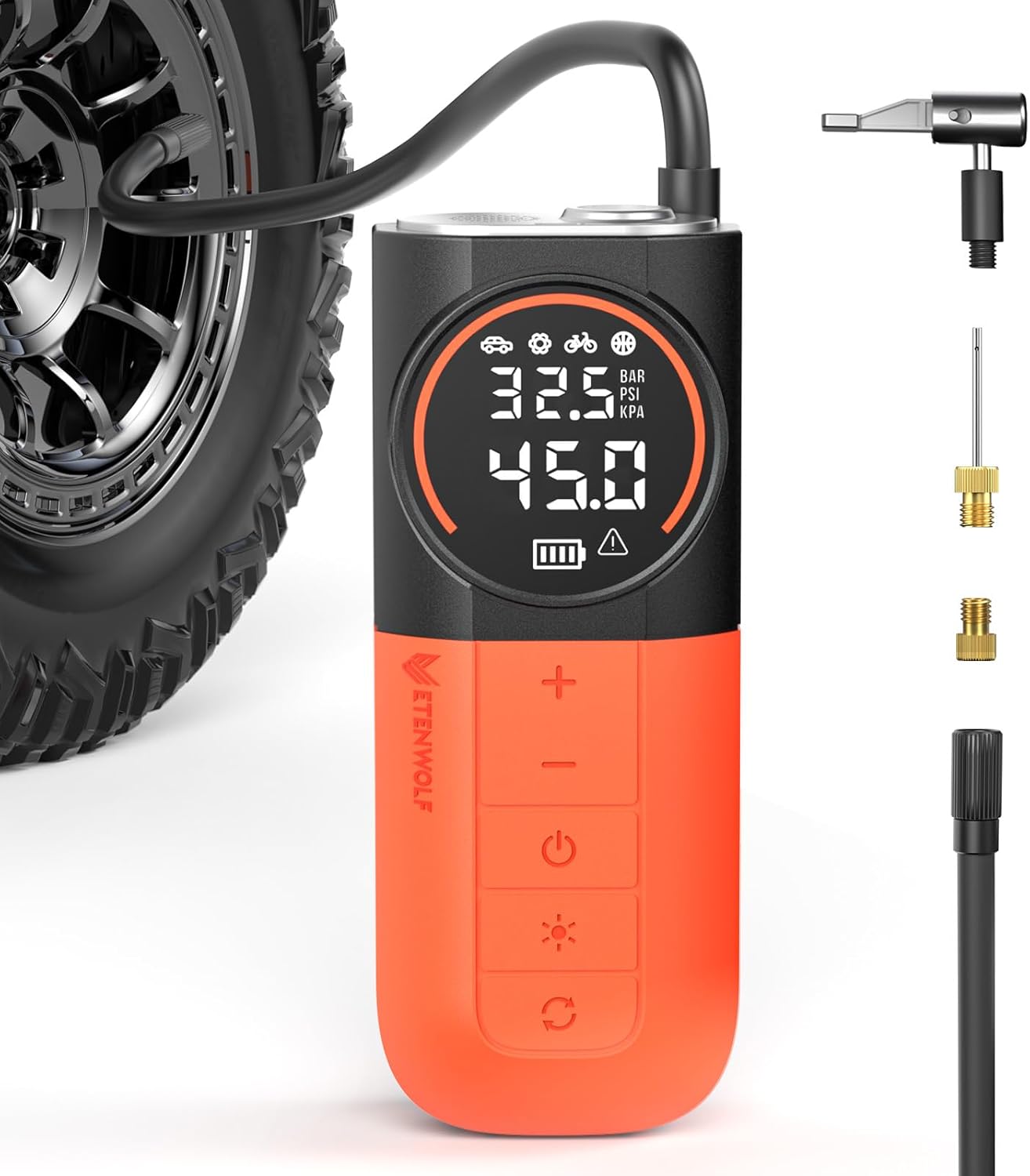
The ETENWOLF S1 cordless tire inflator delivers ultra-fast inflation with up to 160 PSI and a 20 L/min airflow for quicker tire top-offs. Its 5200mAh battery and cooling system support inflating many tires and sports balls on a single charge, while the digital pressure gauge and multi-unit display help you reach the right pressure accurately. With preset modes, pressure memory, an auto-stop feature, and an LED flashlight, it’s built for easy roadside and everyday use.

EVOULTES heavy duty tire inflator with an integrated gauge delivers accurate pressure readings from 10–120 PSI, helping you inflate, deflate, and check tires in one tool. The 16.5-inch extended dual-head air chuck with swivel base reaches hard-to-access dual wheel valves on trucks and RVs. A brass trigger core and side-mounted air release valve make operation smooth, with standard 1/4" NPT threading and quick-connect compatibility for easy setup.
How Tire Age, Tread Depth, and Rotation Affect Replacement Timing
Tires age even when they have tread left, and tread can wear unevenly if pressure, alignment, or balance is off. Check your Sonata’s tires at least monthly and before long trips.
- Rotation: Hyundai recommends rotating tires every 7,500 miles, or sooner if irregular wear develops.
- Tread wear bars: Replace tires when the wear indicator bars show across the tread. That indicates about 2/32 inch of tread remaining.
- Wet-road safety: Consider replacing earlier if you often drive in heavy rain because braking and hydroplaning resistance drop as tread gets shallow.
- Winter driving: Snow traction usually needs more tread depth than dry-road driving, so do not wait for the wear bars if you drive in snow.
- Age: Michelin recommends professional annual inspection after five years of use and replacement by ten years from the manufacture date, even if the tires still look usable.
- Damage: Replace any tire with exposed cords, sidewall bulges, deep cuts, severe cracking, or repeated air loss.
Warning: A tire can pass a quick visual check and still be unsafe. Use a tread depth gauge, check the DOT date code, and have a tire professional inspect cracks, bulges, punctures, or vibration.
Installing and Matching Tires: Balancing, Alignment, and TPMS Tips
Good installation matters as much as buying the right tire. When you install new tires on a 2012 Sonata, ask the shop to handle the full checklist, not just mounting the rubber.
- Match the correct size: Use the tire size on your door placard or a verified factory-equivalent wheel package.
- Balance every wheel: Balancing reduces vibration and helps prevent uneven wear.
- Check alignment: An alignment is wise if the car pulls, the steering wheel is off-center, or the old tires wore unevenly.
- Set cold pressure: Use 33 psi for the factory 16- and 17-inch full-size tires, or 35 psi for the factory 18-inch tire, unless your door placard says otherwise.
- Verify TPMS operation: After replacement, make sure the TPMS warning light is not on. If sensors were replaced or disturbed, the shop may need to relearn or service them.
- Torque lug nuts correctly: Hyundai lists 65–79 lb-ft, or 88–107 N·m, for wheel lug nut torque.
Note: The federal TPMS standard reminds drivers to check each tire monthly when cold and inflate to the vehicle placard pressure. TPMS is a warning system, not a replacement for pressure checks.
Typical Costs, Warranties, and Where to Buy Replacement Tires
Prices change by brand, size, rebates, installation package, and local labor. Current 205/65R16 tire listings and 215/55R17 tire listings show why it is better to compare live quotes than rely on one fixed price range.
When comparing prices, include the full out-the-door cost:
- Tires in the exact size, load index, and speed rating you need
- Mounting and balancing
- Valve stems or TPMS sensor service
- Tire disposal fees
- Road-hazard coverage, if you want it
- Alignment, if uneven wear or steering pull is present
- Sales tax and local shop fees
Treadwear warranties can be useful, but read the terms. Many require proof of regular rotation, correct inflation, and alignment. Road-hazard coverage is usually separate from the manufacturer treadwear warranty.
The cheapest tire is not always the lowest-cost tire. A correctly rated tire with better wet braking, even wear, and a useful warranty can cost less over its service life.
Frequently Asked Questions
What tires come on a 2012 Hyundai Sonata?
The 2012 Hyundai Sonata owner’s manual lists P205/65R16 94H, P215/55R17 93V, and 225/45R18 95V as factory full-size tire specifications. Your exact tire size is printed on the driver-side door placard.
What is my OEM tire size?
Open the driver door and read the tire-and-loading label on the center pillar. Match that size first. If the current tire sidewall shows a different size, ask a tire shop whether the wheels were changed before ordering tires.
Can I use 215/55R17 instead of 205/65R16?
Only if you also have the correct 17-inch wheels and the full setup is verified for fitment. A 215/55R17 tire cannot fit a 16-inch wheel. For most owners, the safest and simplest choice is to replace the tires with the same size shown on the placard.
What tire pressure should a 2012 Hyundai Sonata use?
Hyundai lists 33 psi front and rear for the P205/65R16 and P215/55R17 full-size tires. For the 225/45R18 full-size tire, Hyundai lists 35 psi front and rear. The compact spare is listed at 60 psi. Always follow your door placard if it differs.
Can I replace only two tires?
Sometimes, but it depends on tread depth and tire condition. If two tires are much newer than the others, a shop may recommend replacing all four to keep grip and handling balanced. At minimum, tires on the same axle should match in size, type, and similar tread depth.
Does engine oil affect Sonata tire size or tire pressure?
No. Engine oil choice is separate from tire fitment. Tire size, pressure, load index, and speed rating come from the tire placard, tire sidewall, and owner’s manual tire section.
Conclusion
Your 2012 Hyundai Sonata tire choice should start with the driver-door placard. Hyundai’s factory full-size options are P205/65R16 94H, P215/55R17 93V, and 225/45R18 95V, with 33 psi for the 16- and 17-inch tires and 35 psi for the 18-inch tire. Match the original size whenever possible, keep the same size on all four wheels, rotate every 7,500 miles, and replace tires based on tread, age, damage, and real driving conditions. When in doubt, have a qualified tire shop verify fitment before you buy.
Sources
- 2012 Hyundai Sonata Owner’s Manual — OEM tire sizes, wheel sizes, tire pressures, rotation interval, compact spare pressure, TPMS warnings, and lug nut torque
- NHTSA TireWise — tire pressure, tire safety, tread, and maintenance guidance
- 49 CFR § 571.138 TPMS Standard — monthly cold tire pressure and placard-pressure guidance
- Discount Tire Load Index Guide and Speed Rating Guide — load index and speed rating interpretation
- Michelin Tire Replacement Guidance — tire age, inspection, and replacement timing
- Discount Tire 205/65R16 Listings and 215/55R17 Listings — current size availability and live price comparison examples

Related Articles

Danger of Using Summer Tires in Winter on a Hyundai Sonata
Potentially perilous, using summer tires in winter on your Hyundai Sonata can compromise safety—discover the hidden dangers that await you on icy roads.
Read More
Can You Mix Nitrogen and Air in Hyundai Sonata Tires? Answered
Discover the implications of mixing nitrogen and air in your Hyundai Sonata tires—are the benefits worth the risks? Explore the answer inside!
Read More
How to Tell If Hyundai Sonata Tires Are Too Old to Use Safely
Understand how to assess the age of your Hyundai Sonata tires and discover crucial signs of deterioration that could compromise your safety on the road.
Read More