
Why Do I Keep Getting Nails in My Tires?

If you keep getting nails in your tires, the most likely explanation is repeated exposure to places where nails, screws, wire, and other sharp debris collect. Construction entrances, repair areas, loading zones, road shoulders, and debris-covered parking lots are common places to watch. Tire condition and inflation do not make nails magically appear, but proper tire maintenance can reduce the damage caused by a puncture and help you spot a slow leak sooner.
Quick Answer
Repeated nail punctures usually point to repeated exposure to sharp debris along the routes you drive or places you park. Construction zones, loading areas, road edges, repair sites, and dirty parking lots are common sources. Changing where you drive or park, inspecting your tires, and maintaining the correct pressure can reduce the risk.
Key Takeaways
- Repeated punctures often come from repeated exposure to nails, screws, wire, or scrap near construction, repair, loading, and parking areas.
- Low tire pressure does not necessarily make a tire pick up more nails, but driving underinflated can increase heat, flexing, and internal damage after a puncture.
- If the same tire keeps losing air, do not assume every leak is another nail; the valve, bead, wheel, or a previous repair may also need inspection.
- A passenger or light-truck puncture is generally considered for repair only when it is in the repairable tread area and no larger than 1/4 inch (6 mm).
- Do not pull out an embedded nail yourself. If the tire is rapidly losing pressure, visibly damaged, or flat, stop driving and use a safe alternative such as a spare or roadside assistance.
Why Nails Keep Getting in Tires
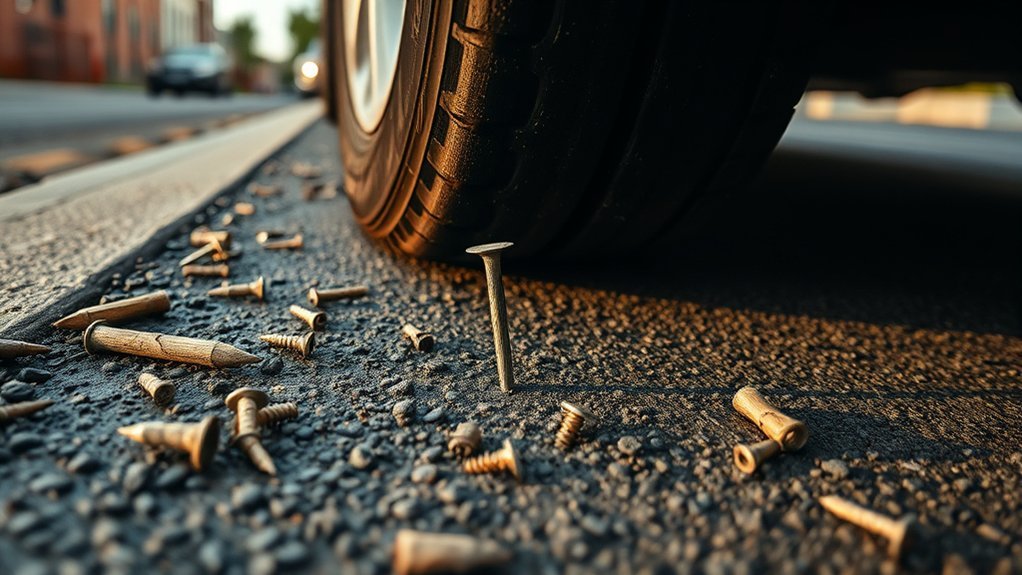
Nails keep getting in tires mainly because sharp metal debris ends up on surfaces your tires repeatedly cross. Common examples include construction entrances, repair shops, loading areas, demolition sites, industrial roads, curbside work zones, and parking lots where building materials or damaged pallets have been handled.
If you use the same road, driveway, job site, or parking area every day, several punctures can feel like extraordinary bad luck even though the underlying problem is simply repeated exposure to the same type of debris.
Your tire condition still matters, but for a different reason. Low pressure does not need to be treated as a proven cause of picking up nails. Instead, an underinflated tire flexes more and can build excess heat, which can make continued driving after a puncture more damaging. The National Highway Traffic Safety Administration recommends maintaining the vehicle manufacturer’s specified cold inflation pressure and checking tire condition regularly.
Likewise, worn tread is a safety concern and eventually requires tire replacement, but you should not assume worn tread is the reason nails keep appearing. Focus first on where you drive and park.
Pro Tip: If punctures keep happening, write down where you drove and parked during the previous day or two. Repeated exposure to one construction entrance, alley, loading area, shoulder, or parking lot may reveal a pattern.
[Products Worth Considering]

The Tymate TM12 RV TPMS delivers real-time tire pressure and temperature monitoring with a stable 433Hz display for safer long-distance driving. It supports simultaneous monitoring across vehicle and trailer zones, includes six alarm modes for pressure, temperature, leakage, battery, and signal loss, and features easy DIY installation with auto calibration. Power is supplied via USB-C charging or solar recharging, with a wide 0–144 PSI range and up to 50 ft signal coverage for RVs and towable trailers.

LiQuiTube Premium Heavy Duty Tire Sealant provides permanent flat tire protection to help maintain proper air pressure while sealing punctures and leaks. It seals bead, rim, and porosity weathering leaks and helps prevent flats in heavy ply industrial tires. Designed for versatile use on trailers and off-road equipment, it can be installed in tubeless tires and also inside tubes.

TP-M13W combination repair unit kit includes wrapped stems with matching patches for fast, reliable tire repairs. It’s suitable for both radial and bias ply tires and is designed for chemical or heat vulcanization. Gray vulcanizing gum with blue backing helps create a strong bond, with the stem portion wrapped for added effectiveness.
Road Hazards That Puncture Tires
You can pick up punctures from nails, screws, wire, sharp metal scraps, broken fasteners, and other debris left on or carried onto the road.
Fallen hardware from trucks, trailers, construction vehicles, repair crews, pallets, and work areas may end up in travel lanes or collect near lane edges and parking areas.
Damaged road edges can create a different type of tire problem. Broken pavement, exposed metal, potholes, curbs, and sharp transitions are more likely to cause cuts, impact damage, or sidewall damage than a classic nail puncture.
Construction Debris
Construction activity can leave nails, screws, wire, broken fasteners, and sharp metal fragments on access roads and nearby pavement. Traffic can then move that material beyond the immediate work zone.
When you drive through or beside an active work area, scan farther ahead and avoid visible debris when you can do so safely.
- Slow down near active work zones and fresh road work.
- Leave enough following distance to see the road surface ahead.
- Avoid debris-covered shoulders and lane edges when it is safe to remain in your lane.
- Inspect your tires afterward if you knowingly drove through scattered metal or construction debris.
If you hear air escaping or notice a sudden pressure warning, move to a safe location before inspecting the tire.
Fallen Hardware
Fallen hardware is another potential source of tire punctures. Nails, screws, bolts, staples, wire, and other small metal pieces can fall from trucks, trailers, tool carts, damaged packaging, or unsecured loads.
These objects may lie flat and be difficult to see. Leaving adequate space behind other vehicles will not stop debris from existing, but it gives you more road visibility and more time to avoid an obvious hazard without making an abrupt maneuver.
If punctures keep occurring, compare your normal routes. Roads serving construction projects, industrial businesses, transfer stations, warehouses, roofing work, or frequent deliveries may expose you to more loose hardware than cleaner alternative routes.
Unsafe Road Edges
Unsafe road edges can damage tires even when no nail is involved. Crumbling pavement, sharp gravel, potholes, damaged curbs, exposed metal, and sudden pavement drop-offs can cut a tire or damage its internal structure.
You are most exposed when a tire strikes a broken edge, drops off the pavement, or is pinched against a curb.
- Slow down before entering visibly damaged pavement.
- Leave reasonable clearance from broken shoulders and curb edges.
- Inspect the tread and sidewalls after a hard impact.
- Have a tire professionally inspected if you notice a bulge, deep cut, vibration, or continuing pressure loss.
How Construction Sites Leave Nails
Construction sites use large quantities of fasteners and metal materials. Nails and screws can fall from open packaging, tool bins, scrap, demolished lumber, pallets, trailers, and work vehicles before crews have a chance to collect them.
Traffic can spread this material from a work area onto access roads, adjacent lanes, shoulders, and nearby parking areas.
Good job-site cleanup reduces exposure, but even a well-managed site can temporarily have debris on the ground while work is underway.
Loose Fasteners On Roads
When crews move tools, lumber, roofing materials, fencing, trim, or other building supplies, loose nails and screws can escape from containers or damaged materials.
You may encounter them near construction entrances, lane closures, pavement cuts, shoulders, and staging areas.
- Watch for cones, barriers, service vehicles, and material-loading areas.
- Reduce speed when road conditions make debris difficult to see.
- Avoid unnecessary lane changes across visibly littered pavement.
- Check your tires after driving through an area where sharp debris was obvious.
If you use the same work-zone route every day, consider a reasonable alternate route if repeated punctures suggest that one area is the source.
Tire-Piercing Debris Spread
A small job site can create a wider debris trail as vehicles move between staging areas and public roads. Nails, screws, cut-off bolts, wire fragments, staples, and pieces of damaged material can be carried on tires, equipment, truck beds, or surrounding pavement.
Traffic can then shift that debris toward turn lanes, shoulders, access points, and parking areas.
Regular tire inspection helps you discover problems sooner, but it does not make the tire puncture-proof. The most useful prevention strategy is reducing unnecessary exposure to visibly contaminated surfaces.
Site Cleanup Gaps
Cleanup gaps can leave nails behind after crews remove formwork, open packaging, dismantle pallets, cut banding, move temporary structures, or clear scrap.
A missed fastener may remain difficult to see in gravel, mud, pavement joints, or along the edge of an access road.
- Inspect busy exit lanes after work activity.
- Clean areas where lumber, pallets, roofing materials, or hardware were stored.
- Collect sharp debris from gravel, mud, and pavement edges.
- Recheck shared vehicle routes after major cleanup.
For drivers, the practical lesson is simple: treat visibly active construction and cleanup areas as higher-debris environments and avoid scattered material when you can do so safely.
How Parking Spots Lead to Tire Punctures
Parking areas can hide nails, screws, staples, wire, broken pallet hardware, and other sharp debris. Small objects often collect near curbs, wheel stops, edges, loading bays, dumpsters, construction materials, and places where maintenance work has been performed.
Turning into or out of a space can bring several parts of the tread across debris that was easy to miss while approaching the spot.
A sidewall can also be damaged by a curb, sharp edge, or other object, but sidewall damage should be treated differently from an ordinary repairable tread puncture.
When practical, choose a visibly clean parking space and avoid driving directly across loose metal, broken materials, or discarded hardware.
How Your Driving Habits Lead to Tire Punctures
Your driving choices cannot prevent every puncture, but they can affect how often your tires cross visible debris.
Following too closely can reduce your view of the pavement ahead. Driving unnecessarily on shoulders or dirty lane edges can also place your tires where loose debris often accumulates.
- Leave enough following distance to see and respond to hazards ahead.
- Avoid driving on shoulders except when necessary and safe.
- Do not make abrupt swerves to avoid a small object if doing so would create a greater collision risk.
- Slow down appropriately in construction, demolition, loading, and road-repair areas.
- Keep your tires at the vehicle manufacturer’s recommended pressure.
Defensive driving is useful here because it gives you more time to identify and avoid obvious debris. It does not guarantee that a hidden nail will be visible.
Why the Same Tire May Keep Losing Air
If one tire repeatedly loses pressure, do not automatically assume you have collected another nail. A tire and wheel assembly can leak for several reasons.
- Another puncture: A new nail, screw, or sharp object may have penetrated the tread.
- A previous repair: An old or improper repair may need professional evaluation.
- Valve or valve-core leak: Air can escape around the valve assembly.
- Bead or wheel problem: Corrosion, damage, or sealing problems where the tire meets the wheel may cause a slow leak.
- Impact damage: A pothole or curb strike can damage the tire or wheel even when no nail is visible.
If the same wheel position repeatedly needs air, ask a tire technician to identify the actual leak rather than assuming the tire simply attracts nails.
Note: A Tire Pressure Monitoring System is useful, but it is not a substitute for checking tire pressure. NHTSA notes that TPMS typically warns when a tire is already significantly underinflated.
Signs of Nails in Your Tire
A nail or screw puncture often causes a slow leak rather than an instant flat. You may notice that one tire needs frequent air, looks lower than the others, or triggers the TPMS warning.
You may also see an embedded metal object in the tread or hear air escaping. Pressure loss can affect handling, although pulling or unusual steering can also have other causes.
A soapy-water solution may help reveal an external air leak by producing bubbles, but locating the leak does not determine whether the tire is safely repairable. A professional still needs to assess the location and internal condition when a puncture is suspected.
Check your tires after known exposure to construction debris, sharp road material, or a hard road impact. The NHTSA TireWise guidance recommends checking tire pressure at least monthly when the tires are cold and inspecting tread and sidewalls for damage.
[Products Worth Considering]

The 22800 wheel stud installer makes replacing wheel studs quick and secure, saving time and effort during tire service. It uses a ratchet or impact wrench to pull new studs firmly into place, helping when existing studs are too long. Compatible with most automotive wheels and light-duty truck wheel studs, it’s designed for easy, tool-assisted installation.

Steelman white tire marking crayons provide high-contrast, semi-permanent marks for repairing and inspecting tires and equipment. They write on wet or dry, smooth or coarse surfaces including rubber, metal, glass, and wood, making them ideal for puncture location and damage outlining. The lead- and zinc-free crayons resist weather and fading yet wipe away when you no longer need the marks.

Replace your worn or missing TPMS sensors with pre-programmed, direct-fit sensors for compatible Ford, Lincoln, and select Mazda models. Each sensor comes ready to activate with a scan tool, helping restore accurate tire pressure monitoring and trouble-free installation. Built with a long-life CR2032 battery and tested before factory release, this set provides dependable performance with a one-year warranty.
What to Do When You Find a Nail
If you discover a nail or screw in the tire, first move the vehicle to a safe location if you can do so without driving on a flat or severely underinflated tire.
Warning: Do not keep driving on a tire that is flat, rapidly losing pressure, visibly bulging, badly cut, or unable to support the vehicle normally. Continued operation while severely underinflated can cause internal damage that may make a puncture unrepairable.
Do not pull out an embedded nail yourself. Removing it can increase air loss. Michelin’s current tire-damage guidance advises leaving an embedded nail in place until the tire can be professionally inspected.
- Check whether the tire is visibly low or flat.
- Look for sidewall cuts, bulges, or other obvious damage.
- Check pressure with a gauge if it is safe to do so.
- Use the vehicle’s approved spare or roadside assistance if the tire cannot safely hold pressure.
- Have a trained tire professional inspect the tire and determine whether it is repairable.
The U.S. Tire Manufacturers Association recommends considering a passenger or light-truck tire for repair only when the puncture is confined to the repairable tread area and is no larger than 1/4 inch (6 mm).
The tire should be removed from the wheel so its interior can be inspected. A proper repair fills the puncture injury with a suitable stem or material and seals the inner liner with a patch or combination repair unit. A plug-only repair inserted from outside the mounted tire is not the industry-standard permanent repair described by USTMA.
A small hole does not automatically mean a tire is repairable. Location, puncture size, internal condition, prior repairs, tread condition, and whether the tire was driven while flat all matter.
When a Nail Puncture Can Be Repaired
A nail puncture may be repairable when a trained technician determines that it meets the applicable tire manufacturer’s requirements and established industry repair criteria.
For many passenger and light-truck tires, key USTMA criteria include:
- The injury is confined to the designated tread repair area.
- The puncture is no larger than 1/4 inch (6 mm).
- The tire is removed from the wheel for a complete internal inspection.
- The repair fills the puncture channel and seals the inner liner.
- The new repair does not overlap another repair.
- The tire has not suffered damage that makes continued service unsafe.
Damage extending into the shoulder, belt-edge area, or sidewall is not treated as an ordinary repairable tread puncture under USTMA guidance. Tire manufacturers may also impose additional restrictions for run-flat tires, certain speed-rated tires, or other applications.
The Michelin tire-repair guide similarly states that repairability depends on tread location, puncture size, and whether the tire has been driven flat.
How to Prevent Nails in Tires
You cannot guarantee that a road tire will never encounter a nail, but you can reduce unnecessary exposure and catch punctures before they cause additional damage.
Use the cold tire pressure specified by the vehicle manufacturer, normally listed on the driver’s door-jamb Tire and Loading Information label or in the owner’s manual. Do not use the maximum pressure molded into the tire sidewall as the normal inflation target.
Inspect your tires regularly for embedded objects, cuts, bulges, unusual wear, and pressure loss. NHTSA recommends checking pressure at least once a month when tires are cold.
Keep tires at the vehicle manufacturer’s recommended pressure and minimize unnecessary driving through areas where sharp construction or repair debris is visible.
If you park at home or work, favor clean paved areas over spots covered with loose hardware, construction debris, broken materials, or scrap when you have a practical alternative.
After driving through road work, construction, demolition, or obvious debris, a visual tire check can help you catch a problem sooner.
Keep an appropriate pressure gauge and the emergency equipment recommended for your vehicle. If your vehicle has a temporary spare, know its inflation, speed, and distance limitations before you need it.
Replace tires when they are worn out or damaged according to applicable tire and vehicle guidance. In the United States, NHTSA advises replacement when tread is worn to 2/32 inch.
If you use an emergency puncture sealant or temporary repair product, follow the product and vehicle manufacturer’s instructions. Do not assume that an emergency sealant or outside-in plug has permanently restored the tire. A tire professional may still need to remove and inspect the tire.
Frequently Asked Questions
Can a tire with a nail still be driven on safely?
Sometimes a tire with an embedded nail still holds pressure, but that does not prove it is safe for normal driving. If it is flat, rapidly losing pressure, bulging, badly cut, or handling abnormally, do not continue driving on it. If it is holding pressure and has no obvious severe damage, arrange professional inspection as soon as practical and follow your tire or vehicle manufacturer’s guidance.
How long can I wait before repairing a nailed tire?
There is no universal 24-hour rule. Have the tire inspected as soon as practical. A tire that is losing pressure should be addressed immediately because driving while severely underinflated can cause additional internal damage and may turn an otherwise repairable puncture into a tire that must be replaced.
Will tire sealant fix a nail puncture permanently?
Do not assume so. Emergency sealants are intended to help in specific temporary situations and must be used according to the product, tire, and vehicle manufacturer’s instructions. A punctured tire should still be professionally assessed to determine whether it qualifies for a proper permanent repair or needs replacement.
Do all nail punctures require a full tire replacement?
No. Many small punctures can be repaired if they are confined to the repairable tread area, no larger than 1/4 inch (6 mm), and the tire has no disqualifying damage. A technician should remove the tire from the wheel and inspect it internally before deciding.
Can I patch a tire if the nail is near the sidewall?
A puncture that extends into the shoulder, belt-edge area, or sidewall should not be treated as an ordinary repairable tread puncture. USTMA repair guidance limits repairs to the designated tread area, and sidewall punctures generally require tire replacement.
Is a tire plug by itself a permanent repair?
Not under USTMA’s recommended passenger and light-truck repair procedure. The tire should be removed for inspection, the puncture channel should be filled, and the inner liner should be sealed. An outside-in plug by itself does not provide that complete repair.
Why does the same tire keep losing air when I cannot find a nail?
The leak may come from something other than a new puncture. Possible sources include the valve or valve core, the tire bead, wheel damage or corrosion, a previous repair, or a small tread puncture that is difficult to see. A tire shop can locate the leak and inspect the tire and wheel assembly.
Sources
- U.S. Tire Manufacturers Association — Tire Repair Basics — repairable tread area, 1/4-inch puncture limit, internal inspection, and proper repair method.
- USTMA — Puncture Repair Procedures for Passenger and Light Truck Tires — detailed repair limitations and shoulder/belt-edge restrictions.
- NHTSA TireWise — tire pressure, TPMS, tread inspection, and routine tire-maintenance guidance.
- Tire Industry Association — Tire Repair — professional inspection and limitations of on-the-wheel plug repairs.
- Michelin — Can My Tire Be Repaired? — puncture size, tread-location, sidewall, and driven-flat repair criteria.
Conclusion
If your tires keep picking up nails, start by looking for a pattern in where you drive and park. Construction access points, loading areas, road edges, repair sites, and debris-covered parking spaces can repeatedly expose tires to sharp objects.
At the same time, do not assume every recurring pressure loss is another nail. A valve, wheel, tire bead, previous repair, or other damage can also cause a slow leak. Keep tires at the manufacturer’s recommended pressure, inspect them regularly, and have persistent leaks properly diagnosed.
When you do find a nail, avoid pulling it out yourself and do not keep driving on a tire that is flat or rapidly losing pressure. A professional inspection will determine whether the puncture is safely repairable or whether the tire needs replacement.
[Products Worth Considering]

Replace or upgrade your zero-turn lawn mower tires with a universal fit flat-free tire and wheel assembly in a convenient 2-pack. Smooth tread front-caster style helps turning with reduced turf damage, while flat-free design eliminates the maintenance and downtime of air-filled flats. The included adapter kit supports 5/8-inch axles and hub lengths from 3.4 to 5 inches for compatibility across most ZTR mowers.

TireJect Off-Road Tire Sealant Kit provides 5-in-1 sealing to help fix tread punctures up to 3/8", sidewall punctures up to 3/8", bead leaks, slow leaks, and minor dry rot on low-speed tires. It permanently seals with liquid rubber, recycled tire particles, and Aramid fibers, making it ideal for flats caused by thorns, nails, and screws. The included dispensing cap attaches to the valve stem for a no-mess installation, along with a metal valve core remover tool and valve stem cap. This kit is for off-road use only.

Get back on the road fast with this compact tire plug repair kit for tubeless tires. It includes self-vulcanizing rubber plugs, T-handle rasp and insert tools, and a storage box that fits in your glove compartment for easy access. Also included are a 4-way valve steam tool set with valve cores and caps for added roadside convenience.

Related Articles
Does the Sun Damage Car Paint? Prevention Tips
Keep your car’s shine intact before the sun wins—learn the hidden paint damage signs and prevention tips that matter most.
Read More
Which Part of a Tire Can Be Patched Safely?
When can a tire be safely patched, and why do some punctures spell trouble?
Read More
What Are Tire Valve Stems and How Do They Work?
Mysterious tire valve stems quietly seal air in and dirt out, but what happens when they fail might surprise you.
Read More