
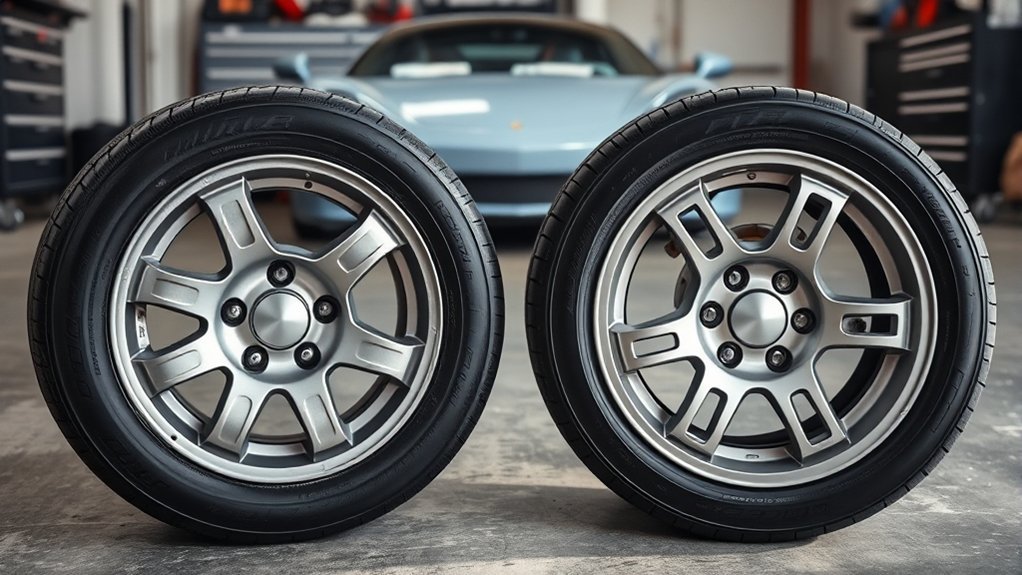
205 and 215 tires differ first in nominal section width: a 215 tire is 10 mm wider than a 205. But width alone does not tell you overall diameter, grip, load capacity, comfort, or fuel economy. Those depend on the full tire size, the tire model, wheel width, inflation pressure, and whether the vehicle manufacturer approves the size.
Quick Answer
205 and 215 are nominal section widths in millimeters, so a 215 tire is 10 mm wider. You can only compare fitment and performance after checking the full size code. A 215 may offer a wider tread footprint, but it can also change diameter, clearance, steering feel, hydroplaning risk, and efficiency depending on the tire and vehicle.
Key Takeaways
- A 215 tire is nominally 10 mm wider than a 205 tire, but the full size code determines sidewall height and overall diameter.
- A wider 215 is not automatically safer, grippier, smoother, or able to carry more load; tire design, compound, load index, pressure, and wheel fitment matter.
- If the aspect ratio and wheel diameter stay the same, the 215 will also be taller because its sidewall is a percentage of a larger width.
- Changing overall diameter can affect clearance, gearing, odometer readings, and speedometer accuracy.
- The safest choice is the original tire size or another size specifically approved by the vehicle manufacturer.
What Do 205 and 215 Tires Mean?
In a tire size such as 205/55R16, the first number is the tire’s nominal section width in millimeters. A 205 is nominally 205 mm wide, while a 215 is nominally 215 mm wide. Michelin explains the same sizing system in its tire-marking guide.
The second number is the aspect ratio. It gives the sidewall height as a percentage of section width. The “R” means radial construction, and the final number is the wheel diameter in inches. That means you cannot decide whether two tires are equivalent by comparing 205 and 215 alone.
Actual mounted width can also vary slightly by tire model and wheel width, so the number on the sidewall is a nominal size rather than a promise that every 215 measures exactly the same when installed.
Why the Full Tire Size Matters
If the aspect ratio stays the same, moving from 205 to 215 increases both width and sidewall height. For example, compare 205/55R16 and 215/55R16:
| Measurement | 205/55R16 | 215/55R16 |
|---|---|---|
| Nominal width | 205 mm | 215 mm |
| Calculated sidewall height | 112.8 mm | 118.3 mm |
| Approx. overall diameter | 631.9 mm | 642.9 mm |
| Diameter difference | Baseline | About 1.7% taller |
Those figures are calculated from the size code. Actual tire dimensions can differ slightly by manufacturer and rim width, so always check the specifications for the exact tire you plan to buy.
A 215 tire is 10 mm wider by nominal size, but width alone does not tell you whether it is a correct replacement for a 205.
Will 205 or 215 Tires Fit Better?
The better-fitting tire is the one approved for your vehicle and wheel. The National Highway Traffic Safety Administration recommends replacing tires with the original size or another size recommended by the vehicle manufacturer. Check the driver-door tire placard and owner’s manual before changing sizes.
Warning: Do not choose a 215 only because it physically mounts on the wheel. Confirm the approved tire size, rim-width range, load index, speed rating, overall diameter, and clearance. A tire can mount and still be an unsuitable replacement.
[Products Worth Considering]

This professional wheel and rim cleaning brush set lifts brake dust, grime, and dirt with soft, scratch-free microfiber and synthetic wool fibers. The rim brush bends up to 360 degrees for easy access to hard-to-reach areas around spokes, lips, and faces. Ideal for thorough cleaning of car, truck, motorcycle, bicycle, RV, and more wheel and tire surfaces.

Keep your tires properly inflated with this analog VONDIOR tire pressure gauge, designed for fast, easy readings without batteries. The swiveling, two-axis hose and large glow dial help you measure at any tire angle with instant visibility. Built with a protective rubber shield, it supports durable, low-maintenance use for cars and trucks.

The Continental Grand Prix 5000 is an allround road bike tire engineered for faster rolling, improved ride comfort, and enhanced puncture protection. It features a Vectran Breaker cut-protection layer, Lazer Grip micro-profile tread for confident cornering control, and Active Comfort Technology to damp vibration for smoother rides. BlackChili compound optimizes grip and speed for everyday performance and long-lasting confidence.
Wheel Fitment Considerations
A 215 has 10 mm more nominal section width than a 205, but that does not mean every 205 and 215 use the same wheel. You must compare the full tire size, including wheel diameter, and check the tire manufacturer’s approved rim-width range for the exact model.
Wheel width changes the way a tire’s sidewalls sit. A tire mounted near the narrow end of its approved rim range can look more rounded, while a wider approved wheel can hold the tread flatter. That can influence steering feel and measured section width.
Wheel offset also matters because it changes where the tire sits relative to the strut, suspension links, and fender. The tire’s bead-seat diameter must match the wheel diameter exactly; for example, an R16 tire belongs on a 16-inch wheel.
Clearance and Rub Issues
A wider tire can reduce clearance on both the inside and outside of the wheel well. With a 215, check space near the strut, spring perch, control arm, inner liner, fender lip, and bumper liner.
Clearance must be checked through full steering lock and suspension travel, not only while the car is parked straight ahead. A taller overall diameter can create additional rubbing even if the width itself seems acceptable.
Vehicles with lowered suspension, non-stock wheels, spacers, or different offsets need extra care because those changes can alter the available space.
Load And Handling Changes
A 215 tire does not automatically carry more weight simply because it is wider. The tire’s certified load capacity is identified by its load index and depends on its construction and inflation conditions. Michelin’s load-rating guide explains that the load index identifies how much weight the tire can carry under specified conditions.
When changing sizes, use a load index and speed rating that meet the vehicle manufacturer’s requirements. Do not assume that two tires with similar dimensions have the same load capacity.
Handling can change after a size swap, but width is only one factor. Tire compound, tread design, sidewall stiffness, wheel width, inflation pressure, alignment, and suspension geometry can outweigh the 10 mm difference between 205 and 215.
How to Check Whether a 215 Fits
- Read the door-jamb tire placard and owner’s manual. Start with the approved factory size or approved alternatives.
- Compare the complete sizes. Check section width, aspect ratio, wheel diameter, load index, and speed rating.
- Check the exact tire’s rim-width range. Do not assume a wheel that accepts one 205 will accept every 215.
- Compare overall diameter. A diameter change can affect clearance and speedometer accuracy.
- Measure clearance. Check both inner and outer clearance through steering and suspension travel.
205 Vs 215 Tires: Handling Differences
It is tempting to say that 205 tires always steer faster and 215 tires always grip better, but real-world handling is more complicated. A wider tire can provide a broader tread footprint and may improve dry-road traction when the tire, wheel, and suspension are designed for it. Continental notes that wider tires can offer performance benefits, while also warning that they can be more susceptible to hydroplaning if used without regard to vehicle and tire-maker guidance.
[Products Worth Considering]

Measure tire tread depth quickly and accurately with this LUMITECO dial gauge that reads in 1/32" increments up to 14/32". The color-coded green/yellow/red zones make it easy to judge tire wear and know when replacement is needed. A rugged, compact design with a protective pouch helps keep the gauge ready for use on cars, trucks, motorcycles, and more.

Upgrade your wheels with MIKKUPPA closed-end lug nuts designed for reliable fit and corrosion resistance. The one-piece, cold-forged and heat-treated steel construction helps resist rust and stripping, while the integrated finish delivers a durable black appearance. Built to OEM standards with a conical 60-degree seat, these nuts provide a secure solution for compatible Ford, Honda, Jeep, and Chevrolet models.

Add style while helping protect your tire valve stems with handmade crystal rhinestone caps and a durable plastic insert. These caps resist corrosion and help keep out rain, snow, and muddy water, extending tire life. Textured non-slip design makes them easy to grip for quick install and removal when checking tire pressure.
Steering Response
A 205 can feel lighter at the steering wheel because it is narrower, but a 215 is not automatically slower to respond. Steering response depends strongly on sidewall stiffness, tread construction, wheel width, pressure, and alignment.
If a 215 is squeezed onto a wheel near the narrow end of its approved range, extra sidewall bulge may soften the initial response. On a properly matched wheel with a stiff performance construction, a 215 can feel equally sharp or sharper than a softer 205.
Use the vehicle manufacturer’s recommended cold pressure for the approved tire setup rather than raising or lowering pressure just to change steering feel.
Cornering Grip
A wider tire can support a wider tread footprint and, in a comparable tire design, may improve dry cornering and braking. However, width alone does not guarantee a shorter stopping distance or more lateral grip. Rubber compound, tread design, temperature, road surface, load, and tire pressure are critical.
That means a high-quality 205 performance tire can outperform a less capable 215 tire. If grip is your priority, compare the exact tire models and their tested wet and dry performance rather than choosing only by section width.
Stability At Speed
A correctly fitted 215 may feel more planted, while a 205 may feel lighter, but these are tendencies rather than rules. The following table shows the practical comparison when all other factors are reasonably similar:
| Feature | 205 Tire | 215 Tire |
|---|---|---|
| Nominal section width | Narrower | 10 mm wider |
| Steering effort | May feel lighter | May feel heavier |
| Dry-road footprint | Narrower shape | Wider shape |
| Clearance margin | Usually greater | Usually smaller |
| Best choice | Depends on OEM approval and tire model | Depends on OEM approval and tire model |
If high-speed stability matters, prioritize the correct size, load index, speed rating, tire construction, and alignment rather than width alone.
205 Vs 215 Tires in Rain, Snow, and Slush
Weather changes the trade-offs. Continental warns that wider tires can be more susceptible to aquaplaning or hydroplaning in some conditions. Water depth, vehicle speed, tread depth, tread pattern, and inflation pressure also have major effects, so a 215 is not automatically worse in rain.
In snow and slush, a narrower tire can sometimes cut through loose material more easily, while a wider tire may offer more dry-road or compacted-surface stability. The tire’s winter compound and tread design usually matter more than a 10 mm width difference.
If you drive in freezing conditions, choose a tire designed for the season and approved for the vehicle instead of using width as a substitute for winter performance.
205 Vs 215 Tires: Ride Comfort and Noise
You cannot reliably predict ride comfort from 205 versus 215 alone. If both tires use the same aspect ratio and wheel diameter, the 215 has a slightly taller sidewall because its sidewall height is a percentage of a wider section. That may add some compliance, but construction, load rating, wheel width, pressure, and suspension tuning can easily change the result.
Width alone does not determine comfort or road noise; sidewall height, tire construction, tread pattern, compound, and inflation pressure often matter more.
Noise is also tire-specific. A 215 does not inherently produce a lower-pitched sound, and a 205 does not inherently create more cabin hum. Tread-block shape, groove design, rubber compound, road texture, and vehicle insulation are more useful predictors.
If comfort is your priority, compare the exact tire model, sidewall construction, overall diameter, load rating, and independent road-test results.
205 Vs 215 Tires: Fuel Economy Impact
A 215 can be heavier or less aerodynamic than a comparable 205, but width by itself does not determine rolling resistance. Continental notes that a wider contact area has no direct one-to-one effect on rolling resistance; tire design, tread compound, construction, inflation, load, road conditions, and temperature all contribute.
Low-rolling-resistance tire technology can matter more than a small width change. NHTSA states that a 10% reduction in tire rolling resistance is estimated to improve vehicle fuel economy by about 1% to 2%, which shows why the tire’s efficiency design matters.
Underinflation also raises rolling resistance. Keep tires at the vehicle manufacturer’s recommended cold pressure and maintain alignment if you want consistent fuel economy.
In practice, a specific 215 may use slightly more, the same, or occasionally less energy than a specific 205. Compare the exact tire specifications rather than assuming every wider tire carries a fixed fuel-economy penalty.
How Tire Diameter Affects Speedometer and Gearing
Speedometer error comes from a change in overall tire diameter, not from width alone. A taller tire travels farther with each revolution, so the vehicle can be moving faster than the speedometer indicates if the system is calibrated for the smaller tire.
For a quick calculation:
- Sidewall height = section width × aspect ratio ÷ 100.
- Approximate tire diameter = wheel diameter in millimeters + two sidewalls.
For example, 205/55R16 calculates to about 631.9 mm in diameter, while 215/55R16 calculates to about 642.9 mm. That is roughly a 1.7% increase. If a vehicle were perfectly calibrated for the 205/55R16 and showed 60 mph, the same vehicle on 215/55R16 would theoretically be traveling about 61 mph, before accounting for real tire growth, wear, and factory speedometer tolerance.
A different aspect ratio can offset some or all of the width increase, which is why “205 to 215” is not enough information to calculate speedometer change.
Which Tire Size Is Right for Your Car?
Start with the vehicle manufacturer’s approved sizes. NHTSA specifically advises using the original tire size or another size recommended by the manufacturer. If both a 205 and 215 setup are approved, then you can compare how each exact tire fits your priorities.
| Priority | What to Check |
|---|---|
| Maximum clearance | The approved option with more inner and outer space; often the narrower size |
| Dry performance | Tire model, compound, tread, wheel match, and approved wider option |
| Fuel economy | Rolling-resistance performance, weight, pressure, and overall size |
| Ride comfort | Sidewall height, construction, pressure, load rating, and suspension tuning |
| Snow and slush | Winter-rated compound and tread first; width is secondary |
| Final decision | Match the tire placard, owner’s manual, and exact wheel/tire specifications |
Note: A “205 wheel” is not a standard wheel size. The 205 number describes tire section width. Wheel fitment is determined by wheel diameter, wheel width, offset, and the tire manufacturer’s approved rim-width range.
Pro Tip: Before buying, compare the exact 205 and 215 tire specification sheets side by side. Check measured section width, overall diameter, approved rim-width range, load index, speed rating, and tire weight.
[Products Worth Considering]

The SAFELIFE dial tire tread depth gauge measures tread depth in 1/32 inch increments with clear, easy-to-read 2-inch dial face. Color zones using a traffic light system help you quickly judge whether tread is low, marginal, or ample for safer driving. Built with a durable zinc cast body and a metal detect probe for precise, comfortable use across cars, motorcycles, trucks, and buses.

This 3-piece wheel and tire brush set makes it easy to clean light, medium, and heavy dirt from wheels, rims, tires, and exterior surfaces. It includes both soft and stiff bristle options for gentle scrubbing and tough grime removal, helping lift brake dust and road buildup. The long-handle design supports comfortable cleaning across cars, trucks, SUVs, RVs, motorcycles, and more, with simple care instructions to restore brush shape.

This 3-piece wheel brush set makes it easy to clean wheels and tires with soft, scratch-free brushes designed for lifting brake dust and grime. The flexible rim brush bends up to 360 degrees to reach hard-to-access areas for a thorough clean, while the comfortable grip helps control during detailing. A dedicated detailing brush supports gentle cleaning for sensitive surfaces, including interior use.
Frequently Asked Questions
Can I Mix 205 and 215 Tires on the Same Vehicle?
Usually, no. Michelin recommends matching tire sizes unless the vehicle manufacturer specifies a staggered setup. AWD and 4WD vehicles can be especially sensitive to circumference differences, so follow the owner’s manual and drivetrain requirements.
Will 215 Tires Increase Braking Performance?
Not automatically. A wider tire can support a wider tread footprint and may improve dry braking when the tire and vehicle are designed for it, but compound, tread design, road surface, temperature, pressure, and ABS calibration can matter more than the 10 mm width change.
Do 205 and 215 Tires Affect Speedometer Accuracy?
Only if the complete tire sizes have different overall diameters. Width alone does not create speedometer error. For example, 215/55R16 is about 1.7% taller than 205/55R16 by size-code calculation, but a different aspect ratio can reduce or reverse that change.
Are 215 Tires More Expensive Than 205 Tires?
Sometimes, but not always. Price depends on brand, model, load rating, speed rating, season, supply, and retailer. Compare the exact tires you are considering instead of assuming that every 215 costs more.
Can I Use 215 Tires on My Original 205 Wheels?
Possibly, but “205” describes the tire, not the wheel. Check the wheel’s diameter and width, then confirm that the exact 215 tire lists that wheel width within its approved rim range. You also need adequate clearance and the correct load and speed ratings.
Is 215/55R16 a Direct Replacement for 205/55R16?
Not automatically. The 215/55R16 is about 10 mm wider and roughly 1.7% larger in calculated overall diameter. It may fit some vehicles, but you should use it only when the vehicle manufacturer or a qualified tire professional confirms the size, wheel, load rating, and clearance are appropriate.
Which Is Better in Rain, 205 or 215?
There is no universal winner. Wider tires can be more susceptible to hydroplaning in some conditions, while tread design, tread depth, rubber compound, pressure, water depth, and speed strongly affect wet grip. Compare the wet-performance data for the exact tire models.
Which Is Better in Snow, 205 or 215?
A narrower tire can sometimes cut through loose snow and slush more easily, but winter compound and tread design are more important than a 10 mm width difference. Use a vehicle-approved winter tire size rather than changing width only for snow performance.
Conclusion
The main difference between 205 and 215 tires is 10 mm of nominal section width, but that number is only the start of the comparison. A 215 can also become taller if the aspect ratio stays the same, which can change clearance and speedometer readings. Grip, comfort, load capacity, noise, and fuel economy depend on the complete tire specification and design.
If you are choosing between the two, use the vehicle’s approved tire sizes first. Then compare the exact tire model, wheel fitment, overall diameter, load index, speed rating, and driving conditions. That approach is safer and more accurate than assuming that 205 always means efficiency or that 215 always means better performance.
Sources
- NHTSA TireWise: Tire Safety Ratings and Awareness — replacement-size guidance, tire placard information, pressure, and rolling resistance.
- Michelin: How to Read Tire Markings and Sidewall Codes — section width, aspect ratio, wheel diameter, load index, and speed rating.
- Michelin: Tire Load Rating and Speed Rating Explained — load-index and speed-rating meaning.
- Michelin: Mixing Tires, Safety, Winter Tires and AWD — matching sizes and AWD/4WD circumference considerations.
- Continental: Wide Tires — wider-tire fitment and hydroplaning cautions.
- Continental: Rolling Resistance of Car Tires — factors that influence rolling resistance, including the limits of using width alone.

