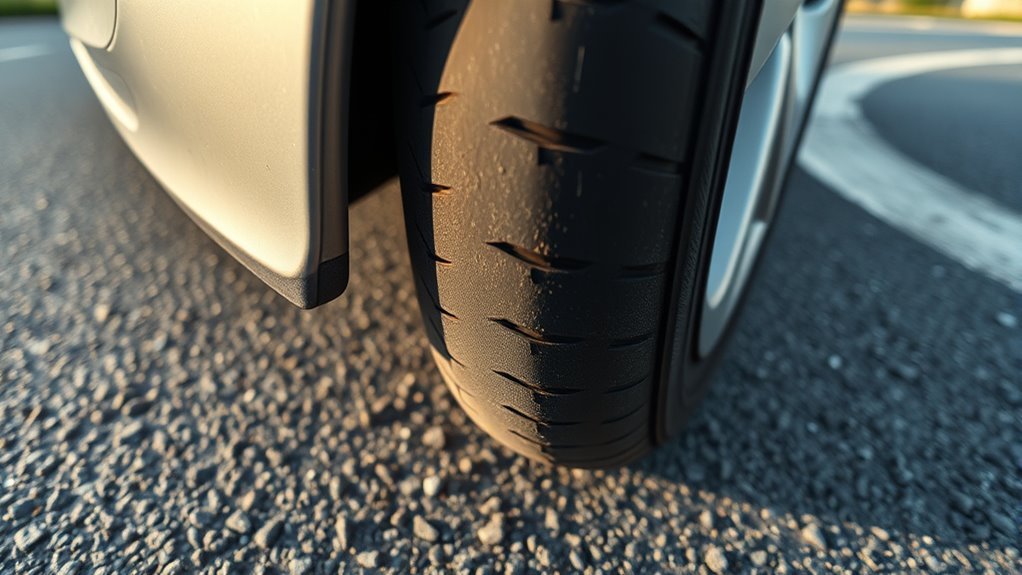
Underinflated tires usually show up as sagging sidewalls, shoulder-edge wear, sluggish steering, pulling, vibration, lower fuel economy, a longer braking feel, or a TPMS warning. Confirm the problem with a cold tire-pressure gauge reading, then inflate to the PSI on the driver-side door placard or owner’s manual. Do not use the maximum PSI printed on the tire sidewall as your daily target, and do not drive normally on a tire that looks flat, has a bulge, exposes cords, or loses air again soon after inflation.
Last updated: July 7, 2026.
Quick Answer
Common signs of underinflated tires include sagging sidewalls, a flatter contact patch, shoulder-edge tread wear, sluggish steering, pulling, vibration, reduced braking confidence, lower fuel economy, and a TPMS warning light. Confirm the problem with a cold tire-pressure reading, then inflate to the vehicle manufacturer’s placard PSI.
Key Takeaways
- Use the PSI on the driver-side door placard or owner’s manual, not the maximum PSI printed on the tire sidewall.
- Check pressure when tires are cold, ideally before driving or after the vehicle has been parked for at least three hours.
- A TPMS light can mean serious underinflation, but it may not warn you when a tire is only a few PSI low.
- Do not drive on a visibly flat tire, sidewall bulge, exposed cords, or a tire that will not hold air.
At a Glance
| Time Required | 5–10 minutes for all four tires |
| Difficulty | Easy |
| Tools Needed | Tire-pressure gauge, air compressor or portable inflator, valve caps |
| Cost | Usually free to a few dollars for air; gauge/inflator cost varies |
How Low Is Too Low for a Tire?
A tire is too low any time it is below the vehicle manufacturer’s cold PSI recommendation. A small drop may only need a top-up, but a visibly flat tire, a tire with sidewall damage, or a tire that loses air again after inflation needs immediate attention. The TPMS warning usually means the pressure is already significantly low, so treat it as a safety warning rather than a routine reminder.
| What You Notice | Likely Meaning | Best Next Step |
|---|---|---|
| A few PSI below the placard, no visible damage | Routine pressure loss or a temperature change | Inflate cold to placard PSI and recheck soon. |
| Same tire keeps dropping | Slow leak, valve issue, bead leak, or wheel damage | Have the tire inspected before relying on it. |
| TPMS warning light is on | One or more tires may be significantly underinflated | Pull over when safe and check all tires with a gauge. |
| Tire looks flat, bulged, cracked, or corded | Possible structural damage or unsafe pressure loss | Do not drive normally. Use a spare or call for help. |
Check Tires: Quick Tests for Underinflated Tires
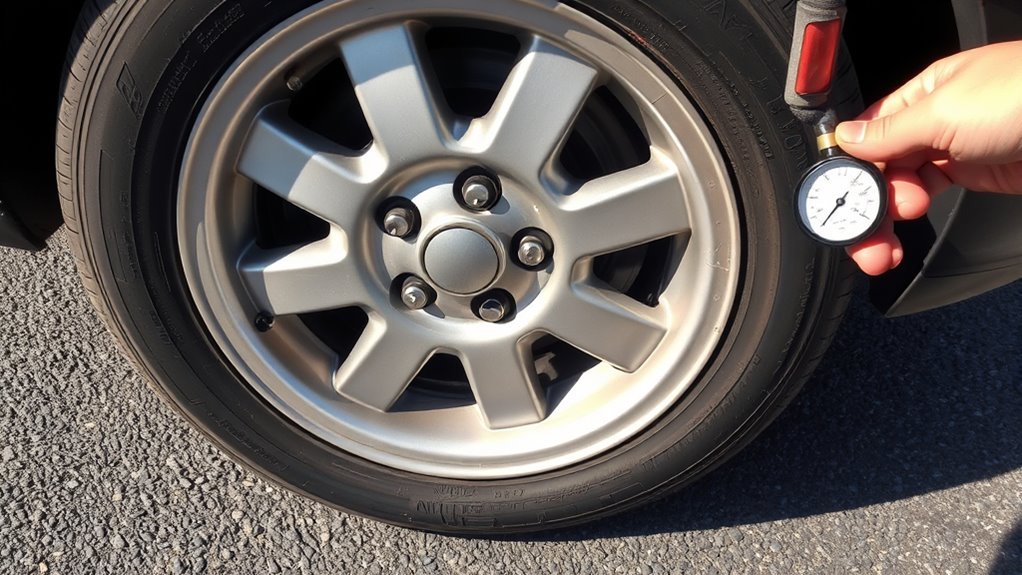
Start with a quick walkaround. Look at each tire from the front, side, and rear. A low tire may show a sagging sidewall, a wider flat spot where the tread meets the road, or shoulder edges that look more worn than the center of the tread.
Then confirm what you see with a pressure gauge. A visual check can catch obvious problems, but it cannot reliably tell whether a tire is 3, 5, or 8 PSI low. The correct pressure is the vehicle manufacturer’s recommended cold pressure, usually listed on the driver-side door placard and in the owner’s manual. NHTSA explains that the manufacturer’s recommended tire pressure is the proper PSI when the tire is cold.
- Find the correct PSI: Check the driver-side door jamb placard or owner’s manual. Do not use the “maximum pressure” molded into the tire sidewall as your daily target.
- Check when cold: Measure before driving, or after the vehicle has been parked for at least three hours.
- Use the gauge correctly: Remove the valve cap, press the gauge squarely onto the valve stem, and read the pressure.
- Add air in short bursts: Inflate gradually, then recheck with the same gauge.
- Reinstall the valve cap: A missing cap can let dirt and moisture into the valve area.
Note: If the tire is warm from driving, the reading may be higher than the true cold pressure. Do not bleed air from a warm tire just to match the cold placard number. Recheck when the tire is cold.
TPMS & Warning Lights Explained
The TPMS, or Tire Pressure Monitoring System, is a warning system. It is not a replacement for monthly gauge checks. Under U.S. Federal Motor Vehicle Safety Standard No. 138, TPMS must warn the driver when one or more tires drop to a specified low-pressure threshold, commonly around 25% below the vehicle manufacturer’s recommended cold inflation pressure. The eCFR text of 49 CFR §571.138 describes the federal TPMS warning requirement.
That threshold matters because a tire can be several PSI low before the TPMS warning appears. For example, a tire with a 32 PSI placard pressure may not trigger a low-pressure warning until it is much lower than the ideal operating pressure. That is why routine manual checks still matter.
[Products Worth Considering]

Keep your tires properly inflated with this analog VONDIOR tire pressure gauge, designed for fast, easy readings without batteries. The swiveling, two-axis hose and large glow dial help you measure at any tire angle with instant visibility. Built with a protective rubber shield, it supports durable, low-maintenance use for cars and trucks.
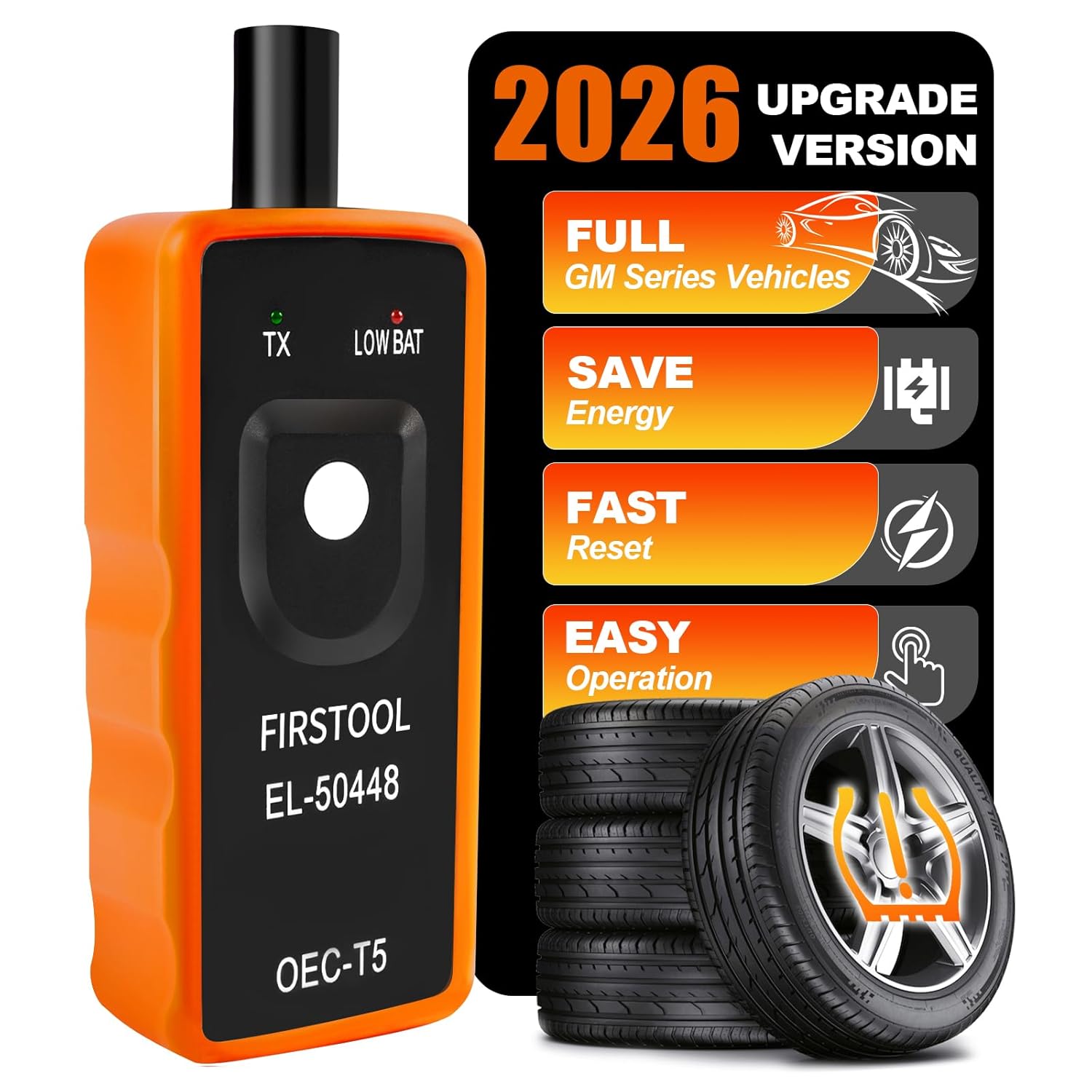
This TPMS relearn tool helps you quickly activate, match, and reset GM tire pressure sensors to keep the vehicle monitoring system working properly. It clears tire pressure alarms and dashboard warning lights after sensor replacement or tire rotation, and supports learning for common 315/433 MHz TPMS sensors. Designed for simple one-button operation, it can help you avoid unnecessary trips to repair shops.

Monitor tire tread wear with a smart, color-coded depth gauge that shows clear condition ranges at a glance. The bar is range marked for fast, easy readings, helping you maintain safer traction and performance. Each gauge is portable with a pocket clip, and the set includes 20 units for daily use and sharing.
TPMS Light Meaning
- Steady TPMS light: One or more tires may be underinflated. Pull over when safe, inspect the tires, and check PSI with a gauge.
- Flashing TPMS light: The system may have a malfunction, such as a sensor or calibration issue. Check tire pressure first, then follow the owner’s manual reset procedure or schedule service if the light returns.
- Light after a cold night: Pressure often drops as temperature falls, so check and top up tires to the placard PSI when cold.
- Light after tire service: The system may need a reset, relearn, or sensor check, depending on the vehicle.
Immediate Driver Actions
If the TPMS light comes on while driving, slow down, avoid hard braking or sharp steering, and pull over in a safe place. Inspect all four tires. If any tire looks flat, has a sidewall bulge, shows exposed cords, or is losing air quickly, do not keep driving on it.
Warning: Do not drive on a tire with a sidewall bulge, visible cords, major cracking, a puncture in the sidewall, or pressure that drops again immediately after inflation. Use the spare if your vehicle has one, call roadside assistance, or have the tire inspected by a professional.
Visual Wear Signs: Sidewall, Shoulders, and Tread Indicators
Underinflation changes the way the tire sits on the road. Instead of carrying the load evenly, the shoulders work harder, the sidewall flexes more, and heat builds faster. Look for these signs during a monthly inspection:
- Sagging sidewalls: The lower sidewall looks compressed or wrinkled compared with the other tires.
- Bulges or bubbles: A raised area on the sidewall may mean internal damage. This is a stop-driving warning.
- Shoulder wear: Both outer edges wearing faster than the center often points to underinflation. Center-only wear can point to overinflation.
- One-side wear: Wear mainly on one inner or outer edge may suggest alignment or suspension issues, not just pressure.
- Tread wear indicators: Wear bars become flush with the tread when tread depth is very low. Bridgestone notes that wear bars are even with the tread surface at 2/32 inch.
A tread-depth gauge is the best quick tool for checking wear. Measure several grooves across each tire and at multiple points around the tire. If the readings vary a lot, the tire may need pressure correction, rotation, alignment, or replacement.
Underinflation vs. Alignment, Balance, or Tire Damage
Not every tire symptom comes from low pressure. Use the pattern to narrow the problem before you spend money on the wrong repair.
| Symptom Pattern | More Likely Cause | What to Check |
|---|---|---|
| Both outer shoulders wearing faster than the center | Underinflation or frequent heavy cornering | Cold PSI, load, rotation history |
| Center tread wearing faster than both shoulders | Overinflation or incorrect pressure target | Gauge reading against the placard PSI |
| One inner or outer edge wearing quickly | Alignment or suspension issue | Alignment angles, ball joints, tie rods, bushings |
| Steering wheel vibration at a specific speed | Wheel balance, bent wheel, tire damage, or uneven wear | Balance, wheel runout, tread damage, pressure |
Driving Symptoms: Handling, Braking, and Ride Changes
You may feel an underinflated tire before you see it. Steering can feel heavy, slow, or imprecise because the sidewall flexes more than normal. The vehicle may also pull to one side if one tire is lower than the others, especially during braking or lane changes.
Braking can feel less predictable because an underinflated tire deforms under load, builds heat, and changes how the tread contacts the road. NHTSA’s tire-pressure maintenance research discusses how pressure differences can affect handling, stopping distance, blowouts, tread separations, and fuel economy.
Under-inflated tires can lower gas mileage by about 0.2% for every 1 PSI drop in the average pressure of all tires.
That fuel-economy effect comes from added rolling resistance. FuelEconomy.gov also notes that properly inflated tires are safer and last longer.
Immediate Triage: Can You Drive? How to Safely Top Up Pressure
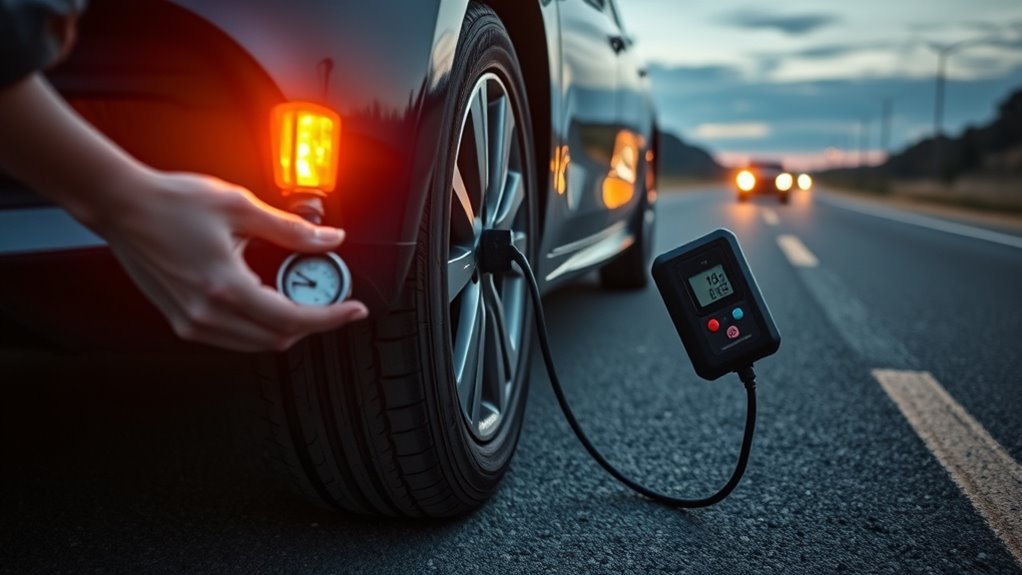
Whether you can drive depends on what you see and what the gauge reads. When in doubt, choose the safer option: stop, inflate, use the spare, or call for help.
| Situation | What to Do |
|---|---|
| A tire is a few PSI low, no visible damage | Inflate to placard PSI and recheck later. |
| TPMS light is on, but tires look normal | Check all four tires with a gauge before driving far. |
| Tire looks flat or severely sagged | Do not drive normally. Inflate only if safe, use the spare, or call roadside assistance. |
| Sidewall bulge, exposed cords, or major cracking | Do not drive on that tire. Replace or have it professionally inspected. |
| Pressure drops again soon after inflation | Treat it as a leak. Check for nails, valve-stem leaks, bead leaks, or wheel damage. |
[Products Worth Considering]

The SAFELIFE dial tire tread depth gauge measures tread depth in 1/32 inch increments with clear, easy-to-read 2-inch dial face. Color zones using a traffic light system help you quickly judge whether tread is low, marginal, or ample for safer driving. Built with a durable zinc cast body and a metal detect probe for precise, comfortable use across cars, motorcycles, trucks, and buses.

This tire inflator with pressure gauge delivers long-lasting performance with a durable rubber-protected gauge and sturdy build. The longer hose and 360 swivel air chuck help you seal the valve securely and keep your hands free while measuring, inflating, or deflating. It’s battery-free for reliable use and provides ±2 PSI accuracy in the mid-range for most typical tires, with universal compatibility for 1/4 NPT compressor outputs.

The TYAMATE TM8 solar-powered wireless TPMS delivers real-time tire pressure and temperature monitoring with six alarm modes for safer driving. A vibrant color LCD display shows readings clearly while windshield mounting keeps it hands-free and easy to read. With a wide 0–87 PSI range, strong 433.92 MHz signal transmission, and quick sensor pairing, it’s ideal for RV, sedan, SUV, MPV, and truck use.
How to Top Up a Low Tire Safely
- Park on level ground away from traffic and turn on hazard lights if you are roadside.
- Find the cold PSI on the driver-side placard or owner’s manual.
- Check the current PSI with a reliable gauge.
- Add air in short bursts with a compressor or portable inflator.
- Recheck pressure and stop at the placard PSI.
- Inspect the tread and sidewall for nails, cuts, bulges, or cracking.
- Recheck the same tire the next day. If it lost pressure again, schedule a repair.
Pro Tip: Keep a digital gauge and small inflator in the vehicle. They are especially useful during cold snaps, long trips, and after a TPMS warning appears far from a service station.
Prevent Underinflation: Monthly Checks, Tools, and Cold-Weather Tips
Check tire pressure at least monthly, before long trips, and after major temperature swings. Tires can naturally lose air over time, and cold weather can make a healthy tire read lower without any puncture.
[Products Worth Considering]
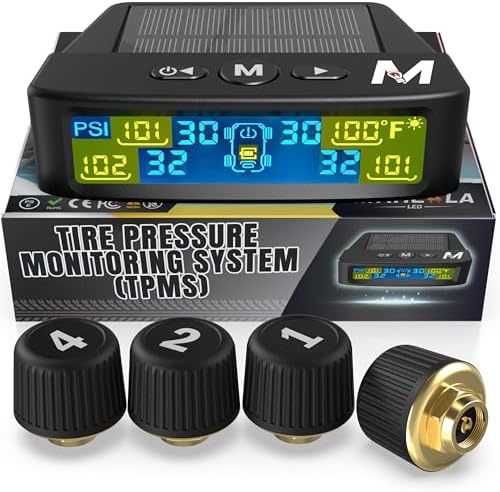
Marcala’s TPMS set of four sensors helps you monitor tire pressure and temperature in real time while driving, with updates every second. The bright color LCD uses auto-dimming for easy viewing, powered by dual solar and USB charging, and offers six alarm modes. Built for trailers, RVs, campers, trucks, and towing setups, the sensors support monitoring 1-4 wheels up to 98 PSI with IP67 waterproof protection.

Measure tire tread depth quickly and accurately with this LUMITECO dial gauge that reads in 1/32" increments up to 14/32". The color-coded green/yellow/red zones make it easy to judge tire wear and know when replacement is needed. A rugged, compact design with a protective pouch helps keep the gauge ready for use on cars, trucks, motorcycles, and more.

Check tire pressure quickly and accurately with the Accutire MS-4021B digital gauge, featuring a large backlit LCD for easy visibility. The angled head and rubber-coated handle make it comfortable to grip, while unit switching lets you read psi, bar, kPa, or kg/cm2. An automatic shutoff helps preserve battery life, and it measures 5–150 PSI in small increments for confident tire maintenance.
Monthly Pressure Checks
Make pressure checks part of a routine: the first fuel stop of the month, the first weekend, or the day before a long drive. Check all four tires, and check the spare if your vehicle has one. Record the readings if one tire keeps drifting low; a repeated drop usually means a leak, not bad luck.
The tire sidewall shows size, load rating, speed rating, and maximum permissible pressure. It is not the everyday target for your vehicle. For daily driving, use the vehicle placard or owner’s manual because that pressure is matched to the vehicle’s weight, tire size, handling, and load requirements.
Cold-Weather Inflation Tips
When temperatures fall, tire pressure drops because the air inside the tire contracts. Bridgestone gives the common rule that tire pressure changes by about 1 PSI for every 10°F change in ambient temperature. That means a tire set correctly in warm weather may be several PSI low on the first cold morning of the season.
- Check in the morning: Cold morning readings are usually the best baseline.
- Do not ignore winter TPMS lights: Add air to the placard PSI instead of waiting for the light to turn off by itself.
- Expect pressure to rise after driving: Heat from driving temporarily raises tire pressure.
- Recheck after big weather shifts: A 30°F drop can be enough to make tires noticeably low.
When Low Pressure Keeps Coming Back
If the same tire keeps losing pressure, topping it up is only a temporary fix. Look for common causes:
- Nail or screw in the tread: Often repairable if the puncture is in the safe repair area and the tire has not been driven flat.
- Leaking valve stem: Air may escape around the valve core or rubber stem.
- Bead leak: Corrosion or debris where the tire seals to the wheel can cause slow loss.
- Cracked or bent wheel: More common after pothole or curb impacts.
- Sidewall damage: Usually not repairable; the tire should be replaced.
Any tire that repeatedly loses air, vibrates, bulges, or shows uneven wear should be inspected by a qualified tire technician.
Frequently Asked Questions
What are the signs of underinflated tires?
The main signs are sagging sidewalls, a flatter contact patch, shoulder-edge tread wear, sluggish steering, pulling to one side, vibration, longer braking distance, lower fuel economy, and a TPMS warning light. Always confirm with a tire-pressure gauge.
What is the 3% tire rule?
The 3% tire rule usually refers to tire sizing, not tire pressure. It means a replacement tire’s overall diameter should generally stay within about 3% of the original tire diameter to help preserve speedometer accuracy, clearance, and safety-system behavior. For PSI, use the door placard or owner’s manual instead.
Can I fix a TPMS error myself?
Sometimes. If the light is caused by low pressure, inflate all tires to the correct cold PSI and drive as the owner’s manual directs so the system can update. If the light flashes, returns quickly, or stays on after correct inflation, the system may need sensor service, recalibration, or professional diagnosis.
Is 28 PSI too low for a car tire?
It depends on the vehicle’s placard PSI. If your placard says 32, 35, or another higher number, 28 PSI is low and should be corrected when the tire is cold. If the tire looks flat, has damage, or drops again after inflation, do not treat it as a simple top-up.
How often should I check tire pressure?
Check tire pressure at least once a month, before long trips, and after major temperature swings. Use a gauge when the tires are cold, then inflate to the vehicle placard PSI.
Can I drive with a tire that is a little low?
If the tire is only a few PSI low and has no visible damage, inflate it to the placard PSI as soon as possible. Avoid highway speeds or heavy loads until pressure is corrected. Do not drive on a tire that looks flat, has a bulge, or loses air again quickly.
Why did my TPMS light turn on when it got cold?
Cold air makes tire pressure drop. A tire that was correct during warmer weather can become low after a sharp temperature drop. Check all tires cold and inflate to the placard PSI. If the light remains on after proper inflation, check the owner’s manual or have the system inspected.
Conclusion
You can catch underinflated tires early by combining three checks: look for sagging sidewalls and shoulder wear, feel for pulling or sluggish handling, and verify PSI with a cold gauge reading. Inflate to the vehicle placard pressure, not the sidewall maximum. If a tire is visibly damaged, will not hold air, or keeps triggering a warning, stop driving on it and get it inspected. Monthly pressure checks, cold-weather top-ups, and fast leak repairs protect handling, fuel economy, tread life, and safety.
Sources
- NHTSA TireWise — cold tire-pressure checks, placard PSI, and tire safety guidance.
- 49 CFR §571.138, Tire Pressure Monitoring Systems — federal TPMS low-pressure warning requirements.
- FuelEconomy.gov: Keeping Your Vehicle in Shape — fuel-economy effect of underinflated tires.
- Bridgestone Tire Inflation Guidance — tire-pressure temperature change rule of thumb and cold-pressure checks.
- Bridgestone Tire Replacement Guidance — tread wear indicators and replacement signs.
- NHTSA tire-pressure maintenance research — handling, stopping distance, blowout, tread separation, and fuel-economy context.