
When you balance your Toyota Camry tires, a technician corrects uneven weight in each wheel-and-tire assembly so the tire can spin smoothly at road speed. The shop removes the wheel assembly, mounts it on a balancing machine, spins it, finds heavy spots, and adds small clip-on or adhesive weights to the rim. Done correctly, tire balancing reduces vibration, helps the tread wear more evenly, and keeps the Camry feeling stable on the highway.
Quick Answer
Toyota Camry tire balancing corrects uneven weight in the wheel-and-tire assembly. A technician spins each assembly on a balancer, adds small weights where needed, and rechecks the result. Balance the tires when they are installed or repaired, when vibration appears, or when a tire shop recommends it during rotation service.
Key Takeaways
- Tire balancing fixes uneven weight distribution; it is different from tire rotation and wheel alignment.
- Common signs include steering-wheel vibration, seat or floor shaking, and uneven or cupped tread wear.
- Have the balance checked when tires are mounted, repaired, remounted, or when vibration starts.
- If balancing does not fix the vibration, the Camry may need an alignment, suspension inspection, wheel check, or road-force balance.
At a Glance
| Time Required | About 30 to 60 minutes for four tires; longer if a wheel is bent, a tire needs repair, or road-force balancing is needed. |
| Difficulty | Professional service recommended; accurate balancing requires a calibrated wheel balancer. |
| Tools Needed | Wheel balancer, wheel weights, valve tools if needed, lift or jack system, and torque wrench. |
| Cost | Varies by shop, region, wheel size, and tire package; balancing is sometimes included with new tire installation or tire-care plans. |
What Is Tire Balancing?
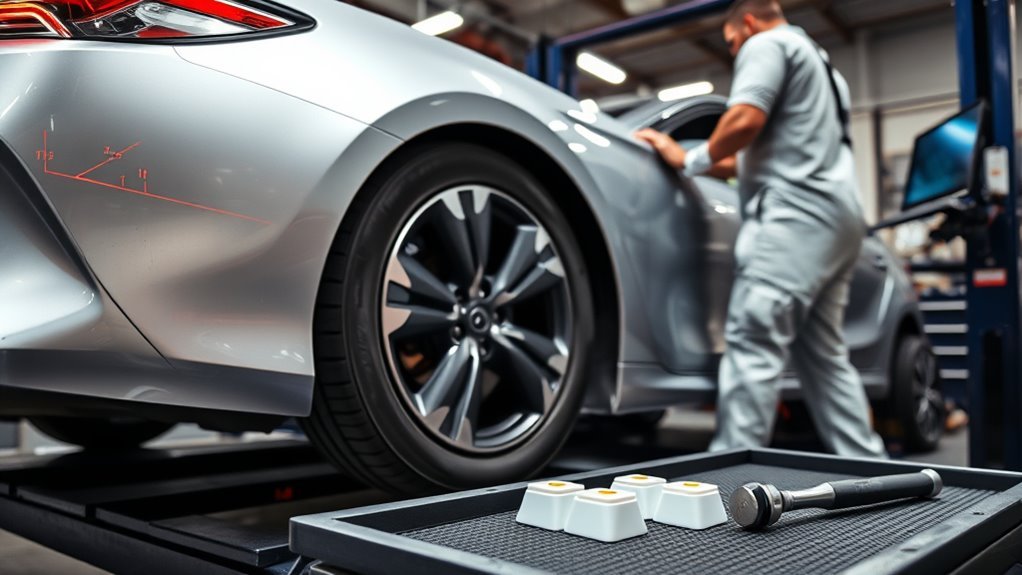
Tire balancing is the process of correcting uneven weight distribution in a wheel-and-tire assembly. Even a small heavy spot can make the assembly spin unevenly, especially at highway speeds. That uneven motion can show up as steering-wheel vibration, seat shaking, floor vibration, or irregular tread wear.
During balancing, a technician mounts the wheel-and-tire assembly on a balancing machine. The machine spins the assembly and identifies where the heavy spots are. The technician then attaches small corrective weights to precise points on the rim and spins the assembly again to confirm the correction.
This service is not the same as tire rotation or wheel alignment. Toyota’s Camry maintenance guide lists tire rotation as part of scheduled maintenance, while balancing is usually performed when tires are mounted, repaired, remounted, or when vibration symptoms appear.
Why Camry Tire Balancing Improves Ride Quality
A properly balanced Toyota Camry tire assembly spins more evenly. That helps the tire maintain steadier contact with the road, reduces vibration through the cabin, and can slow irregular tread wear. It also helps the steering and suspension work without extra shaking from the rotating wheel assembly.
Smoother Steering Feel
If the front wheel-and-tire assemblies are out of balance, you may feel a shimmy or buzz through the steering wheel. The shake often becomes more noticeable as speed rises. Once the assemblies are balanced, the steering usually feels calmer and more predictable.
Balanced tires do not change the Camry’s alignment angles, but they can make the steering feel cleaner because the wheels are no longer fighting an uneven rotating mass.
Less Vibration At Speed
Highway-speed vibration is one of the most common reasons Camry owners ask for tire balancing. Depending on which assembly is out of balance, the vibration may show up in the steering wheel, seat, floor, or body of the car.
| Issue | Balanced Result |
|---|---|
| Steering-wheel vibration | Often reduced if front tire balance was the cause |
| Seat or floor shake | Often reduced if rear tire balance was the cause |
| Irregular tread wear | Can slow further uneven wear when imbalance is corrected early |
Note: Tire balancing can reduce vibration caused by uneven wheel-and-tire weight. It will not fix every shake. Bent wheels, tire runout, worn suspension parts, wheel bearings, brake problems, or poor alignment can create similar symptoms.
What Throws Camry Tires Out of Balance?
Camry tires can lose balance through normal driving and wear. The tire and wheel may start out close to balanced, then drift as the tread wears, a wheel weight falls off, or the tire is repaired and remounted.
- Normal tread wear: As rubber wears away, the tire’s weight distribution can change.
- Lost wheel weights: Clip-on or adhesive weights can come off after curb contact, pothole strikes, wheel cleaning, or age.
- Potholes and curb impacts: A hard hit can bend a wheel, disturb a weight, or damage the tire.
- Flat repairs or remounting: A tire should be rebalanced after it is removed from the wheel and reinstalled.
- Long parking periods: Temporary flat-spotting can mimic imbalance until the tire warms up; persistent vibration should be inspected.
- Uneven wear from pressure, alignment, or suspension issues: These problems may not be balance problems by themselves, but they can create vibration and uneven tread patterns.
Signs Your Camry Tires Need Balancing
The clearest sign of tire imbalance is vibration that appears at certain speeds and changes as you speed up or slow down. The exact feel depends on which wheel-and-tire assembly is affected and whether there are other problems.
Steering Wheel Vibration
A vibrating steering wheel often points to a front wheel-and-tire issue. If the shake appears around moderate or highway speeds, tire balance should be checked. The vibration may increase with speed, fade at a different speed, or come and go depending on road surface.
- Notice when the vibration starts.
- Check whether it gets worse as speed increases.
- Look for missing wheel weights or visible wheel damage.
- Schedule a balance check before the vibration causes more uneven wear.
Uneven Tire Wear
Uneven tire wear can appear as patchy spots, cupping, scalloping, or faster wear in one area of the tread. Imbalance is one possible cause, but alignment, tire pressure, worn shocks, and suspension wear can also be involved.
Inspect your Camry’s tires during routine maintenance and before long trips. NHTSA’s TireWise guidance emphasizes tire maintenance, tread checks, and proper inflation as key tire-safety habits.
Seat Shaking At Speed
Seat or floor shaking at highway speed often suggests a rear tire or wheel issue, although the car still needs a full inspection to confirm the cause. If the vibration started after new tires, a flat repair, a tire rotation, or a pothole hit, ask the shop to recheck balance and wheel condition.
- Notice whether the shake is felt more in the seat than the steering wheel.
- Check if it appears only at certain speeds.
- Inspect the tires for bulges, cuts, cupping, or uneven tread.
- Ask for a balance check and a wheel runout inspection if the vibration persists.
Warning: Do not keep driving normally if vibration is sudden, severe, or follows a hard pothole or curb impact. Pull over safely and inspect the tires. If you see a bulge, exposed cords, a flat tire, wheel damage, or smoke, have the Camry towed or inspected before driving farther.
What Happens During a Tire Balance at the Shop?

At the shop, the technician removes the wheel-and-tire assembly from the Camry and mounts it on a balancing machine. The tire usually stays mounted on the rim unless it needs repair, remounting, or match-mounting.
| Step | Purpose |
|---|---|
| Remove wheel assembly | Take the wheel and tire off the vehicle for machine balancing |
| Mount on balancer | Center the assembly on the balancing machine |
| Spin test | Detect heavy spots and imbalance location |
| Add weights | Counterbalance the heavy spots with clip-on or adhesive weights |
| Re-spin | Verify the correction |
| Reinstall and torque | Install the wheel and tighten lug nuts to specification |
Some shops may road-test the Camry if the customer reported vibration or if the first balance does not fully solve the issue. A road test is especially useful when the technician suspects a bent wheel, tire runout, or suspension problem.
Static vs. Dynamic Balancing
Static and dynamic balancing correct different types of imbalance. For a Toyota Camry, dynamic balancing is normally the better shop method because it checks both the inner and outer planes of the wheel assembly.
Dynamic balancing is the usual choice for modern passenger cars because it corrects imbalance across two planes, helping control both up-and-down and side-to-side vibration.
- Static balancing corrects a single-plane heavy spot that can cause up-and-down hop.
- Dynamic balancing corrects imbalance across two planes of the wheel assembly.
- Road-force balancing adds a loaded roller to help detect tire stiffness variation, runout, and stubborn vibration.
- Match-mounting may be used when the tire and wheel need to be repositioned relative to each other.
If your Camry still vibrates after a normal spin balance, ask the shop whether road-force balancing or a wheel runout check is appropriate.
[Products Worth Considering]

Replace or upgrade your zero-turn lawn mower tires with a universal fit flat-free tire and wheel assembly in a convenient 2-pack. Smooth tread front-caster style helps turning with reduced turf damage, while flat-free design eliminates the maintenance and downtime of air-filled flats. The included adapter kit supports 5/8-inch axles and hub lengths from 3.4 to 5 inches for compatibility across most ZTR mowers.

This universal wheel alignment tool helps you accurately restore tire tilt angles after tire or suspension repairs using an adjustable camber gauge. It features a powerful magnetic base that firmly attaches to brake rotors for stationary, slip-free readings, improving consistency during measurement. Built from durable PC plastic, it resists wear and corrosion and is compact enough for car, truck, RV, and motorcycle alignment tasks.

This professional wheel and rim cleaning brush set lifts brake dust, grime, and dirt with soft, scratch-free microfiber and synthetic wool fibers. The rim brush bends up to 360 degrees for easy access to hard-to-reach areas around spokes, lips, and faces. Ideal for thorough cleaning of car, truck, motorcycle, bicycle, RV, and more wheel and tire surfaces.
Tire Balancing vs. Tire Rotation vs. Wheel Alignment
These services are related, but they solve different problems. Mixing them up can lead to paying for the wrong repair.
| Service | What It Does | When It Helps |
|---|---|---|
| Tire balancing | Corrects uneven wheel-and-tire weight with weights | Vibration, shake, new tires, tire repair, remounting |
| Tire rotation | Moves tires to different positions on the vehicle | Helps even out normal front/rear tread wear |
| Wheel alignment | Adjusts wheel angles such as toe, camber, and caster | Pulling, crooked steering wheel, edge wear, poor tracking |
Bridgestone’s tire maintenance guidance also separates rotation, alignment, and balance because each service addresses a different tire or handling issue.
[Products Worth Considering]

Upgrade your wheels with MIKKUPPA M12x1.5 mag seat lug nuts built for secure, corrosion-resistant performance. These closed-end chrome lug nuts are a direct replacement for select Toyota models, including Camry, Corolla, RAV4, Sienna, Avalon, Highlander, Matrix, Venza, and Prius. Triple-chromium plating and cold-forged, heat-treated steel help deliver strength for daily driving and replacement needs.

The Trivd Frol 1/2" air impact wrench delivers high performance torque up to 1500 ft-lbs with a twin hammer impact mechanism for strong, balanced blows. It features an ergonomic grip, compact lightweight design, and quick-stop control with 3 forward speeds up to 8000 RPM plus a reverse speed. Built for demanding automotive repair and tire shop work, the rear exhaust helps keep debris away from the surface.

This metal-free wheel and tire cleaning brush uses dense, fluffy synthetic wool to safely clean rims, spokes, fenders, and engine areas without worrying about damaging surfaces. Its flexible, comfortable design helps you reach detailed areas while maintaining durability, and the extra absorbent fibers work well with wheel spray cleaners for faster cleanup. Reusable and washable performance helps prevent grime and build-up for cleaner vehicles and easier maintenance at home.
When Should You Balance Camry Tires?
You should balance your Toyota Camry tires when the tires are first mounted on wheels, when a tire is removed and remounted after repair, and whenever vibration or shimmy appears. Michelin advises checking tire balance at the first sign of vibration and checking alignment or suspension if rebalancing does not solve it.
For routine maintenance, a practical approach is to ask for a balance check around tire-rotation visits, especially if you drive rough roads, recently hit a pothole, or notice uneven wear. Toyota’s current Camry maintenance guide lists scheduled maintenance every 5,000 miles or six months and includes tire rotation at those intervals, so rotation service is a convenient time to ask whether a balance check is needed.
- Balance when new tires are installed.
- Balance after a flat repair that required tire removal.
- Balance if a wheel weight falls off.
- Balance after a hard pothole or curb impact if vibration starts.
- Balance if the steering wheel, seat, or floor shakes at speed.
- Have alignment and suspension checked if balancing does not solve the vibration.
Pro Tip: When you rotate your Camry tires, ask the shop to inspect for missing weights, bent rims, cupped tread, and uneven wear. Catching these signs early can prevent repeated vibration visits.
What Tire Balancing Cannot Fix
Tire balancing is useful, but it is not a cure-all. If the Camry still shakes after the tires are balanced, another problem may be causing the vibration.
- Poor alignment: Balancing will not correct wheel angles or fix a pull to one side.
- Bent wheel: A bent rim may need repair or replacement.
- Tire runout or internal tire damage: A tire can be out of round or have a separated belt.
- Worn suspension or steering parts: Loose or worn parts can create vibration even with balanced tires.
- Brake pulsation: Vibration while braking may point to brake rotor or brake hardware issues.
- Wheel bearing problems: A growl, hum, or looseness may need mechanical inspection.
If a standard balance does not fix the issue, ask for a road-force balance, wheel runout check, alignment inspection, and suspension check.
DIY or Professional Tire Balancing?

Professional tire balancing is usually the safer and more accurate choice for a Toyota Camry. A modern shop balancer can locate small imbalances that are difficult to find with basic DIY tools. The technician can also inspect for bent wheels, damaged tires, worn tread, and other causes of vibration.
DIY balancing can work for experienced users with the right equipment, but it is easy to miss a small imbalance. If you only have basic garage tools, you can still do useful pre-checks: inspect tread wear, confirm tire pressure, look for missing weights, and check for visible wheel damage. Leave the actual precision balancing to a tire shop.
- DIY checks are useful before scheduling service.
- Professional machines improve accuracy and speed.
- Correct balance helps ride comfort and tire life.
- Persistent vibration needs diagnosis, not repeated guesswork.
[Products Worth Considering]

This 3-piece wheel and tire brush set makes it easy to clean light, medium, and heavy dirt from wheels, rims, tires, and exterior surfaces. It includes both soft and stiff bristle options for gentle scrubbing and tough grime removal, helping lift brake dust and road buildup. The long-handle design supports comfortable cleaning across cars, trucks, SUVs, RVs, motorcycles, and more, with simple care instructions to restore brush shape.

This 3-piece wheel brush set makes it easy to clean wheels and tires with soft, scratch-free brushes designed for lifting brake dust and grime. The flexible rim brush bends up to 360 degrees to reach hard-to-access areas for a thorough clean, while the comfortable grip helps control during detailing. A dedicated detailing brush supports gentle cleaning for sensitive surfaces, including interior use.

The Ziopetru adjustable magnetic wheel alignment tool helps you check and restore camber and caster positioning after removing and reinstalling undercarriage components. With a clear leveling/bubble measurement system and an easy zeroing adjustment knob, it supports precise horizontal angle checking. The strong magnetic base mounts to metal surfaces for convenient use at home on cars, motorcycles, trucks, vans, and SUVs.
Frequently Asked Questions
Does tire balancing take a long time?
No. A normal four-wheel tire balance often takes about 30 to 60 minutes. It can take longer if the shop finds a bent wheel, damaged tire, stuck weights, seized hardware, or a vibration that needs road-force balancing.
Do they take your tires off to balance them?
The shop removes the wheel-and-tire assembly from the Camry and mounts that assembly on a balancing machine. The tire usually stays mounted on the rim unless it needs repair, remounting, or match-mounting.
Do new Camry tires need balancing?
Yes. New tires should be balanced after they are mounted on the wheels. Even a new tire and wheel can have small weight differences that create vibration at speed.
Can tire balancing fix a Camry that pulls to one side?
Usually no. Pulling to one side is more often related to alignment, tire pressure, tire condition, brake drag, or suspension issues. Balancing mainly fixes vibration caused by uneven weight in the rotating wheel-and-tire assembly.
Why does my Camry still vibrate after balancing?
If vibration remains after balancing, the problem may be a bent wheel, tire runout, internal tire damage, worn suspension, poor alignment, wheel bearing wear, brake pulsation, or incorrect wheel mounting. Ask the shop about road-force balancing and a full wheel, tire, alignment, and suspension inspection.
Conclusion
Balancing your Camry’s tires helps the wheel-and-tire assemblies spin smoothly, which reduces vibration, improves ride comfort, and helps prevent irregular tread wear. The best time to balance is when tires are installed, repaired, remounted, or when shaking starts. Use Toyota’s rotation schedule as a reminder to inspect the tires, but do not treat balancing as a substitute for alignment, tire-pressure checks, or suspension diagnosis. If the Camry still shakes after balancing, ask for a deeper inspection before replacing parts at random.
Sources
- Toyota 2025 Camry Warranty & Maintenance Guide — scheduled maintenance and tire rotation interval context.
- Michelin: Symptom Vibration — vibration, tire balancing, and when to check alignment or suspension.
- Continental Tires: Balancing Tires — balancing purpose, symptoms, and periodic balancing guidance.
- Bridgestone: Tire Rotation, Alignment, Balance & Rotation — difference between tire rotation, alignment, and balance.
- NHTSA TireWise — tire safety, maintenance, tread, and consumer tire-care guidance.
- Discount Tire: Tire Balancing — balancing process, symptoms, and common vibration causes.