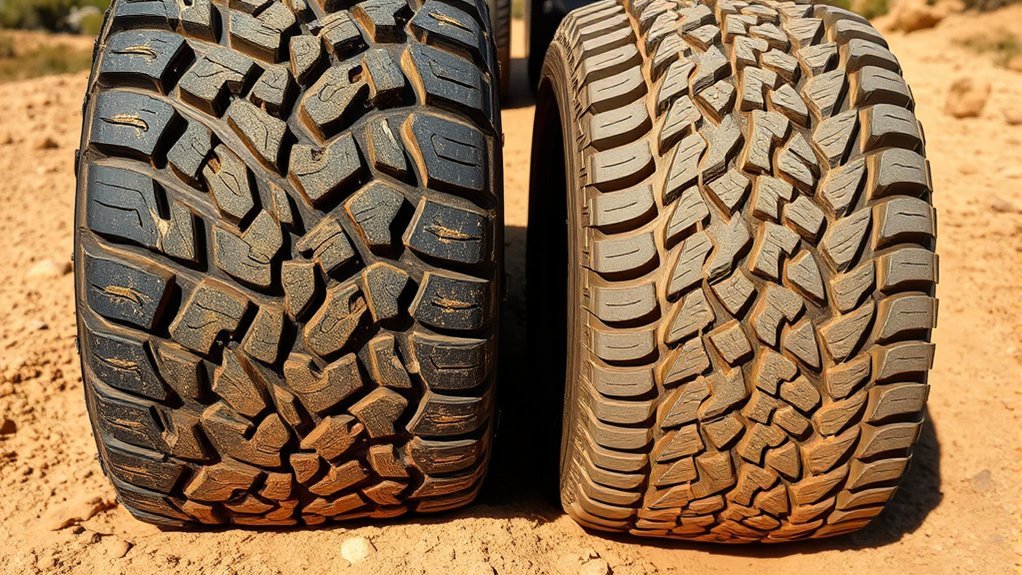
Choosing between rugged-terrain and all-terrain tires comes down to how often you leave pavement and which trade-offs you can accept. All-terrain tires usually provide the better balance for commuting, highway travel, gravel roads, and moderate trails. Rugged-terrain tires add more aggressive tread and trail protection for mud, sand, rocks, and rough job sites, but they may bring more road noise, weight, and rolling resistance.
Quick Answer
Choose all-terrain tires if most of your driving is on pavement and you want quieter road manners, longer warranty coverage, and dependable gravel or light-trail traction. Choose rugged-terrain tires if you regularly face mud, sand, rocks, or rough job sites and accept more noise, weight, and possible fuel-economy loss for added off-road toughness.
Key Takeaways
- All-terrain tires are usually better daily drivers because their tread patterns tend to favor pavement comfort, predictable handling, and moderate off-road use.
- Rugged-terrain tires sit between A/T and M/T designs, but the exact balance varies by manufacturer and model.
- Do not judge winter performance by the A/T or R/T label. Check the exact tire for the Three-Peak Mountain Snowflake symbol.
- Mileage warranties are model- and size-specific. They are not a guarantee of how long a tire will last on your vehicle.
- Fitment comes before tread style. The tire must meet the vehicle manufacturer’s size, load-capacity, speed-rating, rim-width, and inflation requirements.
All-Terrain Tires for Daily Drivers: An Overview
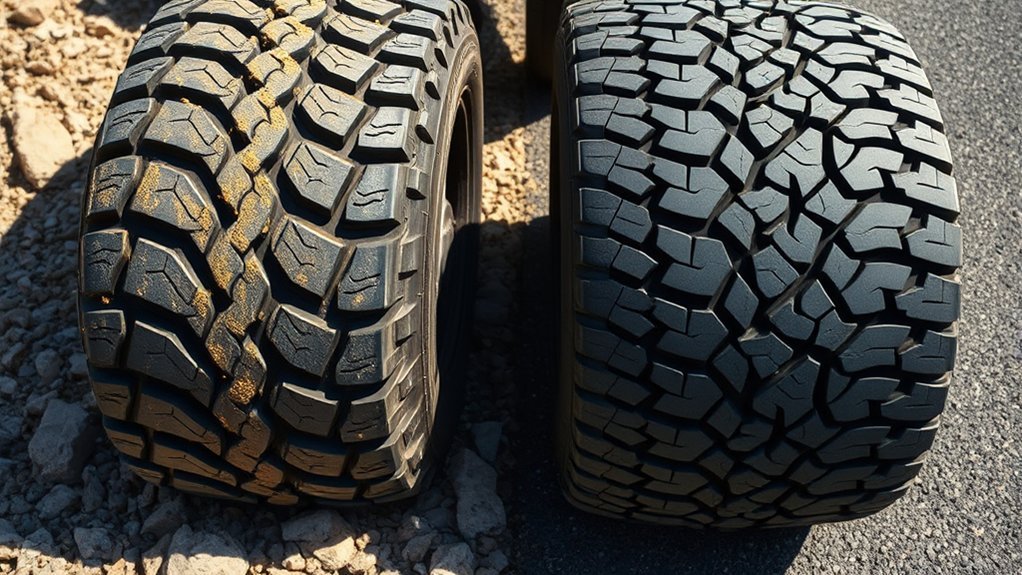
All-terrain tires, commonly marked A/T, are designed to combine usable pavement manners with traction on gravel, dirt, grass, shallow mud, and moderate trails. Compared with highway-terrain tires, they normally use larger tread blocks, deeper grooves, more pronounced shoulders, and features that help release stones and loose material.
An A/T tire is often the practical choice when your truck or SUV handles weekday commuting, family trips, towing, unpaved access roads, camping, and occasional trail use. Road-focused A/T models can be relatively quiet, while more aggressive A/T models may approach an R/T tire in appearance and off-road ability.
There is no universal rule requiring every A/T tire to be used 80% on pavement. Treat that number as an informal shopping shortcut rather than a technical standard. Compare the exact model’s tread, construction, warranty, snow marking, load specifications, and manufacturer performance information.
What Are Rugged-Terrain Tires?
Rugged-terrain tires, often labeled R/T or described as hybrid-terrain tires, are intended to fill the space between traditional all-terrain and mud-terrain designs. They commonly use larger shoulder lugs, wider tread voids, stronger-looking sidewall features, and tread patterns intended to add grip and damage resistance in loose or uneven terrain.
R/T is best understood as a market category rather than one uniform performance rating. Manufacturers position these products differently. For example, Toyo describes the Open Country R/T Trail as a hybrid A/T tire, while its more aggressive R/T products lean closer to an M/T design. Nitto calls the Ridge Grappler a hybrid-terrain tire blending A/T and M/T characteristics.
Because the category is broad, the letters on the sidewall do not tell you everything. One R/T model may be quiet enough for frequent highway travel, while another may prioritize deep tread, heavier construction, and off-road bite.
Note: A/T, R/T, and M/T labels describe a tire’s intended use, but they are not substitutes for tested specifications. Check the exact size and model for load capacity, speed rating, 3PMSF qualification, warranty terms, and approved rim width.
Key Features of All-Terrain and Rugged-Terrain Tires
The following table describes common tendencies, not guarantees. Performance can overlap significantly between an aggressive A/T and a road-friendly R/T.
| Feature | All-Terrain Tires | Rugged-Terrain Tires |
|---|---|---|
| Primary purpose | Daily road use with gravel, dirt, and moderate trails | Mixed road use with more demanding off-road conditions |
| Tread design | Moderate voids, stable center blocks, and more road-focused siping | Larger voids, more aggressive shoulders, and heavier sidewall features |
| Road noise | Usually lower, though aggressive A/T models can still be noticeable | Usually higher, but variable-pitch designs can reduce pattern noise |
| Pavement handling | Generally more settled and predictable for commuting and highway travel | Street-capable, but steering response and ride may feel heavier or less refined |
| Wet roads | Often more road-focused, but performance depends on compound, grooves, and tread depth | Can perform well, but large blocks and voids do not automatically provide better wet braking |
| Gravel and hardpack | Very capable for forest roads, ranch roads, and maintained trails | Strong grip and added protection on rougher, less maintained surfaces |
| Mud | Suitable for light or occasional mud, depending on tread openness | Often clears moderate mud more effectively because of larger voids and shoulder lugs |
| Sand and loose soil | Capable with suitable vehicle setup and driving technique | May add bite in loose terrain, though tire weight and excessive wheelspin can cause digging |
| Rocks and trail damage | Appropriate for moderate trails when the exact model has suitable construction | Often provides stronger shoulder and sidewall protection for rough terrain |
| Snow | Model-specific; look for the 3PMSF symbol | Model-specific; an aggressive appearance does not prove severe-snow performance |
| Tread warranty | Often longer, but varies by model, size, and P-metric or LT construction | Often shorter than a road-focused A/T, but meaningful mileage warranties are available |
| Fuel efficiency | Usually the more efficient of the two when size and construction are comparable | May add rolling resistance and rotating mass, especially in larger LT sizes |
| Best fit | Commuters, road trips, towing, gravel, camping, and moderate trail use | Drivers who regularly encounter mud, rocks, sand, rough access roads, or demanding job sites |
[Products Worth Considering]

Keep your tires properly inflated with this analog VONDIOR tire pressure gauge, designed for fast, easy readings without batteries. The swiveling, two-axis hose and large glow dial help you measure at any tire angle with instant visibility. Built with a protective rubber shield, it supports durable, low-maintenance use for cars and trucks.
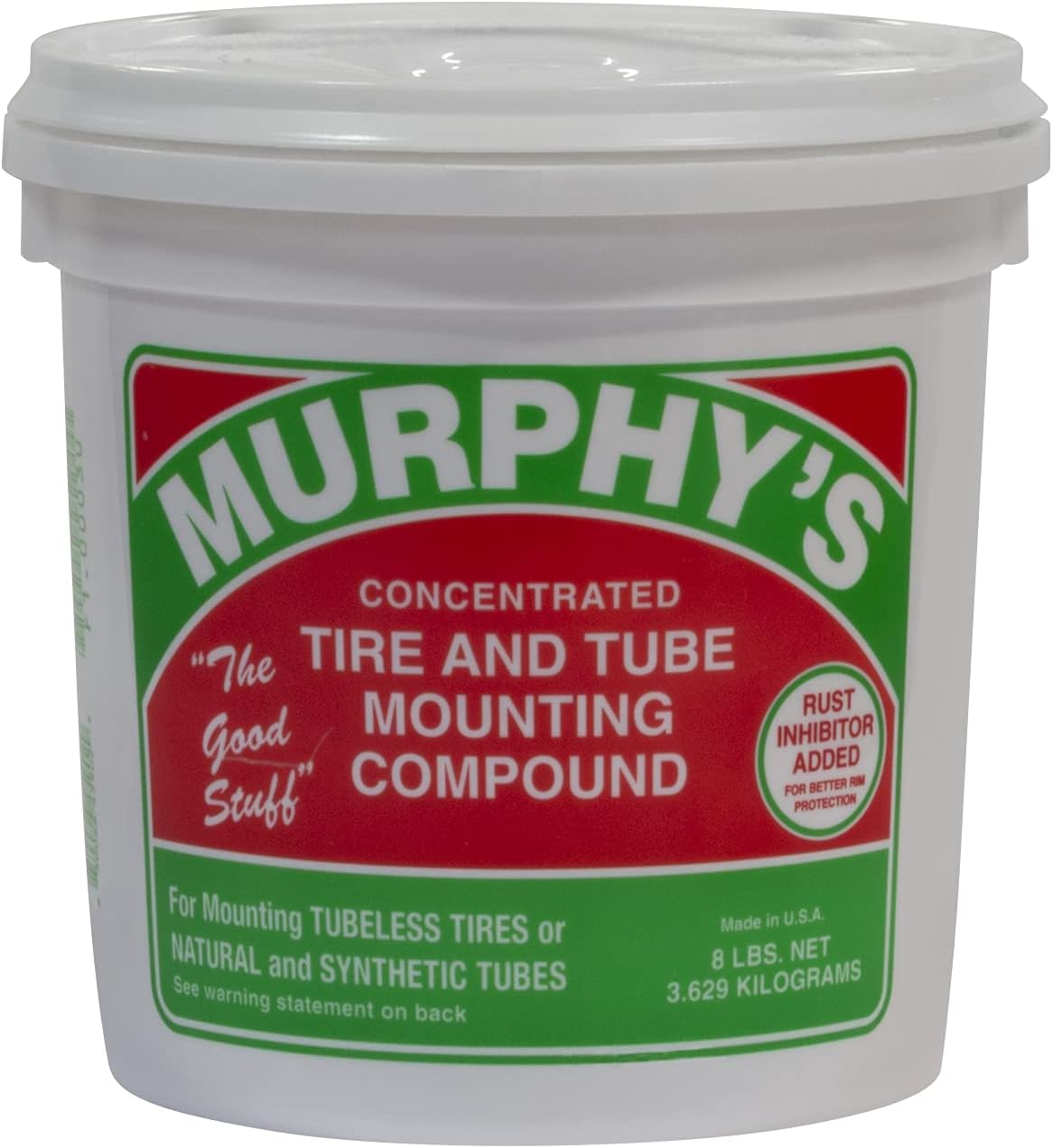
A concentrated tire and tube mounting compound designed to help simplify mounting rubber tires and tubes on passenger, semi truck, construction, and OTR applications. Its ultra-thick formula packs beads effectively and includes rust inhibitors to help protect against corrosion during use.

The Airmoto portable tire inflator quickly and accurately fills car, truck, SUV, motorcycle, and bicycle tires up to 120 PSI with auto shut-off when your target pressure is reached. Its large LCD, multi-unit pressure display, and digital gauge make it easy to dial in settings and verify readings, while the built-in LED flashlight helps in low light. The included polyurethane hard carrying case and storage mesh pocket keep the inflator and accessories protected and organized.
Off-Road Performance: Rugged vs. All-Terrain Tires
R/T tires often gain an advantage as the ground becomes softer, rougher, or more likely to damage a tire. Larger shoulder blocks and more open channels can help the tread find edges in mud and loose soil. Added sidewall and shoulder features may also improve resistance to cuts, impacts, and punctures.
A/T tires remain highly capable on gravel, hardpack, forest roads, shallow ruts, and moderate rocky trails. An aggressive A/T with a strong carcass may outperform a road-friendly R/T in some conditions, so compare actual construction and manufacturer data instead of relying only on the category name.
Tread Design Differences
- Center tread: A/T tires commonly use more closely supported center blocks for road stability. R/T tires may use larger or more irregular blocks to create additional biting edges.
- Void area: R/T tread channels are often wider, which can help release mud, stones, and loose soil. Wider voids can also increase pattern noise.
- Shoulders: R/T tires frequently use larger, staggered shoulder lugs for traction in ruts and soft surfaces.
- Sidewalls: Many R/T models include prominent sidewall lugs or reinforced construction, but the number of body plies and actual materials vary by size.
- Siping: Road- and winter-focused A/T tires may use more siping to create wet- and snow-gripping edges. Aggressive tread blocks alone do not guarantee winter traction.
Traction in Various Terrains
Hardpack dirt and gravel: Both categories work well. A/T tires normally provide enough traction while retaining better road comfort, making them the efficient choice for maintained unpaved roads.
Mud: R/T tires usually have more room between tread blocks to clear moderate mud. If deep mud is your vehicle’s main environment, a true mud-terrain tire may still provide more effective self-cleaning.
Sand: Vehicle weight, tire pressure, flotation, throttle control, and tread design all matter. Aggressive R/T tread can add traction, but excessive wheelspin can dig the vehicle deeper.
Rocks: Look beyond the tire label and compare sidewall construction, shoulder protection, tread compound, and load rating. R/T tires often provide more trail protection, but not every size uses the same internal construction.
Snow: Check for the 3PMSF symbol rather than assuming that larger tread blocks are better. Snow-packed roads require different characteristics than deep, loose off-road snow.
How Do All-Terrain and Rugged Tires Perform on Pavement?
For frequent pavement driving, A/T tires usually have the advantage. Their more supported tread blocks tend to produce steadier steering, lower pattern noise, and less tread movement during braking and cornering.
- Road noise: A/T tires are generally quieter, although noise varies widely among models and can increase as tread wears unevenly.
- Ride comfort: Tire construction, load range, sidewall stiffness, wheel diameter, and inflation pressure can matter as much as tread category.
- Wet braking: More tread void does not automatically mean a shorter stop. Compound, siping, groove layout, tread depth, and temperature all affect wet performance.
- Steering feel: Heavy LT tires with large blocks may feel slower to respond than the vehicle’s original highway-oriented tires.
- Highway stability: Choose a tire with the required load and speed ratings and maintain the pressure shown on the vehicle placard.
Modern R/T designs can still provide acceptable highway manners. Manufacturers often use variable tread-block spacing to reduce pattern noise, but an R/T tire will rarely be as quiet as a touring or highway-terrain tire of similar quality.
Winter Performance: 3PMSF, M+S, and Tire Type
The Three-Peak Mountain Snowflake symbol indicates that a tire has met an industry severe-snow traction requirement. It does not mean the tire has been certified for every winter condition, and it does not measure tread life.
An M+S, M/S, or M&S marking identifies a tire intended for mud-and-snow service based largely on tread design. It should not be treated as equivalent to the performance-based 3PMSF qualification.
Note: A 3PMSF-qualified A/T may be a better winter-road choice than an aggressive R/T without that marking. For frequent ice, packed snow, and prolonged cold, a dedicated winter tire may still provide better braking and control.
Read the exact model specification because 3PMSF availability can differ among product lines. Do not assume that every tire sold under an A/T or R/T name carries the symbol.
Tread Life and Fuel Efficiency: Which Tire Lasts Longer?
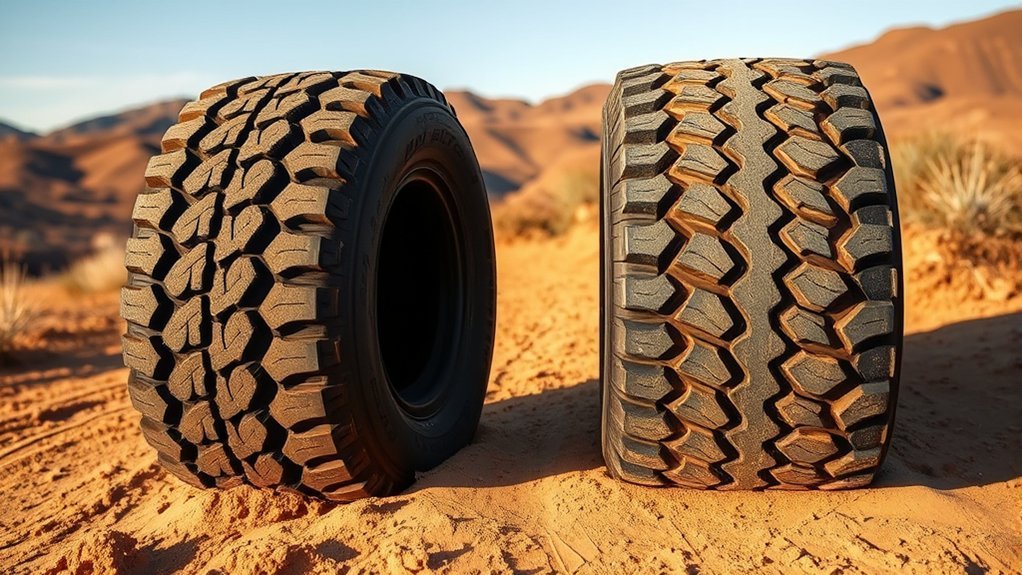
A/T tires often carry longer treadwear warranties because many are designed for substantial highway use. Current examples also show why broad mileage ranges can be misleading. The Toyo Open Country A/T III lists coverage of up to 65,000 miles, depending on size and construction, while the Open Country R/T Trail lists a 45,000-mile treadwear warranty.
A mileage warranty is not a prediction that every buyer will reach that distance. Coverage may be prorated and subject to rotation, alignment, inflation, vehicle, service, and documentation requirements. Actual tread life also depends on driving style, towing load, road surface, climate, wheel alignment, and how frequently the tire is used off road.
| Factor | How It Affects Tire Life or Efficiency |
|---|---|
| Tread aggressiveness | Large, flexible blocks may create more heat, noise, and irregular-wear risk on pavement. |
| Tire weight | Heavier tires add rotating mass and may affect acceleration, braking feel, and efficiency. |
| Overall diameter and width | Larger or wider replacements can change gearing, aerodynamic drag, rolling resistance, clearance, and speedometer accuracy. |
| Inflation pressure | Incorrect pressure can increase heat, wear, rolling resistance, and the risk of tire damage. |
| Rotation and alignment | Regular rotation and correct alignment help control uneven tread wear and noise. |
| Off-road use | Sharp rocks, wheelspin, cuts, impacts, and chunking can reduce usable service life. |
NHTSA estimates that reducing tire rolling resistance by 10% can improve vehicle fuel economy by about 1%–2%, but actual results depend on the tire, vehicle, pressure, load, speed, and driving conditions.
A similarly sized A/T tire will often be more fuel-efficient than an aggressive R/T, but the category label alone cannot predict an exact MPG change. Compare the new tire’s weight, dimensions, construction, and rolling-resistance information when available.
Towing, Load Capacity, and Safe Fitment
Tread style should never be the first fitment decision. Before selecting an A/T or R/T tire, check the vehicle owner’s manual and the Tire and Loading Information Label on the driver’s door area. NHTSA’s tire guidance directs drivers to these sources for the correct replacement size and recommended cold inflation pressure.
- Tire size: Confirm section width, aspect ratio, construction, and rim diameter.
- Load index and load range: The replacement must support the vehicle, passengers, cargo, trailer tongue weight, and other equipment.
- Speed rating: Use a rating appropriate for the vehicle and follow the vehicle and tire manufacturers’ requirements.
- Approved rim width: Confirm that the tire is approved for the installed wheel.
- Overall diameter: Larger tires can affect clearance, gearing, braking, speedometer readings, stability-control systems, and spare-tire compatibility.
- AWD and 4WD systems: Follow the owner’s manual regarding permitted differences in tire size, circumference, brand, model, and tread depth.
- Towing use: Do not assume that the stiffest-looking or highest-load-range tire is automatically the best match. Excess stiffness and weight can change ride and handling.
Warning: Never choose a replacement tire solely because it fits on the wheel or looks more aggressive. Match the vehicle manufacturer’s required size and load capacity, and use the cold inflation pressure on the vehicle placard—not the maximum pressure molded on the tire sidewall. Have major size, construction, or load-range changes reviewed by a qualified tire professional.
[Products Worth Considering]
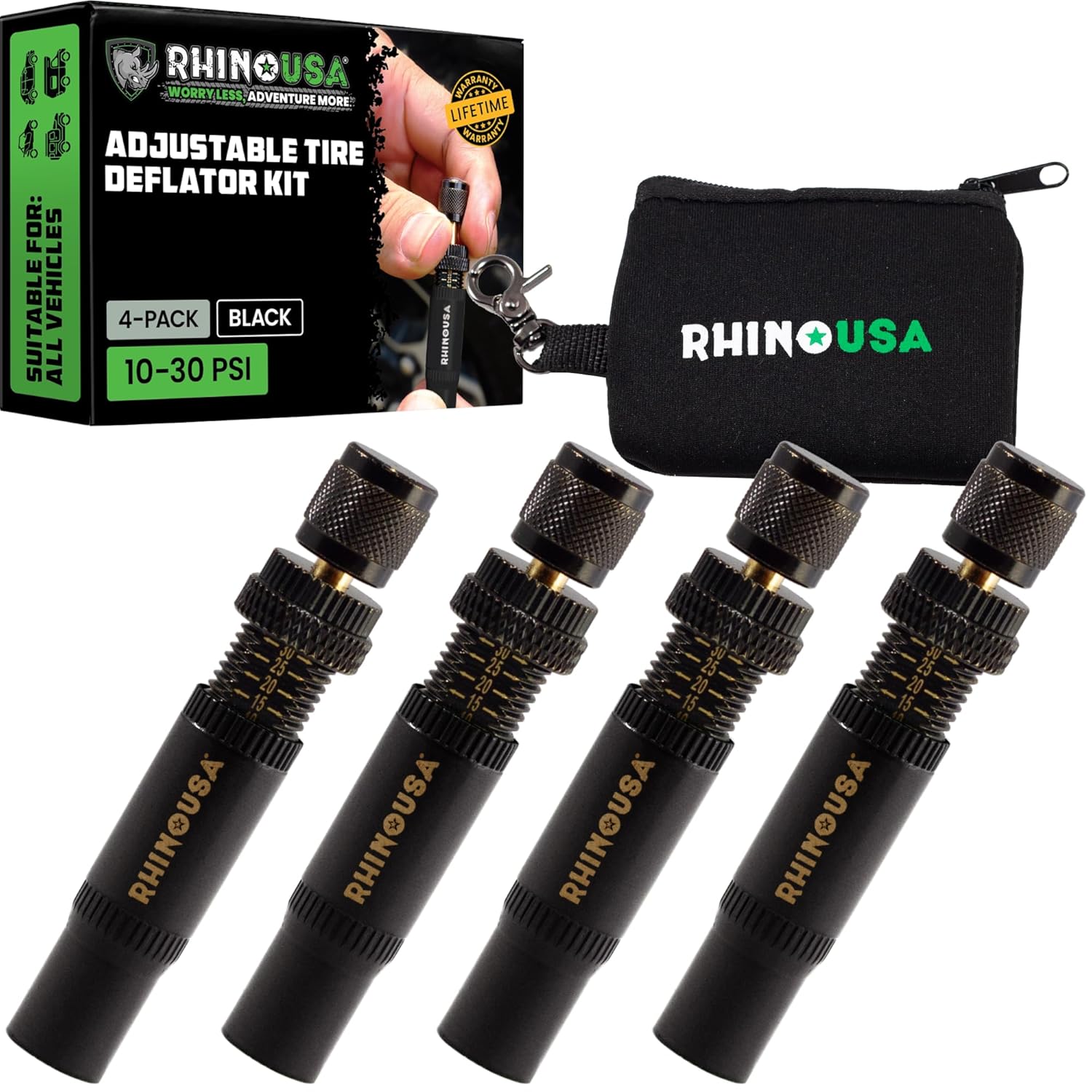
Use the Rhino USA adjustable tire deflators to air down all four tires at once by screwing one deflator onto each valve stem, letting you step away while the tires reach your preset pressure. Each deflator independently adjusts across a 10–30 PSI range with laser-etched indicators for quick setup and verification, making it ideal for beach, sand, and rocky off-road trails.
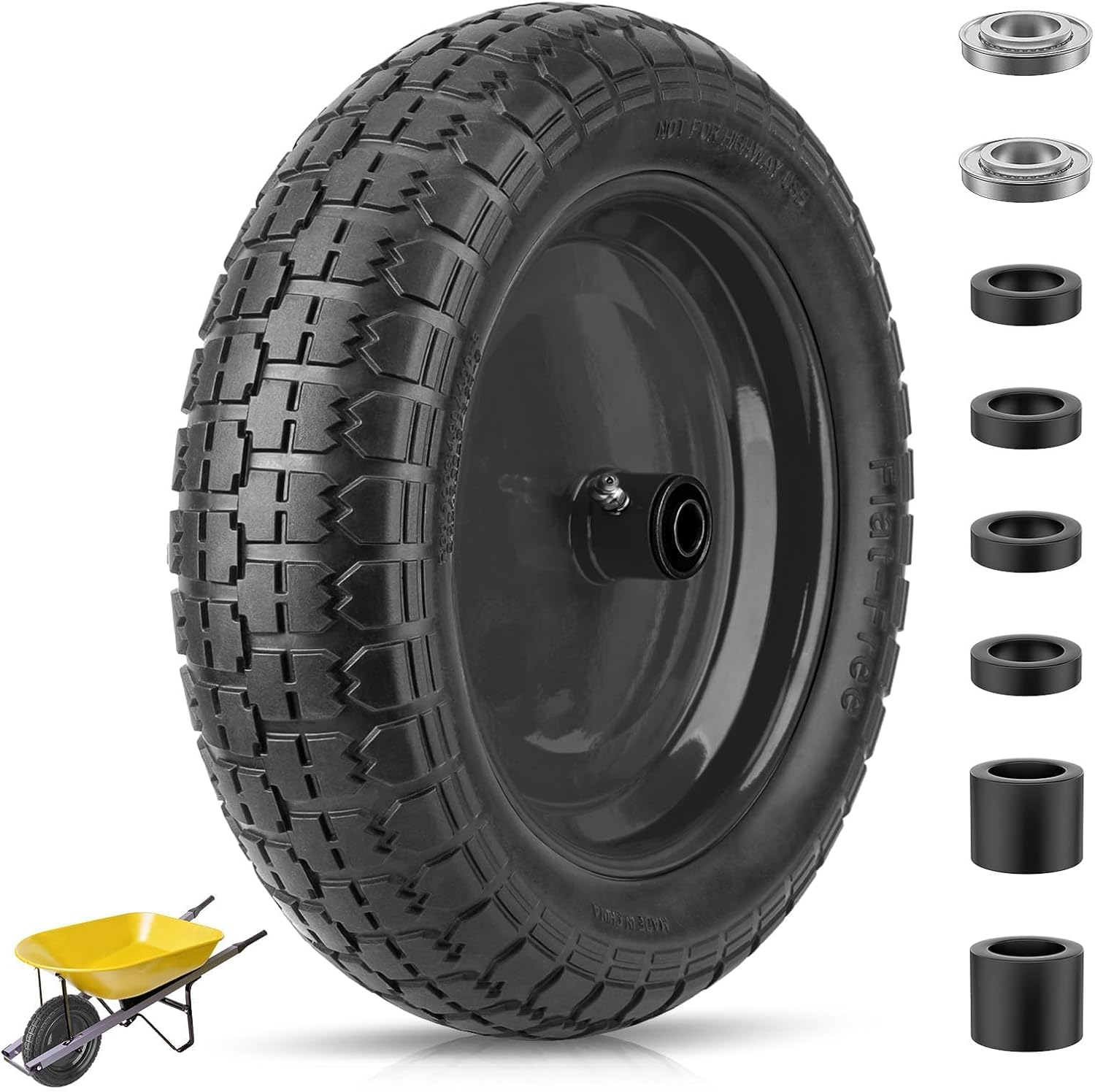
This flat-free TICONN wheelbarrow tire features durable polyurethane foam construction that never needs inflation, helping prevent punctures and reducing maintenance on rough outdoor terrain. With a 300 lb max load capacity and stable steel rim design, it supports safer transport for yard work and hauling tasks. An adapter kit with ball bearings and nylon spacers is included for easier fit and customization across common wheelbarrow and cart axle setups.

Secure your trailer or RV tires with a scissor-style wheel chock stabilizer that applies opposing force to help prevent wheel shift. It fits tight wheel gaps from 3.5 inches up to 12 inches and works for travel trailers, campers, fifth wheels, toy haulers, and heavy-duty trucks. The surface uses new electrophoretic technology to help prevent rust for reliable travel use.
Where Highway-Terrain and Mud-Terrain Tires Fit
An A/T or R/T is not always the best answer.
- Choose a highway-terrain tire when nearly all driving is on pavement and your priorities are cabin quietness, ride comfort, wet-road manners, and fuel economy.
- Choose an all-terrain tire for daily pavement use mixed with gravel, dirt, snow-rated travel, camping, towing, and moderate trails.
- Choose a rugged-terrain tire when you need more mud, sand, rock, or rough-surface capability than a typical A/T but still drive meaningful highway miles.
- Choose a mud-terrain tire when deep mud, severe trails, or specialized off-road use outweigh concerns about noise, tread wear, weight, and pavement refinement.
Do not buy an R/T only for appearance if the vehicle rarely leaves pavement. A road-focused tire will usually provide better comfort and may cost less to operate.
How to Choose the Right Tire for Your Driving Style
Start with your normal driving rather than the most extreme trail you might visit once. The best tire is the one that safely handles your routine mileage while providing enough reserve capability for your real off-road conditions.
[Products Worth Considering]

Orange Seal regular formula tubeless sealant quickly seals punctures and forms a durable bond inside your tire to help reduce flats. Made with natural latex, it adheres effectively to rubber and seals from the inside out, including the critical bead-to-rim interface for a reliable ride. It seals punctures up to 1/4 inch, slices up to 3/4 inch, and performs in temperatures as low as 11°F across MTB, road, cyclocross, gravel, and e-bike applications.

The GADFISH spare tire carrier is built for reliable hauling with a reinforced welded triangular structure and a behind plate that securely holds the tire up to 150 lbs. It fits a wide range of trailer wheel lug setups, making it suitable for boat trailers as well, while the sloping design helps reduce wind resistance and provides low-ground clearance. Installation is designed to be straightforward with different length bolts and no drilling required.

Slip the Powerbuilt tire step over your vehicle’s tire to reach roof racks, engine bays, truck boxes, and more without overreaching. Its adjustable, universal design fits tires with a cross tread width up to 13 inches, including car, truck, RV, and semi tires. The non-slip cheesegrater surface and anti-slip tape provide secure grip while the open design lets mud and debris pass through. Fold-flat storage with rubber bumpers helps keep your tire and the step protected between uses.
Assess Your Driving Habits
- Daily mileage: How many miles are on highways, city streets, gravel, and trails?
- Terrain: Do you face maintained dirt, sharp rocks, deep ruts, mud, sand, or construction debris?
- Weather: Do you need verified severe-snow performance, frequent wet-road braking, or hot-weather durability?
- Load: Do you tow, haul tools, carry a slide-in camper, or travel with heavy accessories?
- Comfort: How much tread noise, vibration, and steering heaviness will you accept?
- Operating cost: Are fuel economy, tread warranty, rotation cost, and replacement availability major concerns?
Evaluate Terrain Frequency
If most miles are paved and your off-road travel consists of gravel, forest roads, campsites, and occasional moderate trails, an A/T tire is usually the stronger overall choice.
If rough surfaces are a regular part of work or recreation and you frequently need more shoulder bite, tread clearance, or sidewall protection, an R/T may justify its compromises.
If deep mud or extreme trail use dominates, compare an R/T with a true M/T rather than assuming the hybrid option will provide the maximum available traction.
Compare Exact Models and Sizes
Once you select a category, compare at least two or three exact tires in the size your vehicle requires. Review:
- Published weight
- Tread depth
- Load index and load range
- Speed rating
- Approved rim-width range
- 3PMSF marking
- Sidewall and carcass construction
- Treadwear-warranty terms
- Wet, noise, comfort, and off-road information
- Availability of matching replacements and a full-size spare
Pro Tip: Compare specifications for the exact size you plan to buy. Construction, weight, tread depth, load rating, warranty coverage, and even sidewall ply count can change from one size to another within the same tire line.
Maintenance for A/T and R/T Tires
Aggressive truck tires need consistent maintenance to control noise and uneven wear.
- Check cold inflation pressure at least monthly and before towing or long trips.
- Use the vehicle placard pressure unless the vehicle or tire manufacturer provides an approved alternative for a modified application.
- Rotate tires at the interval and pattern recommended by the vehicle and tire manufacturers.
- Have alignment checked if the vehicle pulls, the steering wheel is off-center, or tread begins wearing unevenly.
- Inspect the tread and sidewalls after rocky or debris-filled trails for cuts, exposed cords, punctures, trapped stones, and missing tread chunks.
- Rebalance tires when vibration develops or after off-road impacts.
- Track tread depth across several points, not only the center of the tire.
- Check the DOT Tire Identification Number and search NHTSA’s recall database when buying or inspecting tires.
If you reduce pressure for off-road travel under appropriate guidance, reinflate the tires to the correct road-use pressure before returning to sustained pavement speeds. Do not drive at highway speed on intentionally aired-down tires.
Frequently Asked Questions
What’s better, all-terrain or rugged-terrain tires?
All-terrain tires are usually better for drivers who spend most of their time on pavement and need moderate off-road capability. Rugged-terrain tires are better suited to frequent mud, sand, rocks, rough access roads, and job sites where added tread aggression and trail protection justify more noise and weight.
What are rugged-terrain tires good for?
Rugged-terrain tires are useful for mixed road and off-road driving that is more demanding than a typical A/T application. Common uses include muddy trails, loose sand, rocky routes, unimproved work sites, overlanding, and vehicles that need stronger shoulder or sidewall protection without moving to a full mud-terrain tire.
Are rugged-terrain tires louder than all-terrain tires?
They usually are because their larger tread blocks and wider voids generate more pattern noise. The difference varies by model, vehicle, road surface, alignment, rotation schedule, and tread wear. Some modern R/T tires use variable block spacing to reduce highway noise.
Are A/T or R/T tires better in snow?
The exact model matters more than the category label. Look for the Three-Peak Mountain Snowflake symbol, which indicates that the tire has met a severe-snow traction requirement. An aggressive R/T without 3PMSF qualification should not automatically be considered better than a snow-rated A/T.
Do rugged-terrain tires reduce fuel economy?
They can, especially when the replacement is heavier, wider, taller, or more aggressive than the original tire. Rolling resistance, inflation pressure, load, wheel weight, alignment, speed, and driving style also affect fuel use, so the category alone cannot predict an exact MPG change.
Can you tow with all-terrain or rugged-terrain tires?
Yes, when the exact tire has the correct size, load index, load range, speed rating, pressure, and wheel compatibility for the loaded vehicle and trailer. Tread appearance does not determine towing capacity. Follow the vehicle, trailer, wheel, and tire manufacturers’ limits.
Can I replace the factory tires with larger R/T tires?
Only after confirming wheel width, suspension and body clearance, load capacity, speed rating, overall diameter, spare-tire fit, braking, gearing, speedometer accuracy, and compatibility with ABS, traction control, and AWD or 4WD systems. A qualified tire professional should review substantial size or construction changes.
Conclusion
For most drivers who commute, travel on highways, tow, and occasionally use gravel roads or moderate trails, an all-terrain tire provides the better balance of comfort, tread coverage, road handling, and off-road traction. Choose a rugged-terrain tire when mud, rocks, sand, rough job sites, or trail damage are regular concerns and those benefits outweigh added noise, weight, and possible fuel-efficiency loss.
Make the final decision by comparing exact tire models in the correct size. Verify the vehicle’s load and inflation requirements, check for 3PMSF qualification when winter traction matters, review warranty terms, and confirm that any size or construction change is safe for the vehicle.
Sources
- National Highway Traffic Safety Administration — TireWise — replacement size, vehicle placard, inflation, maintenance, treadwear, and rolling-resistance guidance.
- U.S. Tire Manufacturers Association — Severe Snow Conditions Definition — Three-Peak Mountain Snowflake qualification.
- Toyo Tires — Open Country A/T III — current A/T positioning, 3PMSF status, construction features, and mileage-warranty examples.
- Toyo Tires — Open Country R/T Trail — R/T hybrid positioning, off-road features, comfort trade-offs, and warranty information.
- Nitto Tire — Ridge Grappler — hybrid-terrain design and variable-pitch road-noise features.
- National Highway Traffic Safety Administration — Recall Lookup — tire and vehicle-equipment safety recall searches.