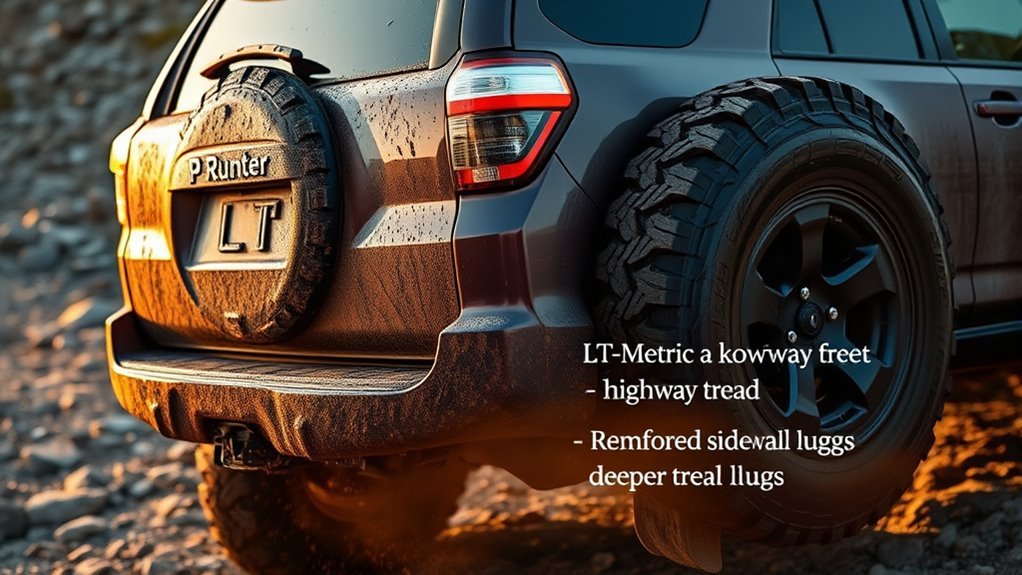
Choosing between P-metric and LT tires for your 4Runner comes down to how you really drive, how much weight you carry, and how often your tires meet sharp rocks, ruts, and loaded trail miles. P-metric tires usually make more sense for daily driving, highway trips, and mild dirt roads. LT tires make more sense when you tow, haul, air down often, or drive rocky trails where sidewall strength matters.
Quick Answer
Choose P-metric tires for a mostly stock 4Runner that spends most of its time on pavement, gravel, and light trails. Choose LT tires if you tow, carry heavy gear, run over sharp rocks, air down often, or need extra sidewall and load-range strength.
Key Takeaways
- P-metric tires usually ride smoother, weigh less, and fit daily 4Runner use better than LT tires.
- LT tires add strength for towing, heavy gear, overlanding, aired-down driving, and rocky terrain.
- Do not judge a tire by “ply” language alone. Check load index, load range, pressure, and your door-jamb label.
- Passenger tires on SUVs need load derating, so confirm the real load capacity before changing tire type.
- The best tire is the one that matches your real use, not the most aggressive tire that fits the wheel well.
Last updated: July 6, 2026
P-Metric vs. LT Tires for Your 4Runner: Start Here
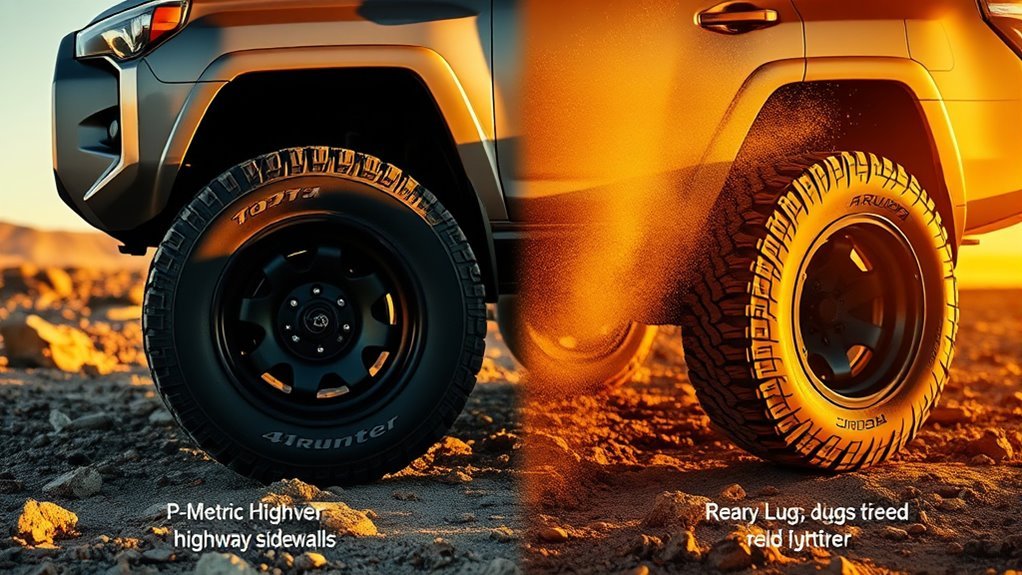
Start with your 4Runner’s actual use. If your week includes commuting, school runs, highway travel, rain, snow, and the occasional graded forest road, a quality P-metric all-terrain tire may be the better fit. It usually keeps the 4Runner quieter, smoother, and easier to live with every day.
If your 4Runner carries recovery gear, drawers, rooftop cargo, armor, a trailer tongue load, or camping gear for long trips, LT tires deserve a serious look. They are built for light-truck service, higher load pressures, and harder use.
Pro Tip: Before you shop, open the driver door and read the Tire and Loading Information Label. Toyota notes that the exact passenger and cargo capacity for your vehicle is shown on the driver door-jamb label, not a generic online chart.
| Your 4Runner Use | Better Starting Point |
|---|---|
| Mostly highway, city driving, rain, snow, and maintained dirt roads | P-metric or Euro-metric SUV tire |
| Weekend trails with moderate gravel, sand, or forest roads | P-metric all-terrain or XL-rated tire, depending on load |
| Rocky trails, heavy gear, towing, armor, or frequent airing down | LT tire with the right load range and pressure |
| Long overland trips far from tire service | LT tire, full-size spare, repair kit, and compressor |
What’s Hidden Inside Your Tire and Why It Matters
The tire code tells you more than the size. A “P” at the start of the size means passenger-metric. “LT” means light truck. You may also see SL, XL, Load Range C, Load Range D, or Load Range E. These markings affect load capacity, pressure, ride feel, and durability.
Do not treat “ply rating” as a literal count of fabric layers. Modern tires use advanced materials, so load range is mainly a strength and pressure category. Tire Rack explains that load range or ply rating indicates how much load a tire is designed to carry at a specific pressure.
| Feature | P-Metric Tire | LT Tire |
|---|---|---|
| Main purpose | Passenger vehicles, crossovers, SUVs, and light-duty use | Light trucks, loaded SUVs, towing, hauling, and severe use |
| Common marking | P265/70R17, SL, or XL | LT265/70R17, Load Range C, D, or E |
| Ride feel | Usually softer and quieter | Usually firmer and heavier |
| Load behavior | Capacity depends on load index and SUV derating | Capacity depends on LT load range, load index, and inflation pressure |
| Trail durability | Fine for mild trails and gravel | Better for rocks, heavy loads, and repeated airing down |
Highway Miles and Light Trails: Where P-Metric Wins
Most 4Runner owners still spend most of their miles on pavement. In that setting, P-metric tires often make the truck feel better. They usually weigh less than similar LT tires, ride more smoothly, and place less strain on steering, braking, and suspension parts.
P-metric tires also make sense for owners who use the 4Runner as a daily driver with occasional dirt-road travel. A good P-metric all-terrain can handle gravel roads, dry two-tracks, campground access roads, and maintained forest roads without the ride penalty of a heavy LT tire.
The key is honesty. If you mostly drive pavement and only want the aggressive look of an LT tire, you may pay for strength you rarely use. That cost can show up as firmer ride quality, slower acceleration, more road noise, and lower fuel economy depending on the tire model and size.
[Products Worth Considering]

This ALL-TOP auto-stop tire deflator valve kit lets you air down off-road tires quickly without watching pressure, automatically stopping when your preset PSI is reached. Each valve is individually calibrated for reliable performance with an acceptable +/- 2 PSI tolerance. The adjustable deflator range covers 10 to 30 PSI and includes four valves plus valve caps and a zipper pouch for easy setup on trucks, SUVs, RVs, UTVs, and powersports.

Black Magic Tire Wet delivers a deep wet-look shine that makes tires appear dark, rich, and freshly detailed. Its long-lasting formula helps resist rain, dust, and road grime for weeks of glossy protection, not days. Apply by spraying onto clean, dry tires—no buffing or wiping required—with a low-sling design to reduce splatter on paint and wheels.

The 22800 wheel stud installer makes replacing wheel studs quick and secure, saving time and effort during tire service. It uses a ratchet or impact wrench to pull new studs firmly into place, helping when existing studs are too long. Compatible with most automotive wheels and light-duty truck wheel studs, it’s designed for easy, tool-assisted installation.
When Your 4Runner Needs LT Off-Road Muscle
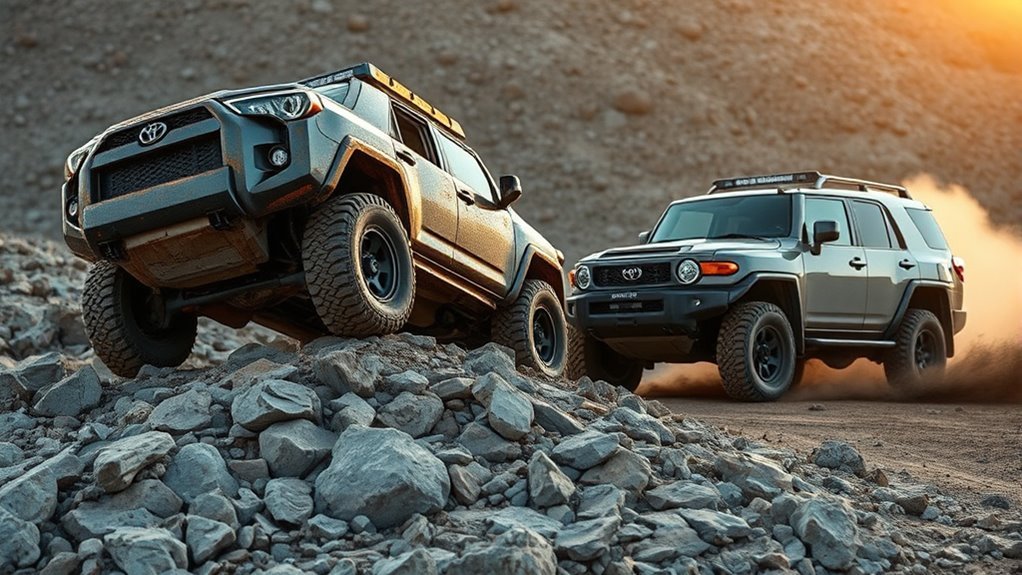
LT tires make sense when your tires are part of your safety margin. If you drive over sharp rock, carry constant cargo weight, tow, or spend time far from tire shops, the stronger LT construction can be worth the extra weight and firmer ride.
[Products Worth Considering]
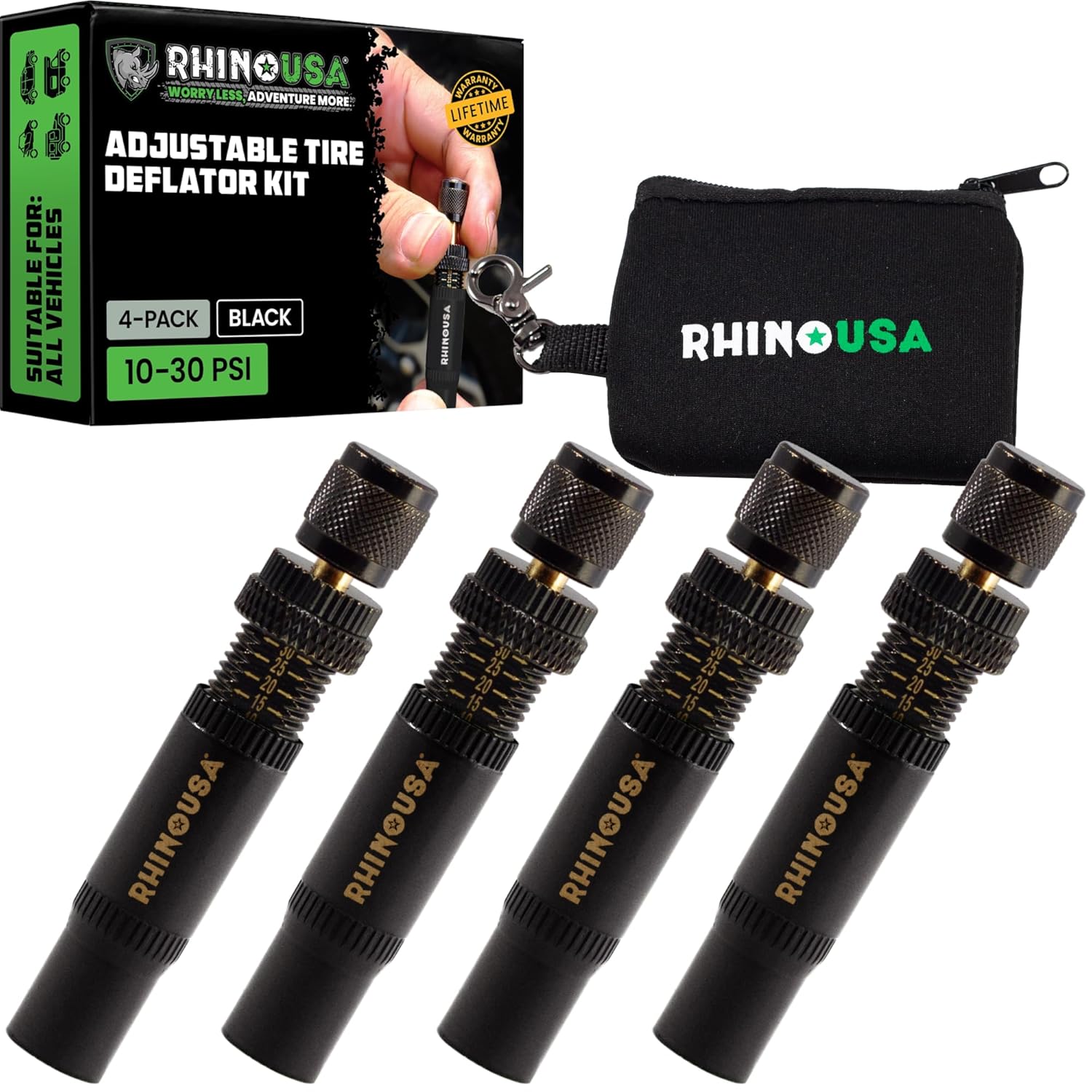
Use the Rhino USA adjustable tire deflators to air down all four tires at once by screwing one deflator onto each valve stem, letting you step away while the tires reach your preset pressure. Each deflator independently adjusts across a 10–30 PSI range with laser-etched indicators for quick setup and verification, making it ideal for beach, sand, and rocky off-road trails.

Secure your vehicle during transport with this 4-pack of heavy-duty tire tie down straps designed for trailers and hauling. The ratchet system with flat hooks and D-rings helps you tension the straps quickly, while the wheel-friendly design protects tires. With high break strength and corrosion-resistant hardware, these straps provide reliable, confidence-inspiring tie-down security for cars, trucks, and UTVs.
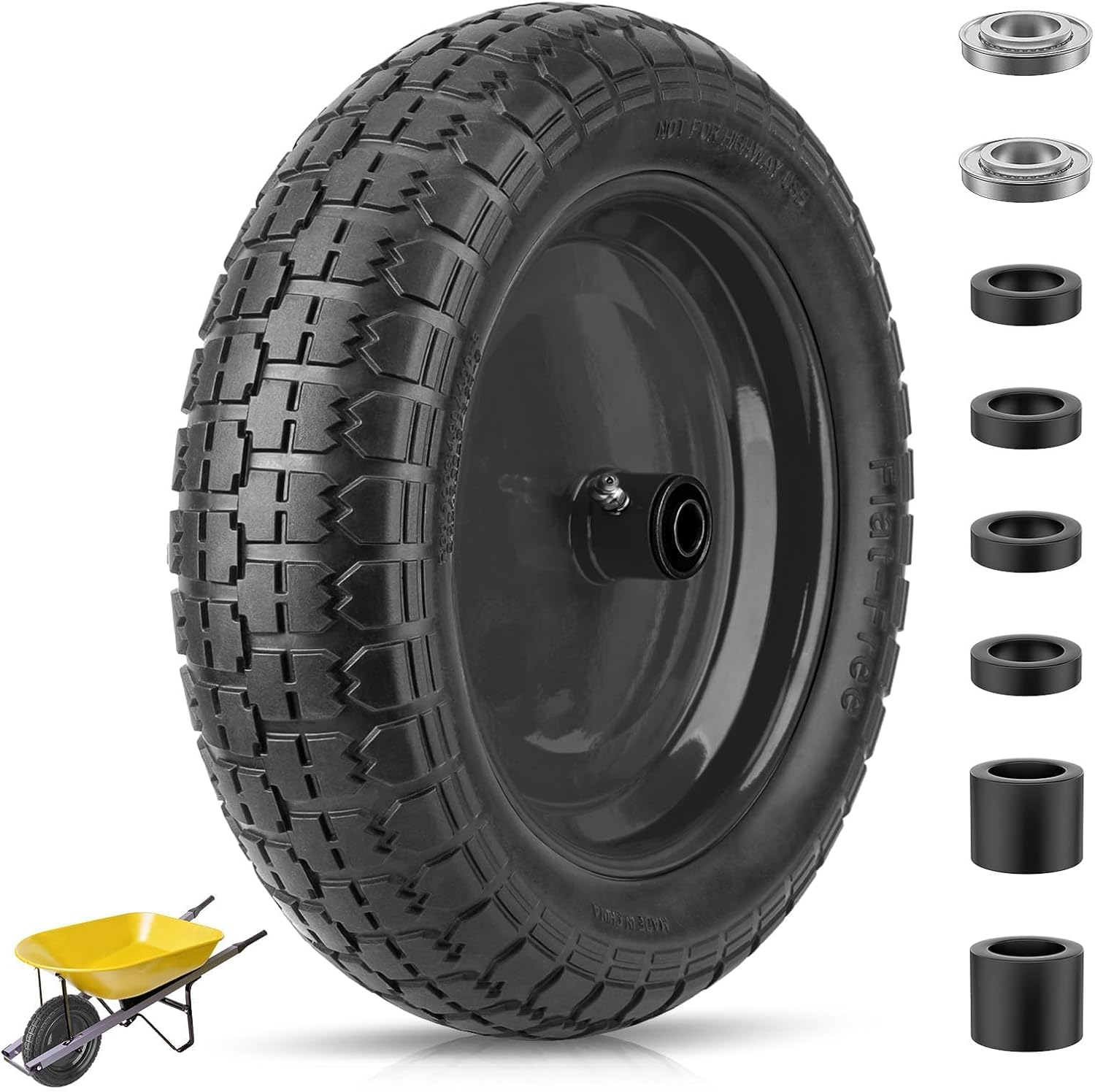
This flat-free TICONN wheelbarrow tire features durable polyurethane foam construction that never needs inflation, helping prevent punctures and reducing maintenance on rough outdoor terrain. With a 300 lb max load capacity and stable steel rim design, it supports safer transport for yard work and hauling tasks. An adapter kit with ball bearings and nylon spacers is included for easier fit and customization across common wheelbarrow and cart axle setups.
Rocky Terrain Demands
Rocky terrain puts the sidewall at risk. A sharp rock can pinch, cut, or bruise a tire, especially when you air down for traction. LT tires are not puncture-proof, but they usually give you a stronger casing and better resistance to trail damage than a comparable P-metric tire.
LT tires also handle repeated flexing better when used correctly. That matters on slow trails where the tire compresses against ledges, roots, and broken rock. If you explore places where a flat tire can turn into a recovery problem, the extra strength can be a smart trade-off.
Warning: Airing down improves traction, but it also increases heat and sidewall flex. Never drive highway speeds while aired down. Reinflate before returning to pavement, and stay within the tire and wheel manufacturer’s limits.
Load Capacity Matters
Load capacity matters more than the tire label alone. A stock 4Runner with two passengers needs a different tire setup than a loaded overland build with steel armor, drawers, water, tools, a roof rack, and a trailer.
When you add weight, calculate it. Include passengers, cargo, recovery gear, aftermarket accessories, and trailer tongue weight. Toyota states that towing capacity depends on base curb weight plus cargo, occupants, and added vehicle equipment, and that you should not exceed weight ratings.
Sidewall Strength Essential
Sidewall strength is one of the biggest reasons to choose LT tires. A stronger sidewall can help when you drive rocky trails, lower tire pressure for traction, or carry heavy gear for long distances.
That strength comes with trade-offs. LT sidewalls are usually stiffer, which means the ride can feel harsher on broken pavement. If your 4Runner rarely leaves maintained roads, that stiffness may not help you much.
The Hidden Cost of Heavy Tires: Weight, MPG, and Comfort
LT tires often weigh more than similar P-metric tires. That extra rotating weight can affect acceleration, braking feel, steering response, suspension comfort, and fuel economy. The exact difference depends on tire size, tread design, load range, wheel weight, and inflation pressure.
| Trade-Off | What You May Notice |
|---|---|
| More tire weight | Slower acceleration and more effort from brakes and suspension |
| Stiffer construction | Firmer ride over cracks, joints, and washboard roads |
| Aggressive tread | More road noise, especially as the tire wears |
| Higher load pressure needs | You may need pressure tuning based on load tables, not guesswork |
Weight Penalty Impact
Heavy tires are not automatically bad. The problem starts when the tire is heavier than your use case requires. A heavier LT tire can help a loaded trail rig, but it can feel wasteful on a mostly stock commuter 4Runner.
When comparing tires, check actual tire weight, not just size. Two 265/70R17 all-terrain tires can have very different weights depending on construction, tread depth, and load range.
Ride Quality Trade-offs
Ride quality matters because you feel it every day. P-metric tires usually absorb small bumps better. LT tires usually feel firmer because they are built to carry load and resist damage.
If your 4Runner is a family vehicle or road-trip SUV, comfort may matter more than extreme trail strength. If it is a loaded trail vehicle, the firmer ride may be a fair price for stronger construction.
Sidewall Showdown: Which Tire Survives the Rocks?
For sharp rocks, LT tires usually have the advantage. Their stronger construction helps resist cuts, bruising, and sidewall damage. That does not mean they can survive careless driving. Line choice, speed, pressure, and wheel placement still matter.
| Trail Factor | P-Metric Tire | LT Tire |
|---|---|---|
| Gravel roads | Usually fine | Also fine, but may be firmer |
| Sharp rocks | More vulnerable | Better resistance |
| Frequent airing down | Use caution and avoid very low pressure | Better suited when used correctly |
| Heavy overland load | May be enough if load rating works | Often the safer choice |
[Products Worth Considering]

Malco tire mounting and demounting lubricant is a ready-to-use tire lube formulated to reduce friction during tire installation for passenger cars, light trucks, farm tires, and heavy-duty equipment. It provides rust-inhibiting protection to help reduce corrosion on rims and wheels, and helps support proper tire bead seating during inflation to reduce air leakage. The silicone-free, soap-free formula is whitewall safe to help prevent discoloration on whitewall tires and sensitive sidewall markings.

Measure tire tread depth quickly and accurately with this LUMITECO dial gauge that reads in 1/32" increments up to 14/32". The color-coded green/yellow/red zones make it easy to judge tire wear and know when replacement is needed. A rugged, compact design with a protective pouch helps keep the gauge ready for use on cars, trucks, motorcycles, and more.

Monitor tire tread wear with a smart, color-coded depth gauge that shows clear condition ranges at a glance. The bar is range marked for fast, easy readings, helping you maintain safer traction and performance. Each gauge is portable with a pocket clip, and the set includes 20 units for daily use and sharing.
4Runner Load Ratings: Why P-Metric Can Hit Limits
P-metric tires are not automatically weak, and LT tires are not automatically correct. The real question is whether the tire can safely carry your loaded 4Runner at the correct pressure.
Federal tire rules say that when passenger car tires are installed on a multipurpose passenger vehicle, truck, bus, or trailer, each tire’s load rating is reduced by dividing by 1.10 before calculating axle load capacity. That means you should not use the printed passenger-car load number at face value on an SUV.
Note: If you change tire type, size, or load range, ask the tire shop to confirm load capacity, wheel rating, clearance, pressure needs, and TPMS compatibility. The sidewall maximum pressure is not your automatic driving pressure.
Use this simple load check before buying:
- Read the original tire size, cold pressure, and combined occupant/cargo limit on your driver door-jamb label.
- Read the replacement tire’s load index or LT load range from the sidewall and manufacturer specs.
- If the tire is passenger-metric on an SUV, divide the applicable load capacity by 1.10.
- Add passengers, cargo, accessories, tools, water, roof load, and trailer tongue weight.
- Make sure you stay under the vehicle’s payload, axle, tire, wheel, and towing ratings.
This method is better than guessing from forum posts. Your 4Runner’s trim, year, accessories, wheel choice, and cargo load all affect the answer.
4Runner Tires for Your Region: Rocky West vs. Smooth East
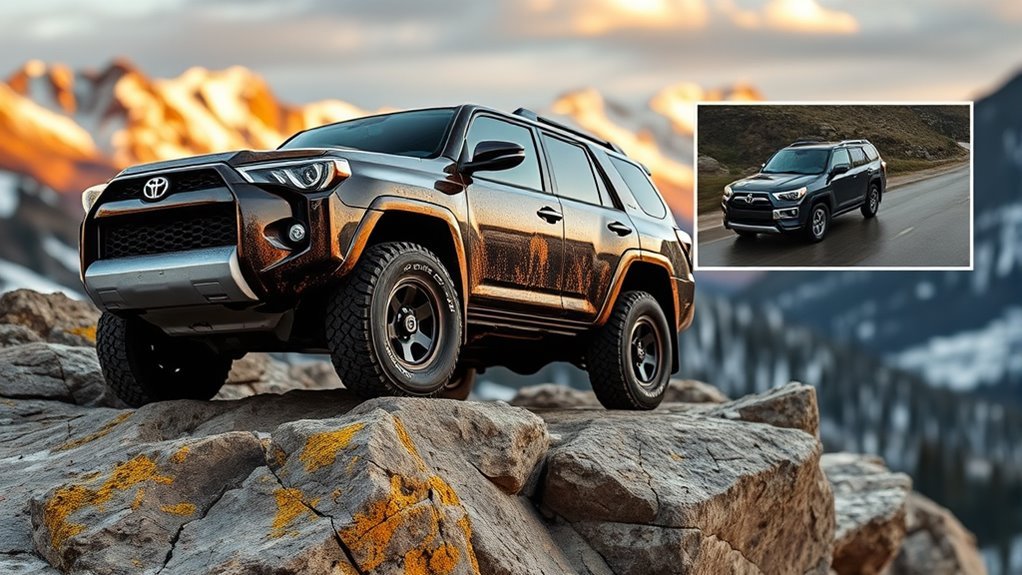
Regional terrain should influence your tire choice. A 4Runner in Utah, Colorado, Arizona, or Nevada may see rock ledges, washboard roads, sharp desert trails, and long distances from tire service. LT construction can make sense there, especially on loaded rigs.
A 4Runner in a flatter, wetter, or more pavement-heavy region may benefit more from a lighter P-metric tire with strong wet braking, winter performance, and low road noise. In those conditions, sidewall armor may matter less than rain grip and daily comfort.
Climate also matters. If you drive in snow and ice, tire compound and winter rating can matter more than P-metric versus LT construction. A heavy LT mud-terrain tire is not automatically safer in winter than a good all-weather or winter-rated tire.
Keeping Your 4Runner’s New Tires Balanced for the Long Haul
New tires should be balanced when installed. NHTSA also recommends checking tire pressure monthly when tires are cold, replacing unsafe tires at 2/32 inch tread depth, and rotating tires according to the owner’s manual or sooner if uneven wear appears.
Balancing Techniques Matter
Standard balancing corrects weight imbalance in the tire and wheel assembly. Road-force balancing goes further by using a load roller to measure tire and wheel uniformity under simulated road load. It can help when a 4Runner has vibration that normal balancing does not solve.
Road-force balancing is especially useful after installing aggressive all-terrain tires, LT tires, or larger tire sizes. It is not magic, though. Bent wheels, uneven tire wear, bad alignment, worn suspension parts, and poor tire quality can still cause vibration.
Rebalancing Over Time
Rebalance if you feel steering-wheel shake, seat vibration, cupping, or uneven tread wear. You should also inspect balance after hard off-road impacts, bead leaks, wheel damage, or repeated driving on rough trails.
Rotation matters too. A 4Runner can wear tires unevenly if alignment, pressure, or rotation intervals are ignored. Keep a record of tire pressure, rotation mileage, alignment checks, and any vibration symptoms.
Your 4Runner Tire Decision: 5 Questions to Answer
Use these questions before you buy. They will point you toward the right tire construction faster than brand hype or aggressive tread photos.
- How much pavement do you drive? If most miles are highway and city, P-metric usually makes sense.
- How much weight do you carry? Add passengers, cargo, accessories, and trailer tongue weight before choosing.
- What terrain do you actually drive? Gravel and dirt roads do not demand the same tire as rocky trails.
- Will you air down often? Frequent airing down favors stronger construction, proper tools, and careful pressure management.
- Can you accept the trade-offs? LT tires may add strength, but they can also add weight, road noise, and ride firmness.
For many 4Runner owners, the best answer is a high-quality P-metric or XL all-terrain tire. For loaded trail rigs, towing setups, and rocky routes, the better answer is often an LT tire with the correct load range and pressure.
Frequently Asked Questions
Are P-metric tires better than LT tires for a 4Runner?
P-metric tires are better for many daily-driven 4Runners because they usually ride smoother, weigh less, and feel quieter on pavement. LT tires are better when your 4Runner carries heavy weight, tows, drives rocky trails, or needs stronger sidewalls.
Are LT tires better for off-road driving?
LT tires are usually better for rocky, loaded, and repeated off-road use. They can resist trail damage better than comparable P-metric tires. For mild dirt roads, gravel, and occasional camping trips, a good P-metric all-terrain tire may be enough.
Is 10-ply or 12-ply better for towing?
Do not choose by ply language alone. Compare load index, load range, required inflation pressure, wheel rating, and actual axle load. A higher load range can help with heavy towing, but it may also ride harsher and require pressure that your setup does not need.
Should I get LT tires for my 4Runner?
Get LT tires if your 4Runner regularly carries heavy cargo, tows, runs armor, drives rocky trails, or airs down often. Stay with P-metric or XL tires if your 4Runner mostly drives pavement, light trails, and family trips.
Do LT tires need more air pressure than P-metric tires?
Often, yes. LT tires are designed around light-truck load and inflation tables. Do not inflate them only by the sidewall maximum or only by the original P-metric door label. Use the tire maker’s load-inflation data and a qualified tire shop’s guidance.
Can I mix P-metric and LT tires on a 4Runner?
Avoid mixing tire construction, size, tread pattern, or load range on a 4Runner unless a qualified tire professional confirms it is safe for temporary use. For normal driving, use a matched set with the correct size, load rating, and pressure.
Conclusion
Your 4Runner does not need the toughest tire on the shelf. It needs the right tire for your weight, roads, terrain, and comfort expectations. P-metric tires are the smarter choice for many daily drivers. LT tires are the smarter choice when load, towing, rock protection, and remote travel matter more than ride softness.
Before you buy, read your door-jamb label, compare load index and load range, check wheel compatibility, and confirm the correct cold pressure. That simple process gives you a safer tire choice than choosing by looks or forum trends alone.
Sources
- Toyota 4Runner Owner’s Manuals — owner-manual reference for tire, loading, and vehicle-specific guidance.
- Toyota Canada 4Runner Specifications — payload and towing notes, including door-jamb load-carrying capacity guidance.
- NHTSA TireWise — tire pressure, tread, balancing, alignment, rotation, and size safety guidance.
- 49 CFR 571.110 — federal tire selection and load-rating rules for vehicles with GVWR of 10,000 pounds or less.
- Tire Rack: Load Ranges and Ply Ratings — explanation of load range, ply rating, and LT tire pressure categories.
- Tire Rack: Road Force Balancing — explanation of load-roller balancing and tire/wheel uniformity checks.