The safest Toyota Tundra tire pressure for towing is not one fixed number. Start with the cold PSI printed on your Tundra’s driver-door Tire and Loading Information label, then adjust only when your owner’s manual, tire manufacturer load table, wheel rating, and actual loaded weight support it. Guessing 40, 45, or 50 PSI can create poor handling, uneven wear, or an overloaded tire.
Quick Answer
For most Toyota Tundra towing setups, use the cold tire pressure on the driver-door placard as your starting point. Do not automatically inflate to 40, 45, or 50 PSI. Increase pressure only if your tire load table, wheel rating, and loaded axle weight confirm that it is safe.
Key Takeaways
- The correct Tundra tire pressure starts with the cold PSI on the driver-door tire label, not a universal towing number.
- Tongue weight, passengers, cargo, and trailer load all count against your payload and axle ratings.
- Truck tires and trailer tires use different pressure guidance. Check the trailer placard and trailer tire sidewall separately.
- Set pressure when tires are cold, ideally before driving or after the truck has been parked for at least three hours.
- Never exceed the tire sidewall maximum, wheel pressure limit, GVWR, GAWR, GCWR, hitch rating, or trailer rating.
At a Glance
| Time Required | 5–10 minutes for a basic cold-pressure check; longer if you need to weigh the truck and trailer. |
| Difficulty | Easy for checking PSI; moderate if confirming axle weights and tire load tables. |
| Tools Needed | Accurate tire pressure gauge, air compressor or inflator, Tundra owner’s manual, door placard, trailer placard, and tire load table for replacement LT tires. |
| Cost | Free if you already own a gauge and inflator; usually low cost for a certified scale ticket when weighing a loaded tow setup. |
Warning: Do not use the tire sidewall “maximum pressure” as your automatic towing pressure. That number is a limit, not always the recommended setting. Also check the wheel’s pressure rating because some wheels are rated lower than the tire.
Why Tire Pressure Matters for Towing Safety
When your Tundra is towing, the tires carry more than the truck’s curb weight. Passengers, cargo, hitch equipment, tongue weight, and trailer weight all affect how much load is placed on the tires and axles. Proper cold tire pressure helps the tire carry its rated load, reduces heat buildup, improves steering feel, and helps prevent uneven wear.
The key word is cold. The National Highway Traffic Safety Administration advises checking tire pressure before long trips and using the vehicle tire placard or owner’s manual for recommended pressure and load limits. A tire is generally considered cold before driving or after the vehicle has been parked for at least three hours.
The right towing PSI is the pressure that matches your actual tire, wheel, axle, and load—not the biggest number printed on the tire.
[Products Worth Considering]

ETENWOLF’s tire pressure gauge helps you quickly and accurately check tire PSI across cars, trucks, motorcycles, bikes, and more. It’s manually calibrated to ANSI B40.1 Grade A for reliable readings, includes a large glow dial for easy nighttime viewing, and features a 360-degree swivel chuck for use at any valve angle. The gauge also works consistently in extreme hot or cold weather.

These universal tire valve stem caps help protect valve cores from dust, debris, and moisture while helping maintain stable tire pressure. The corrosion-resistant metal construction and sealed design provide reliable protection in road grime, mud, and winter conditions. Twist-on installation makes them quick to fit on cars, SUVs, trucks, and motorcycles.
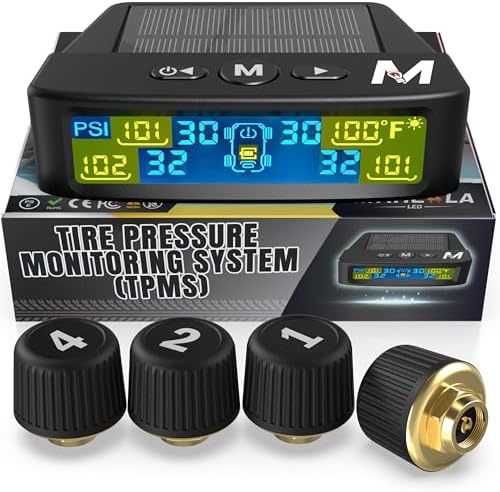
Marcala’s TPMS set of four sensors helps you monitor tire pressure and temperature in real time while driving, with updates every second. The bright color LCD uses auto-dimming for easy viewing, powered by dual solar and USB charging, and offers six alarm modes. Built for trailers, RVs, campers, trucks, and towing setups, the sensors support monitoring 1-4 wheels up to 98 PSI with IP67 waterproof protection.
How to Find the Correct Toyota Tundra Tire Pressure for Towing
The most reliable place to begin is your Tundra’s Tire and Loading Information label on the driver-side door jamb. Toyota’s owner information explains that the recommended cold tire inflation pressure and tire size are displayed on this label, so it should be treated as your baseline before towing.
[Products Worth Considering]

Milton S-921 pencil tire pressure gauge helps you maintain optimal tire pressure for passenger cars with accurate readings in PSI and kPa. It features a built-in deflator valve for convenient pressure adjustments, plus a single chuck head and nylon indicator bar for easy use on the go. Built from durable plated brass and designed for reliable performance, it’s a practical road trip and cold-weather maintenance tool.
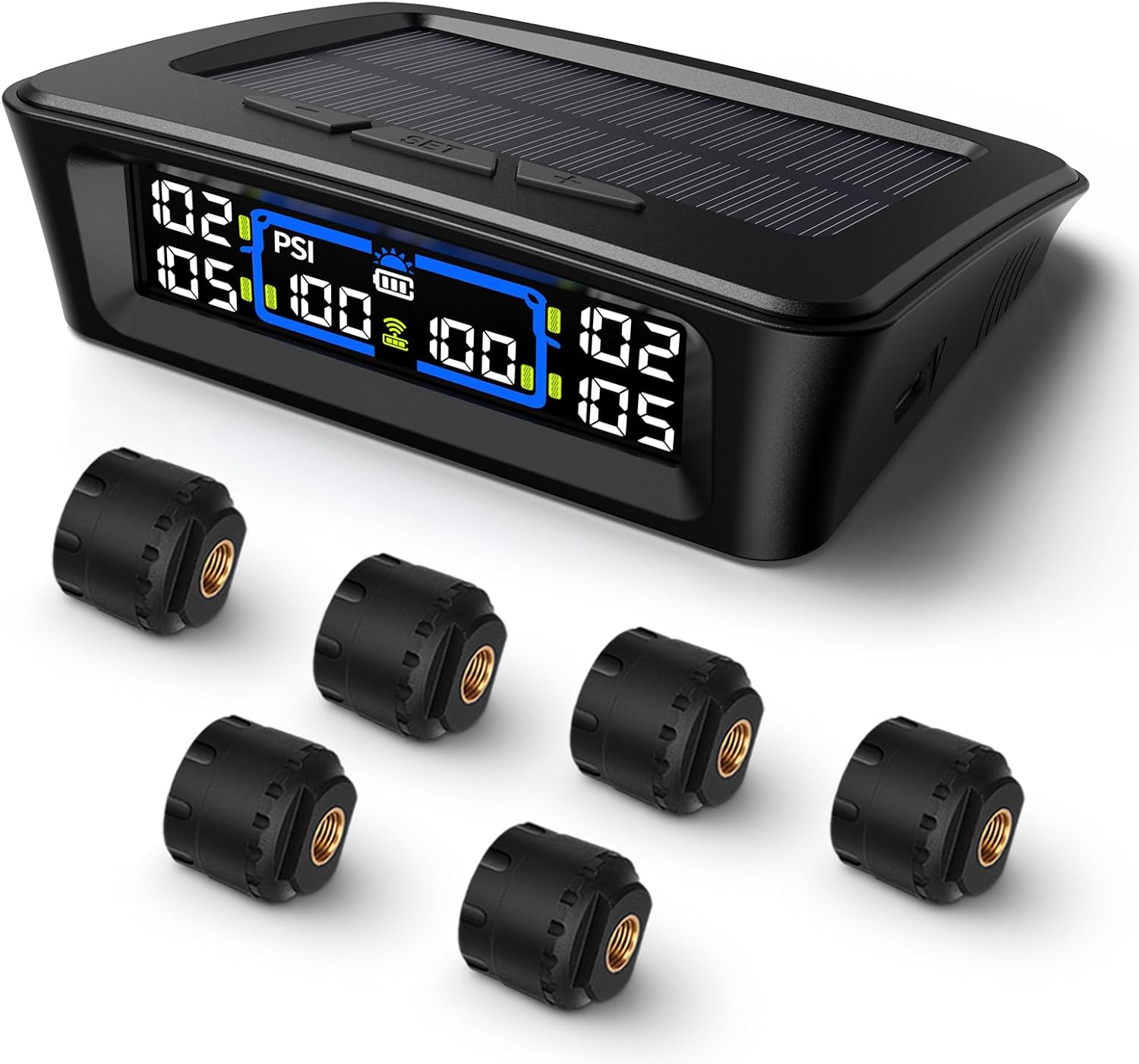
The Tymate TM12 RV TPMS delivers real-time tire pressure and temperature monitoring with a stable 433Hz display for safer long-distance driving. It supports simultaneous monitoring across vehicle and trailer zones, includes six alarm modes for pressure, temperature, leakage, battery, and signal loss, and features easy DIY installation with auto calibration. Power is supplied via USB-C charging or solar recharging, with a wide 0–144 PSI range and up to 50 ft signal coverage for RVs and towable trailers.

The ETENWOLF T600 digital tire pressure gauge delivers precise, manually calibrated readings to ANSI B40.7 Grade 2A standards with ±0.5% PSI accuracy. Its 360° rotating nozzle and display hold make it easy to check pressures from any angle, while a bleed button helps dial tires to the perfect level. With a 0–250 PSI range and support for PSI, BAR, and KPA, it’s a convenient tool for maintaining tire performance across many vehicles and seasons.
Step 1: Check the driver-door tire label
Look for the recommended cold PSI for the exact tire size installed on your Tundra. If your truck still has the original tire size and load type, this label is usually the safest starting point for normal towing within the truck’s ratings.
Step 2: Confirm your actual tire type
If you replaced the original tires with LT tires, E-load-range tires, oversized tires, or a different tire size, the door label may no longer tell the full story. In that case, use the tire manufacturer’s load-inflation table and confirm that the tires, wheels, and valve stems are all rated for the pressure you plan to use.
Step 3: Check payload and axle ratings
Tongue weight presses down on the truck and counts against payload. Toyota’s current Tundra towing guidance tells owners to confirm that gross trailer weight, gross combination weight, gross vehicle weight, gross axle weight, and tongue weight are all within limits. If the rear axle is near its rating, tire pressure alone will not fix an overloaded setup.
Step 4: Set pressure before driving
Use an accurate gauge before the truck has been driven. Add or release air to match the correct cold pressure. After driving, pressure will rise as the tires warm up. That is normal.
Note: Do not bleed air from hot tires just because the PSI rises during towing. Recheck and reset pressure when the tires are cold.
Ideal Tire Pressures for Different Towing Loads
There is no single ideal PSI for every Toyota Tundra towing load. A lightly loaded utility trailer, a boat trailer, and a travel trailer near the truck’s payload limit can all require different checks. Use the table below as a safe decision guide.
| Towing Situation | Safe Pressure Approach |
|---|---|
| Stock tires, light trailer, normal cargo | Use the cold PSI on the Tundra door placard unless your owner’s manual says otherwise. |
| Heavy tongue weight or near-payload towing | Weigh the loaded truck and trailer, confirm GAWR/GVWR/GCWR, then verify tire capacity at the chosen PSI. |
| Replacement LT or load-range tires | Use the tire maker’s load-inflation table. Do not assume all E-rated tires should run 50 PSI. |
| Trailer tires | Use the trailer placard, trailer owner’s manual, tire sidewall, and tire load table. Do not use the Tundra’s PSI for the trailer. |
| Pressure rises after driving | Leave it alone unless there is a leak, damage, or over-limit condition. Reset cold pressure later. |
[Products Worth Considering]

This tire inflator with pressure gauge delivers long-lasting performance with a durable rubber-protected gauge and sturdy build. The longer hose and 360 swivel air chuck help you seal the valve securely and keep your hands free while measuring, inflating, or deflating. It’s battery-free for reliable use and provides ±2 PSI accuracy in the mid-range for most typical tires, with universal compatibility for 1/4 NPT compressor outputs.

The TYAMATE TM8 solar-powered wireless TPMS delivers real-time tire pressure and temperature monitoring with six alarm modes for safer driving. A vibrant color LCD display shows readings clearly while windshield mounting keeps it hands-free and easy to read. With a wide 0–87 PSI range, strong 433.92 MHz signal transmission, and quick sensor pairing, it’s ideal for RV, sedan, SUV, MPV, and truck use.

This digital tire pressure gauge with built-in inflator helps you accurately check and adjust tire pressure for safer driving and better fuel efficiency. It supports multiple units (PSI, KPA, BAR, KG/CM²) and reads within 1% for reliable results. The 3-in-1 design inflates, deflates, and measures, with a quick-connect air chuck and compatible hose setup for cars, trucks, SUVs, RVs, and motorcycles.
Light Load Adjustments
For a light trailer and a lightly loaded truck, the door-label cold PSI is usually the best starting point. Avoid dropping pressure below the placard for ride comfort when towing because underinflation can increase sidewall flex, heat, and tire wear.
Heavy Load Recommendations
For heavier trailers, do not simply jump to 45 or 50 PSI. First, confirm the loaded weight on each axle. Then check whether your tires can carry that load at the pressure you plan to use. If you tow a trailer over 5,000 lb, Toyota’s current Tundra towing information also states that a weight-distributing hitch with sufficient capacity is required for that gross trailer weight, when applicable to the vehicle and setup.
Pro Tip: For a travel trailer or heavy cargo trailer, get a loaded scale weight with passengers, fuel, gear, water, hitch equipment, and the trailer loaded as you actually travel. This is the only way to know whether the tires and axles are within limits.
The Impact of Tongue Weight on Tire Pressure
Tongue weight is the downward force the trailer puts on the hitch. For many conventional bumper-pull trailers, a common target is about 10–15% of the loaded trailer weight, but your trailer manual, hitch rating, and vehicle rating always control. Too little tongue weight can contribute to sway. Too much tongue weight can overload the rear axle, reduce front-end steering grip, and make the truck feel unstable.
Tire pressure cannot correct bad load distribution. If the rear of your Tundra squats heavily, the steering feels light, or the headlights aim upward, check tongue weight, payload, hitch setup, and axle weights before assuming the tires only need more air.
When to Recheck Tire Pressure While Towing
Use tire pressure checks as part of your pre-trip routine. The goal is not to chase warm PSI changes during every stop; it is to start with the correct cold pressure and watch for problems.
| Indicator | What to Do |
|---|---|
| Before a towing trip | Check all truck and trailer tires cold, including the spare if accessible. |
| Major temperature change | Recheck cold PSI because pressure can change as ambient temperature changes. |
| Uneven tire wear | Inspect alignment, load distribution, tire condition, and pressure history. |
| TPMS warning | Slow down safely, inspect the tire, and verify pressure with a gauge. |
| Trailer sway or rear-end sag | Check tongue weight, hitch setup, cargo placement, axle weights, and tire pressure. |
How Seasonal Changes Affect Tire Pressure
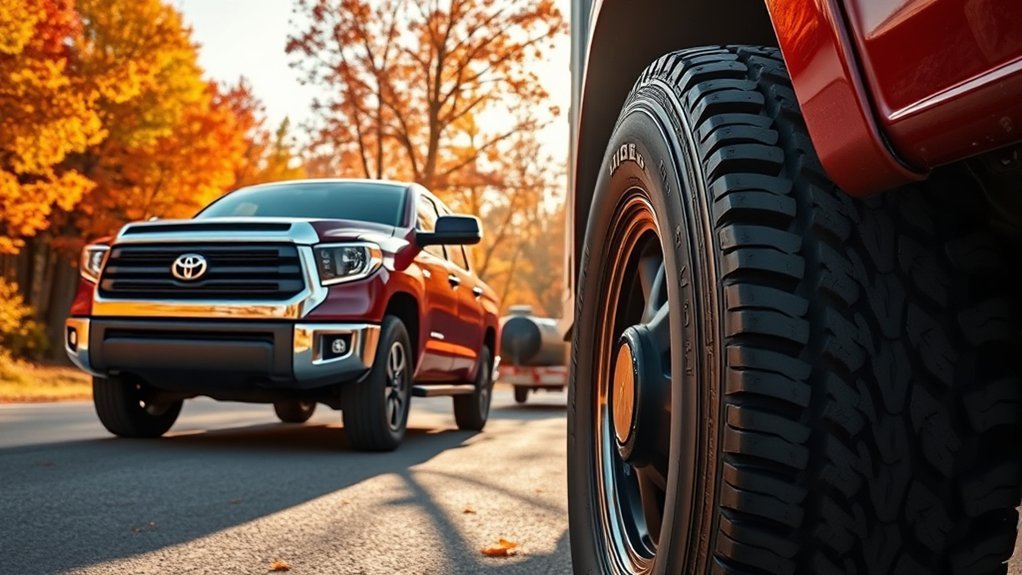
Air pressure changes with temperature. The U.S. Tire Manufacturers Association notes that tire pressure can increase or decrease by about 1–2 PSI for every 10°F temperature change. That means a pressure that was correct in warm weather may be low on a cold morning.
Temperature Fluctuations Impact Pressure
Cold weather usually lowers tire pressure. Hot weather, highway speed, and towing load increase tire temperature and can raise warm pressure. Always set your target based on cold pressure rather than releasing air from warm tires during a trip.
Seasonal Adjustments for Towing
Check pressures more often during seasonal changes, mountain trips, desert heat, or winter towing. If you add heavy winter gear, cargo, water, tools, or camping equipment, treat the setup as a new load and verify payload and tire capacity again.
Simple Tips for Keeping Your Tire Pressure in Check
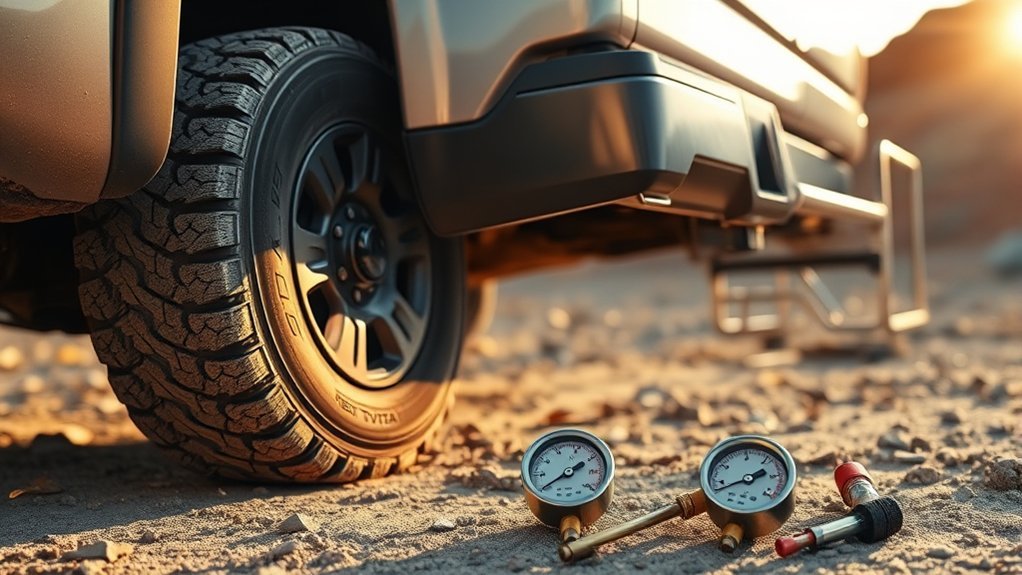
A simple routine prevents most towing tire pressure mistakes. Keep a quality gauge in the truck, use it before towing, and do not rely only on the dashboard TPMS. TPMS is helpful, but it may not warn you until a tire is already significantly underinflated.
| Check | Frequency | Why It Matters |
|---|---|---|
| Truck tire PSI | Before each towing trip | Confirms the tires start at the correct cold pressure. |
| Trailer tire PSI | Before each towing trip | Trailer tires often run different pressures than truck tires. |
| Tread and sidewalls | Before long trips and monthly | Cuts, cracking, bulges, and uneven wear can signal unsafe tires. |
| Valve caps and stems | Every pressure check | Damaged stems and missing caps can lead to slow leaks. |
| Loaded weight | Whenever your trailer load changes | Pressure guidance depends on actual load, not empty trailer weight. |
Real-World Tundra Towing Checks That Matter
Many Tundra owners focus on PSI first, but pressure is only one part of a safe towing setup. The better approach is to check the full system: tire pressure, tire load rating, payload, trailer balance, hitch setup, and actual scale weight.
- Use the door-label PSI as your starting point for stock tires.
- Check the trailer’s own tire placard and do not copy the truck’s PSI to the trailer.
- Keep left and right tires on the same axle at the same cold pressure unless the manufacturer specifically says otherwise.
- Verify that the loaded trailer does not exceed the Tundra’s towing, payload, axle, or combined weight ratings.
- Use a weight-distributing hitch when required by Toyota and rated for the loaded trailer.
- Slow down if you feel sway, heat, vibration, or steering instability; do not try to solve it by adding random air pressure at the next stop.
Frequently Asked Questions
Should you put max PSI in tires when towing?
Not automatically. The sidewall max is a pressure limit for the tire, not always the correct pressure for your Tundra. Use the door placard, owner’s manual, tire load table, wheel rating, and actual loaded weight to choose a safe cold PSI.
Is 40 PSI too high for a Toyota Tundra when towing?
It depends on your model year, tire size, tire type, wheel rating, and door-label recommendation. For some setups, 40 PSI may be close to the recommended range. For others, it may be too high or too low. Check the placard first.
Is 40 PSI too high for a van?
Not necessarily, but vans often have different front and rear pressure requirements because they carry people and cargo differently than pickups. Use the van’s tire placard and owner’s manual rather than applying Toyota Tundra advice to a van.
Is 40 PSI too high for 4WD?
Four-wheel drive does not determine tire pressure by itself. The correct PSI depends on the vehicle placard, tire size, load rating, and load carried. A 4WD Tundra, 4WD SUV, and 4WD van can all require different pressures.
Is 50 PSI too much for trailer tires?
It depends on the trailer tire and wheel. Many trailer tires list a required cold PSI on the sidewall for maximum load, but you must also check the trailer placard and wheel rating. Never exceed the lower limit of the tire or wheel.
Should I lower tire pressure after it rises on the highway?
Usually no. Tire pressure rises as tires warm up during driving and towing. If you set the pressure correctly when cold, do not bleed air from hot tires unless a qualified tire professional or the manufacturer’s instructions indicate a problem.
Conclusion
The best Toyota Tundra tire pressure for towing is the pressure that matches your actual truck, tire, wheel, and load—not a generic 40–50 PSI range. Start with the cold PSI on the driver-door label, check the trailer tires separately, confirm payload and axle ratings, and use tire load-inflation tables for replacement LT or load-range tires. When in doubt, weigh the loaded setup and follow Toyota, trailer, and tire manufacturer guidance.
Sources
- Toyota Owners — 2025 Tundra Tire Inflation Pressure — supports using the tire and loading information label for recommended cold tire pressure.
- Toyota Owners — 2025 Tundra Trailer Towing — supports checking gross trailer weight, combined weight, vehicle weight, axle weight, tongue weight, and weight-distributing hitch guidance.
- NHTSA — Tire Safety: Everything Rides on It — supports checking pressure before long trips, using the placard/manual, and checking pressure cold.
- U.S. Tire Manufacturers Association — Tire Care Essentials — supports monthly checks, cold checks, temperature-related PSI changes, towing checks, and TPMS limitations.
- Michelin — Proper RV Tire Inflation — supports using load-inflation tables, weighing axle ends, and not exceeding wheel pressure limits.
- FuelEconomy.gov — Gas Mileage Tips — supports the fuel-economy effect of proper tire inflation.