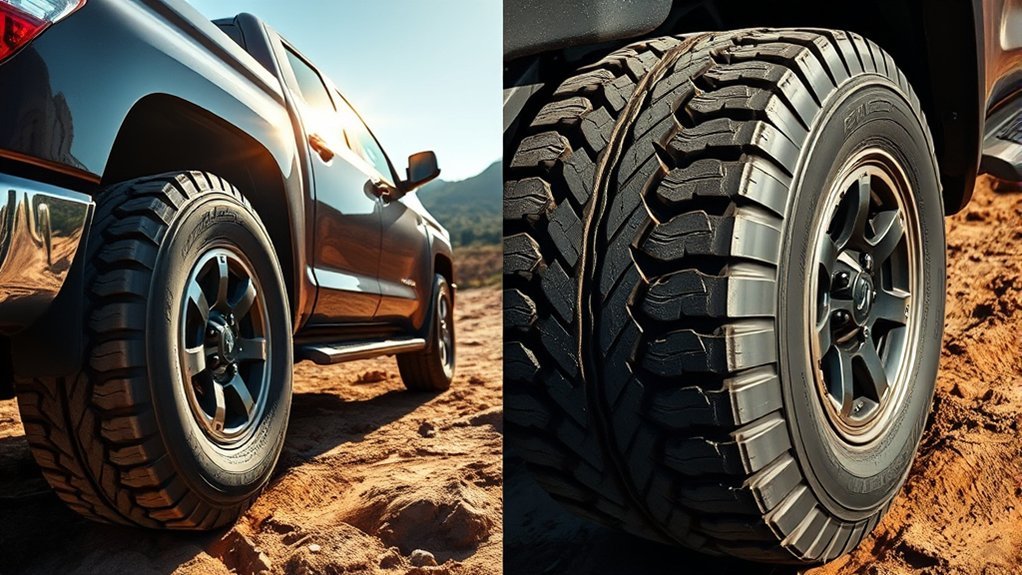
Choosing between original-equipment and aftermarket tires for your Toyota Tundra is not simply a choice between factory quality and a cheaper alternative. The right tire depends on your exact model year, trim, wheel package, load requirements, climate, and driving conditions. This guide was reviewed in July 2026 and explains how to compare those factors without sacrificing safe fitment.
Quick Answer
Choose an OE-spec tire when you want to preserve your Tundra’s factory balance of comfort, noise, handling, and efficiency. Choose an aftermarket tire when you need a different strength, such as better off-road grip, winter traction, or tread life. In either case, match the required size, load capacity, wheel, and inflation specifications.
Key Takeaways
- Your driver-door tire placard and model-year owner’s manual are the starting points for size, load capacity, and cold inflation pressure.
- OE tires are selected to support the factory’s performance targets, but they do not automatically last longer or carry more weight.
- Aftermarket tires can improve a specific trait, such as off-road traction or winter grip, but every gain can introduce tradeoffs in noise, comfort, weight, or efficiency.
- Larger tires require more than a quick rubbing check. Overall diameter, wheel width, offset, suspension travel, brake clearance, TPMS operation, and spare-tire compatibility all matter.
- Never install a tire with inadequate load capacity, and do not use the maximum pressure printed on the sidewall as your normal inflation target.
Understanding OEM vs Aftermarket Tires for Your Tundra
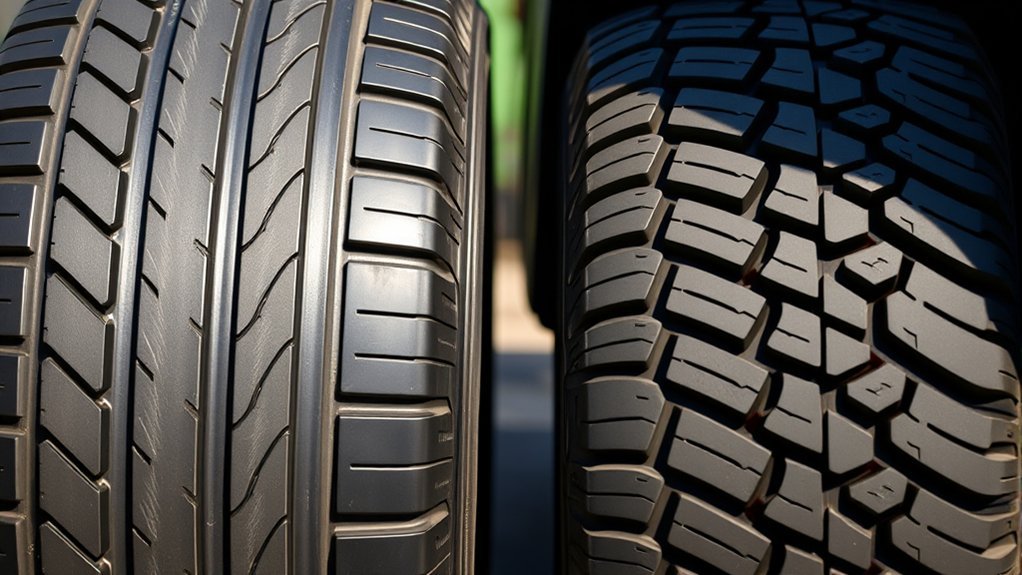
The terms OEM tire and OE tire are often used interchangeably. More precisely, an original-equipment tire is the tire installed or approved for a vehicle when it leaves the factory. An aftermarket tire is any replacement tire sold outside that original factory installation, including a replacement from the same brand and product family.
An OE tire may be selected or tuned to support goals such as ride comfort, steering response, cabin noise, wet braking, rolling resistance, or off-road performance. However, buying the same brand name does not always mean you are buying the identical factory specification. Tire models can be sold in several sizes, load indexes, speed ratings, and OE-specific versions.
Toyota Tundra tire sizes also vary widely. The correct specification depends on the truck’s model year, trim, drivetrain, suspension, and factory wheel package. For example, Toyota’s current Tundra lineup includes several wheel diameters rather than one universal stock size. Check your exact vehicle through the Toyota owner’s manual portal before ordering tires.
Note: The tires currently installed on a used Tundra may not match its original specification. Confirm the driver-door placard instead of assuming the existing tire is correct.
Check the Tire Placard Before Comparing Options
The Tire and Loading Information label is normally located on the driver-side door edge or door jamb. It identifies the manufacturer-recommended tire size and cold inflation pressure for the original configuration. The owner’s manual provides additional information about tire maintenance, TPMS operation, approved equipment, and warnings.
Record the following details before comparing replacement tires:
- Tire-size designation: This identifies the tire width, aspect ratio, construction, and required wheel diameter.
- Load index or load range: This indicates how much weight the tire can support when used at the appropriate pressure.
- Speed rating: This identifies the tire’s tested speed capability under specified conditions. Use a rating appropriate for the vehicle and application.
- Recommended cold pressure: This is the pressure specified by Toyota for the listed tire and loading configuration.
- Front and rear differences: Confirm whether your truck specifies the same size and pressure at all four positions.
The National Highway Traffic Safety Administration recommends using the door placard or owner’s manual to identify the correct tire size and inflation pressure. A qualified tire professional should confirm any alternate size before installation.
Warning: The pressure molded onto a tire’s sidewall is not your normal inflation target. It relates to the tire’s rated load and pressure limits. Use the vehicle placard’s recommended cold pressure unless a qualified professional has established a safe specification for an approved alternate tire.
The correct replacement tire is defined by its complete specification, not only by the diameter printed on the sidewall.
Tire Size, Load Index, and Speed Rating Explained
A tire designation such as 275/65R18 contains several separate measurements. The first number is the approximate section width in millimeters. The second number is the sidewall height expressed as a percentage of the width. The letter R identifies radial construction, and the final number identifies the wheel diameter in inches.
Additional characters following the size identify the load index and speed rating. Two tires can share the same dimensional size while having different load capacities or speed ratings. Michelin’s load and speed rating guide explains why these values must be checked separately.
P-Metric and LT Tires
Some Tundra configurations may use passenger-type tires, while other applications may call for light-truck construction. An LT tire usually has a stronger casing and may support higher loads at higher pressures. That does not make it the best choice for every truck.
Compared with a suitable passenger-type tire, an LT tire may add weight, transmit more road impact, require different pressure, and reduce ride comfort. It can still be worthwhile for frequent heavy hauling, towing, rough roads, or off-road use. The decision should be based on actual axle loads and the tire manufacturer’s load-and-inflation data, not the appearance of the sidewall.
Key Benefits of Choosing OE-Spec Tires for Your Tundra
An OE-spec replacement can be the simplest choice when you like how your Tundra drove on its original tires. It reduces the number of variables introduced during replacement and helps preserve the performance balance Toyota intended for that configuration.
Possible advantages include:
- Predictable fitment: The approved size and specification are less likely to create clearance, calibration, or wheel-compatibility problems.
- Familiar ride and handling: Replacing like for like can help maintain the steering feel, comfort, and noise level you already know.
- System compatibility: The factory specification is designed around the vehicle’s braking, stability-control, four-wheel-drive, and tire-pressure systems.
- Simpler shopping: You can search by the exact size, load index, speed rating, and OE specification shown on the original tire and vehicle documentation.
These advantages should not be confused with a guarantee of longer tread life or better value. Some OE tires prioritize quietness, efficiency, or steering response rather than maximum mileage. Compare the exact replacement tire’s warranty, wet performance, winter rating, and intended use.
Benefits of Aftermarket Tires for Your Tundra
Aftermarket tires give you more control over the traits you want to emphasize. A Tundra used for daily commuting has different needs from one that regularly tows, works on construction sites, travels on gravel, or drives through deep winter conditions.
Aftermarket options may provide:
- Longer highway tread life: Highway-terrain tires often focus on stable road manners, lower noise, and even wear.
- More off-road traction: All-terrain tires use a more open tread and stronger shoulder design for gravel, dirt, and light trail use.
- More aggressive mud performance: Mud-terrain tires use large tread voids that can clear loose soil, although they usually create more road noise and vibration.
- Better severe-weather capability: All-weather or dedicated winter tires can provide better cold-weather traction than a basic all-season tire.
- Different durability priorities: Some tires emphasize chip resistance, sidewall protection, puncture resistance, or commercial use.
- More warranty and price choices: The aftermarket includes budget, midrange, and premium products with different mileage and road-hazard coverage.
An aftermarket tire is not automatically cheaper, harsher, or lower quality. It is simply a replacement that was not the truck’s original factory-installed specification. A premium aftermarket tire may cost more than an OE replacement while offering better performance for a particular use.
How Tire Choices Affect Performance and Fuel Economy
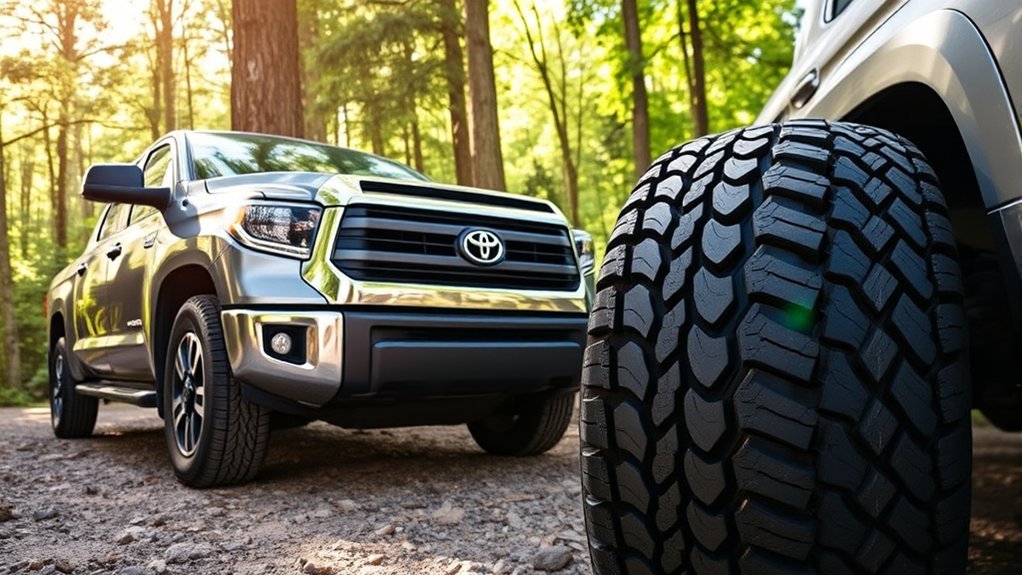
Tire changes can affect acceleration, braking, steering, ride quality, and fuel use. However, size alone does not determine the result. The complete wheel-and-tire package matters.
Rolling Resistance
A tire deforms as it rolls, and some energy is lost as heat. Tread compound, casing construction, pressure, width, and tread design can all change rolling resistance. An aggressive off-road tire may consume more energy than a road-focused tire, but the difference varies by exact product and driving conditions.
Tire and Wheel Weight
A heavier tire or wheel adds rotating and unsprung mass. This can make acceleration feel slower and may affect braking, suspension response, and fuel use. Larger-diameter tires are often heavier, but two tires of the same dimensions can also differ significantly in weight.
Overall Diameter
A taller tire changes the effective gearing. The engine may operate at a slightly different speed for a given road speed, while acceleration can feel less responsive. A substantial diameter change can also affect the relationship between actual speed and the speed shown on the instrument display.
Only half of the increase in overall tire diameter becomes additional axle clearance. For example, adding two inches of tire diameter adds roughly one inch beneath the axle, assuming the tire fits and does not contact the vehicle.
Tread and Aerodynamic Effects
Wide tires and open tread patterns can increase drag, noise, and energy loss. Highway-focused tires usually have more closely spaced tread blocks, while all-terrain and mud-terrain designs trade some road efficiency for loose-surface traction.
Inflation Pressure
Underinflation increases heat and rolling resistance. The U.S. Department of Energy notes that properly inflated tires can improve safety, tread life, and fuel efficiency. Check pressure when the tires are cold and follow the applicable vehicle or professionally established alternate-size specification.
Larger Tire and Wheel Fitment Risks
A tire may clear the body while the truck is parked but still rub when you turn, brake, carry cargo, tow, or compress the suspension. A complete fitment check should include the following:
- Clearance at full steering lock in both directions
- Clearance through the suspension’s compression and rebound travel
- Upper control arm, shock, sway-bar, liner, mud-flap, and body-mount clearance
- Wheel width and tire manufacturer rim-width requirements
- Wheel offset and backspacing
- Brake-caliper clearance
- Front and rear axle load capacity
- Spare-tire size and storage clearance
- TPMS sensor compatibility and registration
- Speedometer, odometer, stability-control, and four-wheel-drive effects
Wheel offset can create problems even when the tire diameter appears reasonable. Moving the tire outward may increase fender contact and bearing leverage. Moving it inward may reduce clearance around suspension or steering components.
Warning: Do not assume that a 33-inch or 35-inch tire fits every Tundra. Fitment can change between generations, trims, suspension packages, wheel widths, and offsets. Verify loaded and articulated clearance before regular driving or towing.
Choosing a Tire for Towing, Off-Road Use, and Weather
| Primary Use | Likely Tire Category | Prioritize | Common Tradeoff |
|---|---|---|---|
| Daily highway driving | Highway-terrain or road-focused all-season | Wet braking, noise, comfort, tread warranty | Less traction in deep mud or rough terrain |
| Mixed highway and gravel | Mild all-terrain | Chip resistance, wet grip, stable road manners | More noise and weight than many highway tires |
| Frequent trails or loose terrain | Aggressive all-terrain or mud-terrain | Sidewall protection, tread voids, puncture resistance | Road noise, heavier steering, faster irregular wear |
| Regular towing or heavy payload | Properly rated highway, all-terrain, or LT tire | Load capacity, heat control, stability, pressure requirements | Stiffer ride and added weight with heavier constructions |
| Severe winter conditions | All-weather or dedicated winter tire | Cold-weather compound, snow and ice traction | Seasonal storage, faster warm-weather wear for winter tires |
[Products Worth Considering]

Marsflex brand TPMS replacement sensors help restore tire pressure monitoring for compatible Toyota, Lexus, Scion, and Pontiac models. Each sensor is pre-programmed for the vehicle application and includes a long-life battery for up to 8 years of normal use. Designed to replace common OE numbers and requires relearning using a TPMS scan tool after installation.

These universal tire valve stem caps help protect valve cores from dust, debris, and moisture while helping maintain stable tire pressure. The corrosion-resistant metal construction and sealed design provide reliable protection in road grime, mud, and winter conditions. Twist-on installation makes them quick to fit on cars, SUVs, trucks, and motorcycles.

These aluminum alloy tire valve stem caps with an O-ring seal help protect valve stems from corrosion while adding a clean, stylish look to your vehicle. The universal fit works across cars, trucks, motorcycles, bicycles, and more, making them an easy upgrade for everyday driving and off-road use. Installation is quick, and the included four-pack keeps all your tires dressed and protected.
Towing and Payload
Your tire must support the truck, passengers, cargo, hitch load, accessories, and trailer-related load applied to the vehicle. Do not select a lower load index or inadequate load range simply because the dimensional size matches.
A higher-capacity tire can provide useful load margin when properly specified, but it does not increase the Tundra’s official payload, axle, gross vehicle weight, or towing ratings. Those limits are established by Toyota and remain in effect.
Off-Road Driving
Choose tread aggressiveness based on the terrain you actually drive. A mild all-terrain tire is often a practical compromise for owners who spend most of their time on pavement. A mud-terrain tire may perform better in deep mud and loose surfaces, but it can produce more noise and less refined wet-road behavior.
Winter and Wet Conditions
Do not judge wet or winter performance only by tread depth. Compound, siping, tread shape, and temperature range matter. Drivers who regularly encounter packed snow, ice, or prolonged freezing temperatures should compare severe-snow-rated all-weather tires with dedicated winter tires.
Making the Right Decision: Cost, Quality, and Fitment
OE and aftermarket tires should be compared as exact products, not broad categories. The same tire family may be sold in several constructions and ratings, so compare the complete sidewall specification and manufacturer part number.
| Factor | OE-Spec Replacement | Aftermarket Alternative |
|---|---|---|
| Fitment confidence | High when the complete factory specification is matched | High for an approved same-size replacement; alternate sizes need additional verification |
| Ride and noise | Usually close to the truck’s original behavior | Can be quieter, firmer, softer, or louder depending on construction and tread |
| Tread life | Varies by exact OE tire and factory priorities | Wider selection of mileage-focused, commercial, and off-road products |
| Load capability | Matches the original configuration when the exact rating is used | Can match or exceed the required rating, but must be checked by exact size and pressure |
| Off-road and winter choice | Limited to the factory-selected performance balance | More tread, compound, and construction choices for specialized use |
| Purchase price | May cost less, the same, or more depending on availability | Ranges from budget to premium; aftermarket does not automatically mean cheaper |
| Main advantage | Preserves the known factory specification | Lets you optimize the tire for your own conditions and priorities |
Include installation, balancing, valve or TPMS service, alignment, disposal fees, road-hazard coverage, and expected tread life when comparing cost. A lower purchase price can become poor value if the tire wears unevenly, creates unwanted noise, or does not suit your normal use.
Pro Tip: Compare the complete tire specification and manufacturer part number. Two tires with the same model name and dimensions may still have different load indexes, speed ratings, constructions, warranties, or OE markings.
[Products Worth Considering]

Replace worn or malfunctioning GM TPMS sensors with this 433MHz pre-programmed sensor set designed for compatibility with many Chevrolet, Buick, GMC, and Cadillac models. It includes guidance for proper OBDII relearning/pairing after installation and supports reliable long-term operation with a high-performance CR2032 battery. Quality tested for durability and performance to help restore accurate tire pressure monitoring.

The 22800 wheel stud installer makes replacing wheel studs quick and secure, saving time and effort during tire service. It uses a ratchet or impact wrench to pull new studs firmly into place, helping when existing studs are too long. Compatible with most automotive wheels and light-duty truck wheel studs, it’s designed for easy, tool-assisted installation.

Upgrade your wheels with MIKKUPPA closed-end lug nuts designed for reliable fit and corrosion resistance. The one-piece, cold-forged and heat-treated steel construction helps resist rust and stripping, while the integrated finish delivers a durable black appearance. Built to OEM standards with a conical 60-degree seat, these nuts provide a secure solution for compatible Ford, Honda, Jeep, and Chevrolet models.
How to Choose Tundra Replacement Tires
- Identify the exact truck. Record the model year, trim, drivetrain, factory wheel size, suspension package, and any modifications.
- Read the door placard. Note the original size and recommended cold pressure.
- Check the manual. Review tire, wheel, TPMS, snow-tire, towing, and replacement warnings for your model year.
- Define your main use. Estimate how much of your driving is highway, city, towing, gravel, trail, snow, or work-site use.
- Compare complete specifications. Check size, load index, load range, speed rating, approved wheel width, weight, tread category, and warranty.
- Verify alternate fitment. Have a qualified installer check diameter, width, offset, clearance, brake fitment, TPMS, spare compatibility, and loaded operation.
- Price the installed package. Include mounting, balancing, sensors, alignment, taxes, fees, and coverage rather than comparing tire price alone.
[Products Worth Considering]
This TPMS relearn tool helps you quickly activate, match, and reset GM tire pressure sensors to keep the vehicle monitoring system working properly. It clears tire pressure alarms and dashboard warning lights after sensor replacement or tire rotation, and supports learning for common 315/433 MHz TPMS sensors. Designed for simple one-button operation, it can help you avoid unnecessary trips to repair shops.

Replace your worn or missing TPMS sensors with pre-programmed, direct-fit sensors for compatible Ford, Lincoln, and select Mazda models. Each sensor comes ready to activate with a scan tool, helping restore accurate tire pressure monitoring and trouble-free installation. Built with a long-life CR2032 battery and tested before factory release, this set provides dependable performance with a one-year warranty.

The Topeak SmartGauge D2 delivers precise digital tire pressure readings for bikes, motorcycles, and sports equipment up to 250 psi (17 bar). Its rotating SmartHead works with both Presta and Schrader valves, so you can check pressure quickly without adapters. The LCD display makes it easy to read results in psi, bar, or kg/cm² with an included CR2032 battery for immediate use.
Common Tundra Tire Buying Mistakes
- Ordering by model name without confirming the exact size and load index
- Assuming every Tundra uses the same factory tire size
- Using the sidewall maximum pressure as the daily inflation pressure
- Choosing an LT tire only because it looks stronger
- Selecting a larger tire without checking wheel offset or suspension travel
- Mixing noticeably different tread designs, constructions, or outside diameters
- Ignoring wet braking and noise when buying an aggressive off-road tread
- Assuming a higher load range increases the truck’s rated payload or towing capacity
- Forgetting TPMS sensors, registration, or spare-tire compatibility
- Skipping an alignment when the old tires show uneven wear
Maintenance After Installing New Tires
Check all four tires after installation and confirm that the size, load rating, and direction or outside markings are correct. Make sure the TPMS warning light operates normally and that no tire contacts the body or suspension during steering and normal driving.
Check cold inflation pressure at least monthly and before towing or carrying a heavy load. Inspect tread wear, cuts, bulges, embedded objects, and sidewall damage. Rotate the tires at the interval appropriate for your Tundra and tire warranty, and investigate feathering, one-sided wear, pulling, or new vibration promptly.
If you installed an alternate size, recheck clearance under real operating conditions. Include passengers, cargo, steering movement, driveway angles, and suspension compression. Stop using the setup if you find rubbing, damaged wiring, cut liners, or contact with a suspension component.
Frequently Asked Questions
What are the best tires for a Toyota Tundra?
No single tire is best for every Tundra. Highway drivers should prioritize wet braking, low noise, comfort, and tread life. Mixed-surface drivers may prefer a mild all-terrain tire. Frequent towing requires suitable load capacity and stability, while severe winter driving may justify an all-weather or dedicated winter tire. Confirm exact fitment for your model year and trim.
What brand are Toyota Tundra OEM tires?
Toyota does not use one universal Tundra tire brand. The supplier and tire model can vary by year, trim, wheel package, market, and production configuration. Read the current tire’s sidewall and compare it with the vehicle placard and model-year specifications before ordering a replacement.
Can I install aftermarket tires without modifying my Tundra?
Usually, yes, when you choose a replacement approved for the factory wheel and match the required size, load capacity, and speed rating. Modifications are more likely when you change overall diameter, width, wheel offset, wheel width, or suspension height.
Will 33-inch or 35-inch tires fit a stock Tundra?
Fitment depends on the Tundra generation, trim, factory suspension, wheel width, offset, actual measured tire dimensions, and how the truck is used. A size that clears one Tundra may rub another during full steering lock or suspension compression. Verify the complete setup before purchasing.
Do aftermarket tires reduce Tundra fuel economy?
Not automatically. Fuel use can increase when the replacement is heavier, wider, underinflated, more aggressive, or substantially taller than the factory tire. A road-focused aftermarket tire with suitable pressure and rolling resistance may perform similarly to, or occasionally better than, another replacement option.
Do I need LT tires for towing with a Tundra?
Not in every case. The tire must provide adequate load capacity for the vehicle and actual operating load. Some suitable passenger-type tires can support normal use, while frequent heavy towing, rough roads, or commercial work may justify an LT construction. Use the placard, axle ratings, measured loads, and tire manufacturer data to make the decision.
Conclusion
Choose an OE-spec tire when your priority is preserving your Toyota Tundra’s known factory behavior. Choose an aftermarket tire when you need a measurable improvement in a specific area, such as highway tread life, gravel durability, winter traction, or off-road grip.
Neither category is automatically safer, longer-lasting, cheaper, or better for towing. The safe choice is the exact tire that matches your truck’s required size, load capacity, wheel, inflation needs, and operating conditions. Start with the door placard, confirm the model-year manual, and have any alternate-size package checked as a complete system before installation.
Sources
- Toyota Manuals and Warranties — model-year owner’s manuals, tire specifications, TPMS guidance, and vehicle warnings.
- Toyota Tundra Specifications — current trim, wheel, tire, and equipment differences.
- NHTSA TireWise — tire-size, placard, pressure, inspection, and replacement safety guidance.
- U.S. Department of Energy Fleet Management Guidance — proper inflation and rolling-resistance effects on fuel efficiency.
- Michelin Load and Speed Rating Guide — explanation of tire load indexes, speed ratings, and sidewall specifications.
- Michelin Changing Tire Size Guidance — manufacturer-size verification, alternate sizing, load capacity, and mixing precautions.