Hot weather can make your Hyundai Sonata’s tires work harder, especially when tire pressure, tread depth, alignment, and driving habits are ignored. Heat can raise tire pressure, underinflation can build damaging friction, and worn tread can reduce grip during sudden summer rain. The good news: a simple monthly tire check can help you catch problems early and make your tires last longer.
Quick Answer
Hot weather can speed up Hyundai Sonata tire wear by increasing tire pressure, heat buildup, and rubber aging. Check cold tire pressure monthly, measure tread depth, rotate tires on schedule, avoid overloading, drive smoothly, and replace tires earlier if tread is near 4/32 inch and you often drive in rain.
Key Takeaways
- Use the cold PSI listed on your Sonata’s driver-door Tire and Loading Information Label or in the Hyundai owner’s manual, not the number printed on the tire sidewall.
- Check pressure at least monthly and before long trips, heavy loads, or major temperature swings.
- Use a tread-depth gauge for accuracy; the penny test is a quick backup, but 4/32 inch is a better planning point for wet-weather safety.
- Smooth acceleration, gentle braking, regular rotation, and shaded parking all help reduce heat stress and uneven tire wear.
At a Glance
| Time Required | About 10 minutes for a monthly tire check; longer if you find uneven wear or need air. |
| Difficulty | Easy for basic checks; professional help is needed for alignment, balancing, mounting, and tire damage. |
| Tools Needed | Tire pressure gauge, tread-depth gauge or penny, flashlight, and your Sonata’s door placard or owner’s manual. |
| Cost | Free if you already have a gauge; low-cost if you need to buy a basic pressure or tread-depth gauge. |
How Hot Weather Damages Hyundai Sonata Tires and What You Can Do
Hot pavement, highway speeds, and summer road trips can all raise the stress on your Sonata’s tires. The biggest risks are pressure change, extra heat buildup, and faster rubber aging.
As outside temperature rises, tire pressure can rise too. That does not mean you should ignore low tires or randomly bleed air after driving. The correct target is the vehicle manufacturer’s recommended cold tire pressure, which you can find on the driver-door Tire and Loading Information Label or in the owner’s manual.
Heat also affects the rubber itself. Tire aging happens as rubber is exposed to heat, oxygen, sunlight, and normal driving stress. In hot climates, older tires may show cracking, dry-looking sidewalls, or tread separation risk sooner than the same tire in a milder climate.
Warning: Never use the maximum PSI printed on the tire sidewall as your normal inflation target. That number is not the recommended pressure for your Hyundai Sonata. Use the cold PSI on the door placard or in the Hyundai owner’s manual.
How to Check Tire Pressure Regularly in Hot Weather
Checking pressure is the most important tire habit in hot weather. Underinflated tires flex more as they roll, which creates heat buildup, irregular wear, and internal stress. Overinflated tires can wear more in the center and may be more vulnerable to impact damage from potholes or road debris.
Follow this simple routine:
- Check when tires are cold. For the most accurate reading, check after the car has been parked for at least three hours or before you drive more than a short distance.
- Find the correct PSI. Look at the driver-side door placard or the Hyundai owner’s manual portal for the correct tire size, load information, and inflation guidance for your specific Sonata.
- Use a quality gauge. Check all four tires and the spare if your Sonata has one.
- Adjust carefully. Add air if low. If pressure is high because the tire is hot from driving, recheck it later when cold before making a final adjustment.
- Do not rely only on TPMS. Tire Pressure Monitoring Systems are helpful, but they are not a replacement for monthly checks with a gauge.
Note: Tire pressure can change with temperature. Recheck your Sonata’s tires during heat waves, before highway trips, and whenever the car will carry extra passengers or luggage.
[Products Worth Considering]

Keep your tires properly inflated with this analog VONDIOR tire pressure gauge, designed for fast, easy readings without batteries. The swiveling, two-axis hose and large glow dial help you measure at any tire angle with instant visibility. Built with a protective rubber shield, it supports durable, low-maintenance use for cars and trucks.

Monitor tire tread wear with a smart, color-coded depth gauge that shows clear condition ranges at a glance. The bar is range marked for fast, easy readings, helping you maintain safer traction and performance. Each gauge is portable with a pocket clip, and the set includes 20 units for daily use and sharing.

Measure tire tread depth quickly and accurately with this LUMITECO dial gauge that reads in 1/32" increments up to 14/32". The color-coded green/yellow/red zones make it easy to judge tire wear and know when replacement is needed. A rugged, compact design with a protective pouch helps keep the gauge ready for use on cars, trucks, motorcycles, and more.
How to Check Tread Depth Effectively
Tread depth matters because tread grooves move water away from the tire’s contact patch. As the grooves get shallower, the tire has less ability to grip wet roads, stop quickly, and resist hydroplaning.
The most accurate method is a tread-depth gauge. Check several grooves across each tire and compare the inner, center, and outer tread. Uneven measurements can point to alignment, rotation, suspension, or inflation problems.
You can also use the penny test as a quick check. Insert a penny into the tread with Lincoln’s head facing down. If you can see all of Lincoln’s head, the tire is at about 2/32 inch and should be replaced. Built-in wear bars also show when tread has reached the minimum replacement point.
Wet-road stopping distance can increase sharply as tread wears. Tire Rack’s wet-braking tests show why replacing before the bare minimum can be safer in rainy climates.
For wet-weather driving, do not wait until your tires are completely worn out. If your Sonata often sees summer storms, standing water, or slick highways, plan replacement when tread approaches 4/32 inch, even though 2/32 inch is the usual minimum wear-bar point.
[Products Worth Considering]

The SAFELIFE dial tire tread depth gauge measures tread depth in 1/32 inch increments with clear, easy-to-read 2-inch dial face. Color zones using a traffic light system help you quickly judge whether tread is low, marginal, or ample for safer driving. Built with a durable zinc cast body and a metal detect probe for precise, comfortable use across cars, motorcycles, trucks, and buses.

Accurately measure tire tread depth with a calibrated gauge marked from 0 to 1 inch in 1/32 inch increments. The color-coded bar helps you quickly identify tread condition ranges, supporting safe driving for trucks, motorcycles, automobiles, and passenger vehicles.

The TYAMATE TM8 solar-powered wireless TPMS delivers real-time tire pressure and temperature monitoring with six alarm modes for safer driving. A vibrant color LCD display shows readings clearly while windshield mounting keeps it hands-free and easy to read. With a wide 0–87 PSI range, strong 433.92 MHz signal transmission, and quick sensor pairing, it’s ideal for RV, sedan, SUV, MPV, and truck use.
Smart Driving Tips for Hot Weather
Your driving style affects tire temperature and wear. Aggressive acceleration, hard braking, sharp cornering, and high-speed driving on hot pavement all create extra friction.
- Accelerate smoothly. Spinning or scrubbing the tires wears tread faster.
- Brake early and gently. Hard stops add heat and can create uneven wear.
- Slow down on rough pavement. Potholes and road debris are harder on overinflated or underinflated tires.
- Avoid overloading. Follow the load limit on the Tire and Loading Information Label, especially before summer trips.
- Take breaks on long highway drives. This gives tires a chance to cool and gives you time to inspect for damage.
Pro Tip: If your Sonata suddenly pulls to one side, vibrates, or makes a thumping sound, stop safely and inspect the tires. Those symptoms can point to low pressure, tire damage, imbalance, alignment issues, or internal tire separation.
Essential Tire Maintenance Schedule for Hot Weather
A simple schedule is easier to follow than random checks. Use this as a baseline, then follow your Sonata’s owner’s manual if it gives a different service interval.
| Task | How Often | Why It Matters in Heat |
|---|---|---|
| Check cold tire pressure | Monthly and before long trips | Prevents underinflation heat buildup and overinflation wear. |
| Measure tread depth | Monthly or whenever pressure is checked | Helps you plan replacement before wet-weather grip becomes poor. |
| Rotate tires | Follow the owner’s manual; if no interval is available, USTMA suggests 5,000 to 8,000 miles | Promotes even wear across all four tires. |
| Inspect for cracks, bulges, cuts, nails, and uneven wear | Monthly and after hitting potholes | Heat can make existing damage more serious. |
| Check alignment and balance | When the car pulls, vibrates, or tires wear unevenly | Prevents one tire edge or tread area from wearing out early. |
Pay attention to wear patterns. Center tread wear often points to overinflation. Wear on both outer edges often points to underinflation. Wear on one edge can mean alignment trouble. Cupping or scalloped wear can point to balance, suspension, or shock problems.
[Products Worth Considering]

ETENWOLF’s tire pressure gauge helps you quickly and accurately check tire PSI across cars, trucks, motorcycles, bikes, and more. It’s manually calibrated to ANSI B40.1 Grade A for reliable readings, includes a large glow dial for easy nighttime viewing, and features a 360-degree swivel chuck for use at any valve angle. The gauge also works consistently in extreme hot or cold weather.

Steelman white tire marking crayons provide high-contrast, semi-permanent marks for repairing and inspecting tires and equipment. They write on wet or dry, smooth or coarse surfaces including rubber, metal, glass, and wood, making them ideal for puncture location and damage outlining. The lead- and zinc-free crayons resist weather and fading yet wipe away when you no longer need the marks.

Milton S-921 pencil tire pressure gauge helps you maintain optimal tire pressure for passenger cars with accurate readings in PSI and kPa. It features a built-in deflator valve for convenient pressure adjustments, plus a single chuck head and nylon indicator bar for easy use on the go. Built from durable plated brass and designed for reliable performance, it’s a practical road trip and cold-weather maintenance tool.
Strategies for Parking to Reduce Heat Exposure
Parking habits will not replace tire maintenance, but they can reduce unnecessary heat and UV exposure. Whenever possible, park your Hyundai Sonata in a garage, under a carport, or in shade. This helps limit direct sun exposure on the rubber and keeps tire temperatures lower before your next drive.
If shaded parking is not available, avoid leaving the car on very hot pavement for long periods when another option is available. Tire covers can help if the vehicle sits outside for days at a time, especially in high-sun areas.
Also avoid parking with one tire pressed hard against a curb. Sidewall pinching or scuffing can weaken the tire, and heat can make existing sidewall damage more concerning.
When Should You Seek Professional Tire Inspections?
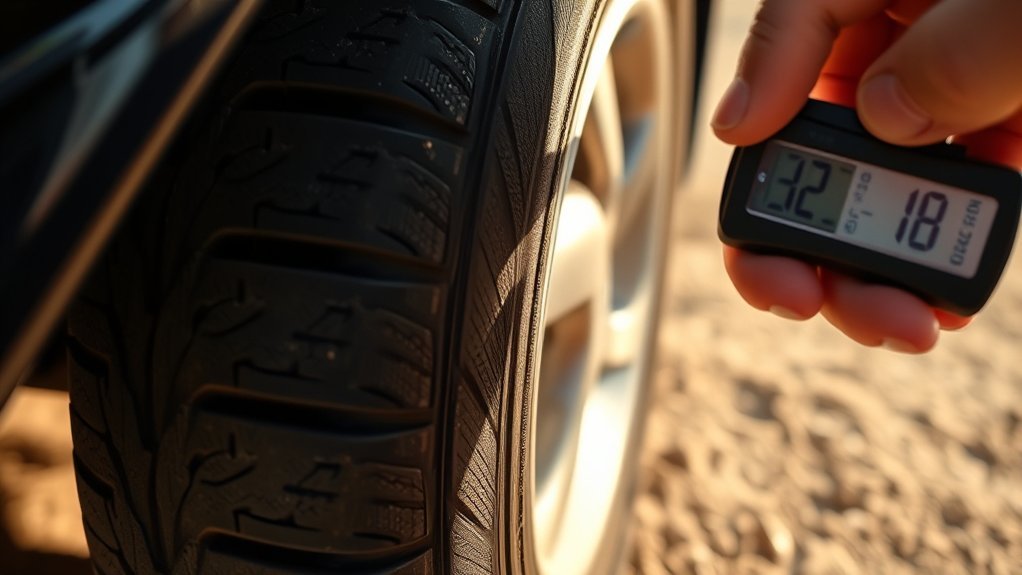
Monthly self-checks are important, but some tire issues need a trained technician. According to AAA tire maintenance guidance, service professionals should handle work such as puncture repairs, tire replacement, rotation and balancing, and wheel alignment.
Have your Sonata’s tires inspected professionally if you notice any of these signs:
- Cracks, bulges, bubbles, exposed cords, or sidewall cuts.
- A nail, screw, or slow leak.
- Vibration, thumping, or shaking at speed.
- The vehicle drifts or pulls to one side.
- Uneven tread wear across one tire or between tires.
- Tread at or below 2/32 inch, or near 4/32 inch if you drive in frequent rain.
- Any tire that looks older, dry, or damaged before a long summer road trip.
Warning: If a tire blows out while driving, do not slam on the brakes. Hold the wheel firmly, ease off the accelerator, keep the vehicle controlled, and pull over when it is safe.
Frequently Asked Questions
Do tires wear out faster in hot climates?
Yes, tires can wear out faster in hot climates when heat is combined with underinflation, overloading, aggressive driving, poor alignment, or older rubber. Heat and oxygen also contribute to tire aging, so regular pressure, tread, and damage checks matter more in hot areas.
How long do Hyundai Sonata tires last?
There is no fixed Hyundai Sonata tire lifespan. Many drivers may see tens of thousands of miles from a set, but actual life depends on tire model, pressure, rotation, alignment, climate, road surface, load, and driving style. Judge replacement by tread depth, visible damage, tire age, and professional inspection.
How can you extend tire life by avoiding fast driving?
Avoid hard acceleration, sudden braking, sharp cornering, and high-speed driving on very hot pavement. Smooth driving reduces friction and heat buildup, which helps preserve tread and lowers the chance of uneven wear.
Should I lower my Sonata’s tire pressure in hot weather?
Do not lower tire pressure just because the weather is hot. Use the cold PSI on the driver-door placard or owner’s manual. If you checked after driving and the reading looks high, let the tires cool and recheck before making a final adjustment.
Is the penny test enough for Hyundai Sonata tire tread?
The penny test is useful for a quick minimum check, but a tread-depth gauge is better. If you often drive in rain, start planning replacement around 4/32 inch rather than waiting for the 2/32-inch wear-bar point.
Conclusion
Hot weather does not have to ruin your Hyundai Sonata’s tires early. The key is to stay ahead of heat-related problems: check cold pressure monthly, measure tread depth, rotate tires on schedule, avoid overloading, park in shade when possible, and get a professional inspection when you see cracks, bulges, vibration, pulling, or uneven wear. A few minutes of tire care each month can protect traction, comfort, fuel economy, and safety.
Sources
- NHTSA TireWise — cold tire pressure, Tire and Loading Information Label, TPMS, tread, and blowout safety guidance.
- Hyundai Owner’s Manual Portal — official Hyundai vehicle manual lookup for Sonata-specific tire and loading information.
- U.S. Tire Manufacturers Association Tire Care Essentials — monthly pressure checks, tread depth, TPMS limitations, and tire rotation guidance.
- Tire Rack Wet Braking and Tread Depth Test — wet-weather braking differences at various tread depths.
- AAA Tire Maintenance Guide — tire inspection, wear symptoms, alignment, balancing, and professional service guidance.
- NHTSA Tire Aging Presentation at NTSB Tire Safety Symposium — heat, oxygen, tire aging, and high-temperature failure risk background.