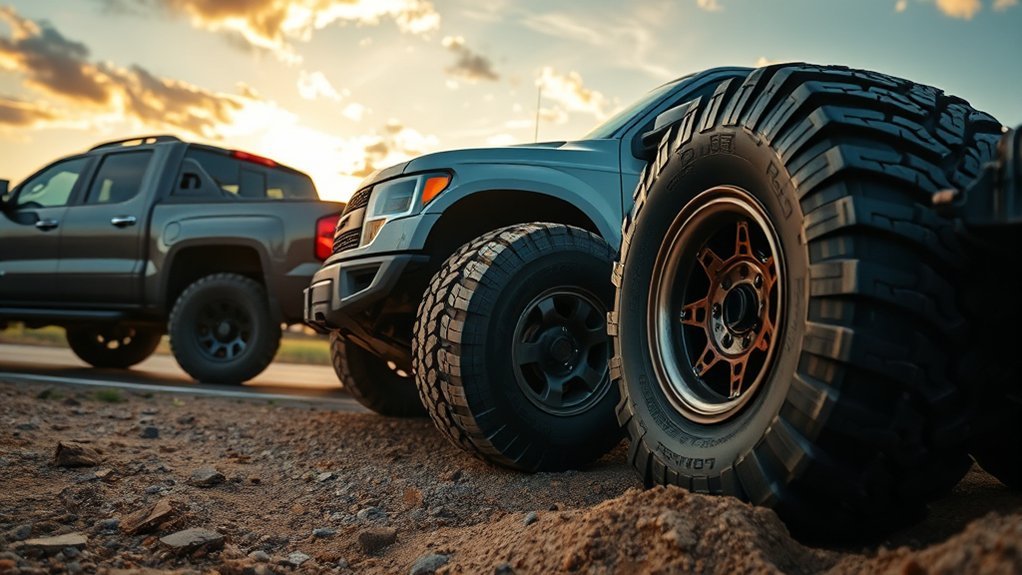
If you are choosing between HT, AT, and MT tires, the right option depends on where you actually drive. Highway-Terrain (H/T) tires favor paved-road comfort and efficiency, All-Terrain (A/T) tires balance pavement with off-road ability, and Mud-Terrain (M/T) tires prioritize traction in demanding mud, rocks, loose dirt, and trails.
Quick Answer
Choose HT tires if most of your driving is on paved roads and you value quietness, comfort, and efficiency. Choose AT tires for a mix of highways, gravel, dirt, and moderate trails. Choose MT tires when difficult off-road terrain is a regular part of your driving rather than an occasional exception.
Key Takeaways
- HT tires generally provide the best road comfort and lowest noise for pavement-focused driving.
- AT tires are the most versatile choice when you regularly mix pavement with gravel, dirt, or moderate trails.
- MT tires prioritize traction and durability in difficult off-road terrain but usually give up some highway refinement and efficiency.
- A 3PMSF snow rating is model-specific; the letters HT, AT, or MT alone do not tell you how well a tire performs in winter.
- Always confirm tire size, load capacity, speed rating, and vehicle fitment instead of choosing only by tread style.
At a Glance
| HT Tires | Best for mostly paved-road driving, commuting, highway trips, towing on pavement, quietness, and comfort. |
| AT Tires | Best for mixed pavement, gravel, dirt roads, campsites, work sites, and moderate recreational trails. |
| MT Tires | Best for frequent deep mud, loose soil, rocks, ruts, and demanding off-road use where traction matters more than road refinement. |
| Before Buying | Check the vehicle-recommended tire size, load requirements, speed rating, wheel clearance, and the individual tire model’s wet, snow, warranty, and road-noise characteristics. |
Which Tire Type Fits Your Driving?
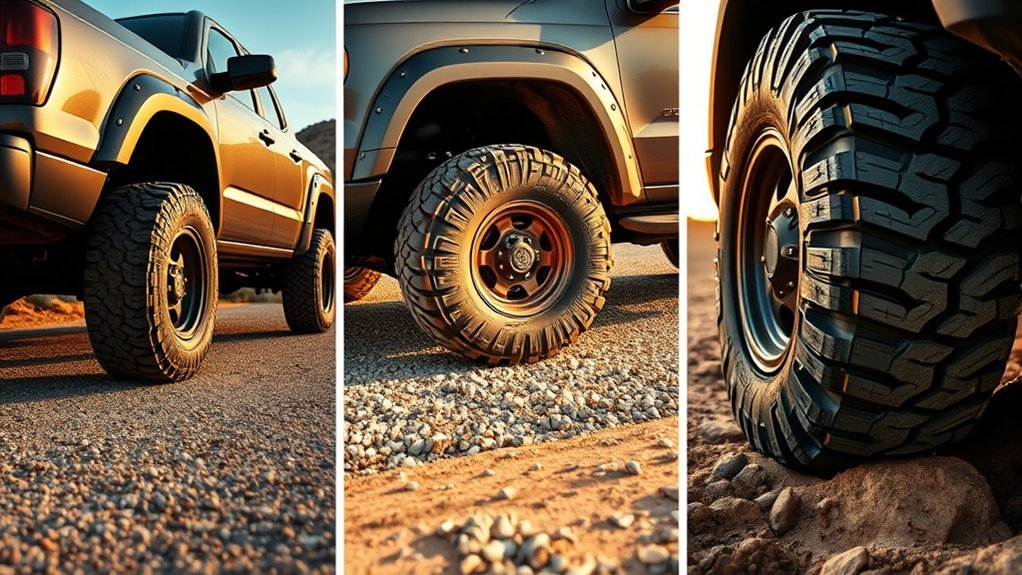
The best tire type depends on your normal driving environment. A highway-focused tire does not have the same tread priorities as a tire built for loose dirt or deep mud. At the same time, an aggressive off-road tread can create compromises you may notice every day on pavement.
If almost all your miles are on paved roads, HT tires are usually the logical starting point. If you combine highways with gravel roads, dirt, campsites, work sites, or moderate trails, AT tires provide more flexibility. If you routinely encounter deep mud, rocks, large ruts, or difficult off-road terrain, MT tires are designed for that more specialized job.
These categories describe a tire’s intended use, not an absolute performance ranking. Two tires from the same category can differ substantially in noise, wet grip, snow performance, tread life, weight, construction, and price, so compare the specifications and testing of the individual models you are considering.
HT Tires for Comfort and Fuel Economy
Highway-Terrain (H/T), often marketed as highway all-season tires, focus primarily on paved-road performance. Their less aggressive tread patterns generally favor a smooth ride, lower tread noise, stable highway handling, and efficient rolling characteristics.
| Feature | HT Tendency | What It Means |
|---|---|---|
| Road comfort | High | Well suited to daily commuting and long highway trips |
| Road noise | Generally low | Less aggressive tread usually creates less pattern noise |
| Off-road ability | Limited | Suitable for pavement and mild unpaved access rather than difficult trails |
| Fuel efficiency | Often favorable | Highway-oriented designs commonly prioritize lower rolling losses |
| Tread life | Often a priority | Check the actual model’s warranty and specifications rather than assuming every HT lasts longer |
For example, Toyo describes its Open Country H/T II as a highway all-season tire and emphasizes quietness, wet-road performance, tread life, and light-snow traction. That is a useful illustration of the category’s priorities, although another H/T model may behave differently.
Pro Tip: If your vehicle rarely leaves pavement, do not pay for off-road capability you will seldom use. A well-matched highway tire can give you better daily comfort while still meeting the load and performance requirements of your truck or SUV.
AT Tires for Balanced On- and Off-Road Use
All-Terrain (A/T) tires are designed for versatility. Compared with highway tires, their tread usually has larger blocks, more open channels, stronger shoulders, or other features intended to improve traction on gravel, dirt, loose surfaces, and moderate trails while remaining practical for regular pavement use.
- Good fit for SUVs and pickups that regularly travel on both paved and unpaved roads
- More loose-surface traction than a typical highway tire
- Usually more tread noise than a comparable H/T tire, although modern A/T models vary widely
- Available in many different constructions, load capacities, and tread aggressiveness levels
- Some models carry the Three-Peak Mountain Snowflake (3PMSF) severe-snow symbol
BFGoodrich’s tire-selection guidance describes all-terrain tires as the balanced option for drivers who combine highway use with moderate off-road travel. That balance is why A/T tires are often the practical middle choice for daily-driven trucks and SUVs that also see trails or rough access roads.
Do not assume every A/T tire behaves the same. Some lean toward road comfort, while others have larger voids and more aggressive shoulders for stronger off-road use. Compare the actual model rather than relying only on the letters “A/T.”
MT Tires for Serious Off-Road Use
Mud-Terrain (M/T) tires prioritize demanding off-road traction. Large tread blocks, open voids, aggressive shoulder areas, and designs that help release packed mud allow these tires to work in conditions where a road-focused tire can quickly lose grip.
| Feature | MT Tendency |
|---|---|
| Best use | Frequent difficult off-road driving |
| Mud and loose-terrain traction | A major design priority |
| Rock and rough-trail capability | Generally stronger than road-focused designs |
| Road noise | Usually higher than H/T and many A/T tires |
| Highway refinement | Generally lower |
| Efficiency | Often lower, but the effect depends on the specific tire and vehicle |
Manufacturer examples show why M/T tires should be viewed as specialist equipment. Toyo’s Open Country M/T, for example, uses an aggressive open tread and shoulder design intended to improve off-road traction and release mud and snow from its channels.
M/T tires can still be driven on pavement when they are suitable for the vehicle and road use, but you should expect a different experience from a highway tire. Noise, tread feel, weight, steering response, wet-road behavior, and fuel use can all vary by model.
Warning: Do not choose an MT tire only because its tread looks aggressive. If difficult off-road terrain is rare in your driving, you may accept extra road noise, weight, cost, and pavement compromises without gaining useful everyday capability.
HT vs AT vs MT Tires Compared
The table below summarizes the general trade-offs. These are category tendencies, not guarantees for every individual tire.
| Factor | HT | AT | MT |
|---|---|---|---|
| Best environment | Paved roads | Pavement plus moderate off-road use | Difficult off-road terrain |
| Highway comfort | Usually highest | Moderate to high, model-dependent | Usually lowest of the three |
| Road noise | Usually lowest | Usually moderate | Usually highest |
| Gravel and dirt | Limited to light use | Strong general-purpose choice | Strong, especially as conditions become more difficult |
| Deep mud | Poor choice | Varies; suitable for moderate conditions | Major design strength |
| Fuel-economy tendency | Usually most favorable | Middle ground | Often least favorable |
| Snow performance | Depends on model and rating | Many models offer strong snow-focused features and some carry 3PMSF | Aggressive tread alone does not guarantee superior winter-road performance |
| Tread life | Often pavement-focused | Varies widely | Varies widely with compound and use |
| Cost | Varies by size and model | Varies by size, construction, and model | Aggressive construction and large sizes can increase purchase and operating costs |
[Products Worth Considering]
This flat-free TICONN wheelbarrow tire features durable polyurethane foam construction that never needs inflation, helping prevent punctures and reducing maintenance on rough outdoor terrain. With a 300 lb max load capacity and stable steel rim design, it supports safer transport for yard work and hauling tasks. An adapter kit with ball bearings and nylon spacers is included for easier fit and customization across common wheelbarrow and cart axle setups.

Upgrade your ride with a 2-pack set of 26x1.95 folding mountain bike tires built for dependable traction on mud, rocks, and trail surfaces. A reinforced puncture-resistant layer helps protect against sharp debris, while included butyl inner tubes provide strong sealing and shock absorption. Ready for fast swaps with included tire levers and universal sizing for most bikes.

This tire inflator with pressure gauge delivers long-lasting performance with a durable rubber-protected gauge and sturdy build. The longer hose and 360 swivel air chuck help you seal the valve securely and keep your hands free while measuring, inflating, or deflating. It’s battery-free for reliable use and provides ±2 PSI accuracy in the mid-range for most typical tires, with universal compatibility for 1/4 NPT compressor outputs.
Snow Traction, Road Noise, and Price Compared
[Products Worth Considering]

Built for smooth-trail to technical single-track riding, these Blackburn mountain bike tires deliver superior traction and ultimate control with an optimized knobby tread. A protective layer under the tread enhances strength and puncture resistance, helping you stay confident on rough terrain. The carbon steel bead makes folding and unfolding the tire easier without damage.

Keep your tires properly inflated with this analog VONDIOR tire pressure gauge, designed for fast, easy readings without batteries. The swiveling, two-axis hose and large glow dial help you measure at any tire angle with instant visibility. Built with a protective rubber shield, it supports durable, low-maintenance use for cars and trucks.
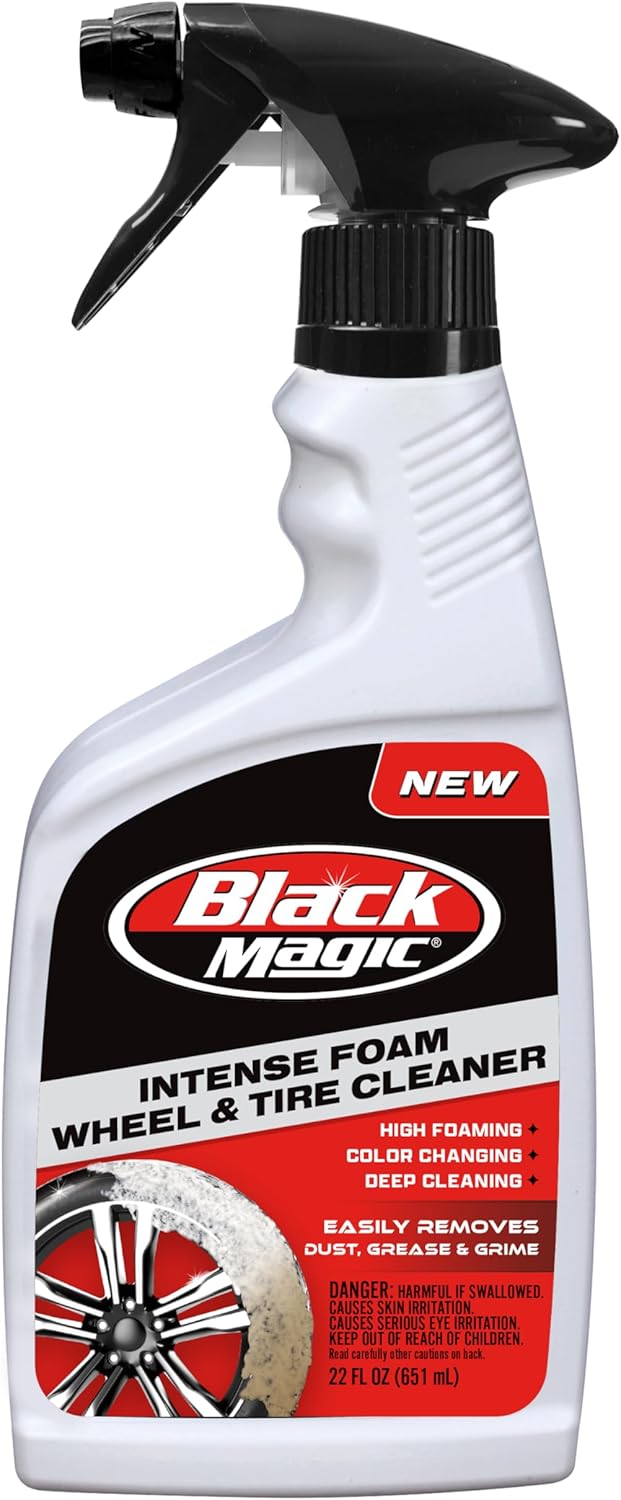
Black Magic Intense Foam Wheel & Tire Cleaner uses a high-foaming action to lift away dirt, grime, and brake dust without scrubbing. The color-changing formula helps show contaminants being dissolved as foam turns from white to brown. Safe for all wheel types and even wheel wells, it leaves a like-new, slick finish with a fresh cherry scent.
Snow and winter driving
Do not judge winter performance only by whether a tire is HT, AT, or MT. Look at the exact model and its sidewall markings. Some highway and all-terrain tires carry the Three-Peak Mountain Snowflake (3PMSF) symbol, indicating that they meet a defined severe-snow acceleration-traction requirement.
However, the symbol has limits. The qualifying test focuses on acceleration traction in packed snow; it does not itself rate snow braking, cornering, or ice traction. A 3PMSF-marked all-season or all-terrain tire should therefore not automatically be treated as equivalent to a dedicated winter tire in severe winter conditions. Tire Rack explains these distinctions in its 3PMSF guide.
Note: An aggressive tread pattern may help in loose snow or off-road conditions, but it does not automatically make a tire better at braking or cornering on icy winter pavement. Compare the specific tire’s winter testing and ratings.
Road noise and comfort
HT tires generally have the advantage when low cabin noise and smooth highway behavior are your priorities. A/T tires occupy the middle ground, although modern road-oriented A/T designs can be surprisingly quiet. M/T tires usually generate more tread noise because their larger blocks and open voids are optimized primarily for off-road traction.
Fuel economy
There is no universal MPG penalty for moving from HT to AT or MT. Tire weight, size, pressure, tread design, compound, vehicle aerodynamics, and rolling resistance all matter. As a general tendency, more aggressive off-road tires can require more energy to roll than highway-focused tires, but the actual difference must be evaluated by model rather than assumed from the category name alone.
Price and total cost
There is also no reliable fixed price range for HT, AT, or MT tires because cost changes dramatically with brand, wheel diameter, tire dimensions, load capacity, construction, and availability. Compare equivalent sizes when shopping.
Purchase price is only part of the cost. A heavier or more aggressive tire may also affect fuel use, noise, ride quality, tread wear, and suspension feel. For a pavement-focused driver, paying more for extreme off-road capability may deliver little practical benefit.
The best tire is not the most aggressive one — it is the tire that matches the conditions you actually drive in.
Where Do R/T Tires Fit?
Rugged-Terrain (R/T) tires are commonly positioned between A/T and M/T designs. They usually look and behave more aggressively than a general-purpose A/T tire while retaining more pavement usability than a dedicated M/T.
The exact meaning of R/T varies by manufacturer, so it should not be treated as a tightly standardized performance level. For example, current tire lineups may describe R/T products as rugged-terrain or hybrid A/T/M/T designs. If you are considering one, compare the exact tire against both the A/T and M/T alternatives for your vehicle.
Check Size, Load Rating, and Fitment Before Switching
Choosing HT, AT, or MT is only one part of selecting a replacement tire. The tire still needs to be suitable for your vehicle.
NHTSA TireWise recommends checking the Tire and Loading Information label, commonly located on the driver’s door edge or door pillar, or the owner’s manual for the vehicle-recommended tire size and cold inflation pressure.
The U.S. Tire Manufacturers Association also advises that replacement tires meet the size, load-index/load-capacity, and speed-rating requirements recommended by the vehicle or tire manufacturer.
- Tire size: Verify that the dimensions are suitable for the vehicle and wheel.
- Load capacity: Make sure the tire can safely support the required vehicle, passenger, cargo, towing, and hauling loads.
- Speed rating: Follow the vehicle or tire manufacturer’s replacement requirements.
- Clearance: Larger or wider tires may affect fender, suspension, steering, or brake clearance.
- Inflation: Use the vehicle manufacturer’s recommended cold pressure for the approved setup rather than simply inflating to the maximum pressure molded on the tire sidewall.
Warning: HT, AT, MT, and R/T describe intended tire use; they do not tell you whether a tire has enough load capacity for your vehicle. This is especially important for pickups used for towing or hauling and when changing between passenger-metric and LT-type tires or moving to a different tire size.
[Products Worth Considering]

Protect tire valves from water, dust, and sand to help prevent leaks and support safe driving. These universal stem caps install quickly by hand and feature durable aluminum alloy construction with an inner sealing ring for better air retention. Compatible with cars, SUVs, trucks, motorcycles, and bicycles for everyday convenience.

Slip the Powerbuilt tire step over your vehicle’s tire to reach roof racks, engine bays, truck boxes, and more without overreaching. Its adjustable, universal design fits tires with a cross tread width up to 13 inches, including car, truck, RV, and semi tires. The non-slip cheesegrater surface and anti-slip tape provide secure grip while the open design lets mud and debris pass through. Fold-flat storage with rubber bumpers helps keep your tire and the step protected between uses.
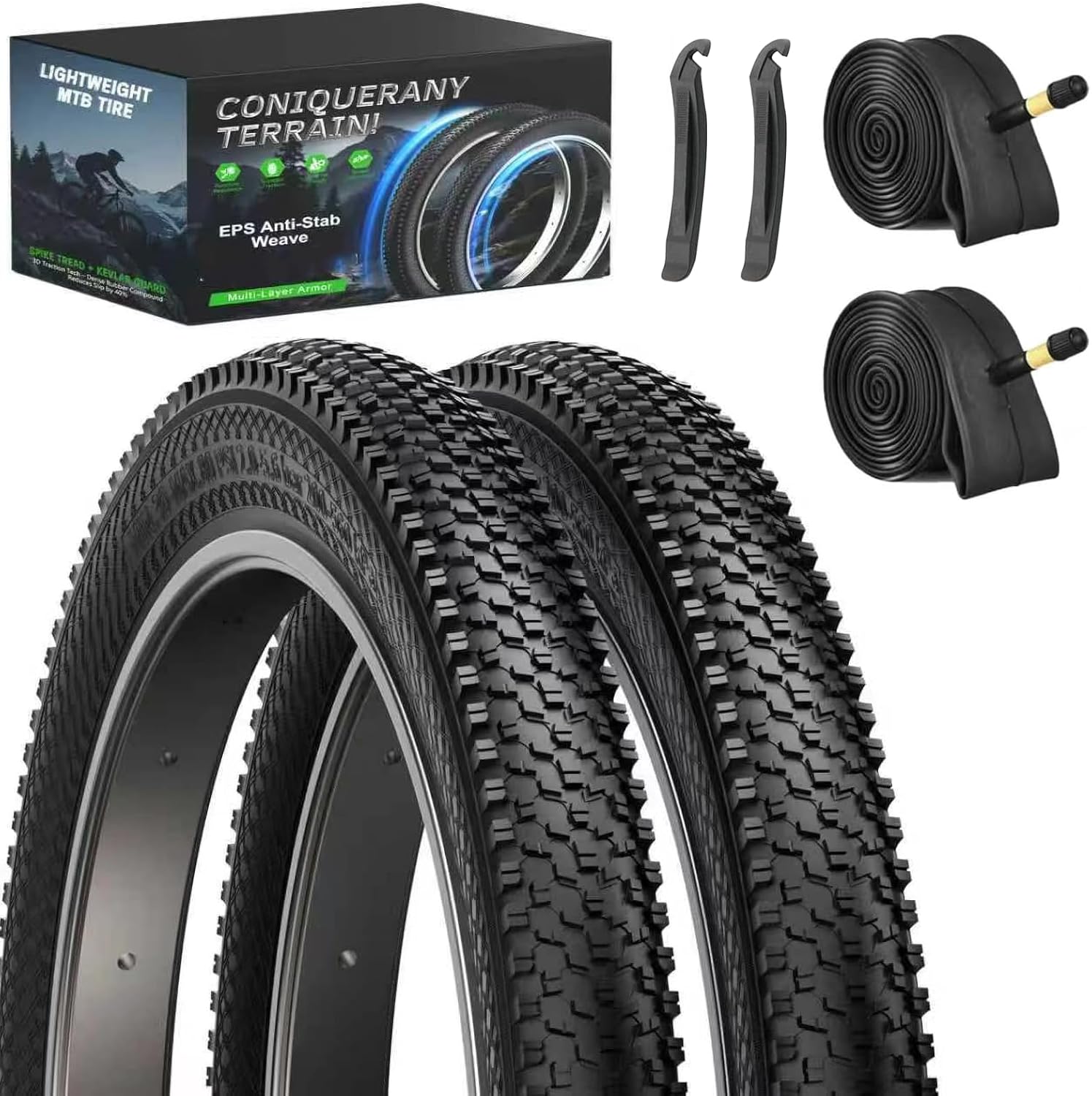
This 2-pack set includes two folding mountain bike tires, two inner tubes, and two tire levers for quick, budget-friendly replacements. The tires feature an anti-stab weave for added protection, plus strong grip and durable construction to help you stay stable across common trail and road conditions. Foldable design makes storage and travel convenient, while the included tubes provide a matched fit for smoother setup.
How to Choose Between HT, AT, and MT
Start with the conditions you encounter regularly, not the most difficult road you might drive once a year.
- Choose HT when pavement dominates your driving and comfort, quietness, wet-road manners, tread life, and efficiency are higher priorities than trail traction.
- Choose AT when unpaved roads and moderate trails are a regular part of your routine but the vehicle still spends substantial time on pavement.
- Consider R/T when you want a more aggressive off-road setup than a typical A/T but still need regular road use.
- Choose MT when deep mud, rocks, loose soil, ruts, and difficult trails occur frequently enough to justify the road compromises.
After choosing a category, compare actual models for wet braking, snow performance, noise, treadwear warranty, tire weight, load specification, construction, and price. Those model-level differences can matter as much as the HT, AT, or MT label.
Frequently Asked Questions
Do I need HT or AT tires?
Choose HT tires if your driving is overwhelmingly on highways and city roads. Choose AT tires if gravel, dirt roads, work sites, campsites, or moderate trails are a regular part of your driving and you are willing to accept some additional road noise or efficiency trade-offs.
Which is better, HT or AT?
Neither is universally better. HT tires generally make more sense for pavement comfort and highway use, while AT tires are more versatile when you regularly leave paved roads. The best choice is the category whose strengths match your normal driving.
What’s better, RT or MT tires?
R/T tires are commonly positioned between A/T and M/T designs and may suit drivers wanting aggressive off-road capability with more road usability. M/T tires are more appropriate when difficult mud, rocks, ruts, and technical off-road terrain are the main priority. Exact performance varies by model.
Do HT tires last longer than AT tires?
Highway tires often prioritize pavement tread life, but you cannot assume every HT tire will outlast every AT tire. Compare the actual treadwear warranty, construction, owner requirements, and test data for the models you are considering. Pressure, alignment, rotation, vehicle weight, and driving style also affect wear.
Are AT tires good in snow?
Some A/T tires perform well in snow, and some carry the 3PMSF severe-snow symbol. Check the exact model. The 3PMSF qualification does not by itself certify ice traction or snow braking and cornering, so it should not automatically be treated as a replacement for a dedicated winter tire in severe winter conditions.
Can you use MT tires on the highway?
Road-legal M/T tires can be used on highways when they are correctly sized, rated, installed, and suitable for the vehicle. However, they normally prioritize off-road capability over quietness and road refinement, so drivers who rarely leave pavement usually have little reason to choose them.
Do AT or MT tires reduce fuel economy?
They can, but there is no fixed MPG loss that applies to every tire. Tread design, tire weight, dimensions, rolling resistance, pressure, and the vehicle all affect fuel use. More aggressive off-road tires often trend toward higher rolling losses than highway-focused tires, but compare the specific models rather than assuming a set penalty.
Can I replace HT tires with AT tires in the same size?
Often there are A/T options in the same nominal size, but size alone is not enough. Confirm load capacity, speed rating, construction, wheel compatibility, clearance, inflation requirements, and the vehicle manufacturer’s replacement recommendations before switching.
Conclusion
HT, AT, and MT tires solve different problems. HT tires are usually the best match for pavement-focused drivers who value quietness and comfort. AT tires provide the broadest compromise for drivers who regularly combine road use with gravel, dirt, and moderate trails. MT tires make sense when difficult off-road conditions are frequent enough to justify their highway trade-offs.
Once you choose the right category, compare individual tires rather than stopping at the label. Check winter ratings, wet-road performance, noise, tread warranty, size, load capacity, speed rating, price, and vehicle fitment. A less aggressive tire that matches your real driving can be a better choice than a more extreme tire whose capability you rarely use.
Sources
- NHTSA TireWise — tire size, vehicle placard, inflation, tread, and general tire-safety guidance.
- U.S. Tire Manufacturers Association: Replacing Tires — replacement size, load index, speed rating, and tire-selection guidance.
- BFGoodrich Tire Selection Guide — differences between all-terrain and mud-terrain use and their on-road/off-road trade-offs.
- Toyo Open Country A/T III — current manufacturer example of all-terrain performance priorities and 3PMSF qualification.
- Tire Rack: Three-Peak Mountain Snowflake Symbol — explanation of the 3PMSF test and its limitations for snow braking, cornering, and ice traction.