Extending your Hyundai Sonata’s tire life comes down to small habits done consistently: correct cold tire pressure, regular tire rotation, smooth driving, quick inspection, and knowing when alignment or balancing is actually needed. The goal is not just longer tread life—it is safer braking, steadier handling, better fuel economy, and fewer surprise tire bills.
Quick Answer
To extend Hyundai Sonata tire life, check cold tire pressure monthly, rotate tires according to your owner’s manual, inspect tread and sidewalls often, avoid overloading, drive smoothly, and get alignment or balancing checked when you notice pulling, vibration, or uneven wear.
Key Takeaways
- Use the tire pressure on your Sonata’s driver-side door-jamb label, not the maximum PSI printed on the tire sidewall.
- Rotate tires on the schedule in your owner’s manual; many Sonata schedules call for about 7,500 miles, or sooner if irregular wear appears.
- Alignment and balancing are not automatic every few thousand miles; check them when you see pulling, vibration, or unusual tread wear.
- Replace tires that are worn to 2/32 inch, show visible cords, have sidewall bulges, or keep losing air.
- Smooth acceleration, gentle braking, and avoiding overload can help your Sonata’s tires wear more evenly.
At a Glance
| Time Required | 5–10 minutes for monthly pressure and tread checks; 30–60 minutes for professional rotation, balancing, or alignment inspection. |
| Difficulty | Easy for pressure and visual checks; moderate to professional for rotation, balancing, and alignment. |
| Tools Needed | Tire pressure gauge, air compressor, tread depth gauge or penny, flashlight, and your Sonata owner’s manual. |
| Cost | Free to low cost for DIY checks; shop pricing varies for rotation, balancing, and alignment service. |
Maintain Proper Tire Pressure for Longevity
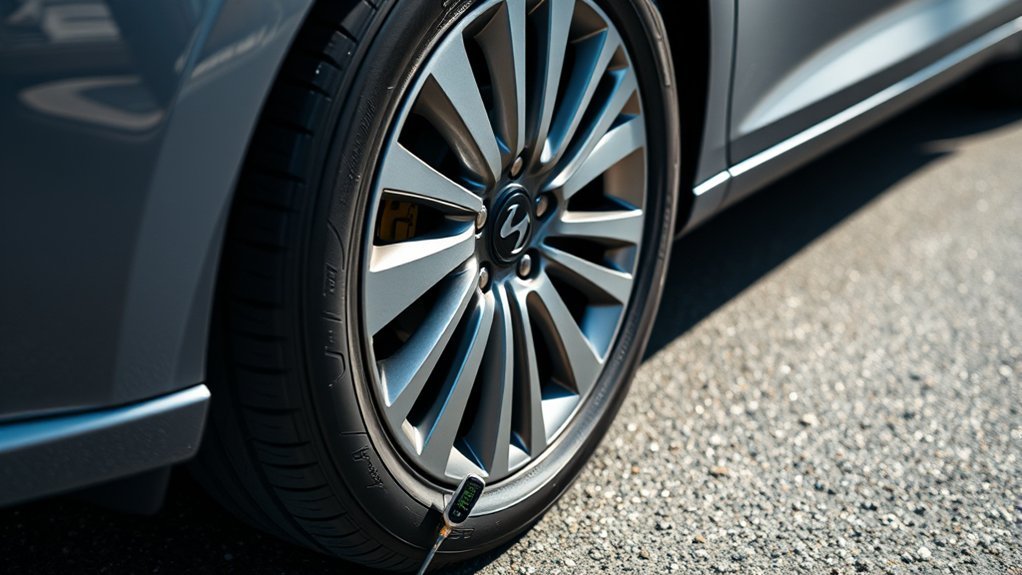
Proper tire pressure is the foundation of Hyundai Sonata tire care. Check your tires, including the spare if your Sonata has one, at least once a month with a quality gauge. Hyundai’s owner guidance says you cannot judge radial tire pressure by sight because a tire can look normal and still be underinflated.
Always check pressure when the tires are cold. Hyundai defines cold tires as tires that have not been driven for at least three hours or have been driven less than 1 mile. Use the pressure listed on the tire and loading information label on the driver’s side center pillar or door-jamb area. Do not use the maximum pressure printed on the tire sidewall as your target.
Correct pressure helps your Sonata ride better, handle better, and wear tires more evenly. FuelEconomy.gov also notes that keeping tires properly inflated can improve gas mileage by 0.6% on average and up to 3% in some cases, while underinflated tires can lower mileage by about 0.2% for every 1 PSI drop in average pressure across all tires.
Note: A TPMS warning means at least one tire is already significantly underinflated. Still check tire pressure monthly, because TPMS is a warning system, not a replacement for a gauge.
Rotate Your Hyundai Sonata Tires for Even Wear
Regular tire rotation helps your Hyundai Sonata’s tires share wear more evenly. Front tires often work harder because they handle steering, braking force, and much of the vehicle’s weight transfer. Rotation moves tires to different positions so one pair does not wear out much sooner than the others.
Follow the maintenance schedule in your Sonata owner’s manual first. Some Hyundai Sonata guidance lists tire rotation at 12,000 km, or about 7,500 miles, and sooner if irregular wear develops. NHTSA also advises checking the owner’s manual for frequency and notes that, when recommended by the manufacturer, rotation is often done every 5,000 to 8,000 miles.
After rotation, bring front and rear tires back to the correct pressure if your Sonata specifies different front and rear pressures. Hyundai also advises checking lug nut torque after rotation and inspecting for uneven wear, bumps, bulges, or visible fabric or cord.
Pro Tip: Pair tire rotation with oil changes or scheduled maintenance so you do not forget it. If your tires are directional, asymmetrical, different front/rear sizes, or if you are using a compact spare, follow the specific pattern in your owner’s manual or tire shop guidance.
Ensure Wheel Alignment for Tire Health
Wheel alignment affects how evenly your Sonata’s tires contact the road. But alignment is not something you need to reset every few thousand miles automatically. Hyundai says the wheels are aligned at the factory and alignment may need to be reset if you notice unusual tire wear or the vehicle pulling one way or the other.
Watch for these alignment warning signs:
- Your Sonata pulls left or right on a straight, level road.
- The steering wheel sits off-center when you are driving straight.
- One tire edge wears faster than the rest of the tread.
- You recently hit a curb, pothole, or road debris hard.
- The car feels less stable than usual after suspension or steering work.
Ignoring alignment problems can shorten tire life fast because one part of the tread is dragged across the pavement instead of rolling cleanly. If you see one-edge wear, feathering, or the car pulls to one side, have a qualified technician inspect the alignment and suspension.
[Products Worth Considering]

Measure tire tread depth quickly and accurately with this LUMITECO dial gauge that reads in 1/32" increments up to 14/32". The color-coded green/yellow/red zones make it easy to judge tire wear and know when replacement is needed. A rugged, compact design with a protective pouch helps keep the gauge ready for use on cars, trucks, motorcycles, and more.

Monitor tire tread wear with a smart, color-coded depth gauge that shows clear condition ranges at a glance. The bar is range marked for fast, easy readings, helping you maintain safer traction and performance. Each gauge is portable with a pocket clip, and the set includes 20 units for daily use and sharing.

Keep your tires properly inflated with this analog VONDIOR tire pressure gauge, designed for fast, easy readings without batteries. The swiveling, two-axis hose and large glow dial help you measure at any tire angle with instant visibility. Built with a protective rubber shield, it supports durable, low-maintenance use for cars and trucks.
Balance Your Tires for a Smoother Ride
Tire balancing helps the wheel and tire assembly spin smoothly. An out-of-balance tire can cause vibration, uneven wear, and extra stress on suspension parts. Hyundai says that if you notice vibration while driving on a smooth road, your wheels may need to be rebalanced.
[Products Worth Considering]

The SAFELIFE dial tire tread depth gauge measures tread depth in 1/32 inch increments with clear, easy-to-read 2-inch dial face. Color zones using a traffic light system help you quickly judge whether tread is low, marginal, or ample for safer driving. Built with a durable zinc cast body and a metal detect probe for precise, comfortable use across cars, motorcycles, trucks, and buses.

Accurately measure tire tread depth with a calibrated gauge marked from 0 to 1 inch in 1/32 inch increments. The color-coded bar helps you quickly identify tread condition ranges, supporting safe driving for trucks, motorcycles, automobiles, and passenger vehicles.

Steelman white tire marking crayons provide high-contrast, semi-permanent marks for repairing and inspecting tires and equipment. They write on wet or dry, smooth or coarse surfaces including rubber, metal, glass, and wood, making them ideal for puncture location and damage outlining. The lead- and zinc-free crayons resist weather and fading yet wipe away when you no longer need the marks.
Key Benefits of Balancing
- Smoother ride: Proper balance reduces steering wheel, seat, or floor vibration.
- More even tread wear: A tire that hops or shakes can develop irregular wear patterns.
- Better comfort: Balanced tires help your Sonata feel steadier at highway speeds.
- Protection for related parts: Reducing vibration can help limit unnecessary stress on suspension and steering components.
Signs of Imbalance
The most common sign is vibration that appears at certain speeds, especially on smooth pavement. You may feel it through the steering wheel, floor, or seat. Uneven patchy wear, lost wheel weights, or vibration after a tire repair can also point to a balancing issue.
Balancing Frequency Recommendations
Do not rely on a fixed 5,000- or 6,000-mile balancing rule. Have tires balanced when new tires are installed, when a tire is removed from the wheel and remounted, when a wheel weight is lost, or when you feel vibration on a smooth road. During rotation, ask the technician to inspect tires for uneven wear and balance concerns.
Adopt Smooth Driving Habits for Tire Longevity
How you drive matters. Aggressive acceleration, hard braking, sharp cornering, and high-speed pothole impacts can all increase tire stress. Smooth driving helps the tread wear evenly and keeps heat buildup lower.
Avoid Sudden Accelerations and Hard Braking
Fast launches and abrupt stops scrub rubber off the tread. Start gently, brake early, and leave enough following distance so you can slow down smoothly. This also makes daily driving more comfortable and helps protect other wear items, including brakes.
Use Gentle Cornering Techniques
Hard cornering wears tire shoulders and can worsen edge wear if pressure or alignment is already off. Slow before a turn, steer smoothly, and avoid jerky steering inputs. Your Sonata will feel more stable, and the tires will work less hard.
Maintain Moderate Speeds
Higher speeds can raise tire temperature and increase stress, especially in hot weather, with heavy cargo, or on underinflated tires. Keep speeds reasonable, avoid repeated hard lane changes, and slow down for rough pavement.
Don’t Overload Your Vehicle for Tire Safety
Overloading your Hyundai Sonata can shorten tire life and create a safety risk. The tire and loading information label on the driver’s door-jamb area lists the original tire size, recommended cold tire pressure, seating capacity, and vehicle capacity weight. That capacity is the maximum combined weight of occupants and cargo for your specific vehicle.
Hyundai warns that overloading may cause tire heat buildup, possible tire failure, increased stopping distances, and poor handling. Spread cargo evenly, keep heavy items low in the trunk, and remove unnecessary weight when you do not need it.
FuelEconomy.gov estimates that an extra 100 pounds in a vehicle can reduce MPG by about 1%, with the effect depending on the vehicle’s weight.
Warning: Never exceed the vehicle capacity weight, GVWR, or axle ratings shown on your Sonata’s labels. Overload can reduce handling and braking ability and may lead to tire failure.
Keep an Eye on Your Tires for Damage
A monthly tire inspection helps you catch problems before they become expensive or dangerous. Check tread, sidewalls, valve stems, and the area around the bead. Look for cuts, cracks, bulges, embedded nails, exposed cords, and uneven wear.
Inspect for Cuts, Bulges, and Embedded Objects
Walk around the car with a flashlight. Look at the inside and outside shoulders as well as the center tread. A bulge, bubble, exposed cord, or deep sidewall cut is not a “watch it later” problem—it usually means the tire needs professional inspection right away.
Also watch for recurring air loss. If one tire repeatedly needs air, there may be a puncture, valve issue, bead leak, or wheel damage. Have it inspected instead of simply adding air every few days.
Check Tread Depth
NHTSA says tires are not safe and should be replaced when tread is worn to 2/32 inch. You can use the penny test by placing a penny into the tread with Lincoln’s head upside down and facing you. If you can see the top of Lincoln’s head, replace the tire.
A tread depth gauge is more accurate than a penny and costs very little. Measure several grooves across each tire and use the lowest reading, not the best reading. If one area is much lower than the rest, look for pressure, alignment, suspension, or rotation issues.
Read Common Wear Patterns
- Center wear: Often linked to overinflation or too much center loading.
- Both-edge wear: Often linked to underinflation or repeated hard cornering.
- One-edge wear: Often linked to alignment issues.
- Cupping or scalloping: May point to worn suspension parts, imbalance, or poor shock/strut control.
- Patchy wear after vibration: Have balancing and suspension checked.
How to Store Tires for Maximum Lifespan
If you swap between winter and all-season tires, storage matters. The U.S. Tire Manufacturers Association recommends storing tires in a clean, dry, cool, well-ventilated place away from heat, sunlight, chemicals, petroleum products, and ozone-generating sources such as electric motors, battery chargers, generators, and welding equipment.
- Clean and dry them first: Remove road grime, salt, stones, and brake dust before storage.
- Keep them out of sunlight: UV exposure and heat can age rubber faster.
- Avoid chemicals: Keep tires away from gasoline, oil, solvents, and corrosive materials.
- Use covers or bags: Tire bags or covers help limit dust and light exposure.
- Store safely: If mounted on wheels, stacking is usually acceptable. If unmounted, store upright and rotate their position occasionally to reduce stress.
Choose the Right Tires for Your Driving Conditions
The right tire for a Hyundai Sonata depends on climate, driving style, road conditions, and the size/load rating your vehicle requires. Check the owner’s manual or the Tire and Loading Information Label for the correct size. Hyundai warns against replacing tires with the wrong size, type, construction, or tread pattern because it can affect handling and vehicle systems.
For many Sonata owners, all-season tires are a practical daily-driving choice. If you regularly drive in deep snow, winter tires can provide stronger cold-weather and snow traction than all-season tires. Summer tires can feel sharp in warm weather but are not designed for freezing temperatures, snow, or ice.
When replacing tires, match the correct size, load rating, and speed rating. Avoid mixing tire types unless the tire manufacturer and vehicle manual allow it. If one tire is damaged and the others are heavily worn, ask a tire professional whether replacing only one tire is safe for your setup.
[Products Worth Considering]

The Trivd Frol 1/2" air impact wrench delivers high performance torque up to 1500 ft-lbs with a twin hammer impact mechanism for strong, balanced blows. It features an ergonomic grip, compact lightweight design, and quick-stop control with 3 forward speeds up to 8000 RPM plus a reverse speed. Built for demanding automotive repair and tire shop work, the rear exhaust helps keep debris away from the surface.

The JACO FlowPro Tire Inflator measures, inflates, and airs down tires up to 100 PSI with battery-free operation and ±2% accuracy after calibration. It features a glowing pressure dial for night visibility, a heavy-duty steel build with a hybrid hose, and a precision push-to-inflate thumb trigger. The patented Lightning Air Chuck locks on for a secure seal, and the kit includes quick-connect hardware for easy inline use with your air compressor.

Milton S-921 pencil tire pressure gauge helps you maintain optimal tire pressure for passenger cars with accurate readings in PSI and kPa. It features a built-in deflator valve for convenient pressure adjustments, plus a single chuck head and nylon indicator bar for easy use on the go. Built from durable plated brass and designed for reliable performance, it’s a practical road trip and cold-weather maintenance tool.
Stay on Top of Regular Maintenance for Optimal Performance
Use this simple maintenance rhythm to extend Hyundai Sonata tire life:
- Monthly: Check cold tire pressure, inspect tread, look for damage, and check the spare if equipped.
- Before long trips: Recheck pressure, tread, visible damage, and load weight.
- At scheduled service: Rotate tires according to your owner’s manual and inspect brake pads while the wheels are off.
- When symptoms appear: Check alignment if the car pulls or tire edges wear unevenly; check balancing if you feel vibration on smooth roads.
- When replacing tires: Use the correct size and type, balance the new tires, and set pressure to the door-jamb specification.
Note: Tire care is safety care. A tire that is damaged, severely underinflated, overloaded, or worn out can affect braking, steering, traction, and control.
Frequently Asked Questions
How do I increase the longevity of Hyundai Sonata tires?
Check cold tire pressure monthly, rotate tires on the owner’s manual schedule, drive smoothly, avoid overload, inspect tread and sidewalls, and address pulling, vibration, or uneven wear quickly. These steps help the tread wear more evenly and reduce preventable tire stress.
How often should I rotate Hyundai Sonata tires?
Follow your Sonata owner’s manual first. Many Hyundai Sonata schedules call for tire rotation around 7,500 miles, and tires should be rotated sooner if irregular wear develops. If your tires are directional, asymmetrical, staggered, or damaged, ask a tire professional for the correct pattern.
Do I need wheel alignment every 5,000 miles?
Usually, no. Alignment should be checked when your Sonata pulls to one side, the steering wheel is off-center, tire edges wear unevenly, or you hit a curb or pothole hard. Hyundai guidance says alignment may need reset when unusual wear or pulling appears.
How often should I balance Hyundai Sonata tires?
Balance tires when new tires are installed, when a tire is removed and remounted, if a wheel weight is lost, or when you feel vibration on a smooth road. A fixed mileage interval is less useful than paying attention to vibration and uneven wear.
How long do Hyundai Sonata tires last?
There is no single mileage number for every Sonata tire. Tire life depends on the tire model, treadwear rating, pressure habits, rotation schedule, alignment, road surface, weather, cargo weight, and driving style. Many passenger tires are replaced because of tread wear, damage, age, or uneven wear before reaching their warranty mileage.
When should I replace my Sonata tires?
Replace tires when tread reaches 2/32 inch, when the treadwear indicators are flush with the tread, or when you see exposed cords, sidewall bulges, serious cracking, or damage that a tire professional says is not repairable. Also replace tires that repeatedly lose air after repair attempts.
Conclusion
Your Hyundai Sonata’s tires will last longer when you treat tire care as a simple routine instead of a once-in-a-while repair. Check cold pressure monthly, rotate on schedule, inspect tread and sidewalls, avoid overload, and respond quickly to vibration, pulling, TPMS warnings, or uneven wear. A few minutes of attention can protect your tires, your fuel economy, and your safety on every drive.
Sources
- Hyundai Owner’s Manual — Check Tire Inflation Pressure — supports monthly tire pressure checks and gauge use.
- Hyundai Owner’s Manual — Recommended Cold Tire Inflation Pressures — supports cold-tire checking, pressure effects, and low-pressure risks.
- Hyundai Owner’s Manual — Tire Rotation — supports 7,500-mile rotation guidance and inspection during rotation.
- Hyundai Owner’s Manual — Wheel Alignment and Tire Balance — supports symptom-based alignment and balancing checks.
- NHTSA TireWise — supports tire pressure, tread depth, balancing, alignment, rotation, tire size, and replacement safety guidance.
- U.S. Tire Manufacturers Association — Tire Care & Safety — supports tire storage recommendations.