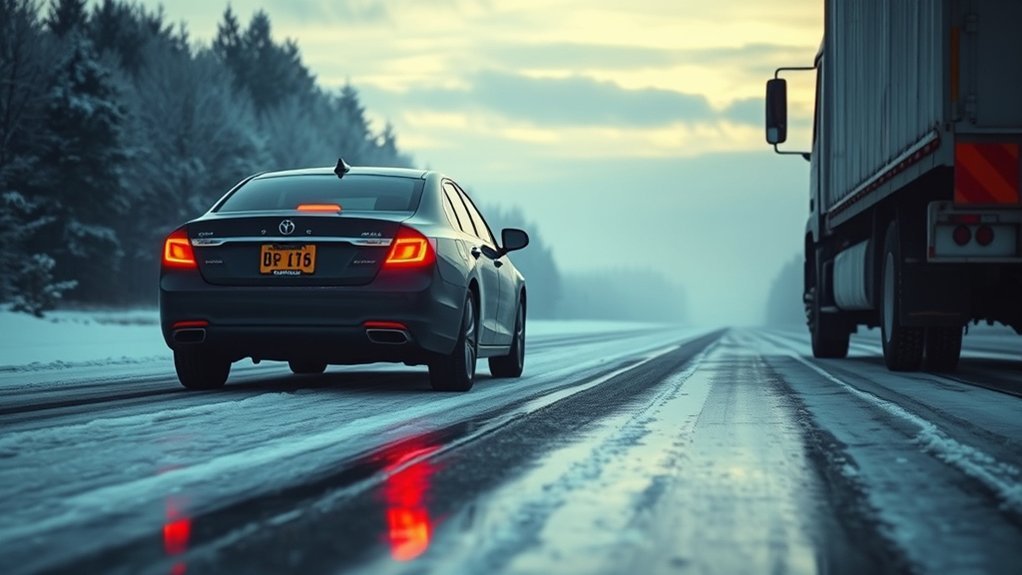
Black ice is a thin, transparent layer of ice that can blend into the road and sharply reduce tire grip. It is especially dangerous on bridges, overpasses, shaded roads, ramps, and during overnight or early-morning refreezing. The safest approach is to slow down before a suspected icy area, leave much more space, avoid sudden inputs, and know how your vehicle’s brakes work before a skid happens.
Quick Answer
To drive safely around black ice, slow down before suspected icy areas, leave much more space, and avoid cruise control and sudden steering, braking, or acceleration. If traction disappears, ease off the accelerator and steer smoothly toward your intended path. If braking is necessary, use the braking method recommended for your vehicle’s ABS system.
Key Takeaways
- Slow down before bridges, shaded roads, curves, ramps, and other places where ice may be present.
- Do not depend on seeing black ice. It can be nearly invisible and may look like ordinary wet pavement.
- Keep acceleration, steering, braking, and gear changes smooth so you do not overwhelm the limited grip available.
- If the vehicle begins to slide, ease off the accelerator and steer gently toward where you want the vehicle to go.
- If emergency braking is required in a vehicle with four-wheel ABS, use firm, continuous brake pressure and do not pump the pedal.
- Good tires, correct cold tire pressure, clear visibility, and checking road conditions before leaving can reduce your risk.
At a Glance
| Time Required | Skid response happens within seconds; allow 5–10 minutes for a basic pre-drive winter check. |
| Difficulty | Moderate to high risk because available traction can change suddenly. |
| Tools Needed | None for skid recovery; a tire-pressure gauge, ice scraper, snow brush, and winter washer fluid help with preparation. |
| Cost | Driving techniques and inspections cost nothing; tire, maintenance, and winter-equipment costs vary. |
What Is Black Ice and Why It’s Dangerous
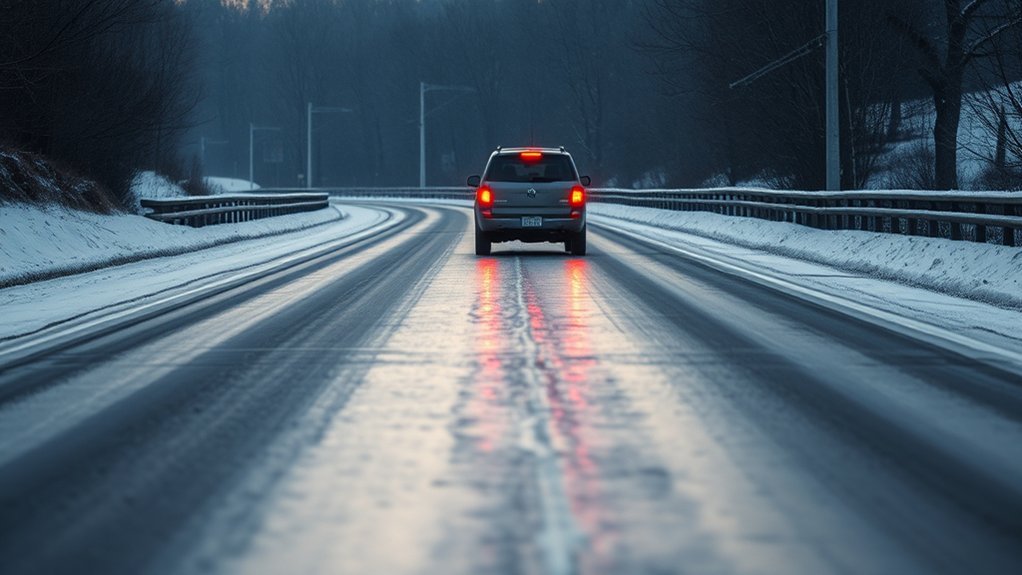
Black ice is patchy, usually clear ice that lets the darker road surface show through. That is why it can be so difficult to see. The National Weather Service notes that black ice commonly develops when moisture on a road freezes or when snowmelt or rain refreezes as temperatures fall below freezing.
Do not rely only on the air temperature shown on your dashboard. Road-surface temperature can differ from the surrounding air, and elevated surfaces can cool faster than nearby ground-level pavement.
Bridges and overpasses can freeze before nearby road surfaces because cold air can cool them from above and below.
Black ice is particularly common during overnight and early-morning refreezing, after rain or melting snow, and anywhere cold pavement remains wet. Even when the surrounding road appears clear, a bridge, ramp, shaded curve, or untreated section may still be icy.
Note: Black ice does not have to look black. The term describes transparent ice through which the road surface remains visible.
How to Spot Black Ice on the Road
You often cannot identify black ice with certainty before reaching it, so use conditions and location as your main warning signs.
Be especially cautious when temperatures are near freezing and the road has recently been wet from rain, fog, melting snow, or runoff. A glossy or wet-looking patch that seems different from surrounding pavement can be a warning, but appearance alone is not reliable.
Watch the behavior of vehicles farther ahead. Unexpected slowing, sliding, fishtailing, or unusually cautious steering may indicate a slippery surface before you reach it.
Also pay attention to bridges, overpasses, elevated ramps, shaded areas, low spots, and roads near water. The National Weather Service specifically identifies bridges and overpasses as high-risk surfaces because they can freeze sooner than ordinary pavement.
Pro Tip: Treat the combination of moisture plus near-freezing conditions as the warning. Waiting until you actually see ice may leave too little time to reduce speed safely.
Where Black Ice Forms Most Often
Black ice can develop anywhere wet pavement freezes, but some locations deserve extra caution:
- Bridges and overpasses: Air moves around both the top and underside of the structure, allowing the pavement to cool quickly.
- Elevated entrance and exit ramps: These can behave much like bridges and may also combine ice with a curve.
- Shaded roads: Trees, hills, walls, and buildings can keep pavement cold after sunny areas have warmed.
- Low spots and drainage areas: Meltwater or runoff can cross the road and refreeze.
- Roads near lakes and rivers: Moisture and local temperature differences can contribute to slick conditions.
- Untreated or low-traffic roads: These may receive less frequent salting, sanding, or plowing.
Nighttime and early morning deserve extra attention because melted water can refreeze as pavement temperatures fall. A road that was only wet during the afternoon can become icy after sunset.
Check Conditions Before You Drive
Your best black-ice recovery is avoiding the skid in the first place. Before leaving in freezing or near-freezing weather, check the forecast and your state or local road-condition service. Allow extra travel time and change your route if bridges, hills, or untreated roads can be avoided.
Clear snow and ice from the windshield, windows, mirrors, lights, and roof so your visibility is not compromised. Confirm that the defroster, wipers, washer system, and lights are working.
The National Highway Traffic Safety Administration recommends preparing both the vehicle and the driver for winter conditions and increasing following distance on slick roads.
Warning: If freezing rain is falling, roads are untreated, officials advise against travel, or conditions exceed your experience, delaying the trip is safer than depending on AWD, winter tires, ABS, or skid-recovery techniques.
[Products Worth Considering]

This tire inflator with pressure gauge delivers long-lasting performance with a durable rubber-protected gauge and sturdy build. The longer hose and 360 swivel air chuck help you seal the valve securely and keep your hands free while measuring, inflating, or deflating. It’s battery-free for reliable use and provides ±2 PSI accuracy in the mid-range for most typical tires, with universal compatibility for 1/4 NPT compressor outputs.

Monitor tire tread wear with a smart, color-coded depth gauge that shows clear condition ranges at a glance. The bar is range marked for fast, easy readings, helping you maintain safer traction and performance. Each gauge is portable with a pocket clip, and the set includes 20 units for daily use and sharing.

The SAFELIFE dial tire tread depth gauge measures tread depth in 1/32 inch increments with clear, easy-to-read 2-inch dial face. Color zones using a traffic light system help you quickly judge whether tread is low, marginal, or ample for safer driving. Built with a durable zinc cast body and a metal detect probe for precise, comfortable use across cars, motorcycles, trucks, and buses.
Slow Down Before You Reach Icy Spots
Reduce your speed before bridges, shaded sections, curves, ramps, and other places where ice may be present. Trying to remove a large amount of speed after your tires are already on ice can overwhelm the available grip.
The posted speed limit is a maximum for suitable conditions, not a target during ice. Drive at a speed that gives you enough time and space to react smoothly.
Reduce Speed Early
Ease off the accelerator well before a suspected icy patch and let the vehicle lose speed progressively. Earlier speed reduction gives your tires more grip in reserve for steering or unexpected changes in traffic.
Approach intersections and curves especially carefully. Avoid sudden acceleration, abrupt lane changes, or last-second braking.
Brake Before Icy Areas
If you need to slow for a bridge, curve, intersection, or downhill section, do as much of that slowing as practical before reaching the slick area.
Use smooth brake pressure during normal slowing and leave substantially more space than you would on dry pavement. There is no single safe following distance in feet that works at every speed and road condition.
If an emergency stop becomes necessary, use the correct braking method for your vehicle rather than trying to avoid ABS activation.
Enter Curves Gently
Slow before entering a curve so you are not asking the tires to provide heavy braking and cornering grip at the same time. Once in the turn, make small, progressive steering inputs.
- Scan as far through the curve as possible.
- Reduce speed before entering.
- Avoid abrupt steering corrections.
- Avoid hard acceleration through the turn.
- Leave extra room around other vehicles.
What to Do When Your Car Starts Sliding
If traction suddenly disappears, your first goal is not to stop instantly. Your first goal is to avoid making the slide worse.
Ease off the accelerator, keep your eyes on your intended path, and make smooth steering corrections. Avoid sudden gear changes, abrupt throttle, and unnecessary braking while the tires are trying to regain grip.
Ease Off The Gas
Lift off the accelerator smoothly. Removing drive torque gives the tires a better opportunity to recover traction without adding another abrupt input.
Do not suddenly downshift as a general skid-recovery technique. A sharp change in drivetrain force can further disturb traction on a very slippery surface.
- Ease off the accelerator.
- Keep both hands ready for small steering corrections.
- Avoid sudden gear changes.
- Do not use the parking brake to correct the skid.
- Look toward the safe path you want the vehicle to follow.
Steer Into The Skid
The phrase “steer into the skid” can be confusing, so focus on the actual goal: point the front wheels gently toward the path you want the vehicle to follow.
If the rear of the vehicle slides to the right, a small steering correction to the right can help realign the vehicle. If the rear slides left, correct gently to the left. As the vehicle straightens, unwind the steering smoothly so you do not create a second skid in the opposite direction.
| Situation | Response |
|---|---|
| Rear slides right | Steer gently right toward the intended path |
| Rear slides left | Steer gently left toward the intended path |
| Vehicle begins to straighten | Smoothly straighten the steering wheel |
If the front tires are sliding straight ahead even though you have turned the wheel, you may be experiencing understeer rather than a rear-wheel skid. Ease off the accelerator and reduce excessive steering angle so the front tires have a better chance to regain grip. Cranking in more steering usually does not create traction that is not available.
Brake Gently If Needed
For ordinary slowing, use smooth brake pressure and avoid an abrupt panic input when there is no immediate obstacle.
If emergency braking is genuinely required and your vehicle has four-wheel ABS, the NHTSA winter-driving guidance says to apply firm, continuous brake pressure and let ABS control wheel slip. A pulsing pedal is normal when ABS activates. Do not pump an ABS brake pedal.
If your vehicle does not have four-wheel ABS, braking technique can be different. Follow the owner’s manual; NHTSA notes that drivers without ABS may need to release and reapply brake pressure if the wheels begin to lock.
- Do not brake unnecessarily just because you have entered an icy patch.
- With four-wheel ABS in an emergency, press firmly and continuously.
- Do not pump four-wheel ABS brakes.
- Keep steering smoothly toward a safe path.
- Know your vehicle’s braking system before winter driving.
How to Steer Through a Black Ice Skid
Keep steering inputs small because a large wheel movement cannot create grip on a surface that offers very little traction. If the vehicle is still traveling approximately straight, avoid unnecessary steering and allow it to settle.
If the rear begins to rotate, correct gently toward your intended path. Do not hold a large steering angle while waiting for the tires to regain grip; when they reach a surface with more traction, a large steering angle can make the vehicle change direction suddenly.
The Ontario Ministry of Transportation’s winter-driving guidance similarly recommends gentle steering and warns against braking, accelerating, or changing gears abruptly on slippery pavement.
Why Braking on Black Ice Can Backfire
The problem is not that brakes themselves are unsafe on ice. The problem is asking the tires for more grip than the road can provide.
Without ABS, excessive brake pressure can lock the wheels and reduce steering control. With four-wheel ABS, the system rapidly adjusts brake pressure to prevent sustained wheel lock, which is why the correct emergency technique is firm, continuous pressure rather than pumping.
ABS cannot create tire grip or eliminate the extra stopping distance caused by ice. It also cannot compensate for entering the hazard too fast.
- Slow before the icy section whenever possible.
- Avoid unnecessary braking while crossing a short slick patch.
- Use firm continuous pressure if emergency braking with four-wheel ABS is required.
- Do not make sudden gear changes to slow the vehicle.
- Prioritize maintaining a controllable path rather than trying to stop instantly.
What to Do After Traction Returns
When the tires begin gripping again, resist the urge to make a large steering or throttle correction. Straighten the wheel progressively, stabilize the vehicle, and continue at a much lower speed.
If you have moved partly out of your lane, check surrounding traffic before making another correction. A second abrupt maneuver can trigger another loss of control.
Once you are stable, find a safe place to stop if you need time to recover, inspect the vehicle, or reconsider whether conditions are safe enough to continue.
Winter Tires and Tread for Grip
Tires determine how much braking, acceleration, and cornering force your vehicle can transmit to the road. Winter tires use tread patterns and rubber compounds designed to retain useful cold-weather traction better than summer tires and, in severe winter conditions, generally better than ordinary all-season tires.
Look for tires appropriate for your vehicle and climate. Many dedicated winter tires carry the Three-Peak Mountain Snowflake, or 3PMSF, symbol. Tire manufacturers such as Michelin also recommend seasonal winter tires when temperatures are consistently cold; Michelin uses 45°F (7°C) as its seasonal guideline.
Do not treat 45°F as a legal threshold or assume that every tire behaves identically at that temperature. Follow the recommendations for your specific tire and vehicle.
Winter tires should normally be installed as a complete set of four so front and rear traction remain balanced.
[Products Worth Considering]

Accurately measure tire tread depth with a calibrated gauge marked from 0 to 1 inch in 1/32 inch increments. The color-coded bar helps you quickly identify tread condition ranges, supporting safe driving for trucks, motorcycles, automobiles, and passenger vehicles.

Measure tire tread depth quickly and accurately with this LUMITECO dial gauge that reads in 1/32" increments up to 14/32". The color-coded green/yellow/red zones make it easy to judge tire wear and know when replacement is needed. A rugged, compact design with a protective pouch helps keep the gauge ready for use on cars, trucks, motorcycles, and more.

Milton S-921 pencil tire pressure gauge helps you maintain optimal tire pressure for passenger cars with accurate readings in PSI and kPa. It features a built-in deflator valve for convenient pressure adjustments, plus a single chuck head and nylon indicator bar for easy use on the go. Built from durable plated brass and designed for reliable performance, it’s a practical road trip and cold-weather maintenance tool.
Prepare Your Car for Black Ice
Good skid technique cannot compensate for badly worn tires, poor visibility, or neglected maintenance. Before winter driving, inspect the tires, lights, wipers, washer system, battery, and other items recommended in your owner’s manual.
[Products Worth Considering]

Measure tyre tread depth precisely with a digital gauge that reads in both MM and inches, helping you monitor safe driving conditions. The large LCD screen is easy to operate, and the compact tool fits for cars, trucks, and motorcycles. It provides high accuracy with a 0-25.4mm range and includes a 1-year warranty for added peace of mind.

The Continental Grand Prix 5000 is an allround road bike tire engineered for faster rolling, improved ride comfort, and enhanced puncture protection. It features a Vectran Breaker cut-protection layer, Lazer Grip micro-profile tread for confident cornering control, and Active Comfort Technology to damp vibration for smoother rides. BlackChili compound optimizes grip and speed for everyday performance and long-lasting confidence.

The Kurgo Seasonal Tire Tote helps protect your car interior, clothes, and garage from tire grime, brake dust, and residue during seasonal tire changes. Its universal design fits most passenger tires between 22" and 31" in diameter, making storage and transport simpler with less mess. Built for rugged, repeated use, it’s machine washable for easy care and comes with a lifetime warranty.
Check Tire Tread
The NHTSA TireWise guidance says passenger-vehicle tires should have at least 2/32 inch of tread and should be replaced when worn to that level.
That is a replacement threshold, not a promise of strong snow or ice performance down to the final 2/32 inch. Winter traction can deteriorate as tread wears, so inspect tires regularly and follow the tire manufacturer’s winter-use guidance.
- Check tread depth at least monthly.
- Use built-in treadwear indicators or an appropriate tread gauge.
- Inspect for cuts, cracks, bulges, punctures, and uneven wear.
- Replace tires at the NHTSA 2/32-inch threshold or sooner when appropriate for winter service.
- Have unusual wear inspected by a qualified tire professional.
Use Winter Tires
Winter tires can improve traction in snow, slush, and cold conditions because their compounds and tread are designed for winter use. They do not make black ice safe, and they do not repeal the need to reduce speed.
Install winter tires on all four wheel positions rather than mixing winter tires on only one axle unless your vehicle or tire manufacturer explicitly instructs otherwise.
Check inflation pressure regularly. Cold weather can lower tire pressure, and the correct pressure is the vehicle manufacturer’s cold-tire specification shown on the driver’s door placard or in the owner’s manual—not the maximum pressure printed on the tire sidewall.
Inspect Lights And Fluids
Visibility becomes even more important when you are looking for subtle changes in a winter road surface.
- Check headlights, brake lights, and turn signals.
- Fill the washer reservoir with fluid suitable for expected winter temperatures.
- Replace wiper blades that streak or skip.
- Make sure the windshield defroster works correctly.
- Check coolant and other fluids according to the vehicle manufacturer’s schedule.
- Clear snow and ice from windows, mirrors, lights, and the roof before moving.
FWD, AWD, and 4WD Do Not Make Black Ice Safe
Front-wheel drive, all-wheel drive, and four-wheel drive can change how a vehicle accelerates or distributes power, but none creates extra friction between the tires and an icy road.
AWD or 4WD may help a vehicle get moving in some winter conditions, yet all four tires still have to provide the grip needed for braking and cornering. That is why tire condition and driving speed remain critical regardless of drivetrain.
Do not let easier acceleration create false confidence. A vehicle that launches cleanly on an icy road may still need a very long distance to stop.
Safe Winter Driving Habits That Help Prevent Skids
| Habit | Why It Helps |
|---|---|
| Reduce speed early | Leaves more available grip for steering and braking |
| Increase following distance | Provides more time to respond and stop |
| Steer smoothly | Reduces sudden demands on limited tire grip |
| Turn cruise control off | Keeps speed changes under direct driver control |
| Check tires and pressure | Helps the tires perform as designed |
| Check conditions before leaving | May let you avoid the hazard entirely |
Avoid cruise control on wet, snowy, or icy pavement. The Ontario Ministry of Transportation specifically advises against cruise control in slippery winter conditions.
Use headlights as required and whenever visibility is poor. Avoid sudden lane changes, hard acceleration, or close following. If a road looks questionable, reduce speed before reaching the questionable section instead of waiting for the tires to slide.
NHTSA estimated that 101,390 police-reported crashes occurred in snow or sleet conditions in 2023, including 22,293 injury crashes. Those figures cover snow/sleet conditions generally and are not specific to black ice.
Frequently Asked Questions
What to Do Driving Over Black Ice?
Ease off the accelerator, keep steering movements small, and avoid sudden acceleration, braking, or gear changes. If the vehicle remains straight, let it settle. If it begins to skid, steer gently toward your intended path. If emergency braking is necessary with four-wheel ABS, use firm, continuous pedal pressure.
What Are the 3 P’s of Winter Driving?
There is no single universal U.S. road-safety standard defining one official set of “3 P’s” for winter driving. Different organizations use different memory aids. The dependable principles are to prepare before leaving, drive patiently at a safe speed, maintain extra space, and avoid sudden vehicle inputs.
What Are the 4 P’s of Winter Safety?
There is no universal four-item winter-driving standard used by every transportation agency. Lists such as preparation, prevention, patience, and practice can be useful memory aids, but they should not replace official guidance: check conditions, slow down, leave extra distance, keep the vehicle prepared, and make smooth inputs.
How Bad Is It to Use FWD on Black Ice?
Front-wheel drive can help with acceleration in some slippery conditions, but it does not make black ice safe. Braking and cornering still depend heavily on the grip available at all four tires. Slow down, use suitable tires, increase following distance, and avoid abrupt inputs regardless of drivetrain.
Should You Brake on Black Ice?
Avoid unnecessary or abrupt braking when you first lose traction. Ease off the accelerator and stabilize the vehicle. If emergency braking is required and your vehicle has four-wheel ABS, apply firm, continuous pressure and let ABS work. Do not pump four-wheel ABS brakes.
Does AWD Help on Black Ice?
AWD can help distribute power during acceleration, but it cannot create tire grip on ice and does not remove the need for longer stopping distances. Tire condition, tire type, speed, and smooth driving remain important for braking and cornering.
Can Black Ice Form When the Air Temperature Is Above 32°F?
It can be possible for pavement temperature to differ from the reported air temperature, especially on elevated or shaded surfaces. Instead of relying on one dashboard reading, treat wet roads and temperatures near freezing as a reason for extra caution.
Should You Use Cruise Control When Black Ice Is Possible?
No. Avoid cruise control on wet, snowy, or icy pavement. Keeping direct control of acceleration makes it easier to respond smoothly when traction changes.
Conclusion
Black ice is dangerous because you may have little warning before traction changes. Your strongest defenses are preparation and lower speed: check conditions before leaving, slow before high-risk areas, leave extra space, keep cruise control off, and make every input smoothly.
If a skid begins, ease off the accelerator and guide the vehicle gently toward your intended path. Know whether your vehicle has four-wheel ABS and follow the correct braking technique. Good tires can improve your margin, but no tire or drivetrain makes glare ice harmless. When conditions are severe, postponing the trip is often the safest decision.
Sources
- National Weather Service — Ice Storms and Black Ice — black-ice definition, overnight refreezing, and why bridges and overpasses are high-risk.
- National Highway Traffic Safety Administration — Winter Weather Driving Tips — winter-driving preparation, following distance, ABS use, tire pressure, and crash data.
- NHTSA TireWise — tire-pressure checks, tread inspections, and the 2/32-inch tread replacement threshold.
- Ontario Ministry of Transportation — Winter Driving — smooth steering, avoiding sudden gear changes, extra following space, and avoiding cruise control on slippery roads.
- Michelin USA — Winter Tire Buying Guide — winter-tire compounds, 3PMSF identification, and manufacturer cold-weather recommendations.