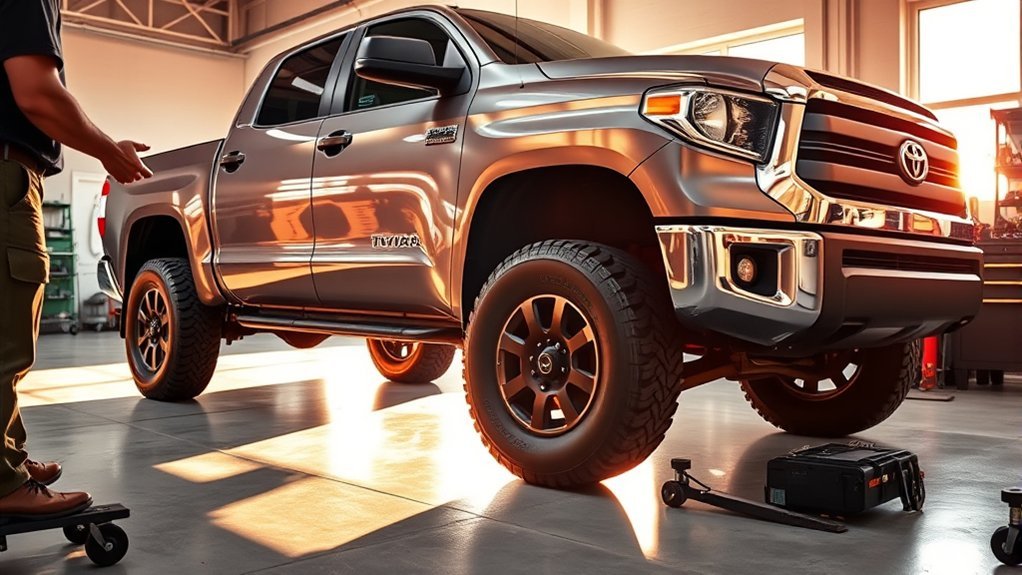
Your Toyota Tundra should get an alignment check whenever you notice pulling, uneven tire wear, a crooked steering wheel, or a hard pothole or curb hit. You can also ask for an alignment check during regular tire rotations, since Toyota’s maintenance schedule lists tire rotation at repeated 5,000-mile service intervals. A full alignment is only needed when the measurements show the wheels are out of spec.
Quick Answer
Check your Toyota Tundra’s wheel alignment at tire rotations, after curb or pothole impacts, after suspension work, when installing new tires with uneven old-tire wear, or anytime the truck pulls, vibrates, or wears tires unevenly. Most Tundras do not need an alignment on a fixed mileage schedule unless symptoms or measurements show it.
Key Takeaways
- Use tire rotations as a smart time to inspect tread wear, steering feel, and alignment symptoms.
- Get an alignment check right away after a hard pothole hit, curb strike, suspension repair, lift kit, or new steering part.
- Pulling, a crooked steering wheel, uneven shoulder wear, or loose steering are common signs your Tundra may be out of alignment.
- New tires should be balanced every time, but alignment is needed when wear patterns or measurements show a problem.
- A four-wheel alignment often costs more than a front-end check, and worn suspension parts can raise the final bill.
At a Glance
| Time Required | 5 minutes for a visual tire check; about 45 to 90 minutes for a professional alignment service |
| Difficulty | Easy inspection for owners; professional equipment needed for final alignment adjustments |
| Tools Needed | Tire pressure gauge, tread depth gauge or penny, flashlight, and professional alignment rack for adjustments |
| Cost | Often about $90 to $200 for a four-wheel alignment, depending on shop, location, model year, and needed repairs |
Top Signs Your Tundra Needs a Wheel Alignment Now

Have you noticed your Toyota Tundra pulling to one side on a straight, level road? That is one of the clearest signs that your wheel alignment needs attention. A steering wheel that sits off-center while you drive straight is another strong clue.
Look closely at your tires, too. Uneven wear on the inside or outside shoulder, feathered tread edges, or bald patches can point to poor alignment, worn suspension parts, incorrect tire pressure, or a balance issue. You should not guess based on one symptom alone.
Warning: If your Tundra suddenly pulls hard, the steering feels loose, the truck shakes badly, or you see a bulge, cord, cut, or exposed belt on a tire, stop driving when it is safe and get the truck inspected before continuing.
You should also schedule an alignment check after a hard pothole hit, curb strike, off-road impact, or suspension repair. A heavy truck can hide small steering changes at first, but those small changes can still shorten tire life.
[Products Worth Considering]

The SAFELIFE dial tire tread depth gauge measures tread depth in 1/32 inch increments with clear, easy-to-read 2-inch dial face. Color zones using a traffic light system help you quickly judge whether tread is low, marginal, or ample for safer driving. Built with a durable zinc cast body and a metal detect probe for precise, comfortable use across cars, motorcycles, trucks, and buses.

The Ziopetru adjustable magnetic wheel alignment tool helps you check and restore camber and caster positioning after removing and reinstalling undercarriage components. With a clear leveling/bubble measurement system and an easy zeroing adjustment knob, it supports precise horizontal angle checking. The strong magnetic base mounts to metal surfaces for convenient use at home on cars, motorcycles, trucks, vans, and SUVs.

Monitor tire tread wear with a smart, color-coded depth gauge that shows clear condition ranges at a glance. The bar is range marked for fast, easy readings, helping you maintain safer traction and performance. Each gauge is portable with a pocket clip, and the set includes 20 units for daily use and sharing.
How Often Should You Check Your Toyota Tundra’s Alignment?
You do not need to align your Tundra by mileage alone if it tracks straight and wears tires evenly. A better rule is to check alignment signs at every tire rotation and perform a professional alignment when the inspection or measurements show a problem.
Toyota’s 2026 Tundra Warranty & Maintenance Guide lists tire rotation at repeated 5,000-mile intervals. Use those visits to inspect tread wear, tire pressure, steering feel, and suspension condition. That habit catches alignment problems before they ruin a tire.
You should also ask for an alignment check in these situations:
- After hitting a pothole, curb, road debris, or trail obstacle hard enough to jar the truck.
- After replacing shocks, struts, control arms, tie rods, ball joints, steering parts, or suspension bushings.
- After installing a lift kit, leveling kit, different wheel offset, or larger tires.
- When new tires replace old tires that showed uneven wear.
- When the steering wheel is crooked or the truck drifts on a straight road.
- When you tow often, haul heavy loads, or drive rough roads regularly.
Pro Tip: Take a photo of your tire tread before every rotation. If one shoulder starts wearing faster than the other, you can spot the pattern early and show it to the technician.
Why a Four-Wheel Alignment Check Matters for Your Tundra
A four-wheel alignment check measures more than the front wheels. It also checks how the rear axle or rear wheel positions relate to the truck’s centerline. That relationship affects the thrust angle, which helps determine whether the truck tracks straight.
This matters on a Toyota Tundra because the truck is heavy, often tows, and may see rough roads, job sites, or off-road use. Small alignment errors can become expensive when they wear down large truck tires.
A complete alignment report usually includes:
- Toe: Whether the tires point slightly inward or outward when viewed from above. Toe errors can scrub tread quickly.
- Camber: Whether the tire leans inward or outward when viewed from the front. Too much camber can wear one shoulder.
- Caster: The steering axis angle that helps the steering return to center and feel stable.
- Thrust angle: Whether the rear axle or rear tracking line points straight with the truck.
Some angles may not be adjustable on every Tundra without extra parts or repair work. A good shop should explain what is adjustable, what is only measured, and whether worn parts need attention before alignment.
What to Expect During a Wheel Alignment Service
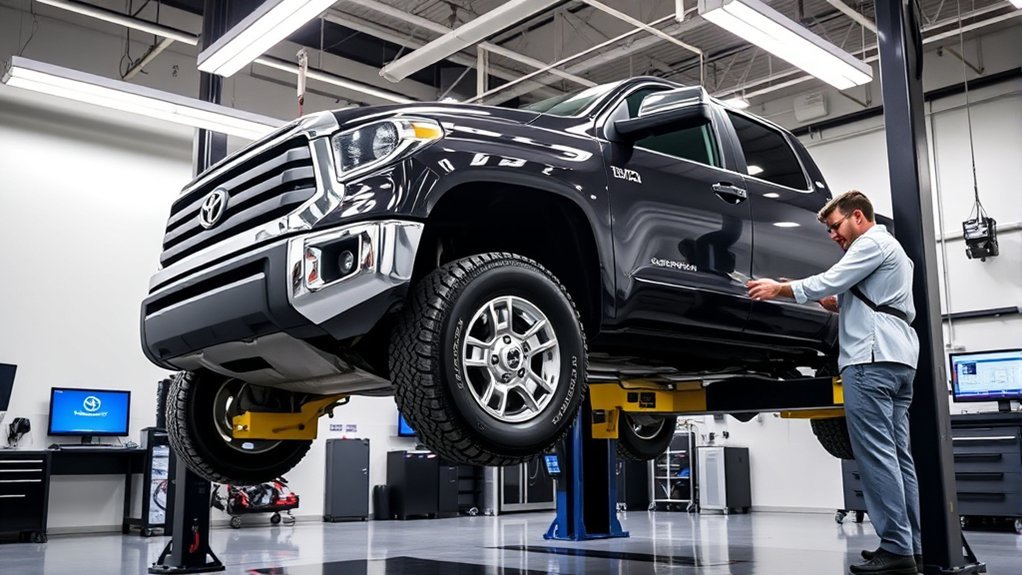
A wheel alignment service starts with a basic inspection. The technician should check tire condition, tire pressure, wheel condition, steering looseness, suspension wear, and ride height before making adjustments. Aligning a truck with worn steering or suspension parts can waste your money.
Next, the shop places the Tundra on an alignment rack and attaches sensors to the wheels. The machine compares the wheel angles to the specifications for your model year, trim, drivetrain, and tire setup. The technician then adjusts the available angles to bring the truck back into spec.
Ask for the before and after alignment printout. The “before” numbers show what was wrong. The “after” numbers show what the shop corrected. Green numbers usually mean the measurement is within spec, while red numbers usually mean it is outside the recommended range.
Note: Wheel alignment and wheel balancing are different services. Alignment corrects wheel angles and tracking. Balancing corrects weight distribution in the tire and wheel assembly, which often causes speed-related vibration.
[Products Worth Considering]

Measure tire tread depth quickly and accurately with this LUMITECO dial gauge that reads in 1/32" increments up to 14/32". The color-coded green/yellow/red zones make it easy to judge tire wear and know when replacement is needed. A rugged, compact design with a protective pouch helps keep the gauge ready for use on cars, trucks, motorcycles, and more.

Accurately measure tire tread depth with a calibrated gauge marked from 0 to 1 inch in 1/32 inch increments. The color-coded bar helps you quickly identify tread condition ranges, supporting safe driving for trucks, motorcycles, automobiles, and passenger vehicles.

This universal wheel alignment tool helps you accurately restore tire tilt angles after tire or suspension repairs using an adjustable camber gauge. It features a powerful magnetic base that firmly attaches to brake rotors for stationary, slip-free readings, improving consistency during measurement. Built from durable PC plastic, it resists wear and corrosion and is compact enough for car, truck, RV, and motorcycle alignment tasks.
Tundra Wheel Alignment Costs Explained
Alignment cost depends on your location, shop type, model year, suspension condition, tire size, and whether the truck needs a front-end or four-wheel alignment. A front-end alignment often costs less, while a four-wheel alignment commonly runs about $90 to $200 at many shops.
Your final bill can rise if the technician finds worn tie rods, ball joints, control arm bushings, damaged wheels, seized adjustment bolts, or suspension parts that need replacement before the alignment can hold.
[Products Worth Considering]

These aluminum alloy tire valve stem caps with an O-ring seal help protect valve stems from corrosion while adding a clean, stylish look to your vehicle. The universal fit works across cars, trucks, motorcycles, bicycles, and more, making them an easy upgrade for everyday driving and off-road use. Installation is quick, and the included four-pack keeps all your tires dressed and protected.

Steelman white tire marking crayons provide high-contrast, semi-permanent marks for repairing and inspecting tires and equipment. They write on wet or dry, smooth or coarse surfaces including rubber, metal, glass, and wood, making them ideal for puncture location and damage outlining. The lead- and zinc-free crayons resist weather and fading yet wipe away when you no longer need the marks.

Measure tyre tread depth precisely with a digital gauge that reads in both MM and inches, helping you monitor safe driving conditions. The large LCD screen is easy to operate, and the compact tool fits for cars, trucks, and motorcycles. It provides high accuracy with a 0-25.4mm range and includes a 1-year warranty for added peace of mind.
Alignment Cost Factors
The biggest cost factor is the condition of your suspension and steering system. If every part is tight and adjustable, the job is usually straightforward. If bolts are seized or parts are worn, the shop may need extra labor or replacement parts.
Truck setup also matters. Lift kits, leveling kits, oversized tires, aftermarket wheels, and heavy towing use can make the job more involved. Some modified Tundras may need aftermarket alignment parts to reach the correct settings.
Average Price Range
For a Toyota Tundra, expect a four-wheel alignment to cost more than a small-car front-end alignment. Many national estimates place typical four-wheel alignment pricing around $90 to $200, but local shop pricing can fall outside that range.
Dealer service departments may cost more than independent tire shops, but they may also have direct access to Toyota procedures and model-specific service information. A qualified independent shop with the right equipment can also do the job well.
Potential Additional Costs
An alignment is only the final adjustment. If your Tundra has worn suspension parts, the shop should fix those first. Otherwise, the truck may drift again soon after the alignment.
Possible extra costs include tire balancing, tire rotation, replacement tie rods, control arm work, ball joints, cam bolts, wheel repair, or tires if the old tread is already damaged. Ask the shop to separate required repairs from optional recommendations.
How Regular Alignment Checks Benefit Your Toyota Tundra
Regular alignment checks help you protect tires, steering feel, and fuel use. The National Highway Traffic Safety Administration says proper tire maintenance includes pressure checks, tread checks, rotation, balance, and alignment. It also notes that alignment helps maximize tire life and prevents a vehicle from veering left or right on a straight, level road.
A Tundra that tracks straight, wears tires evenly, and keeps the steering wheel centered is easier to drive and cheaper to maintain over time.
Regular alignment checks can help you:
- Extend tire life: Proper wheel angles reduce tread scrub and shoulder wear.
- Improve steering feel: A centered wheel and stable tracking make highway driving easier.
- Protect suspension parts: Early checks can reveal worn steering or suspension components.
- Support fuel efficiency: Proper tire pressure, rotation, balance, and alignment reduce wasteful tire drag.
- Catch damage early: Impacts from potholes, curbs, and off-road driving can show up in the alignment readings.
Do You Need an Alignment Every Time You Get New Tires?
You should balance new tires every time they are installed. An alignment is different. You need it when the old tires wore unevenly, the Tundra pulls, the steering wheel is off-center, suspension parts were replaced, or the alignment check shows out-of-spec measurements.
If your old tires wore evenly and your Tundra drives straight, the shop may only need to balance the new tires and inspect the alignment. Still, paying for a quick alignment check can protect a new tire set, especially on a truck used for towing or rough roads.
How to Check for Alignment Problems at Home
You cannot perform a precise alignment at home without professional equipment, but you can spot warning signs early. Start by parking on level ground and checking tire pressure when the tires are cold. Use the pressure listed on the driver-side tire label or owner information, not the maximum pressure printed on the tire sidewall.
Next, inspect tread depth across each tire. Compare the inner shoulder, center, and outer shoulder. If one edge is wearing faster than the rest, you may have an alignment, inflation, or suspension issue.
During a safe test drive, notice whether the Tundra tracks straight on a flat road. Do not judge alignment on a crowned road, in strong wind, or on rough pavement. If the steering wheel stays crooked or the truck drifts repeatedly, schedule a professional inspection.
Frequently Asked Questions
How much does an alignment on a Tundra cost?
A Toyota Tundra alignment often costs about $90 to $200 for a four-wheel alignment, but local prices vary. You may pay more if the shop finds worn suspension parts, seized adjusters, damaged wheels, or tires that need replacement.
How often does Toyota recommend alignments?
Toyota’s maintenance guide lists regular tire rotation and steering inspections, but it does not give one universal wheel alignment interval for every Tundra. Use tire rotations as a time to inspect for alignment symptoms, then align the truck when measurements or warning signs show it is needed.
Is $100 a lot for an alignment?
No. A $100 alignment can be reasonable if it includes proper measurement, adjustment, and a before-and-after printout. Price alone should not decide the shop. Choose a shop that checks tire pressure, tire wear, steering parts, and suspension condition before adjusting the truck.
What are the signs of poor alignment?
Common signs include pulling to one side, a crooked steering wheel, uneven tire shoulder wear, feathered tread, vibration, or loose steering feel. These symptoms can also come from tire pressure, tire balance, wheel damage, or worn suspension parts, so a full inspection matters.
Should I get an alignment after installing new tires?
Get an alignment check if the old tires had uneven wear, the truck pulls, the steering wheel is off-center, or you recently hit a curb or pothole. New tires should always be balanced when installed, but alignment depends on the truck’s condition and measurements.
Conclusion
Keeping your Toyota Tundra’s wheel alignment in check helps protect tire life, steering feel, and driving stability. Do not rely on mileage alone. Check for alignment symptoms during tire rotations, after hard impacts, after suspension work, and whenever your tires start wearing unevenly.
A proper alignment service should include an inspection, accurate measurements, needed adjustments, and a before-and-after printout. When you catch alignment problems early, you avoid premature tire wear and keep your Tundra driving straight.
Sources
- Toyota 2026 Tundra Warranty & Maintenance Guide — backs up scheduled tire rotation and steering inspection context.
- NHTSA TireWise Tire Safety Ratings and Awareness — backs up tire pressure, tread, balance, alignment, rotation, and tire safety guidance.
- Investopedia Wheel Alignment Cost Guide — backs up general two-wheel and four-wheel alignment cost ranges and cost factors.