Disclosure: As an Amazon Associate, we earn from qualifying purchases. If you click a link on this page and make a purchase, we may receive a small commission at no extra cost to you.
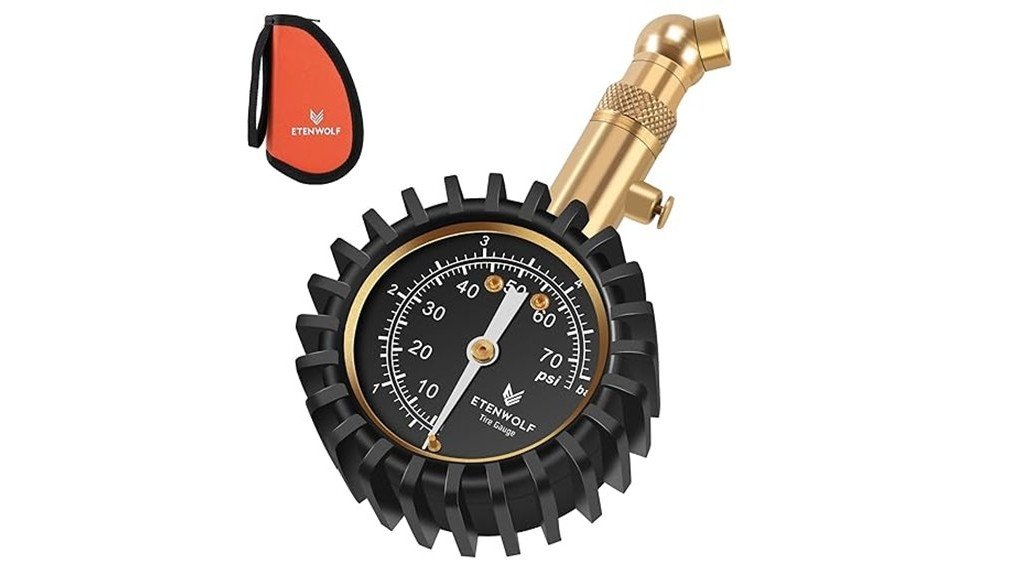
A tire gauge is only useful when you can read it clearly, connect it without fighting the valve stem, and trust the result. The ETENWOLF G200 Tire Pressure Gauge addresses those needs with a 0-75 PSI analog dial, glow-in-the-dark face, 360-degree swivel chuck, and a rubber-protected brass body. It is a strong fit for routine checks on cars, SUVs, motorcycles, pickups, and other tires that stay within its pressure range. The main tradeoff is simple: 75 PSI is enough for many everyday vehicles, but not for every heavy-duty, RV, spare, or high-pressure bicycle tire.
ETENWOLF G200 Specifications at a Glance
| Specification | Detail |
|---|---|
| Brand | ETENWOLF |
| Model | G200 |
| Product type | Analog dial tire pressure gauge |
| Pressure range | 0-75 PSI / 0-5 bar |
| Accuracy standard | ANSI/ASME B40.1 Grade A, manually calibrated |
| Chuck | 360-degree swivel chuck for Schrader valves |
| Display | Large analog glow dial |
| Materials | Brass and rubber |
| Dimensions | 4.76 × 2.83 × 1.38 inches |
| Weight | 285 grams |
| Included accessories | 4 valve caps, 4 Schrader valve cores, and storage bag |
| Best use | Routine pressure checks on tires requiring no more than 75 PSI |
What Is the ETENWOLF G200?
The ETENWOLF G200 is a battery-free mechanical tire pressure gauge. You press its swivel chuck onto a Schrader valve, wait for the needle to settle, and read the pressure on the dual PSI and bar scale. The gauge is designed to retain the reading until you release the trapped pressure and return the needle to zero.
Its main selling point is the combination of a broad everyday range and a more substantial build than a basic pencil gauge. The 0-75 PSI scale covers most passenger cars, many SUVs and pickups, motorcycles, ATVs, and some RV or bicycle applications. You still need to confirm the recommended pressure for each tire before relying on that range.
Key Takeaways
- The G200 is a manual analog gauge, so it needs no batteries and is ready whenever you need it.
- The large glow dial and 360-degree swivel chuck improve visibility and access around awkward valve positions.
- Its Grade A accuracy claim is most meaningful across the middle half of the scale, where the standard allows tighter error than at the outer quarters.
- The brass-and-rubber construction and included storage bag suit garage, glove-box, and roadside use.
- The 75 PSI ceiling and Schrader chuck are the main compatibility limits to check before buying.
Who Should Buy It?
Best For
- Drivers who prefer a battery-free analog gauge with a large dial
- Households checking several cars, SUVs, motorcycles, pickups, or ATVs
- Anyone who wants a compact gauge with spare valve caps, cores, and a storage bag
Skip If
- Your tires or spare require more than 75 PSI
- You want a backlit digital display or multiple digital units
- You need native Presta-valve support without an adapter
Before You Buy: Check the highest required pressure in your garage, including the spare tire. A gauge that tops out at 75 PSI is not the right choice for any tire whose recommended cold pressure is above that limit.
[Products Worth Considering]
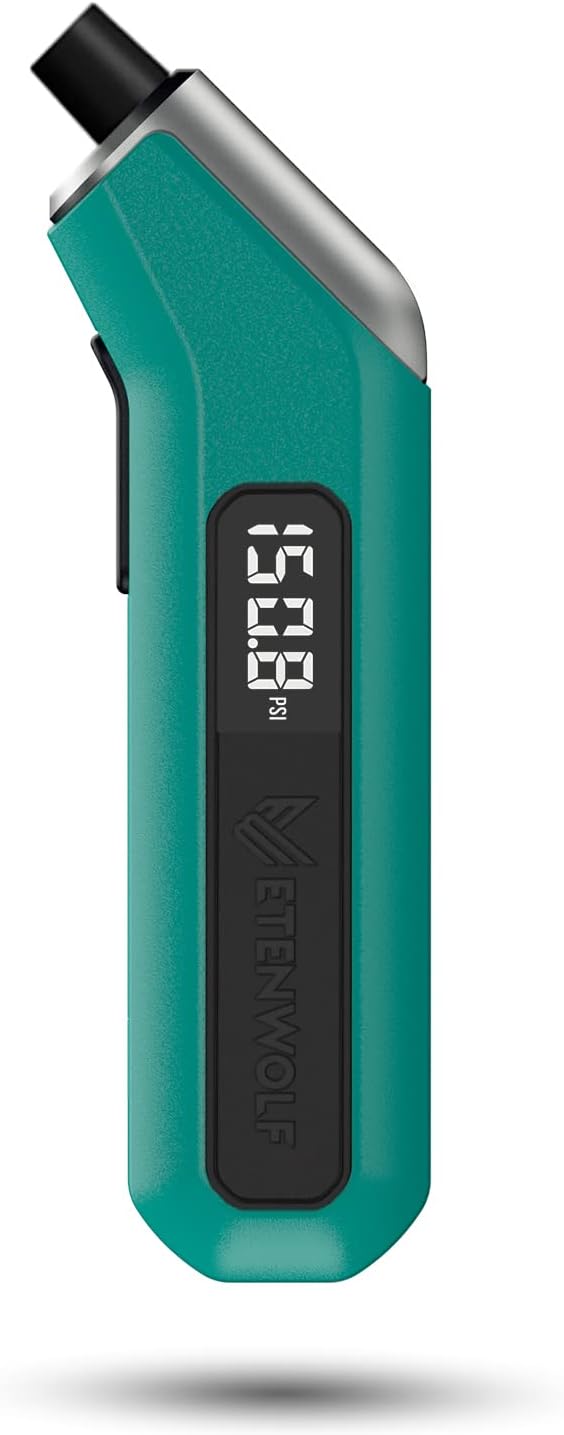
ETENWOLF T300 is a calibrated digital tire pressure gauge designed for reliable readings across low and high pressure ranges. It includes thermal compensation for stable performance in extreme cold or heat, an LED light for visibility, and an auto shut-off to help preserve battery life. Ideal for pickups, RVs, and heavy-duty vehicles, it delivers accurate PSI measurements with sturdy durability.

ETENWOLF’s calibrated tire pressure gauge delivers accurate readings for cars, trucks, motorcycles, bikes, SUVs, RVs, and ATVs across a 0–75 PSI range. The large glow dial improves visibility in low light, while the 360° swivel chuck makes it easy to check valve pressure from any angle. It’s designed to stay accurate even in extreme hot or cold weather.

ETENWOLF’s tire pressure gauge helps you quickly and accurately check tire PSI across cars, trucks, motorcycles, bikes, and more. It’s manually calibrated to ANSI B40.1 Grade A for reliable readings, includes a large glow dial for easy nighttime viewing, and features a 360-degree swivel chuck for use at any valve angle. The gauge also works consistently in extreme hot or cold weather.
Accuracy and Calibration Explained
ETENWOLF lists the G200 as manually calibrated to ANSI/ASME B40.1 Grade A. The listing summarizes that as plus or minus 1% of span, but the Grade A standard needs a little context. Grade A allows an error of up to 1% of full-scale span across the middle half of the dial and up to 2% across the lower and upper quarters.
On a 75 PSI gauge, 1% of span equals 0.75 PSI, while 2% equals 1.5 PSI. That makes the G200 especially well matched to common passenger-vehicle pressures that sit near the middle of its scale. Readings near zero or close to the 75 PSI maximum have a wider permitted error under the Grade A definition.
The gauge is not a user-calibration instrument in the usual sense. To watch for drift, compare it occasionally with a trusted reference gauge. If readings become inconsistent after a hard drop or the needle no longer returns to zero, stop relying on it until it has been checked or replaced.
Glow Dial and Swivel Chuck
The large dial is easier to read than a slim pencil gauge, especially when you are crouched beside a wheel. Its glow face helps in a dim garage or at night after it has been exposed to light. It does not provide the constant brightness of an electronic backlight, so visibility depends on how well the dial has been charged by ambient light.
The 360-degree swivel chuck is more than a cosmetic feature. You can rotate the connection to approach a valve from a comfortable angle rather than twisting your wrist around the wheel. This can be useful on motorcycles, recessed alloy wheels, dual-purpose vehicles, and tires with valve stems that point inward.
Pro Tip: Press the chuck straight and firmly onto the valve until the hissing stops. A brief hiss during connection is normal, but continuous leakage can lower the tire pressure and distort the reading.
Build Quality and What’s in the Box
The G200 uses brass and rubber rather than an all-plastic shell. The brass supports the gauge hardware, while the rubber cover adds grip and helps protect the dial from routine knocks. At 285 grams, it has enough weight to feel substantial without being too large for a glove box or small tool bag.
The package includes one gauge, four valve caps, four Schrader valve cores, and a storage bag. The bag keeps the dial and accessories together and limits contact with loose metal tools that could scratch the lens or strike the mechanism.
The extra valve parts are useful, but they should not be treated as universal replacements. Valve cores and TPMS service parts can vary by application. Use the correct core tool and confirm compatibility before servicing a valve stem, especially on TPMS-equipped wheels.
Fit and Vehicle Compatibility
The G200 directly fits standard Schrader valves, the common valve type used on cars, light trucks, SUVs, motorcycles, ATVs, and many bicycles. A bicycle with a Presta valve needs a separate adapter. The gauge itself does not inflate or deflate a tire to a preset value, so you will still need an air source and must release air separately when pressure is too high.
The 0-75 PSI range is suitable only when the vehicle’s specified pressure stays within that scale. Many passenger vehicles run well below the limit, but some heavy-duty pickups, RV tires, compact spare tires, trailers, and high-pressure road-bike tires may require a 100 PSI or 200 PSI gauge instead.
How It Performs in Real Use
For Monthly Tire Checks
The G200 is well suited to a monthly routine because it has no batteries to maintain. Check all tires when they are cold, compare the reading with the pressure on the driver’s door placard or in the owner’s manual, and include the spare when accessible. Do not use the maximum pressure molded on the tire sidewall as the vehicle’s target.
For Low-Light Roadside Checks
The glow dial can make an unexpected evening pressure check easier than using a non-illuminated pencil gauge. Keep a flashlight available because the dial must absorb light before it glows, and roadside safety should come before tire service. Move away from traffic and use a safe, level location whenever possible.
For Motorcycles and Tight Wheels
The rotating chuck helps you reach valve stems around brake hardware or narrow wheel openings. Its short, direct connection is compact, although riders with very crowded stems may still prefer a flexible-hose gauge.
For a Mixed Garage
One G200 can cover several vehicles when every required pressure is 75 PSI or lower and each uses a Schrader valve. The dual PSI and bar scale also helps when different manuals or equipment labels use different units. For a garage that includes heavy-duty or high-pressure tires, a wider-range gauge is the safer single-tool choice.
How to Use It Correctly
- Check the vehicle placard or owner’s manual for the recommended cold tire pressure.
- Measure when the tires are cold, ideally before driving or after the vehicle has been parked for at least three hours.
- Remove the valve cap and inspect the stem for visible damage or debris.
- Place the swivel chuck squarely over the Schrader valve and press until air stops hissing.
- Read the needle at eye level and compare it with the vehicle specification.
- Add or release air as needed, then measure again.
- After the final reading, release the pressure trapped in the gauge so the needle returns to zero.
- Replace the valve cap and store the gauge in its bag.
For broader tire-safety guidance, review the NHTSA TireWise recommendations, including monthly cold-pressure checks and use of the vehicle manufacturer’s placard pressure.
Compatibility and Safety
The G200 measures pressure at the valve stem and does not interfere with a functioning TPMS sensor during a normal check. It also does not replace TPMS. A dashboard warning may appear only after a tire becomes significantly underinflated, so a separate manual check remains useful.
A pressure gauge cannot diagnose tire damage. Stop and inspect the tire if you see a bulge, cut, exposed cord, cracked valve stem, repeated air loss, or a pressure difference that returns soon after adjustment. Seek professional tire service when the cause is unclear.
Do not attempt to measure beyond the gauge’s 75 PSI range. Avoid striking the gauge, exposing it to fluids, or storing it with pressure trapped in the mechanism. Follow the product instructions and your vehicle or tire manufacturer’s guidance.
Pros and Cons
Pros
- Grade A analog accuracy is well suited to common passenger-vehicle pressure ranges
- Large glow dial is easier to read than a basic pencil gauge
- 360-degree swivel chuck improves access to awkward valve stems
- Battery-free design is ready for garage or roadside use
- Brass-and-rubber construction includes a storage bag and spare valve parts
Cons
- 75 PSI maximum excludes some heavy-duty, spare, RV, trailer, and bicycle tires
- Glow dial is not as bright or consistent as a powered backlight
- Schrader-only chuck needs an adapter for Presta valves
Is It Worth the Price?
The G200 sits in the budget-to-mid-range part of the manual gauge market. Its value comes from the Grade A specification, large dial, swivel chuck, protective rubber body, and included storage accessories rather than digital features.
It is a smart buy for everyday use when your tires stay under 75 PSI and you want a mechanical tool that can remain in the vehicle without battery concerns. It is not the best fit if one wider-range gauge must cover heavy-duty vehicles, high-pressure spares, trailers, or road bicycles.
[Products Worth Considering]

AstroAI’s tire pressure gauge with inflator helps you check and adjust car tire pressure accurately for safer, smoother driving. It offers 3-in-1 operation to inflate, deflate, or measure pressure, with an easy-to-read 2.5-inch glow dial and a heavy-duty air chuck for convenient use. Universal compatibility supports Schrader-valve tires and quick-connect 1/4" NPT air compressors for quick maintenance.

Keep your tires properly inflated with this analog VONDIOR tire pressure gauge, designed for fast, easy readings without batteries. The swiveling, two-axis hose and large glow dial help you measure at any tire angle with instant visibility. Built with a protective rubber shield, it supports durable, low-maintenance use for cars and trucks.

Get precise tire readings with the ETENWOLF T300 Plus digital gauge, calibrated to ANSI B40.7 Grade 2A for reliable accuracy. It measures across a wide 3–200 PSI range and includes thermal compensation for dependable performance from extreme cold to heat. The bright LED display, LED illumination, and replaceable AAA batteries make it easy to check pressures quickly, even in low light.
How It Compares to Alternatives
The ETENWOLF G200 Pro is the closer analog alternative if you want a 0-100 PSI scale. The ETENWOLF T300 digital gauge extends to 200 PSI and offers a digital display, making it more suitable for a wider pressure range. A JACO ElitePro 100 PSI gauge is another analog option worth comparing when you want a wider scale.
The standard G200 makes the most sense when you value a compact direct chuck, glow dial, and 75 PSI scale over a flexible hose or a high-pressure digital readout.
[Products Worth Considering]

This tire inflator with pressure gauge delivers long-lasting performance with a durable rubber-protected gauge and sturdy build. The longer hose and 360 swivel air chuck help you seal the valve securely and keep your hands free while measuring, inflating, or deflating. It’s battery-free for reliable use and provides ±2 PSI accuracy in the mid-range for most typical tires, with universal compatibility for 1/4 NPT compressor outputs.

ETENWOLF T300 is a calibrated digital tire pressure gauge for accurate readings from 3 to 200 PSI across light and heavy-duty vehicles. It includes thermal compensation for reliable performance in extreme cold or heat, with an auto shut-off to extend battery life and an LED for easier reading. The sturdy design supports rugged everyday use, making it ideal for pickups, RVs, and industrial applications.

The ETENWOLF T500 digital tire pressure gauge with inflator delivers accurate readings across a wide 0–250 PSI range, calibrated to ANSI B40.7 Grade 2A. An all-in-one tool combines gauge, air chuck, hose, inflating and controlled bleed for checking, inflating, and deflating tires on many vehicle types. It’s built for reliable use in extreme temperatures and features an illuminated backlit display with replaceable AAA batteries for convenient operation.
Frequently Asked Questions
Is the ETENWOLF G200 accurate across the full 0-75 PSI range?
It is rated to ANSI/ASME B40.1 Grade A. That grade permits up to 1% of span error across the middle half of the scale and up to 2% across the first and last quarters, so the accuracy allowance is not identical at every point on the dial.
Does it work with TPMS-equipped tires?
Yes. A normal pressure check at the Schrader valve does not disturb the TPMS sensor. Use caution with the included replacement cores because TPMS valve service parts are not universal.
Can it measure bicycle tires?
It can measure a bicycle tire with a Schrader valve when the required pressure is 75 PSI or lower. A Presta valve needs an adapter, and many road-bike tires exceed the gauge’s range.
Does the gauge hold the reading?
Yes, the mechanical reading remains visible after you remove the chuck. Release the trapped pressure after use so the needle returns to zero before storage.
How should you store the G200?
Return the needle to zero, place the gauge in its storage bag, and keep it dry. Avoid heavy impacts, loose tools pressing against the dial, and long-term storage with pressure trapped in the mechanism.
How often should you check tire pressure?
Check at least once a month and before long trips, using cold tires whenever possible. Also check after a major temperature change, pothole impact, or repeated TPMS warning.
Who should choose a different gauge?
Choose another model when you need more than 75 PSI, native Presta support, a flexible hose, or a powered backlit display. A 100 PSI or 200 PSI gauge gives more range for mixed heavy-duty equipment.
The Bottom Line
The ETENWOLF G200 is a strong choice for drivers who want an accurate, readable, battery-free gauge for tires within a 0-75 PSI range. Its best features are the large glow dial, swivel chuck, and sturdy brass-and-rubber build, while its main limitation is the pressure ceiling. Skip it when your garage includes tires above 75 PSI or when you need native Presta compatibility.