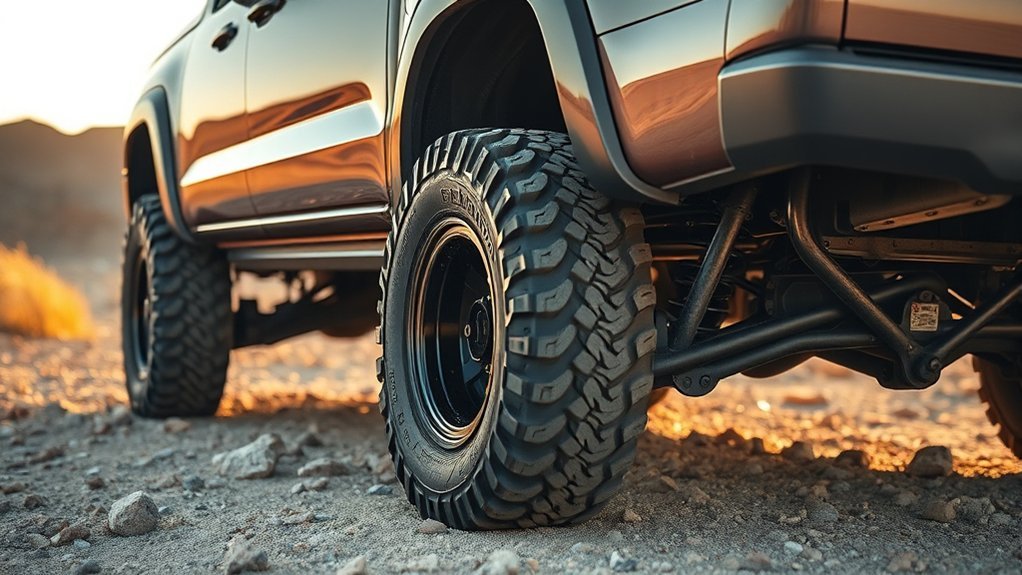
Yes, you may be able to fit bigger tires without a lift kit, but there is no universal size increase that works on every vehicle. Safe fitment depends on the exact tire dimensions, wheel width and offset, steering travel, suspension movement, brake clearance, and the vehicle manufacturer’s tire requirements. Start with the tire placard and owner’s manual, then measure and test the complete wheel-and-tire package before driving on it.
Quick Answer
You can sometimes fit bigger tires without a lift if the tire and wheel remain compatible with your vehicle and clear the body, suspension, brakes, and steering throughout their full range of movement. Do not rely on a universal one-inch, two-inch, or 33-inch rule; verify the exact vehicle, wheel, and tire combination.
Key Takeaways
- Start with the factory tire placard and owner’s manual before considering a different size.
- Overall diameter is only one part of fitment; section width, actual mounted dimensions, wheel width, offset, and suspension travel also matter.
- A tire that clears while parked can still rub at full steering lock, during braking, over bumps, or when the vehicle is loaded.
- Keep the required load index and speed rating and use a wheel width approved for the tire.
- A larger rolling diameter can change speedometer and odometer readings and may affect systems that rely on wheel-speed information.
- A lift is appropriate only when the desired combination cannot maintain safe clearance and geometry at stock height; tire diameter alone does not determine the answer.
At a Glance
| Time Required | About 15–30 minutes for preliminary measurements; longer if professional test-fitting or alignment is required |
| Difficulty | Moderate |
| Tools Needed | Tape measure, straightedge, flashlight, tire specifications, wheel specifications, and access to the vehicle tire placard/owner’s manual |
| Cost | Preliminary measuring costs nothing; professional mounting, test-fitting, calibration, and alignment costs vary by vehicle and shop |
Can You Fit Bigger Tires Without a Lift Kit?
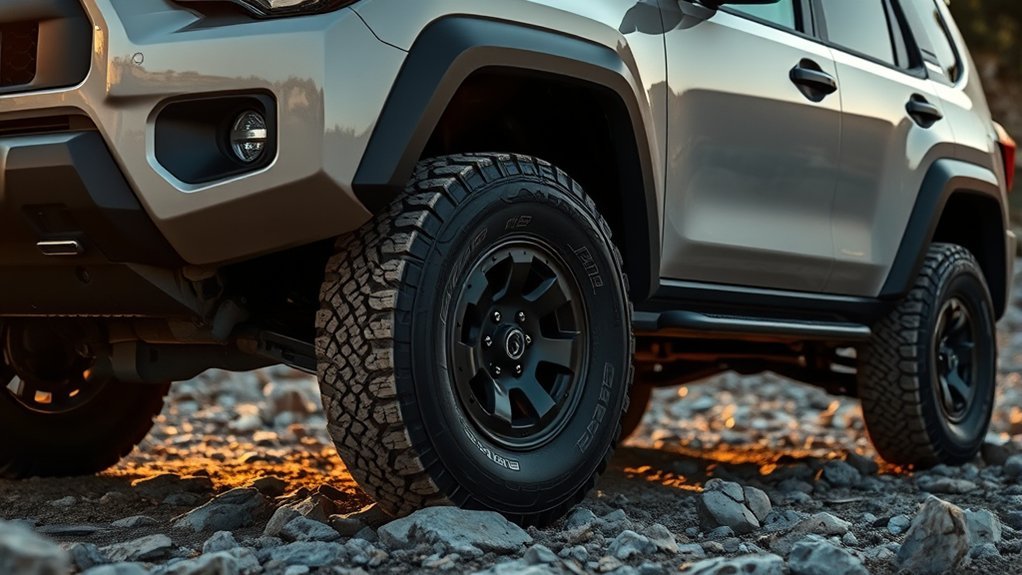
Yes, you can fit bigger tires without a lift kit on some vehicles, but the usable size depends on much more than visible wheel well clearance. Suspension geometry, steering travel, brake clearance, wheel width, wheel offset, tire construction, and actual mounted dimensions all affect the result.
A tire fits only when the complete wheel-and-tire package clears the vehicle through steering, suspension movement, and normal loading—not simply when it clears the fender while parked.
Before changing size, check the factory tire information placard and owner’s manual. The National Highway Traffic Safety Administration advises using the original tire size or another size recommended by the vehicle manufacturer.
You should also verify the replacement tire’s service description. The U.S. Tire Manufacturers Association advises that replacement tires use the size, load index, and speed-rating designation recommended by the vehicle or tire manufacturer.
Tire width matters as much as height. A wider sidewall can move closer to the strut, control arm, sway bar, frame, or outer fender even when the overall diameter seems reasonable.
Wheel offset also changes where that width sits. Lower positive offset generally moves the wheel farther outward, which may create more inner suspension clearance but less fender clearance. More positive offset generally places the wheel farther inward.
Do not treat offset as a universal cure. Moving the tire outward can change scrub radius, steering feel, bearing loads, and fender clearance. The complete combination should be checked rather than adjusting one measurement in isolation.
Warning: Do not remove suspension springs, grind suspension components, relocate brake hoses, or cut structural body parts simply to make a tire fit unless the work is being designed and performed by a qualified professional. Suspension springs can store dangerous energy, and interference with steering or brake components can create a serious safety hazard.
How Much Tire Clearance Do You Have?
Before choosing a larger tire, measure the space around the current tire and identify the closest points at the fender, liner, strut, upper control arm, sway bar, frame, brake components, and any wiring or hoses.
Static clearance is only the first check. The tire also moves as you steer, brake, corner, hit bumps, carry passengers or cargo, and compress the suspension.
There is no universal 3 mm, 5 mm, or 10 mm clearance number that guarantees a larger tire will not rub. The required margin depends on the vehicle’s suspension path, tire deflection, alignment, wheel offset, and intended use.
Measuring Wheel Well Space
Park on level ground with the tires correctly inflated. Measure the closest gaps between the current tire and the inner liner, fender edge, suspension components, and frame.
Turn the steering from straight ahead to full lock in both directions and repeat the measurements. Pay particular attention to the rear of the front wheel opening because many vehicles lose clearance there as the wheel turns.
Measure lateral space as well as vertical space. A tire can gain only a small amount of overall diameter yet become much wider at the sidewall.
Compare both front sides because production tolerances, alignment, previous repairs, and body position can create small differences.
Write down the measurements and compare them with the tire manufacturer’s published dimensions rather than relying only on the size molded into the sidewall.
Pro Tip: Use the tire manufacturer’s actual specification for overall diameter and section width whenever possible. Two tires carrying the same nominal size can have slightly different measured dimensions because tread design, construction, and approved measuring-rim width differ.
Checking Suspension Clearance
After the basic wheel-well measurements, verify how the tire behaves through steering and suspension movement.
A parked vehicle does not reproduce full bump travel, body roll, braking dive, or off-road articulation. If your planned tire sits close to any body or suspension component, have a qualified tire or suspension shop perform a loaded clearance check or test-fit the proposed combination.
The front axle deserves the closest inspection because steering changes the tire’s path through the wheel opening.
Check for contact near:
- Upper control arms and ball-joint areas
- Struts and coil springs
- Sway bars and links
- Frame rails
- Brake hoses and ABS wiring
- Inner liners and mud flaps
- Fender lips and bumper edges
After installation, recheck the area for polished spots, rubber marks, damaged liners, or unusual steering resistance.
Check the Factory Tire Placard First
The factory tire placard is usually on the driver’s door or door pillar. It identifies the original tire size and recommended cold inflation pressure for the vehicle configuration.
NHTSA notes that this information helps owners choose the correct replacement tire size and inflation pressure.
If your manufacturer lists an optional larger size for the same model or trim, that documented combination is a much stronger starting point than an arbitrary internet recommendation.
Do not assume that a tire with a higher maximum sidewall pressure should be inflated to that number. The correct operating pressure depends on the vehicle, tire size, load requirements, and manufacturer guidance.
How to Check Load Index, Speed Rating, and Rim Width
A larger tire is not automatically an acceptable replacement merely because it physically fits.
The service description after the tire size identifies its load index and speed rating. Michelin explains that these ratings define the tire’s load-carrying and speed capabilities under specified conditions.
Compare the planned replacement with the vehicle manufacturer’s requirements and do not reduce required load capacity simply to gain a preferred tire size.
You must also verify the tire manufacturer’s approved rim-width range. Each tire size is designed to mount on a specific range of wheel widths. An 8-inch or 8.5-inch wheel is not automatically correct for every wider tire.
Note: The wheel diameter in the tire size must match the wheel’s bead-seat diameter. For example, an R17 tire requires a 17-inch wheel. Wheel diameter itself does not determine the tire’s total outside diameter.
What Bigger Tires Fit a Stock Suspension?
There is no reliable universal answer because the maximum usable tire size is specific to the vehicle, wheel, tire model, suspension, alignment, and intended use.
Start with the stock tire size, then compare the exact proposed tire’s published diameter and width with the factory setup.
Do not assume that adding one or two inches of overall diameter is safe just because the wheel well appears large. A smaller change can rub on one vehicle while a larger change may be documented and approved on another.
If two possible sizes are close, the narrower option often creates more lateral clearance, but it still needs to satisfy rim-width, load, speed-rating, and manufacturer requirements.
Sidewall shape also matters. The same nominal section width may measure differently on different approved wheel widths.
[Products Worth Considering]

Steelman white tire marking crayons provide high-contrast, semi-permanent marks for repairing and inspecting tires and equipment. They write on wet or dry, smooth or coarse surfaces including rubber, metal, glass, and wood, making them ideal for puncture location and damage outlining. The lead- and zinc-free crayons resist weather and fading yet wipe away when you no longer need the marks.

Replace worn or missing TPMS sensors with a pre-programmed 4-pack designed for compatible GM vehicles. These 315MHz sensors provide real-time tire pressure monitoring and alert you if pressure is too high, too low, or if a rapid air leak occurs. Most installations are ready with minimal relearn effort after mounting, helping improve safety and driving confidence.

This universal wheel alignment tool helps you accurately restore tire tilt angles after tire or suspension repairs using an adjustable camber gauge. It features a powerful magnetic base that firmly attaches to brake rotors for stationary, slip-free readings, improving consistency during measurement. Built from durable PC plastic, it resists wear and corrosion and is compact enough for car, truck, RV, and motorcycle alignment tasks.
How Do You Calculate Tire Diameter?
For a common metric tire size such as 265/70R17, you can estimate unloaded overall diameter from the dimensions in the size code:
Estimated diameter in inches = wheel diameter + 2 × (section width × aspect ratio ÷ 100 ÷ 25.4)
For 265/70R17:
- Sidewall height = 265 × 0.70 = 185.5 mm.
- Convert the sidewall to inches: 185.5 ÷ 25.4 ≈ 7.30 inches.
- Double the sidewall height: 7.30 × 2 ≈ 14.60 inches.
- Add the 17-inch wheel: approximately 31.6 inches.
This calculation is useful for comparison, but it is only an estimate. For final fitment, use the tire manufacturer’s listed overall diameter, section width, approved rim range, and revolutions-per-mile data when available.
How Do Bigger Tires Affect Handling and Speedometer Readings?
Changing from the factory tire package can alter steering response, acceleration, braking feel, ride quality, gearing, and fuel use. The amount of change depends on the actual tire construction, tread, weight, rolling resistance, diameter, and wheel package.
A taller rolling diameter travels farther with each wheel revolution. If the vehicle remains calibrated for the smaller original diameter, the speedometer may indicate a lower speed than the vehicle’s true road speed. Continental also warns that incorrectly matched tire dimensions can affect speedometer accuracy.
- Steering: a heavier or wider package may change steering effort and response.
- Braking: extra rotating mass and a larger effective radius can change braking performance, while tire grip also plays a major role.
- Acceleration: a taller effective gear ratio can reduce initial acceleration.
- Ride: sidewall height, tire construction, wheel weight, and pressure can all affect comfort.
- Speedometer and odometer: a different rolling diameter changes wheel revolutions per mile.
Keep inflation pressure consistent with approved vehicle/tire guidance. Underinflation adds heat and deflection and can worsen handling and tire wear.
Bigger does not automatically mean better or worse; the complete tire and wheel package changes several mechanical variables at the same time.
How to Calculate Speedometer Error
You can estimate the effect of a diameter change with this formula:
Actual speed ≈ indicated speed × new tire diameter ÷ original tire diameter
For example, if an original tire measures 31 inches and the new tire measures 33 inches:
60 mph indicated × 33 ÷ 31 ≈ 63.9 mph actual
The real result can differ slightly because loaded rolling radius, tread wear, inflation pressure, and manufacturer calibration also affect revolutions per mile.
Can Bigger Tires Affect ABS, Traction Control, and Stability Control?
Potentially. Modern vehicles use wheel-speed data for systems such as the anti-lock braking system, traction control, stability control, transmission logic, and speed calculations.
A meaningful change in rolling diameter can alter the relationship between wheel speed and road speed. Some vehicles can be recalibrated for an approved alternate tire size; others have more limited adjustment options.
If your vehicle has advanced four-wheel-drive, stability-control, or driver-assistance systems, check the service information or ask the manufacturer or a qualified technician whether the proposed tire diameter requires recalibration.
Why Do Bigger Tires Rub After an Upgrade?
Bigger tires rub when their added diameter, width, sidewall shape, or changed wheel position reduces the clearance around the body or suspension.
| Cause | Typical Result |
|---|---|
| Larger overall diameter | Reduced room at liners, bumper edges, or wheel arches during steering and compression |
| Greater section width | Less clearance to control arms, struts, liners, or fenders |
| Different wheel offset | Moves the tire inward or outward and changes which component becomes the limiting point |
| Suspension compression or body roll | A tire that clears while parked may contact surrounding parts while driving |
| Alignment changes | Changes the tire’s position and travel path inside the wheel opening |
Your suspension geometry is dynamic. As the wheel moves up, down, and through the steering arc, the tire does not remain in the same place relative to the surrounding components.
That is why a tire can pass a parking-lot check yet rub during a sharp turn, driveway transition, hard braking event, or loaded trip.
What Wheel Size and Offset Work Best?
The correct wheel must satisfy several requirements at once: wheel diameter, approved tire rim-width range, brake clearance, bolt pattern, center-bore requirements, load rating, and offset.
A larger-diameter wheel can allow a lower-profile tire, but it does not create extra outer-tire clearance if the overall tire diameter and width remain unchanged.
Offset and backspacing determine where the wheel and tire sit relative to the hub, suspension, and fender.
[Products Worth Considering]

Malco tire mounting and demounting lubricant is a ready-to-use tire lube formulated to reduce friction during tire installation for passenger cars, light trucks, farm tires, and heavy-duty equipment. It provides rust-inhibiting protection to help reduce corrosion on rims and wheels, and helps support proper tire bead seating during inflation to reduce air leakage. The silicone-free, soap-free formula is whitewall safe to help prevent discoloration on whitewall tires and sensitive sidewall markings.

The VEHLIVE SU-50448 II TPMS relearn tool provides a fast activation reset to restore accurate tire pressure monitoring after sensor replacement or tire rotation. It supports 315 MHz and 433 MHz GM series sensors and helps clear dashboard pressure warnings. With simple two-button operation and horn-confirmed relearning order, you can reprogram sensors conveniently at home.

Autel MX TPMS sensors combine 315MHz and 433MHz in a single easy-to-install press-in design for faster tire service. They support wireless programming with strong signal performance, and the sensors are clone-able for streamlined replacement. Built for reliability and tested to SAE standards, each sensor includes a series number for quality control.
Wheel Diameter Basics
The wheel diameter must match the tire’s bead-seat diameter. A tire marked R17 mounts on a 17-inch wheel; an R18 tire mounts on an 18-inch wheel.
Within that requirement, the tire manufacturer specifies an approved wheel-width range. Staying within that range helps the tire maintain its intended bead seating and shape.
- Confirm the wheel diameter required by the tire size.
- Confirm that wheel width is within the tire manufacturer’s approved range.
- Confirm wheel load capacity and vehicle fitment.
- Check brake-caliper clearance.
- Verify full-lock and suspension clearance after mounting.
A larger wheel with a shorter sidewall may sharpen steering response but can also reduce impact compliance. Choose the package for the vehicle’s intended use rather than wheel diameter alone.
Offset and Backspacing
Wheel offset is the relationship between the wheel’s mounting surface and its centerline. It changes how far the complete wheel-and-tire assembly sits inward or outward.
Reducing positive offset generally moves the tire outward. That can improve clearance to an upper control arm or strut, but it can reduce clearance at the fender and can alter steering geometry.
Increasing positive offset generally moves the tire farther inward, which may improve outer-fender coverage while reducing suspension clearance.
Backspacing describes the distance from the mounting surface to the wheel’s inner edge. More backspacing generally places more of the wheel inward.
Do not select offset solely to eliminate one rub point. The goal is to keep acceptable clearance on both sides while maintaining the wheel specifications appropriate for the vehicle.
Inner Clearance Checks
Before sizing up, check inner clearance at the strut, spring, upper control arm, sway bar, frame rail, brake components, and wiring.
Measure with the steering in several positions rather than only straight ahead.
- Use a straightedge or measuring tool to identify the closest inner component.
- Compare the proposed tire’s actual section width with the current tire.
- Account for the wheel-width and offset change.
- Test-fit the complete package if calculations show limited clearance.
- Recheck after alignment and after the first drive.
There is no universal minimum clearance figure that works on every chassis. Leave enough margin for tire deflection, wheel movement, suspension travel, and normal production variation.
Do Wheel Spacers Help Fit Bigger Tires?
A spacer moves the wheel outward, so it can increase clearance between the tire and some inner suspension parts. However, it simultaneously reduces outer-fender clearance and changes the wheel’s effective offset.
That means a spacer can move a rubbing problem rather than solve it.
If spacers are considered, verify legal requirements, hub and stud compatibility, fastener engagement, wheel seating, torque procedures, and the vehicle manufacturer’s guidance. Do not use spacers as a substitute for confirming correct wheel fitment.
[Products Worth Considering]

The Ziopetru adjustable magnetic wheel alignment tool helps you check and restore camber and caster positioning after removing and reinstalling undercarriage components. With a clear leveling/bubble measurement system and an easy zeroing adjustment knob, it supports precise horizontal angle checking. The strong magnetic base mounts to metal surfaces for convenient use at home on cars, motorcycles, trucks, vans, and SUVs.

The 22800 wheel stud installer makes replacing wheel studs quick and secure, saving time and effort during tire service. It uses a ratchet or impact wrench to pull new studs firmly into place, helping when existing studs are too long. Compatible with most automotive wheels and light-duty truck wheel studs, it’s designed for easy, tool-assisted installation.

Secure a full-size spare on your trailer with this powder-coated steel spare tire mount bracket. It fits most 4-, 5-, and 6-lug wheel bolt patterns and mounts to trailer tongues up to 4 in wide and 5 in tall. Built for reliable carry with a max 150 lb load rating and includes zinc-plated hardware for straightforward installation.
How Can You Fit Bigger Tires Without a Lift?
You can improve your chances of fitting a larger tire at stock ride height by controlling tire diameter, section width, wheel width, and offset while keeping the complete package within the vehicle’s mechanical and load requirements.
| Check | What to Verify | Goal |
|---|---|---|
| Vehicle placard | Original or manufacturer-approved tire sizes and pressure guidance | Establish the correct baseline |
| Load and speed rating | Required service description | Maintain required tire capability |
| Fender and liner clearance | Full steering and suspension movement | No damaging contact |
| Inner clearance | Struts, control arms, frame, hoses, and wiring | Maintain safe separation |
| Wheel width | Tire manufacturer’s approved rim-width range | Correct tire-to-wheel fit |
| Wheel offset | Inner and outer tire position | Avoid shifting the rub point |
| Rolling diameter | Speedometer and vehicle-system compatibility | Avoid calibration problems |
If extra room is needed, a narrower tire or a documented wheel/tire combination is generally preferable to forcing clearance through extreme alignment settings or structural cutting.
Minor nonstructural liner contact may sometimes be addressed on vehicle-specific builds, but never trim or relocate brake, steering, suspension, electrical, or structural components merely to clear a tire.
Step-by-Step Bigger-Tire Fitment Check
- Read the tire placard and owner’s manual. Record the original size, cold inflation pressure, and any approved optional sizes.
- Record your current wheel specifications. Note wheel diameter, width, offset, and any existing spacers.
- Choose a candidate tire. Confirm its load index, speed rating, approved rim-width range, published overall diameter, and section width.
- Compare dimensions. Calculate the diameter and width changes rather than looking only at the sidewall size code.
- Measure static clearance. Check the fender, liner, strut, control arm, sway bar, frame, brake components, and wiring.
- Check steering clearance. Turn from lock to lock and inspect both front wheel openings.
- Consider dynamic movement. If the proposed combination is close anywhere, arrange a professional loaded/full-travel clearance check.
- Test-fit one front assembly when practical. The front usually presents the most demanding combination of steering and suspension movement.
- Verify electronics and calibration. Determine whether the diameter change affects speedometer calibration or vehicle systems.
- Install and align. Keep alignment within the manufacturer’s acceptable specifications.
- Inspect after driving. Look for rub marks, abnormal noises, steering interference, pressure loss, or uneven wear.
What About AWD, 4WD, and the Spare Tire?
AWD and some 4WD vehicles can be sensitive to differences in rolling circumference between tires. The acceptable difference varies by manufacturer and drivetrain design.
If your vehicle has an AWD or full-time 4WD system, follow its owner’s manual regarding tire matching, tread-depth differences, and replacement practices. Do not assume that one substantially different tire can be mixed with the remaining three.
Also check the spare. A substantially different rolling diameter may have restrictions when used temporarily, especially on vehicles with AWD or electronically controlled drivetrains.
If the new full-size tire will not fit in the factory spare location, plan for that before the upgrade rather than discovering it after a roadside puncture.
What About TPMS?
If you keep the original wheels, the existing tire-pressure monitoring sensors may remain usable if they are serviceable and compatible with the installation.
If you change wheels, make sure the wheels accept the correct sensor type and that the sensors can communicate with the vehicle. Some vehicles automatically learn replacement sensors, while others require a relearn or programming procedure.
TPMS does not replace manual pressure checks. Set inflation pressure according to approved vehicle and tire guidance for the chosen fitment.
When Is a Lift Kit the Better Choice?
A lift kit makes more sense when the desired tire and wheel package cannot maintain suitable clearance at stock ride height through steering and suspension movement, or when a documented vehicle-specific fitment requires additional ride height.
Lift-kit benefits can include additional body-to-tire clearance and improved off-road approach, breakover, or departure geometry, depending on the design.
There is no universal tire diameter—33 inches or otherwise—that automatically determines whether a lift is required.
A lift also does not fix every rubbing problem. Width, offset, control-arm clearance, caster, steering geometry, gearing, brake performance, and fender shape can still limit tire size.
- Choose a lift when verified tire clearance cannot be achieved safely at stock height.
- Use a system designed for your specific suspension architecture.
- Confirm that brake hoses, driveshaft angles, steering components, and electronic systems remain within their required operating range.
- Have the vehicle aligned after suspension-height changes.
- Recheck tire clearance after the lift is installed rather than assuming the new height guarantees fitment.
If you tow or carry heavy loads, remember that a lift does not increase the vehicle’s factory payload, axle, tire, or towing ratings unless the vehicle manufacturer specifically states otherwise.
Frequently Asked Questions
Will Bigger Tires Void My Vehicle Warranty?
Not automatically. The Federal Trade Commission explains that using aftermarket parts does not automatically cancel a vehicle warranty. However, warranty coverage for a particular repair can be affected when an aftermarket modification causes the failure or damage involved. Keep fitment records and check your written warranty terms.
Do Bigger Tires Reduce Fuel Economy?
They can. A heavier wheel-and-tire package, more aggressive tread, different rolling resistance, lower pressure, and a taller effective gear ratio can increase the energy needed to move the vehicle. The actual fuel-economy change varies by tire and vehicle, so a larger nominal size does not create the same MPG penalty in every case.
Can I Keep My Stock Wheels With Larger Tires?
Possibly. Check whether the larger tire is approved for your stock wheel width and whether its actual section width and diameter clear the suspension, steering, body, and brakes. The tire’s required wheel diameter must also match the stock wheel.
Will Bigger Tires Affect Braking Performance?
They can. Tire grip, rotating mass, overall diameter, tire construction, road surface, and brake-system capacity all affect stopping performance. A larger or heavier package may increase the work the brakes must do, but there is no single braking-distance change that applies to every tire upgrade.
How Often Should I Rotate Oversized Tires?
Follow your vehicle owner’s manual and tire manufacturer’s schedule first. As a general reference, Bridgestone gives a broad guideline of roughly 5,000–8,000 miles or about six months, while noting that the ideal interval depends on the vehicle and driving conditions. Rotate sooner if inspection shows irregular wear and the tire pattern allows rotation.
Can a Tire Fit While Parked but Rub While Driving?
Yes. Steering movement, braking dive, suspension compression, body roll, tire deflection, and vehicle load can reduce clearance while the vehicle is moving. That is why static parking-lot measurements are only the first part of a proper fitment check.
Do I Need an Alignment After Installing Bigger Tires?
An alignment check is wise if you changed suspension height, wheel offset significantly, steering components, or alignment settings, or if the vehicle pulls or develops irregular wear. Tire size alone does not automatically change alignment angles, but the complete modification should leave alignment within the vehicle manufacturer’s specifications.
Conclusion
You can fit bigger tires without a lift kit on some vehicles, but safe fitment is determined by the complete package rather than a universal tire-size rule. Start with the factory placard, confirm load and speed ratings, use an approved wheel width, compare actual tire dimensions, and check clearance through steering and suspension movement. Also account for speedometer calibration, electronic systems, AWD requirements, TPMS, and spare-tire compatibility. If the desired tire cannot maintain safe clearance at stock height, a properly engineered lift may be the better option.
Sources
- National Highway Traffic Safety Administration — TireWise — tire sizing, placard, inflation, and replacement-tire safety guidance.
- U.S. Tire Manufacturers Association — Replacing Tires — replacement size, load-index, and speed-rating guidance.
- Michelin — Tire Load Rating and Speed Rating — explanation of tire service-description ratings.
- Continental — Tire Size Guide — tire dimensions and effects of changing wheel-and-tire sizing.
- Federal Trade Commission — Auto Warranties and Auto Service Contracts — warranty guidance for aftermarket parts.
- Bridgestone — Tire Rotation — general tire-rotation interval guidance.