For a stock 2015 Hyundai Sonata, the correct highway tire pressure is the same pressure Hyundai specifies for normal driving: 34 PSI when cold at all four tires. Highway speed, passengers, or a desire for better fuel economy are not reasons to substitute 35 PSI front and 37 PSI rear. Always confirm the number on your own driver-door tire placard before adding air.
Quick Answer
For a stock 2015 Hyundai Sonata, set all four tires to 34 PSI when cold. Hyundai lists the same 34 PSI front and rear for the original 16-, 17-, and 18-inch tire sizes, even at maximum load. For another Sonata year or tire setup, follow the driver-door placard.
Key Takeaways
- The cited 2015 Hyundai Sonata specification is 34 PSI cold in the front and rear.
- Check the label on the driver-side door jamb because another model year, market, powertrain, or tire package may use a different value.
- Measure pressure after the car has been parked for at least three hours or driven less than one mile at moderate speed.
- Do not use the maximum pressure printed on the tire sidewall as the vehicle’s operating target.
- Do not bleed warm tires down to the cold specification after a highway drive.
At a Glance
| Time Required | About 10 minutes |
| Difficulty | Easy |
| Tools Needed | Accurate tire-pressure gauge and an air compressor or service-station air pump |
| Cost | No added cost if you already have a gauge and air source; equipment and station-air charges vary |
Warning: Do not inflate a Sonata to the maximum pressure molded on the tire sidewall. That number is a tire limit, not the pressure selected by Hyundai for the vehicle. Also stop driving if a tire is rapidly losing air, has a bulge, exposes reinforcing material, or is otherwise seriously damaged.
Recommended Hyundai Sonata PSI for Highway Driving
The 2015 Hyundai Sonata owner’s manual lists 34 PSI, or 235 kPa, at the front and rear for the original full-size tire combinations shown below. The specification is the same for normal and maximum load in that manual.
| Original Tire Size | Front, Cold | Rear, Cold |
|---|---|---|
| 205/65R16 | 34 PSI | 34 PSI |
| 215/55R17 | 34 PSI | 34 PSI |
| 235/45R18 | 34 PSI | 34 PSI |
Do not assume every Sonata uses this value. Specifications can differ by model year, country, Hybrid configuration, replacement tire size, or vehicle modification. Check the Tire and Loading Information label on the driver-side door jamb. You can also locate the correct manual through Hyundai’s manuals and warranties resource.
For a stock 2015 Sonata covered by Hyundai’s listed tire sizes, highway driving does not change the factory target: use 34 PSI cold at all four tires.
How to Check and Set PSI Before a Highway Trip
Check all four tires before a long drive, preferably in the morning. According to NHTSA TireWise, a cold tire is one that has not been driven for at least three hours. Hyundai also treats a tire as cold when the vehicle has been parked for at least three hours or driven less than one mile at moderate speed.
- Park on level ground. Wait until the tires are cold whenever possible.
- Read the driver-door placard. Confirm the exact front and rear values for your car.
- Remove the valve cap. Keep it somewhere clean so dirt does not enter the valve.
- Press the gauge squarely onto the valve. A brief hiss is normal, but a poor seal can produce a false reading.
- Add air when the reading is low. Inflate in short bursts and check again.
- Release a small amount if a cold tire is overfilled. Recheck until it matches the placard.
- Reinstall the valve cap. Repeat the process for every tire and the spare, if the car has one.
Pro Tip: Compare your handheld gauge with a trusted shop gauge occasionally. A gauge that consistently reads two or three PSI high or low can lead to incorrect inflation even when your procedure is otherwise sound.
If you must check after driving, record the warm readings but do not bleed each tire down to the cold specification. Driving heats the tires and raises pressure. Let the car cool before making the final adjustment.
Adjust Front and Rear PSI for Passengers or Cargo
Do not automatically increase the rear tires to 37 PSI when carrying passengers or luggage. The cited 2015 Sonata table lists the same 34-PSI front and rear pressure for normal and maximum load. Your first responsibility is to stay within the vehicle’s stated passenger and cargo capacity and follow its placard.
[Products Worth Considering]

The TYAMATE TM8 solar-powered wireless TPMS delivers real-time tire pressure and temperature monitoring with six alarm modes for safer driving. A vibrant color LCD display shows readings clearly while windshield mounting keeps it hands-free and easy to read. With a wide 0–87 PSI range, strong 433.92 MHz signal transmission, and quick sensor pairing, it’s ideal for RV, sedan, SUV, MPV, and truck use.

Milton S-921 pencil tire pressure gauge helps you maintain optimal tire pressure for passenger cars with accurate readings in PSI and kPa. It features a built-in deflator valve for convenient pressure adjustments, plus a single chuck head and nylon indicator bar for easy use on the go. Built from durable plated brass and designed for reliable performance, it’s a practical road trip and cold-weather maintenance tool.

Keep your tires properly inflated with this analog VONDIOR tire pressure gauge, designed for fast, easy readings without batteries. The swiveling, two-axis hose and large glow dial help you measure at any tire angle with instant visibility. Built with a protective rubber shield, it supports durable, low-maintenance use for cars and trucks.
Adjust for Passenger Load
Check the tires cold before loading the car for a trip. If the placard gives one pressure for normal use and another for a heavily loaded vehicle, use the applicable value. If it gives only one value, do not invent a higher pressure because the trunk is full.
- Confirm the cold pressure before loading.
- Check the payload information on the Tire and Loading Information label.
- Distribute cargo securely and avoid exceeding the vehicle’s capacity.
- Use the placard pressure unless Hyundai provides a separate loaded-vehicle value.
Match Pressure to the Vehicle Specification
Inflation pressure allows a tire to carry load, but the correct value depends on the complete vehicle-and-tire engineering package. That includes axle ratings, tire size, wheel capacity, suspension tuning, and handling requirements. The tire’s sidewall maximum does not replace this vehicle-specific calculation.
If you have installed a tire size that Hyundai did not approve for the vehicle, ask a qualified tire professional to determine whether the tire’s load capacity, wheel width, pressure requirement, clearances, and TPMS compatibility are suitable.
Do Not Set Pressure by Sidewall Appearance
Radial tires normally show some sidewall bulge where they meet the road. You cannot accurately judge inflation by looking at that bulge. Use a reliable gauge instead. If a correctly inflated rear tire appears distorted, rubs the body, or behaves abnormally under an allowed load, have the tire, wheel, and suspension inspected rather than adding pressure above the vehicle specification.
How Ambient Temperature Changes Tire Pressure
Tire pressure commonly changes by about 1 PSI for every 10°F change in ambient temperature. The U.S. Tire Manufacturers Association describes a typical change of about 1–2 PSI for each 10°F rise or fall.
For example, a tire set correctly during warm weather may read several PSI lower after a strong cold front. Add enough air to restore the cold placard pressure. Do not compensate by permanently setting the tires several PSI above the placard during warm weather.
Note: Pressure also rises as the tire warms during driving. A higher reading after a highway trip does not by itself mean the tire was overinflated when cold.
Check pressure at least monthly, before long trips, and during rapid seasonal temperature changes. If one tire repeatedly loses more air than the others, have it checked for a puncture, valve leak, bead leak, corrosion, or wheel damage.
Safety Trade-Offs of Higher PSI
Inflating above the vehicle specification may make the steering feel firmer, but steering feel alone does not prove that the car is safer or faster. Hyundai warns that overinflation can produce a harsher ride, increased center-tread wear, and greater vulnerability to road-hazard damage.
Correct pressure also supports fuel economy. FuelEconomy.gov advises drivers to use the pressure on the door-jamb label or in the owner’s manual and not the maximum pressure printed on the sidewall. The goal is to correct underinflation, not to chase a small rolling-resistance change by exceeding Hyundai’s target.
- At the placard pressure: The tire is operating at the vehicle manufacturer’s intended baseline for load, ride, wear, and handling.
- Below the placard pressure: Heat buildup, shoulder wear, sluggish response, and fuel use can increase.
- Above the placard pressure: Ride harshness, center wear, and impact-damage risk can increase.
- At the sidewall maximum: The tire is not necessarily at a suitable operating pressure for the Sonata.
Owner’s PSI vs. Personal Tuning
The vehicle placard is not merely a suggested range. It is the manufacturer’s cold-pressure specification for the original vehicle setup. Tire-pressure changes should not be treated like a casual suspension adjustment, especially for wet roads, emergency braking, potholes, or sustained highway use.
Follow Hyundai’s Recommendation First
For a stock 2015 Sonata using one of the listed original tire sizes, start and remain at 34 PSI cold front and rear. Confirm the figure on your own car because the door placard takes priority over a general online article.
- Check the pressure monthly and before long trips.
- Restore the placard value after a seasonal temperature drop.
- Do not lower warm tires to the cold target.
- Investigate recurring pressure loss instead of repeatedly topping off the tire.
When a Different Pressure May Be Appropriate
A different pressure may be necessary when the vehicle manufacturer specifies another value, when an approved alternate tire package has separate instructions, or when a properly engineered modification changes the required tire-and-wheel data. A professional recommendation should account for actual axle loads, tire load tables, wheel ratings, and vehicle behavior—not just a driver’s preference for firmer steering.
Track-use pressure adjustments are a separate subject and should not be carried over to public-road highway driving.
Signs Your Tires Need Rotation, Balancing, or Replacement
Pressure is only one part of tire safety. Inspect the tread and sidewalls when you check PSI. Uneven wear, vibration, pulling, or recurring pressure loss can point to a tire, wheel, alignment, steering, or suspension problem.
Replace a tire when tread reaches 2/32 inch, but do not wait for that limit when the tire has a bulge, exposed cord, serious cut, separation, or another unsafe condition.
- Uneven tread wear: Check pressure, rotation history, alignment, and suspension condition.
- Steering-wheel vibration at speed: Have the tire and wheel inspected for imbalance, damage, irregular wear, or a bent wheel.
- Vehicle pulls to one side: First confirm equal correct pressure, then have alignment, brakes, tires, and suspension checked.
- Center tread wears faster: Check for overinflation or an unsuitable pressure history.
- Both shoulders wear faster: Check for underinflation, overloading, or aggressive cornering.
- Bulge or exposed material: Stop using the tire and arrange professional service.
[Products Worth Considering]
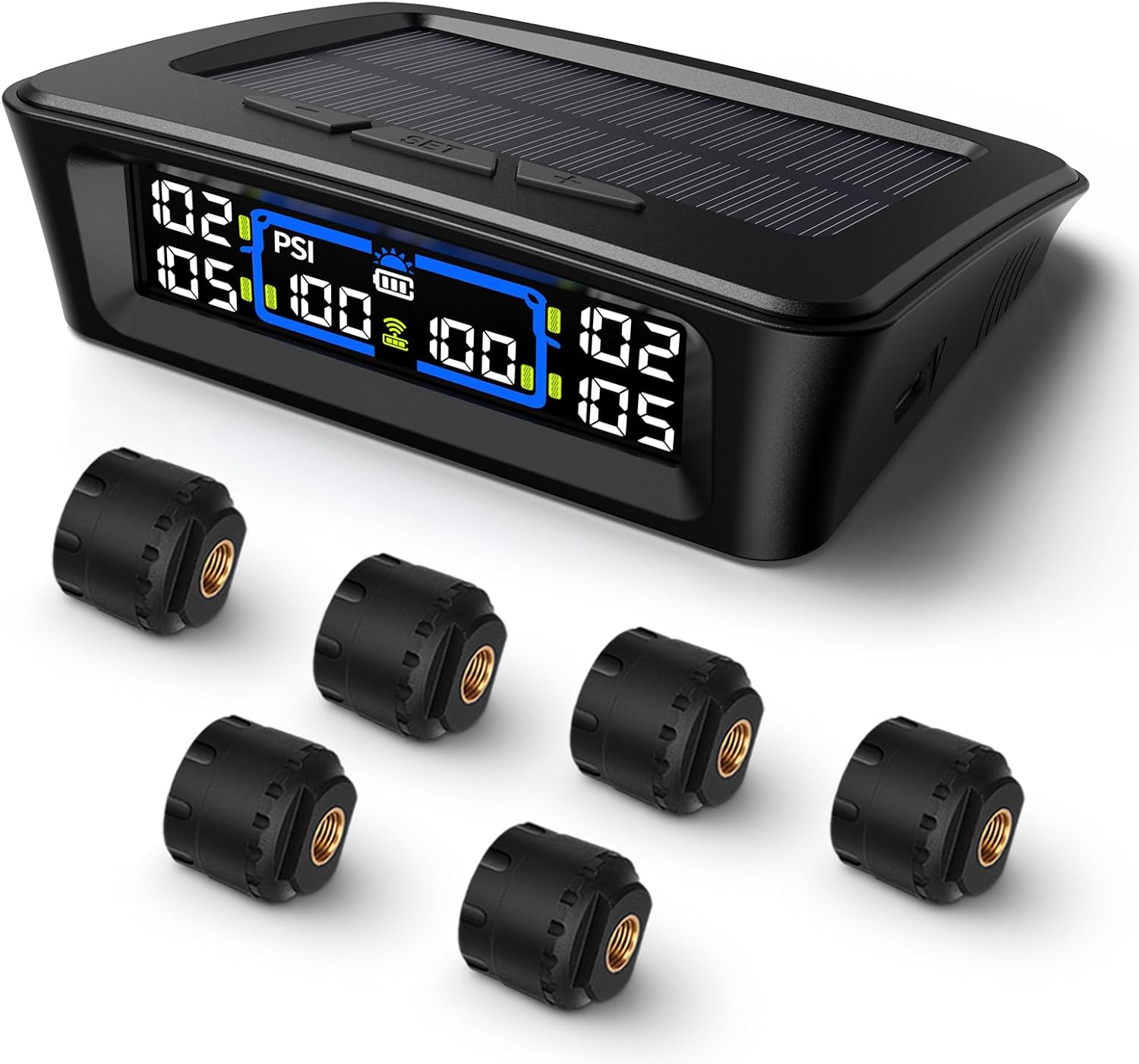
The Tymate TM12 RV TPMS delivers real-time tire pressure and temperature monitoring with a stable 433Hz display for safer long-distance driving. It supports simultaneous monitoring across vehicle and trailer zones, includes six alarm modes for pressure, temperature, leakage, battery, and signal loss, and features easy DIY installation with auto calibration. Power is supplied via USB-C charging or solar recharging, with a wide 0–144 PSI range and up to 50 ft signal coverage for RVs and towable trailers.

Accurately measure tire tread depth with a calibrated gauge marked from 0 to 1 inch in 1/32 inch increments. The color-coded bar helps you quickly identify tread condition ranges, supporting safe driving for trucks, motorcycles, automobiles, and passenger vehicles.

Upgrade your Toyota tire setup with these corrosion-resistant, leak-proof valve stem caps designed to help protect the valve core from water, snow, and road grime. The caps feature a snug rubber seal and durable copper alloy construction to resist rust and oxidation while maintaining stable tire pressure. Ideal for replacing worn original caps and keeping your wheels looking clean and stylish.
Quick Pre-Highway Tire-Pressure Checklist and Tools
Complete this check before a long highway trip:
- Read the cold-pressure specification on the driver-door placard.
- Measure all four tires with an accurate gauge.
- Set a stock 2015 Sonata covered by the cited manual to 34 PSI cold front and rear.
- Check the spare tire or tire-mobility kit, if equipped.
- Inspect the tread for uneven wear, embedded objects, and low tread depth.
- Inspect the sidewalls for cuts, cracks, scrapes, bulges, or exposed material.
- Confirm that valve caps are installed.
- Make sure the TPMS warning is off after the pressures are corrected.
- Carry a gauge and, when practical, a portable compressor.
Do not continue onto the highway when a tire is visibly damaged, rapidly losing pressure, or causing severe vibration. Have the vehicle inspected before driving at sustained speed.
[Products Worth Considering]

The SAFELIFE dial tire tread depth gauge measures tread depth in 1/32 inch increments with clear, easy-to-read 2-inch dial face. Color zones using a traffic light system help you quickly judge whether tread is low, marginal, or ample for safer driving. Built with a durable zinc cast body and a metal detect probe for precise, comfortable use across cars, motorcycles, trucks, and buses.

Monitor tire tread wear with a smart, color-coded depth gauge that shows clear condition ranges at a glance. The bar is range marked for fast, easy readings, helping you maintain safer traction and performance. Each gauge is portable with a pocket clip, and the set includes 20 units for daily use and sharing.

Measure tire tread depth quickly and accurately with this LUMITECO dial gauge that reads in 1/32" increments up to 14/32". The color-coded green/yellow/red zones make it easy to judge tire wear and know when replacement is needed. A rugged, compact design with a protective pouch helps keep the gauge ready for use on cars, trucks, motorcycles, and more.
Frequently Asked Questions
Can winter tires require a different highway PSI than all-season tires?
Not automatically. Maintain winter tires at the vehicle’s recommended cold pressure unless Hyundai or the tire manufacturer provides a different instruction for the exact fitment. Cold weather lowers the measured pressure, so winter tires may need air more often even though the target itself has not changed.
How does tire pressure affect the Sonata’s adaptive cruise control?
Correct tire pressure supports predictable ride height, handling, and braking, but adding air is not a radar-calibration procedure. Severe underinflation or an abnormal vehicle stance may contribute to driver-assistance limitations. A persistent Smart Cruise Control warning should be diagnosed according to the owner’s manual.
Can overinflation improve fuel economy on long drives?
Increasing pressure above the vehicle specification may slightly reduce rolling resistance, but it can also worsen ride quality, tread wear, and resistance to impact damage. The safe approach is to correct underinflation and maintain the placard pressure.
Should I change PSI after installing larger alloy wheels?
Not solely because the wheel diameter increased. Hyundai’s cited 2015 specification lists 34 PSI for its original 16-, 17-, and 18-inch combinations. If the new wheel-and-tire package is not an original approved size, obtain a pressure recommendation based on tire load capacity, actual axle loads, wheel ratings, and vehicle compatibility.
Does the Tire Pressure Monitoring System need recalibration?
Correcting ordinary tire pressure usually does not require sensor-ID programming. After the pressure is corrected or the original repaired wheel is reinstalled, the warning may take a few minutes of driving to clear. Replacing a sensor or installing incompatible wheels may require registration or diagnosis with suitable service equipment.
Why is the tire pressure higher after highway driving?
The tire flexes and warms while driving, causing its internal pressure to rise. This is normal. Do not bleed a warm tire down to the cold placard value; check and adjust it again after the vehicle has cooled.
What should I do if one tire keeps losing pressure?
Have the tire and wheel inspected. Common causes include a puncture, leaking valve or valve core, bead leak, corrosion, or wheel damage. Repeatedly adding air without identifying the cause can allow the problem to worsen.
Conclusion
For a stock 2015 Hyundai Sonata covered by Hyundai’s listed original tire sizes, use 34 PSI cold in the front and rear. Check the driver-door placard before every adjustment, especially if the car is a different model year, Hybrid, imported version, or fitted with non-original tires and wheels. Measure cold, do not bleed warm tires, and investigate recurring pressure loss, vibration, uneven wear, or visible damage before highway travel.
Sources
- Hyundai 2015 Sonata Owner’s Manual — original tire sizes, 34-PSI cold specification, cold-tire definition, inflation warnings, and maintenance guidance
- Hyundai Manuals and Warranties — locating model- and VIN-appropriate owner information
- Hyundai Tire Maintenance and Inspection — manufacturer guidance on tire checks and TPMS
- NHTSA TireWise — cold-pressure checks, placard use, tread depth, tire size, and damage inspection
- U.S. Tire Manufacturers Association Tire Care Essentials — monthly checks, long-trip checks, and temperature-related pressure changes
- FuelEconomy.gov Maintenance Tips — correct inflation and the warning not to use the tire-sidewall maximum as the vehicle target