
Astroai Tire Pressure Gauge With Inflator Review
Disclosure: As an Amazon Associate, we earn from qualifying purchases. If you click a link on this page and make a purchase, we may receive a small commission at no extra cost to you.
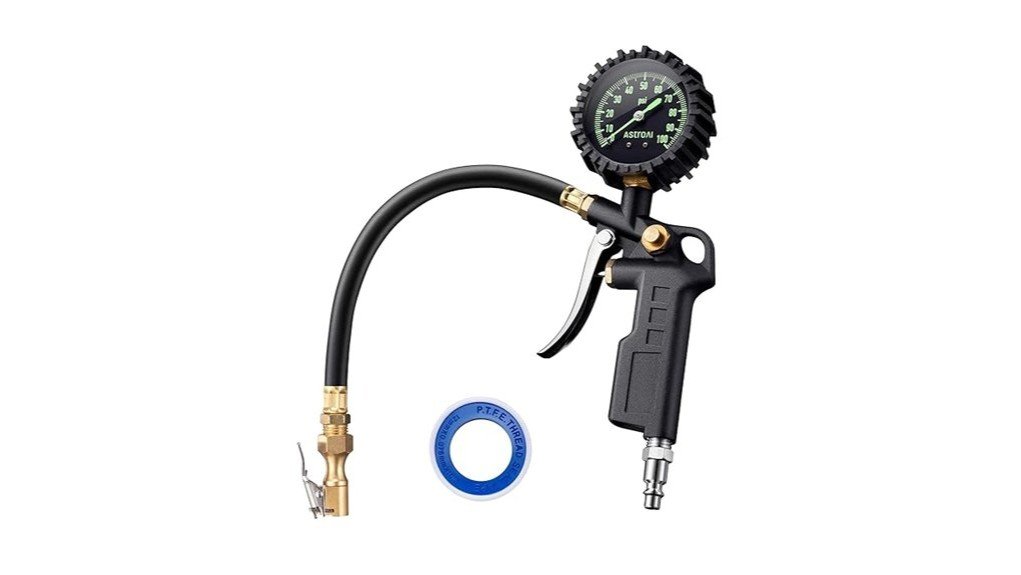
Checking tire pressure is simple, but adding air and correcting an overfilled tire can become slow when you need three separate tools. The AstroAI Tire Pressure Gauge with Inflator combines those jobs in one mechanical unit for use with a separate air compressor. Its large glow dial, trigger control, and bleed button make routine adjustments easier, but the 100 PSI limit and compressor requirement will not suit every setup. This review explains its verified specifications, practical strengths, limitations, and the buyers who will get the most value from it.
Quick Verdict
Rating: 8.3/10, recommended with caveats
Best For: Drivers and home mechanics who already own an air compressor and want one tool for checking, inflating, and bleeding tires.
Bottom Line: The AstroAI TIG100S offers convenient three-function control, a readable battery-free dial, and standard garage compatibility. Its main tradeoffs are the 100 PSI ceiling and the need to seat the air chuck carefully to prevent leakage.
Key Specifications
| Specification | Detail |
|---|---|
| Brand | AstroAI |
| Model | TIG100S |
| Amazon ASIN | B07RVHPWK8 |
| Product type | 3-in-1 mechanical tire inflator gauge |
| Functions | Checks pressure, adds air, and releases excess air |
| Pressure range | 0–100 PSI |
| Accuracy information | ANSI B40.1 accuracy claim with manufacturer-listed ±1 PSI resolution |
| Dial | 2.5-inch luminescent analog dial |
| Power | Battery-free mechanical operation |
| Dimensions | 17.92 × 1.42 × 1.22 inches |
| Weight | Approximately 1.06 pounds |
| Construction | Alloy-steel body with heavy-duty stainless-steel and brass components |
| Tire-valve compatibility | Schrader valves |
| Compressor connection | 1/4-inch NPT quick-connect fitting |
| Included accessories | Brass air chuck, 1/4-inch NPT steel fitting, four valve caps, valve-core tool, and thread-seal tape |
| Best use | Routine garage maintenance for cars, motorcycles, and other Schrader-equipped tires within the gauge range |
[Products Worth Considering]

The AstroAI 2 pack air chucks provide a heavy-duty, closed-flow locking design that helps keep air flowing during inflation while securely attaching to the valve stem. Built with 250 PSI rated brass components and compatible with Schrader valves, they feature 1/4" female NPT threads for a wide fit with common inflators. The straight tip and locking clip make filling tires and monitoring pressure more convenient.

EVOULTES heavy duty tire inflator with an integrated gauge delivers accurate pressure readings from 10–120 PSI, helping you inflate, deflate, and check tires in one tool. The 16.5-inch extended dual-head air chuck with swivel base reaches hard-to-access dual wheel valves on trucks and RVs. A brass trigger core and side-mounted air release valve make operation smooth, with standard 1/4" NPT threading and quick-connect compatibility for easy setup.

Upgrade your air tools with this 18-piece air compressor accessory kit featuring a 25ft recoil poly hose, 1/4" NPT quick connect fittings, and a 100 PSI tire inflator gauge. The set also includes a heavy-duty blow gun with safety and tapered nozzles, plus couplers, inflation needles, plugs, and other essentials for everyday mechanic and workshop tasks. Corrosion-resistant steel and brass components help keep connections reliable for inflating, blowing out, and general pneumatic use.
What Is the AstroAI TIG100S?
The AstroAI TIG100S is a mechanical tire inflator gauge that connects an air compressor to a Schrader tire valve. Instead of checking pressure with one tool, adding air with another, and pressing the valve core separately to release air, you can handle all three tasks through one assembly.
The trigger controls airflow from your compressor, while the integrated bleed button releases pressure when the tire is over the target. The analog dial does not need batteries, and its luminescent face is easier to read than a small unlit scale in a dim garage.
This is not a portable air pump or self-powered inflator. You must connect it to a suitable compressor before the trigger can add air.
Key Takeaways
- The AstroAI TIG100S combines pressure checking, inflation, and controlled air release.
- Its mechanical gauge covers 0–100 PSI and uses a large 2.5-inch glow dial.
- It connects to standard Schrader valves and a 1/4-inch NPT quick-connect compressor setup.
- Battery-free operation removes charging, battery replacement, and electronic-screen concerns.
- The tool is best for a home garage and requires a separate air compressor.
- It is not intended for pressures above 100 PSI or for Presta valves without a suitable adapter.
Who Should Buy It?
Best For
- Drivers who already have a compressor with a standard 1/4-inch quick-connect coupler
- Home mechanics who adjust several vehicle tires during seasonal pressure changes
- Buyers who prefer a battery-free analog gauge with separate inflate and bleed controls
Skip If
- You need a self-powered roadside inflator that works without a compressor
- Your tires or equipment regularly require more than 100 PSI
- You need direct Presta-valve compatibility or a compact pocket gauge
Before You Buy: This tool does not generate compressed air. Confirm that you have a compatible air compressor and 1/4-inch NPT quick-connect setup. Do not expose the gauge to pressure above its 100 PSI maximum, because excess pressure can permanently damage it.
Gauge Range and Reading Accuracy
The dial covers 0–100 PSI, which is enough for most passenger-car, light-truck, motorcycle, lawn-equipment, and Schrader-equipped bicycle tires. The Amazon listing describes the gauge as meeting an ANSI B40.1 accuracy standard and lists a ±1 PSI resolution.
Those specifications are appropriate for routine tire maintenance, but you should not treat a consumer mechanical gauge as laboratory equipment. Manufacturing tolerances, impacts, contamination, hose leaks, and age can affect readings. Checking the AstroAI against a trusted reference gauge from time to time is a sensible way to spot drift.
The dial holds its reading until you press the bleed or reset button. This lets you remove the chuck and view the result without trying to keep your face beside the wheel, although pressing the reset button is necessary before the next check.
Controls and Ease of Use
The TIG100S keeps its controls simple. Press the trigger to send compressor air into the tire, release it to stop airflow, and press the bleed button to lower pressure. Because the gauge remains connected during all three steps, you can approach the vehicle’s target pressure in small adjustments.
The biggest usability factor is the chuck seal. Push the chuck squarely onto the Schrader valve and keep it seated firmly. A tilted or incomplete connection can release air, produce an unstable reading, or make the tool seem less accurate than it is.
The 2.5-inch dial is easier to scan than a small pencil-style gauge. Its glow material helps in low light, but it is not an illuminated screen. The dial must absorb light before it can glow effectively, and a flashlight may still be useful in complete darkness.
Build Quality and Design
AstroAI lists an alloy-steel construction, while the Amazon listing identifies stainless-steel and brass components in the handle and air chuck. The combination gives the tool a more substantial garage-tool feel than a lightweight plastic pressure gauge.
At about 1.06 pounds and nearly 18 inches long, it is manageable around a vehicle without being pocket-sized. The length includes the tool and hose assembly, giving you some separation from the wheel while you operate the trigger and read the dial.
The rubber hose improves reach around wheel spokes, but it is also a wear point. Store the tool without sharply folding the hose, and avoid leaving it under heavy equipment. Inspect the chuck, coupler, hose, and threaded connections if you notice hissing or inconsistent readings.
Fit and Compatibility
The included air chuck is intended for Schrader valves, the standard valve type used on most cars, SUVs, pickups, motorcycles, trailers, and many bicycles. A bicycle with a narrow Presta valve will need a separate adapter, and the quality of that adapter can affect sealing.
On the compressor side, the tool uses a 1/4-inch NPT fitting for common quick-connect systems. Quick-connect plug profiles can vary by region and compressor setup, so compare the included fitting with your existing coupler before relying on the tool for a time-sensitive job.
The 100 PSI range is suitable for common vehicle tires, but some commercial, high-pressure bicycle, RV, or specialty applications may require a higher-range gauge. Always use the pressure listed on the vehicle placard, equipment label, or manufacturer instructions rather than assuming the gauge maximum is an appropriate inflation target.
How It Performs in Real Use
[Products Worth Considering]
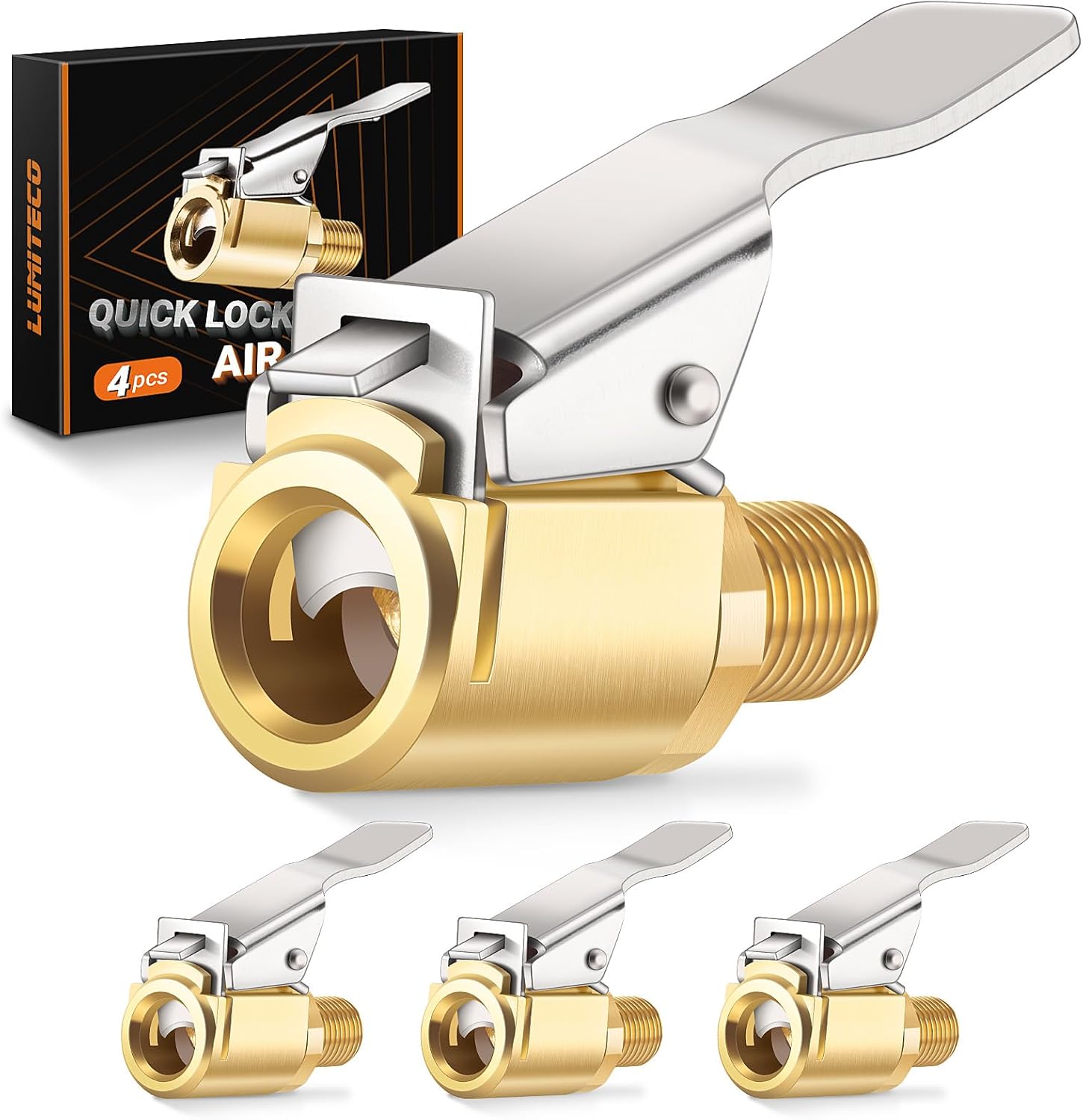
This brass air chuck adapter converts a screw-on inflator connection into a lock-on quick connect for hands-free, no-leak tire inflation. Clip the chuck onto Schrader valve stems and lock it in place to simplify inflating car, bike, and motorcycle tires. Built for durability with a corrosion-resistant brass body and strong quick operation.

This dual head and ball air chuck set provides closed-flow tire inflation that routes air only through the chuck engaged with the valve. It includes both dual-head and ball-head chucks plus quick plug fittings for easy, fast connections to air lines and compressors. Built for reliable, leak-resistant operation, it’s ideal for filling Schrader valves on bikes, motorcycles, cars, trucks, and more.
For Weekly or Monthly Pressure Checks
For routine garage checks, the combined design reduces tool changes. Connect the compressor, seat the chuck, read the dial, and make a small correction without disconnecting. This is especially useful when temperature changes have lowered several tires by a similar amount.
For Seasonal Tire Changes
After installing a summer or winter wheel set, you can move around the vehicle and bring each tire to the placard pressure. The analog design remains ready after long storage because there are no batteries to discharge or corrode.
For Motorcycles and Schrader-Equipped Bicycles
The gauge range covers many motorcycle and bicycle pressures, provided the tire uses a Schrader valve and the chuck fits between nearby spokes or brake components. The full-size handle may be less convenient on tightly packaged small wheels, so confirm access before buying.
For Low-Light Garage Work
The luminescent dial is easier to see than an ordinary black-and-white mechanical scale after it has been exposed to light. It helps during evening maintenance, although it does not replace a work light when you need to inspect the valve, tread, or sidewall.
How to Use It Correctly
- Find the recommended cold-tire pressure on the driver-door placard or in the vehicle manual.
- Check the tire before driving or after the vehicle has been parked long enough for the tires to cool.
- Confirm that your compressor regulator and hose are suitable for the job.
- Connect the AstroAI gauge to the compressor’s quick coupler.
- Remove the valve cap and press the air chuck squarely onto the Schrader valve.
- Read the dial before adding air.
- Press the trigger briefly to add air, then release it and recheck the dial.
- Use the bleed button in short presses if the tire is above the target.
- Disconnect the chuck, reinstall the valve cap, and check for any obvious valve leakage.
Pro Tip: Approach the target pressure in short trigger presses instead of holding the trigger continuously. Small adjustments reduce overshooting and give the dial time to settle between readings.
Compatibility and Safety
Measure tires when they are cold whenever possible. Driving heats the tire and raises its pressure, so adjusting a hot tire down to the cold placard value can leave it underinflated after it cools.
Do not use the maximum pressure printed on the tire sidewall as your routine target. The correct setting normally comes from the vehicle placard or equipment manufacturer. Also keep the compressor’s output within the limits of the gauge, tire, wheel, hose, and fittings.
Stop using the tool if the hose is cracked, the dial is damaged, the needle does not return correctly, or a connection leaks heavily. Tire pressure affects handling, braking, heat buildup, and tire wear, so have a tire professional inspect any wheel that repeatedly loses pressure.
Pros and Cons
Pros
- Combines pressure checking, inflation, and air release in one tool
- Large 2.5-inch analog dial is easier to read than many compact gauges
- Battery-free design is ready after long periods in storage
- Uses a common 1/4-inch NPT compressor connection
- Includes useful extras such as valve caps, thread-seal tape, and a valve-core tool
Cons
- Requires a separate air compressor and compatible coupler
- The 100 PSI maximum is too low for some specialty and commercial applications
- The chuck must be seated carefully to avoid leakage or unstable readings
Maintenance and Storage
Release pressure from the air line before disconnecting or servicing fittings. Wipe the gauge and hose with a dry or slightly damp cloth, and keep moisture, tire sealant, oil, and debris out of the chuck and internal air path.
Store the assembly in a dry cabinet or toolbox with the hose resting in a loose curve. Do not hang heavy objects from the hose or leave the dial where it can be struck. Mechanical gauges can lose accuracy after a hard impact even when the outer case does not show major damage.
If a threaded connection develops a small leak, inspect the fitting and follow the supplied thread-seal-tape instructions. Do not apply tape where loose pieces could enter the airflow path.
Is It Worth the Price?
The AstroAI TIG100S sits in the budget-to-mid-range part of the garage inflator-gauge market. Its value comes from replacing a separate chuck, gauge, and manual bleed method with one battery-free assembly.
It is a smart buy for everyday use when you already own a compressor and mainly service standard passenger vehicles, motorcycles, or similar Schrader-equipped tires. The included small accessories also reduce the number of extra pieces you need to purchase for a basic setup.
It offers less value if you need roadside independence, digital resolution, multiple pressure units, or a range above 100 PSI. In those cases, the cost of a different gauge or self-powered inflator may be easier to justify.
How It Compares to Alternatives
AstroAI’s ATG250 and TIG250B digital inflator gauges extend the range to 250 PSI and add an illuminated digital display, making them better suited to buyers who need higher pressure capacity or finer on-screen readings. They require batteries, while the TIG100S remains simpler and immediately ready after storage.
The JACO FlowPro Digital is another higher-range option worth comparing when digital controls and a 200 PSI capacity matter more than battery-free simplicity. The AstroAI TIG100S makes the most sense when you want a traditional analog dial, common compressor compatibility, and straightforward controls for ordinary vehicle pressures.
Frequently Asked Questions
Does the AstroAI gauge inflate tires by itself?
No. It is an inflator attachment, not an air compressor. You must connect it to a compatible compressor before the trigger can send air into a tire.
Does it work with motorcycle tires?
Yes, it can work with a motorcycle tire that uses a Schrader valve and falls within the 0–100 PSI gauge range. Check that the chuck can reach the valve without interference from spokes, brake parts, or the wheel design.
Can it be used to release excess air?
Yes. Keep the chuck connected to the valve and press the integrated bleed button in short intervals. Recheck the dial after each adjustment so you do not release too much air.
What compressor fittings are compatible?
The tool includes a 1/4-inch NPT steel fitting for common quick-connect compressor systems. Because coupler profiles can differ, compare the fitting with your compressor hose before use and obtain the correct adapter when necessary.
Does it work with Presta bicycle valves?
Not directly. The included chuck is designed for Schrader valves. A compatible Presta-to-Schrader adapter may allow use, but you should confirm the adapter’s pressure rating and sealing quality.
Is the glow dial fully illuminated at night?
The dial uses luminescent material rather than an electric backlight. It glows after exposure to light, but brightness fades and may not be enough for a completely dark work area.
What comes in the package?
The verified package list includes the mechanical inflator gauge and hose assembly, a brass air chuck, a 1/4-inch NPT steel fitting, four valve caps, thread-seal tape, and a valve-core tool. Check the current seller listing before purchase in case packaging changes.
The Bottom Line
The AstroAI TIG100S is a practical choice for drivers and home mechanics who already own an air compressor and want faster control over routine tire-pressure adjustments. Its three-function design, large battery-free dial, and common fittings are its main strengths, while the 100 PSI ceiling and compressor dependency are the main limitations. Skip it if you need a portable roadside pump or high-pressure capability, but consider it for straightforward garage maintenance on Schrader-equipped tires.
Ready to Buy?
Check the latest price, seller information, and package details before you decide.

Related Articles
GOOLOO A6 Gear Tire Inflator Review: 160 PSI Cordless Portable Air Compressor
You want a compact, reliable way to keep your tires at the right pressure without dragging an air hose around or waiting for service.…
Read More
BLACK+DECKER BDINF20C Tire Inflator Review: 20V MAX Cordless and Corded Air Pump
You rely on a compact, reliable inflator when a tire goes low or an air mattress needs a quick top‑up, and the BLACK+DECKER BDINF20C…
Read More
150 PSI Cordless Tire Inflator Review: 5X Faster Portable Air Compressor with Digital Gauge
You do not want to be stuck with underinflated tires when safety, fuel economy, and tire life are on the line. A compact cordless…
Read More