
Highway vs All-Terrain Tires on the Toyota Hilux
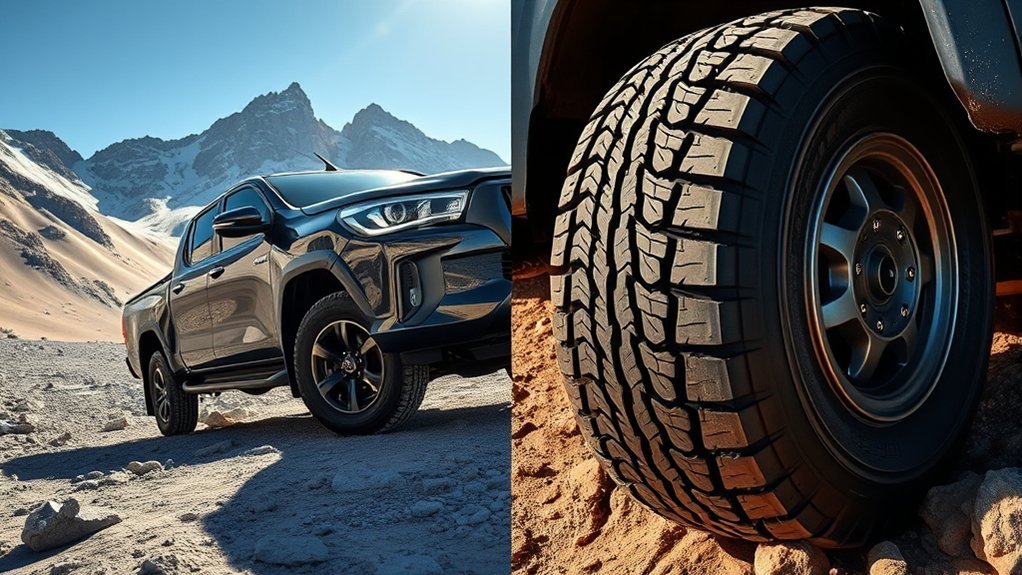
Choosing tires for your Toyota Hilux is not just about picking the toughest-looking tread. The right choice depends on how much time you spend on pavement, gravel, mud, snow, job sites, and loaded highway trips. Highway-terrain tires usually suit daily road use best, while all-terrain tires make more sense when your Hilux regularly leaves sealed roads.
Quick Answer
Choose highway-terrain tires for a Toyota Hilux that spends most miles on paved roads, commuting, or highway towing. Choose all-terrain tires if you often drive on gravel, dirt, light mud, snow, farms, worksites, or remote tracks. Always match the tire size, load rating, speed rating, and cold pressure listed for your Hilux.
Key Takeaways
- Highway-terrain tires are usually quieter, smoother, and more efficient on paved roads.
- All-terrain tires add grip and sidewall toughness for gravel, dirt, light mud, and rougher worksite use.
- Some all-terrain tires carry the 3PMSF severe-snow symbol, but not every A/T tire is a winter tire.
- For towing, payload, or remote travel, load rating and cold tire pressure matter as much as tread pattern.
- Check your Hilux owner’s manual, tire placard, and installer advice before changing tire size.
Understanding Highway vs. All-Terrain Tire Benefits for Your Toyota Hilux
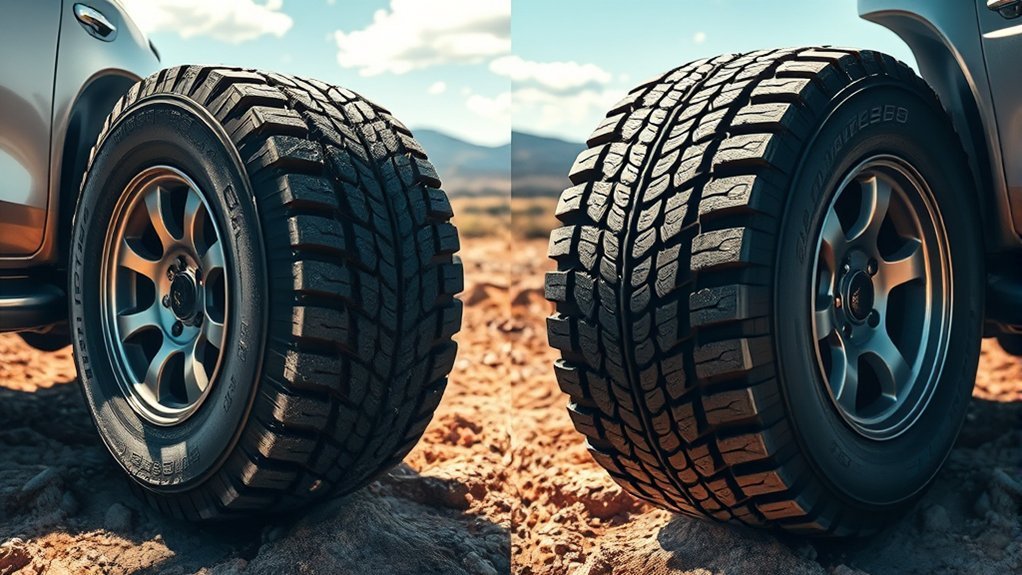
Highway-terrain tires, often called H/T tires, focus on paved-road comfort. They use less aggressive tread patterns, tighter tread blocks, and road-focused construction to reduce noise, improve steering feel, and support easier rolling.
All-terrain tires, often called A/T tires, are built as a compromise between road manners and off-road traction. The NHTSA tire guide describes all-terrain tires as tires mainly used on four-wheel-drive vehicles that provide a compromise between on-road driving and off-road capability.
That compromise is the key point for your Hilux. A/T tires can improve confidence on gravel roads, wet grass, hard-packed dirt, and light mud. They can also add road noise, weight, and rolling resistance compared with a road-focused H/T tire.
Note: Tire category names are helpful, but they do not guarantee performance. Compare the exact tire model, size, load rating, tread depth, wet-braking data, tire label information where available, warranty, and 3PMSF status before buying.
[Products Worth Considering]

Milton S-921 pencil tire pressure gauge helps you maintain optimal tire pressure for passenger cars with accurate readings in PSI and kPa. It features a built-in deflator valve for convenient pressure adjustments, plus a single chuck head and nylon indicator bar for easy use on the go. Built from durable plated brass and designed for reliable performance, it’s a practical road trip and cold-weather maintenance tool.

These universal tire valve stem caps help protect valve cores from dust, debris, and moisture while helping maintain stable tire pressure. The corrosion-resistant metal construction and sealed design provide reliable protection in road grime, mud, and winter conditions. Twist-on installation makes them quick to fit on cars, SUVs, trucks, and motorcycles.

Upgrade your 2024-2026 Tesla Model 3 Highland with REEVAA all-weather mud flaps designed for seamless fit along the original body lines. The set of four delivers strong splash protection against mud, gravel, and road debris while using OEM-grade durable materials. Installation is non-destructive with original hole positions and snap-in clips, and the aerodynamic design helps minimize impact on efficiency.
Highway vs. All-Terrain Tires: Quick Comparison
| Factor | Highway-Terrain Tires | All-Terrain Tires |
| Best use | Daily commuting, highway towing, city driving, paved roads | Gravel, dirt, farm roads, light mud, snow, campsites, worksites |
| Road noise | Usually quieter | Often louder, especially with deeper tread blocks |
| Fuel economy | Usually better due to lower weight and rolling resistance | Can drop slightly with heavier LT or aggressive tread designs |
| Wet paved roads | Often strong, but depends on compound, tread depth, and tire design | Can be good, but aggressive designs may feel less sharp on wet pavement |
| Off-road grip | Limited on loose surfaces | Better bite on dirt, gravel, loose tracks, and light mud |
| Snow | Fine in mild conditions if the tire is rated for them, weaker in deeper snow | Better if the tire carries the 3PMSF symbol; not a replacement for dedicated winter tires in harsh conditions |
Best Choice by Hilux Driving Mix
The simplest way to choose is to match the tire to the surface you drive most. A Hilux used for school runs and highways does not need the same tire as a Hilux used on farms, mining roads, wet fields, or long remote tracks.
| Your Driving Pattern | Better Pick | Why It Fits |
| Mostly pavement, city use, school runs, and freeway trips | Highway-terrain | You get quieter road manners, better comfort, and lower rolling resistance. |
| Mostly pavement with regular gravel roads or campsites | Mild all-terrain | You gain loose-surface grip without moving to a very loud, heavy tread. |
| Farm tracks, worksites, rough gravel, and light mud | All-terrain | The stronger shoulders and more open tread help on loose, uneven ground. |
| Highway towing or loaded trade use | H/T or A/T with correct load rating | Load capacity, pressure, heat control, and stability matter more than tread style alone. |
| Regular snow, icy roads, or winter-tire rules | 3PMSF all-terrain or dedicated winter tire | The 3PMSF symbol shows severe-snow performance testing; dedicated winter tires are safer for ice and harsh winter use. |
Comparing On-Road and Off-Road Performance of Highway and All-Terrain Tires
If your Hilux spends most of its life on paved roads, highway-terrain tires usually feel better day to day. They tend to ride more smoothly, track straighter at speed, and make less tread noise inside the cabin.
That matters on long freeway drives, school runs, business use, and highway towing. A road-focused H/T tire can also help preserve fuel economy because it usually weighs less and rolls more easily than a heavy, deep-lug all-terrain tire.
All-terrain tires make more sense when the Hilux has to work beyond pavement. Their larger voids, stronger shoulder blocks, and more open tread patterns can bite into gravel, dirt, ruts, and light mud better than a highway tire.
For weekend trails, remote campsites, unsealed rural roads, and construction access roads, A/T tires give you extra margin. The trade-off is that your Hilux may feel firmer, louder, and slightly slower to respond on smooth pavement.
The best Hilux tire is not the most aggressive tire. It is the tire that matches your real driving mix without sacrificing safety, load capacity, or wet-road control.
Tread Life and Fuel Efficiency of Each Tire Type
Highway-terrain tires usually have an advantage in tread life when most driving happens on sealed roads. Their tread blocks stay more stable on pavement, which can reduce squirm, heat, and uneven wear.
All-terrain tires can still last well, but aggressive tread blocks often wear faster if the Hilux spends nearly all its time on hot highways. Heavy towing, hard cornering, poor alignment, low pressure, and frequent gravel use can shorten the life of either tire type.
Fuel economy also depends on the exact tire. Heavier all-terrain tires and LT-rated tires can add rolling resistance, while many highway-terrain tires use road-focused construction to reduce drag. The difference may be small on one trip, but it can matter over thousands of miles.
Use the vehicle tire placard or owner’s manual for cold inflation pressure. NHTSA also recommends checking pressure at least monthly when the tires are cold and checking tread while you do it.
Pro Tip: If your Hilux drives 80% pavement and 20% gravel, consider a mild all-terrain tire instead of a very aggressive A/T. You keep useful gravel traction without adding as much noise, weight, or fuel penalty.
How Highway and All-Terrain Tires Perform in Snow and Wet Conditions
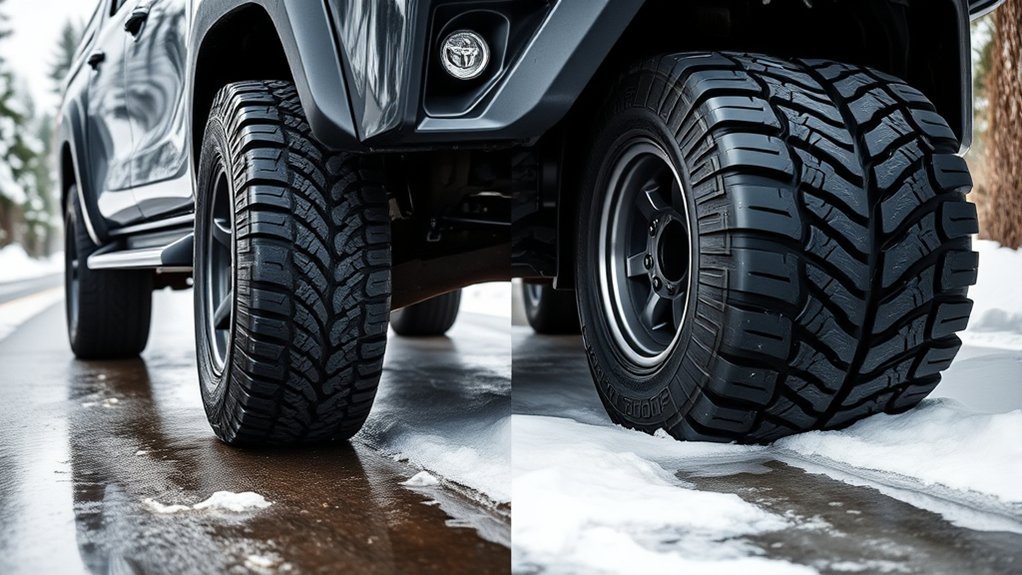
Wet-road performance is not guaranteed by the words “highway” or “all-terrain.” It depends on tread depth, rubber compound, siping, groove design, tire age, and the tire’s tested wet performance. NHTSA’s Uniform Tire Quality Grading guide explains that traction grades relate to a tire’s ability to stop on wet pavement under controlled test conditions. It also notes that the traction grade does not cover cornering traction.
Highway-terrain tires often feel more stable in heavy rain because their tread patterns are usually optimized for water evacuation and pavement contact. However, a worn H/T tire can lose wet grip quickly, especially once grooves become shallow.
All-terrain tires can work well in rain, but very open tread designs may feel less precise on wet asphalt than a road-biased tire. If you drive fast highways in heavy rain, prioritize proven wet braking, tread depth, correct pressure, and tire condition instead of tread appearance alone.
Snow needs extra care. Some all-terrain tires carry the Three-Peak Mountain Snowflake symbol, often shortened to 3PMSF. USTMA defines severe-snow tires by snow grip performance criteria and a mountain-with-snowflake sidewall marking. Still, a 3PMSF all-terrain tire is not always equal to a dedicated winter tire on ice or packed snow.
Warning: Do not assume every all-terrain tire is winter-ready. Check the sidewall for the 3PMSF symbol, follow local winter-tire laws, and use a matched set of four tires with similar tread depth.
Hilux Fitment Checks Before You Buy Tires
Before choosing H/T or A/T tires, confirm what your Toyota Hilux can safely use. The safest starting point is the original tire size, load index, speed rating, and pressure listed on the tire placard or in the owner’s manual.
- Size: Match the factory size unless you have confirmed wheel clearance, suspension clearance, and speedometer impact.
- Load rating: Choose a tire that meets or exceeds the required load rating, especially if you tow, haul tools, carry camping gear, or drive a work-spec Hilux.
- Speed rating: Do not drop below the rating required for your vehicle and local road rules.
- Pressure: Use the Hilux placard or manual for cold tire pressure, not the maximum pressure printed on the tire sidewall.
- Spare tire: Keep the spare close in size and overall diameter to the tires on the vehicle, especially for 4WD use.
- 4WD matching: Avoid mixing tire types, sizes, or heavily different tread depths across the same drivetrain.
- Upsizing: Larger A/T tires may rub, reduce acceleration, affect braking, and increase fuel use if the setup is not checked properly.
NHTSA says tire buyers should check the owner’s manual or tire information label for the correct tire size. Toyota also directs owners to the specifications section of the owner’s manual or the tire information placard for tire pressure guidance.
How to Read the Sidewall Before Choosing H/T or A/T
The tire sidewall tells you more than the tread pattern does. Before you compare brands or tread styles, check the full size and service description. A common tire code includes section width, aspect ratio, wheel diameter, load index, and speed rating.
- Size code: This tells you the tire width, sidewall height ratio, construction, and rim diameter.
- Load index: This tells you how much weight one tire can carry when inflated correctly.
- Speed rating: This shows the tested speed capability of the tire under specified conditions.
- LT or load range marking: Some light-truck tires use stronger construction for heavier loads, but they can ride firmer.
- 3PMSF symbol: This mountain-and-snowflake symbol helps identify tires tested for severe-snow use.
- DOT date code: The last four digits identify the week and year the tire was made.
Do not rely on tread style alone. Two all-terrain tires can look similar but perform very differently in rain, noise, wear, snow, and towing stability.
[Products Worth Considering]

These aluminum alloy tire valve stem caps with an O-ring seal help protect valve stems from corrosion while adding a clean, stylish look to your vehicle. The universal fit works across cars, trucks, motorcycles, bicycles, and more, making them an easy upgrade for everyday driving and off-road use. Installation is quick, and the included four-pack keeps all your tires dressed and protected.

Keep your tires properly inflated with this analog VONDIOR tire pressure gauge, designed for fast, easy readings without batteries. The swiveling, two-axis hose and large glow dial help you measure at any tire angle with instant visibility. Built with a protective rubber shield, it supports durable, low-maintenance use for cars and trucks.

The 22800 wheel stud installer makes replacing wheel studs quick and secure, saving time and effort during tire service. It uses a ratchet or impact wrench to pull new studs firmly into place, helping when existing studs are too long. Compatible with most automotive wheels and light-duty truck wheel studs, it’s designed for easy, tool-assisted installation.
Load Rating, Towing, and Payload Matter More Than Looks
A Hilux often works harder than a normal passenger car. It may carry tools, recovery gear, water, camping equipment, passengers, a canopy, or trailer tongue weight. That extra load makes tire load rating and pressure more important.
If your Hilux tows or hauls often, do not choose a tire only because it has a stronger-looking tread. Make sure the tire’s load capacity meets or exceeds your vehicle requirement. A mild H/T tire with the correct load rating can be safer for highway towing than an aggressive A/T with the wrong service rating.
LT-rated all-terrain tires can make sense for heavier work, rough gravel, and remote travel. The trade-off is that they may ride firmer and weigh more. If your Hilux is mostly empty and used around town, a heavy-duty LT A/T may feel harsher than you need.
Note: The maximum pressure printed on a tire sidewall is not your normal driving pressure. Use the cold pressure listed by Toyota for your Hilux setup, then ask a qualified tire installer for guidance if you change size, load range, wheels, or vehicle load.
Common Mistakes When Changing Hilux Tires
Most tire problems start before the tire is installed. Avoid these common mistakes when comparing highway and all-terrain tires for your Hilux.
- Choosing tread for appearance: A very aggressive A/T can look tough but feel loud, heavy, and vague on wet pavement.
- Ignoring wet braking: Off-road grip does not automatically mean strong wet-road stopping.
- Buying the wrong load rating: This can create heat, wear, and stability problems when the truck is loaded.
- Using sidewall max pressure: That number is not the normal pressure for your Hilux.
- Mixing tire types: Mixing H/T and A/T tires, sizes, or tread depths can upset handling and 4WD operation.
- Upsizing without checking clearance: Larger tires can rub the guards, suspension, mud flaps, or body mounts.
- Forgetting the spare: A mismatched spare can cause trouble during long trips, especially in 4WD use.
Maintenance After Fitting New Hilux Tires
New tires still need basic care. Check cold pressure monthly, including the spare, and check tread depth at the same time. NHTSA also recommends checking the owner’s manual for tire rotation guidance, and rotating tires when the vehicle manufacturer recommends it.
- After installation: Confirm all four tires match in size, load rating, speed rating, and tread type.
- After the first few drives: Watch for vibration, pulling, rubbing, steering shake, or TPMS warnings.
- Monthly: Check cold pressure, visible damage, tread depth, and uneven wear.
- Before towing or remote travel: Recheck pressure, spare condition, valve stems, tread damage, and repair gear.
- After rough tracks: Inspect sidewalls and tread for cuts, stones, bulges, and punctures.
If you air down tires for low-speed off-road traction, reinflate them before returning to normal road speeds. Driving at highway speed on underinflated tires can build heat and increase failure risk.
Which Tire Is Right for You? Making the Best Choice for Your Driving Style
Choose highway-terrain tires if your Hilux is mainly a road vehicle. They suit commuters, families, fleet drivers, highway towing, and owners who want a quieter ride with better fuel economy.
Choose all-terrain tires if your Hilux regularly sees gravel, dirt, light mud, snow, farms, trails, campsites, or construction access roads. They give you more bite and toughness when the road surface changes.
Choose a 3PMSF-rated all-terrain tire if you need one tire for mixed pavement, gravel, and moderate winter use. Choose dedicated winter tires if your Hilux regularly faces ice, packed snow, freezing rain, or strict winter-tire laws.
For most Hilux owners, the best answer sits between the extremes. A mild A/T tire can be a smart upgrade for mixed driving, while a high-quality H/T tire remains the better choice for a Hilux that lives mostly on pavement.
Frequently Asked Questions
What is the weakness of the Toyota Hilux when choosing tires?
The Hilux is tough, but it can feel firm, noisy, or less refined on pavement than a road-focused SUV. Aggressive all-terrain tires can make that firmer feel and road noise more noticeable. If comfort matters most, choose a highway-terrain tire or a mild all-terrain tire instead of a deep-lug option.
What tyres should I put on my Hilux?
Put highway-terrain tyres on your Hilux if you drive mostly on paved roads and want comfort, low noise, and better fuel economy. Put all-terrain tyres on it if you often drive on gravel, dirt, snow, light mud, farms, worksites, or remote tracks. In both cases, match the factory size, load rating, speed rating, and pressure guidance.
Are all-terrain tires good for freeway driving?
Yes, many all-terrain tires are fine for freeway driving, especially mild A/T designs. Expect more road noise and possibly lower fuel economy than highway-terrain tires. For long freeway trips, choose an A/T with strong wet braking, good ride reviews, and the correct load and speed rating.
Do all-terrain tires last longer than highway tires?
Not always. Highway-terrain tires often last longer on paved roads because their tread blocks are more road-focused. All-terrain tires may wear faster if used mostly on highways, especially if they are heavy, aggressive, underinflated, overloaded, or poorly aligned.
Can I fit larger all-terrain tires on a Toyota Hilux?
Sometimes, but do not guess. Larger tires can rub the guards, affect steering clearance, alter speedometer readings, reduce braking performance, and add fuel use. Check your Hilux model, wheel offset, suspension setup, local rules, and installer advice before upsizing.
Do I need 3PMSF tires for a Hilux in winter?
If you drive in regular snow or areas with winter-tire rules, look for the 3PMSF symbol or use dedicated winter tires. A basic M+S marking is not the same level of severe-snow performance assurance. For ice and packed snow, dedicated winter tires are usually the safer choice.
Can I mix highway and all-terrain tires on a Hilux?
Avoid mixing highway and all-terrain tires on the same Hilux. Different tread patterns, sizes, grip levels, and tread depths can affect braking, steering, stability, and 4WD operation. Use a matched set unless your owner’s manual or tire professional gives a specific temporary instruction.
Will all-terrain tires reduce Hilux fuel economy?
They can. Heavier all-terrain tires, deeper tread blocks, and stronger LT construction can increase rolling resistance. The change depends on the exact tire, size, pressure, vehicle load, and driving speed. A mild A/T usually has a smaller penalty than a heavy, aggressive A/T.
Are highway-terrain tires okay on gravel roads?
Yes, highway-terrain tires can handle occasional maintained gravel roads if you drive carefully and keep the correct pressure. They are not the best choice for sharp rocks, ruts, loose climbs, muddy tracks, or repeated rough-road work. For regular gravel, a mild all-terrain tire is usually a better fit.
What tire pressure should I use after changing Hilux tires?
Start with the cold tire pressure listed on your Hilux tire placard or owner’s manual. Do not use the maximum pressure printed on the tire sidewall as your normal road pressure. If you change tire size, load range, wheels, or payload, ask a qualified tire installer for load-and-inflation guidance.
Conclusion
Highway-terrain tires are the better choice for a Toyota Hilux that spends most of its time on pavement. They usually ride quieter, feel smoother, and support better fuel economy. All-terrain tires are the better match when your Hilux regularly handles gravel, dirt, light mud, snow, worksites, or remote travel.
Before buying either type, check the tire placard, owner’s manual, load rating, speed rating, cold pressure, and spare-tire match. The right Hilux tire is not just the one with the strongest tread. It is the one that safely fits your vehicle and matches the roads you drive most.
Sources
- NHTSA TireWise — tire type selection, tire size, pressure, tread, rotation, and maintenance guidance
- NHTSA Tire Buyers’ FAQ — tire type definitions and owner’s manual / tire label fitment guidance
- NHTSA Consumer Guide to Uniform Tire Quality Grading — treadwear, traction, and temperature grading reference
- U.S. Tire Manufacturers Association TISB 37 — severe-snow tire and 3PMSF marking reference
- Toyota Australia Owner Manuals — model-specific owner-manual reference for tire size, pressure, and vehicle guidance
[Products Worth Considering]

This ALL-TOP auto-stop tire deflator valve kit lets you air down off-road tires quickly without watching pressure, automatically stopping when your preset PSI is reached. Each valve is individually calibrated for reliable performance with an acceptable +/- 2 PSI tolerance. The adjustable deflator range covers 10 to 30 PSI and includes four valves plus valve caps and a zipper pouch for easy setup on trucks, SUVs, RVs, UTVs, and powersports.

Accurately measure tire tread depth with a calibrated gauge marked from 0 to 1 inch in 1/32 inch increments. The color-coded bar helps you quickly identify tread condition ranges, supporting safe driving for trucks, motorcycles, automobiles, and passenger vehicles.

This manual duck head tire changer kit makes tire installation and removal simpler by letting you embed the duck head into the tire with applied pressure. The integrated design and durable steel construction help reduce friction and improve efficiency and safety during use. Suitable for 16–21 inch wheels, it’s convenient for cars, trucks, SUVs, and ATV tires, with 24-hour after-sales support.

Related Articles
Toyota Hilux Run-Flat Tires: What You Need to Know
Take control of your safety with Toyota Hilux run-flat tires; discover their benefits and hidden costs that could change your driving experience forever.
Read More
Effects of Underinflated Tires on the Toyota Hilux
Inadequate tire pressure in your Toyota Hilux can lead to serious safety issues and costly repairs; discover how to avoid these pitfalls.
Read More
The Risks of Overinflating Toyota Hilux Tires
Overinflating your Toyota Hilux tires can lead to dangerous blowouts and uneven wear, but understanding the risks is crucial for your safety.
Read More