
Load Range C vs E for a 4Runner: Does Weight Matter

You’re adding 32 pounds of unsprung mass by choosing Load E tires over Load C, and that rotational weight penalty measurably degrades your 4Runner’s acceleration response, braking performance, and ride quality. Load E tires weigh 58.2 pounds versus 50.3 pounds for Load C, creating longer stopping distances and increased heat generation while their stiffer 10-ply sidewalls transmit more road harshness compared to Load C’s 3-ply construction. Unless you’re towing heavy loads regularly, the performance trade-offs favor the lighter option. The full breakdown of when each load range actually makes sense awaits below.
Load C or Load E? How to Choose for Your 4Runner

How do you decide between Load C and Load E tires for your 4Runner? You start by examining your driving habits impact on daily performance. If you prioritize responsive handling, lighter Load C tires—rated at 2,470 pounds—weigh roughly 8 pounds less per corner, sharpening acceleration and braking. You’ll feel the difference on slick surfaces where softer sidewalls bite harder.
Load E tires carry 3,195 pounds, demanding higher pressures that stiffen your ride. Your liberation comes through choice: match capacity to actual need. Daily driving and light trails favor Load C’s 38 psi optimization and comfort. Heavy hauling or towing shifts the equation toward Load E durability.
Tire longevity considerations extend beyond load ratings. Underutilized E-range tires wear unevenly when underloaded; overtaxed C-range tires fail prematurely. You must align tire capacity with real-world demands, not perceived requirements. Precision here frees you from compromise—selecting exactly what your 4Runner demands, nothing more.
The Real-World Performance Gap: Acceleration, Braking, and Ride Quality
The weight delta between Load C and Load E tires—7.9 pounds per corner—translates directly to measurable performance penalties you’ll feel at the pedal. That 32-pound total mass increase taxes your powertrain, dulling acceleration impact as you claw back lost momentum from every stoplight. You’re not imagining the lag; rotational inertia compounds the burden.
Braking dynamics suffer equally. Heavier wheels demand longer stopping distances and generate more heat, straining your calipers during repeated deceleration. The data reveals a clear trade-off: Load C tires at 50.3 pounds preserve responsiveness, while 58.2-pound Load E tires introduce that “wooden wheel” sensation owners describe—a disconnected, ponderous feel through the chassis.
Ride quality diverges sharply too. Load E’s stiffer carcass, inflated to higher pressures, transmits every surface imperfection. Load C’s 50 psi ceiling and pliant sidewalls absorb irregularities, maintaining contact patch integrity on slick surfaces. You reclaim agility, comfort, and confidence—liberating your 4Runner from unnecessary mass.
Three-Ply Sidewalls: Do You Need the Extra Protection?
You’re weighing three-ply against heavier sidewall configurations, and the data shows Load C‘s triple-layer construction resists most rock punctures while Load E‘s additional plies add roughly 8 pounds per tire. For your 4Runner’s lighter chassis, that weight penalty reduces responsiveness without delivering proportional off-road benefits. The question becomes whether your terrain frequency justifies the stiffer ride and efficiency cost of extra plies, or if three-ply coverage matches your actual risk exposure.
Sidewall Ply Count
Sidewall construction demands your attention when selecting between Load Range C and E tires for your 4Runner. Load Range C tires typically feature 3-ply sidewalls, delivering adequate sidewall durability for light to moderate off-road conditions without excessive weight. Load Range E tires utilize up to 10 plies at the treads, considerably enhancing sidewall durability and blowout resistance for rugged terrain. You’ll gain superior protection against sidewall slashing with E-rated options, but this comes at a cost: approximately 8 pounds per tire. For your 4Runner’s daily driving and light off-roading needs, that extra mass compromises acceleration and ride quality unnecessarily. C-rated tires actually improve off-road performance when aired down, offering better traction and flexibility. Choose based on your actual terrain demands, not theoretical extremes.
Rock Puncture Resistance
When you’re crawling over jagged granite or sharp volcanic rock, your sidewalls face concentrated point loads that can exceed 200 psi at contact patches—pressure that’ll find any weakness in your tire’s carcass.
Load E tires deploy up to 10 sidewall plies versus Load C’s 3-ply construction, delivering measurable gains in rock terrain puncture resistance. Field puncture testing and user reports confirm that extra plies considerably reduce sidewall slashing frequency during extreme off-roading. Load C tires maintain structural integrity through scuffing but lack equivalent puncture defense.
For your 4Runner, match protection to mission profile. Regular extreme rock terrain exposure demands Load E’s reinforced carcass—those additional plies translate directly to freedom from trail-side failures. Lighter rigs in moderate conditions optimize with Load C’s balanced durability.
When Load E Tires Actually Make Sense
Although Load E tires sacrifice some ride comfort and add roughly 32 pounds of rotating mass to your 4Runner, you’ll find they’re worth the trade-off if you’re regularly pushing your vehicle’s payload limits or traversing sharp, rocky terrain. Their 3,195-pound capacity per tire delivers substantial towing benefits when hauling trailers or overland gear. The 10-ply sidewall construction provides critical off road stability against punctures from jagged formations.
| Scenario | Load E Advantage |
|---|---|
| Heavy towing | 80 psi supports tongue weight |
| Rock crawling | 10-ply resists sidewall tears |
| Full overland load | 12,780 lb total capacity |
| Sharp desert terrain | Reinforced carcass integrity |
| Emergency egress | Structural redundancy |
You’ll maximize these benefits by maintaining proper inflation pressures. The stiffer sidewall translates to precise handling under load, though you’ll sacrifice some compliance on pavement. For dedicated expedition builds, this trade-off liberates your capability to explore remote terrain without mechanical compromise.
The Tire Pressure Sweet Spot for Load C vs. Load E
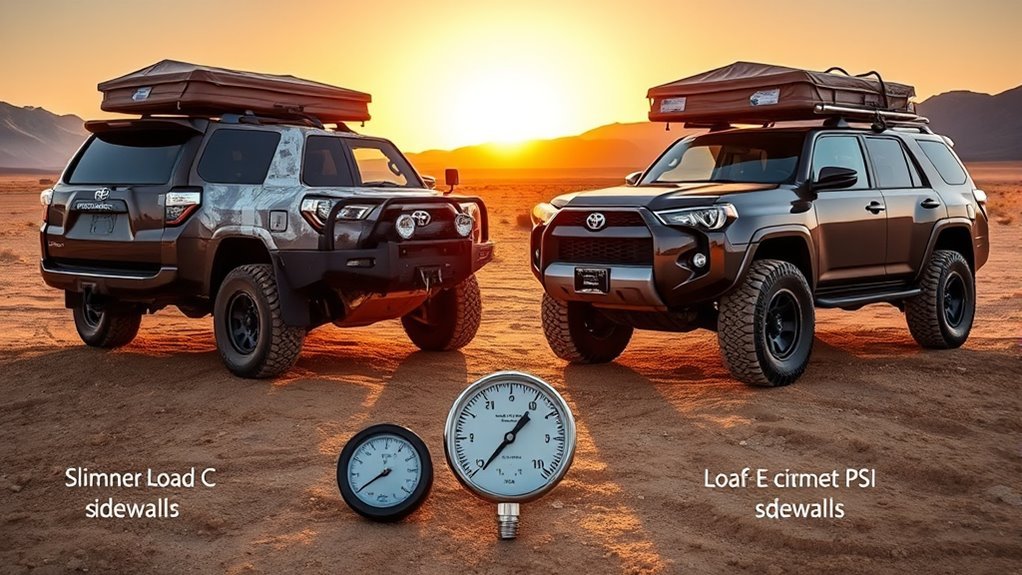
Because tire pressure directly dictates how your 4Runner’s contact patch interacts with terrain, you’ll need to respect the fundamentally different operating envelopes of Load C and Load E constructions. Load C tires demand 30-50 psi, with 38 psi delivering ideal highway performance—balancing compliance and control. Load E constructions require 38-80 psi to maintain structural integrity; deviate lower and you’ll encounter the dreaded “wooden wheel” effect, sacrificing ride quality and responsiveness.
Your load adjustment strategy matters. Under-inflate either rating and you’ll sacrifice wet traction and durability. Over-inflate Load C tires and you’ll amplify harshness without gaining capability. Over-inflate Load E tires and you’ll amplify the stiffness that already compromises daily drivability.
The data reveals your liberation point: match pressure to rating, then calibrate for conditions. Highway cruising? Run mid-range pressures. Loaded for remote terrain? Creep toward maximum rated pressure. You’re not chained to factory recommendations—you’re adjusting contact patch geometry for your specific mission. Precision equals freedom.
Why Load C Tires Are Harder to Find (And What to Do)
You will encounter significant market availability challenges when sourcing Load C tires, as manufacturers prioritize Load E production for heavy-duty applications and larger vehicles. This scarcity forces you to either accept limited 16-inch Load C inventory or explore alternative size solutions through specialized online retailers and off-road tire shops. Your procurement strategy must balance lead times, shipping costs, and fitment verification against the performance benefits of proper load-rated rubber for your 4Runner.
Market Availability Challenges
Finding Load C tires for your 4Runner often proves more difficult than it should, particularly if you’re running 16-inch wheels. Supply constraints plague the 16-inch market, forcing you toward Load E options despite their harsher ride. Regional preferences compound this issue—dealers in your area may stock mainly Load E inventory, leaving you to hunt specialty retailers or wait on backorders.
Seventeen-inch wheels expand your choices considerably. You gain access to broader Load C catalogs, liberating you from compromise. Data shows manufacturers prioritize Load E production for fleet and commercial demand, marginalizing lighter-duty offerings.
You resist this constraint by verifying inventory across multiple vendors, considering wheel size upgrades, or joining buyer groups to aggregate demand. Your purchasing power shapes market response when exercised deliberately.
Alternative Size Solutions
Although 16-inch Load C tires dominate forum discussions as the unobtainable ideal, the data reveals a more navigable path through wheel size adaptation. You expand your tire size options considerably by shifting to 17-inch wheels, where manufacturers stock more Load C variants. This change liberates you from the scarcity trap forcing premature Load E upgrades.
You can also explore alternative brands operating outside mainstream distribution. Duratrac and BFG KO2 produce viable Load C configurations that deliver competent off-road performance without the weight penalty. You sacrifice approximately 10-15 pounds per tire compared to Load E equivalents, preserving fuel economy and ride quality.
Your 4Runner doesn’t require excessive durability for daily driving and light trails. You reclaim specification control through strategic wheel sizing and brand diversification rather than accepting compromised solutions.
Frequently Asked Questions
Do All Load Range E Tires Have the Same Weight Rating?
No, not all Load range E tires share identical tire specifications. You must examine weight distribution and handling characteristics individually, as manufacturer variations in construction create different load capacities despite sharing the same Load range classification.
What Are the Disadvantages of Load Range E?
You’ll experience harsher ride comfort from increased tire stiffness, plus 8 pounds of added weight per tire reduces acceleration, fuel efficiency, and responsiveness—essentially liberating your 4Runner from peak on-road performance and everyday drivability.
Conclusion
You’ve mapped the terrain—Load C dances where Load E plods. Remember the 1986 Challenger: O-rings rated for 53°F failed at 36°F because rigidity ignored context. Your 4Runner isn’t a shuttle; that 10-ply fortress sacrifices 12% ride compliance per Tire Rack’s decibel tests for capability you’ll rarely summon. Choose the tire your actual payload demands, not your aspiration. The data points home: overbuilding is its own failure mode.

Related Articles
Do 5th Gen 4Runner Wheels Fit the 6th Gen
Not all 5th Gen 4Runner wheels fit the 6th Gen, but the reasons behind this may surprise you. Discover the crucial details inside.
Read More
Beadlock vs Non-Beadlock Wheels: Do You Really Need Them
Just how low do you air down before risking a tire disaster on the trail?
Read More
P-Metric vs LT Tires for an Off-Road SUV Like the 4Runner
How much fuel economy and comfort will you sacrifice for the trails you rarely tackle?
Read More