
How to Rotate Five Tires Including the Spare on a 4Runner
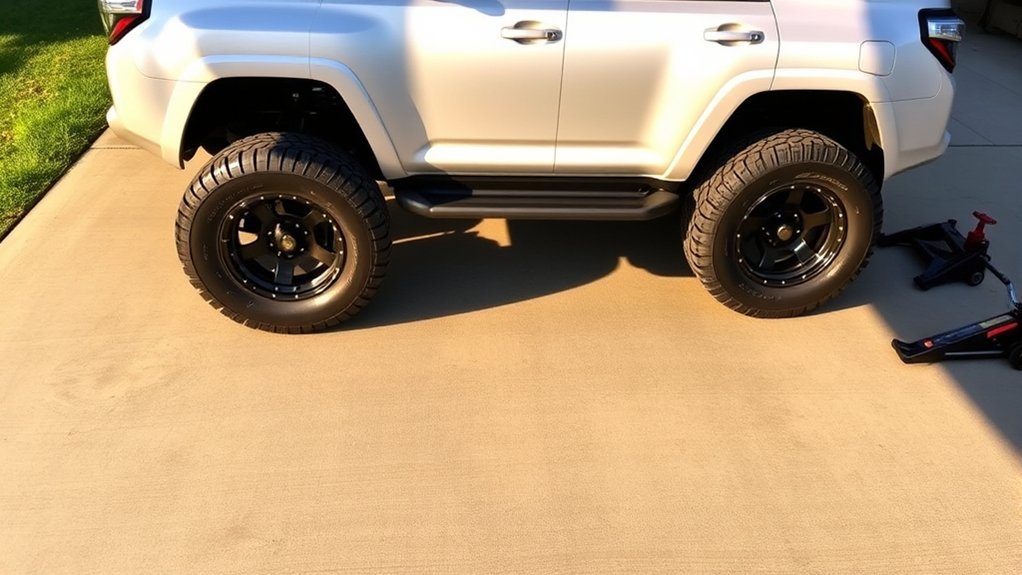
To rotate five tires on your 4Runner, start by lifting the vehicle and securing it with jack stands. Remove the rear tires and move them to the front in their current positions. Then, cross the front tires to the opposite rear positions. Make certain the spare is involved, replacing one of the front tires. Lower the vehicle, and re-torque the lug nuts to 75-100 pound-feet. For ideal results and best practices, explore the detailed guidelines ahead.
Step-By-Step Tire Rotation Guide
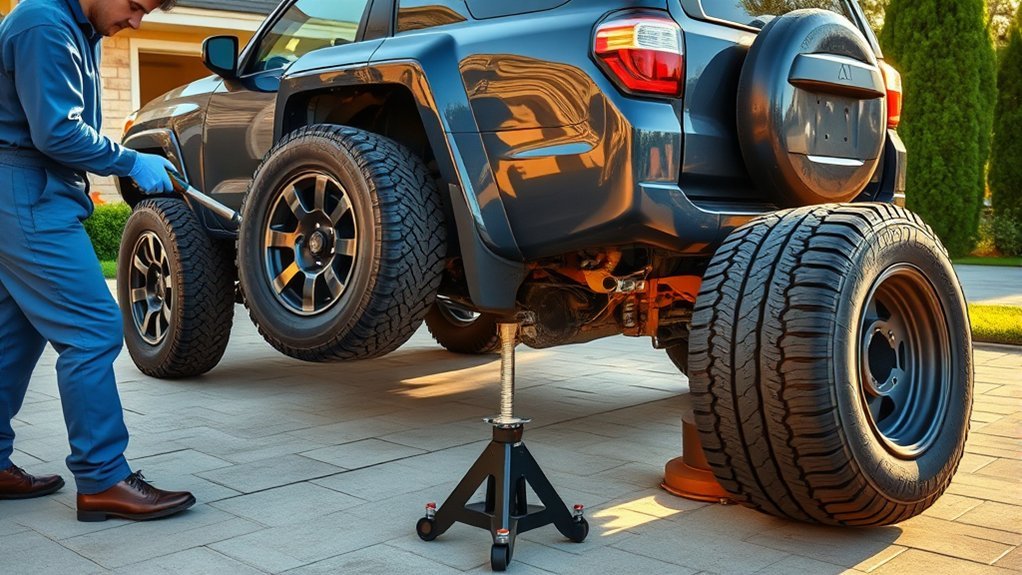
To rotate the tires on your 4Runner effectively, follow this step-by-step guide. Start by lifting the vehicle with a good quality jack, then secure it with jack stands for safety. Remove the lug nuts from the rear tires and move them straight to the front positions, guaranteeing proper tire alignment. Take the front tires and cross them to the opposite rear positions, using the rearward cross rotation method to promote even wear patterns. Include the spare tire by placing it in the right rear position, then move the left front tire to the spare tire’s original location. Once all tires are rotated, lower the 4Runner back to the ground. Finally, re-torque the lug nuts to 75-100 pound-feet to confirm secure installation. This method not only enhances tire longevity but also maintains peak performance for your 4Runner, giving you the freedom to explore confidently.
Essential Tools for a Successful Tire Rotation
Before you start the tire rotation process, gather the right tools to guarantee everything goes smoothly. You’ll need a good quality floor jack and 2-4 jack stands to safely lift your 4Runner. A breaker bar is essential for loosening lug nuts, while an impact wrench can speed up their removal. Make sure you have a torque wrench to tighten the lug nuts to the right specifications, typically between 75 to 100 pound-feet. Non-marring impact sockets are recommended to prevent damage to lug nuts during installation.
Don’t overlook regular maintenance of your tools; check the integrity of your jack and keep your spare parts organized. Proper tool organization not only enhances the efficiency of your tire maintenance but also guarantees your safety throughout the process. With these tools at your side, you’re well-equipped for a successful tire rotation.
Best Practices for Spare Tire Rotation
Including your spare tire in the rotation process is essential for maintaining even tread wear across all five tires. This practice not only enhances uniform wear but also improves your 4Runner’s stability and performance. To guarantee your spare is effective during emergencies, rotate it every 5,000 miles according to the recommended pattern.
| Tire Position | New Position |
|---|---|
| Left Rear | Front |
| Right Rear | Right Front |
| Right Front | Left Rear |
| Spare (if applicable) | Right Rear |
Make sure your spare tire is non-directional and matches the size of your other tires. Regularly rotating the spare will prevent mismatched tread depths and enhance driving safety, solidifying the spare tire’s importance in your vehicle’s performance. Embrace this routine to extend tire lifespan and guarantee reliable handling.
Understanding Different Tire Rotation Patterns: Which One to Use?
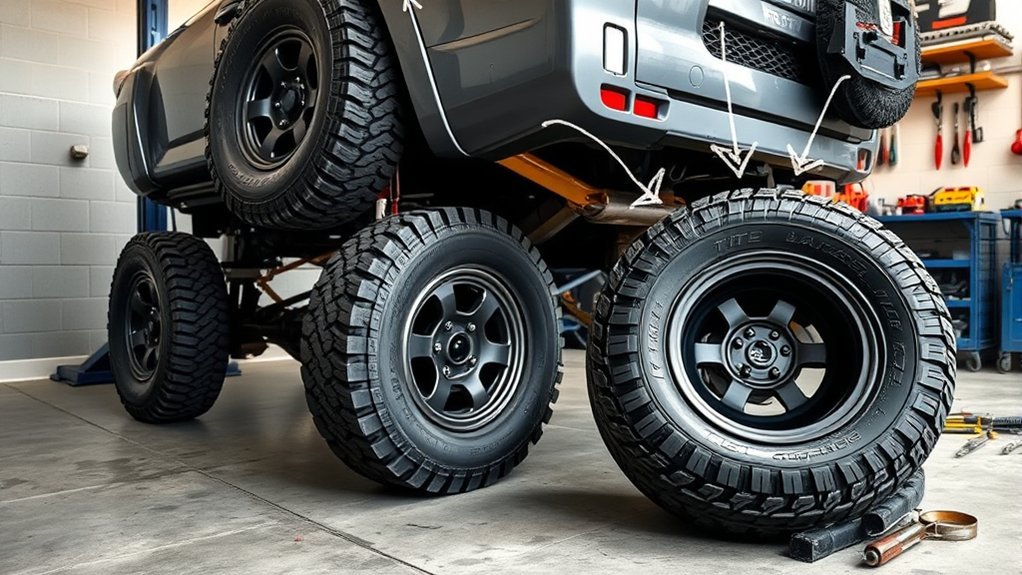
When it comes to tire rotation on your 4Runner, understanding the right patterns is crucial for peak performance. You’ll need to take into account whether your tires are directional or non-directional to select the appropriate method. Always refer to your owner’s manual for the manufacturer-recommended rotation pattern to guarantee even wear and stability.
Rotation Methods Overview
Understanding different tire rotation methods is essential for maintaining the longevity and performance of your 4Runner’s tires. Regular rotation helps mitigate uneven tire wear, guaranteeing a balanced tread life. For your 4Runner, the recommended method is the rearward cross pattern:
- Move rear tires straight to the front.
- Cross front tires to the opposite rear positions.
- Rotate every 5,000 miles per the maintenance schedule.
- Confirm the spare tire is non-directional and matches the main tires.
- Always consult your owner’s manual for specific guidelines.
Directional vs. Non-Directional
Tires are essential for your 4Runner’s performance, and knowing the difference between directional and non-directional tires is important for effective rotation. Directional tires feature a specific tread pattern designed for one-way rotation, often marked with arrows on the sidewall. To maintain peak performance, rotate them in the same direction. Non-directional tires, on the other hand, can be rotated using various methods, such as the rearward cross pattern, allowing for even wear across all tire types. Toyota generally recommends front-to-back rotation for non-directional tires to enhance safety and prevent uneven wear. By understanding these tire types and adhering to recommended patterns, you can considerably extend tire lifespan and improve your 4Runner’s handling.
Recommended Patterns for 4Runner
Selecting the right tire rotation pattern for your 4Runner is crucial for maintaining tire health and vehicle performance. The recommended rearward cross method guarantees even tire wear across all five tires, including the spare. Here’s what you should know:
- Rotate all five tires every 5,000 miles for peak performance.
- Move rear tires straight to the front and front tires to the opposite rear positions.
- This pattern is ideal for non-directional tires, enhancing wear and handling.
- Including the spare prevents mismatched tread depths, improving stability.
- Regular rotations can reduce vibrations, boosting overall driving experience.
Safety Tips During Tire Rotation
When you’re ready to rotate the tires on your 4Runner, safety should be your top priority. Start by verifying the vehicle is on a flat, stable surface to avoid any rolling or movement while you work. Use wheel chocks on the opposite tires to further prevent unintended movement during the rotation process. Always employ jack stands after lifting the vehicle with a jack; this prevents accidental falls and guarantees your safety. Before lifting, check the rear differential clearance to avoid any damage. Remember, proper tire maintenance includes not only rotating the tires but also re-torquing the lug nuts to the manufacturer’s specifications—typically between 75 to 100 pound-feet—after a test drive. By following these safety tips and utilizing the right safety equipment, you’ll make tire rotation a secure and efficient task.
How to Properly Tighten Lug Nuts After Rotation
After rotating the tires on your 4Runner, it’s crucial to tighten the lug nuts properly to assure safety and performance. Follow these steps to guarantee a secure fit:
- Use a torque wrench to tighten lug nuts to the manufacturer’s specified torque settings, generally between 75 to 100 pound-feet.
- Hand-tighten all lug nuts first to avoid damaging the threads or wheel.
- Employ a crisscross pattern when tightening to evenly distribute pressure across the wheel, preventing warping.
- Re-torque the lug nuts after a short test drive to accommodate any settling that might occur.
- Periodically check lug nuts during regular maintenance, especially after rotations or replacements, to maintain ideal safety and performance.
Monitoring Tire Health: Signs You Need a Rotation

Properly tightening lug nuts is just one part of maintaining your tires’ health. To guarantee peak performance, regularly monitor your tire pressure and tread depth. Look for uneven tread wear, such as bald spots or cupping, which signals a needed rotation. If you notice a decrease in grip during turns or in wet conditions, your tires might be wearing unevenly, indicating that it’s time for a rotation. Additionally, if your vehicle vibrates or pulls to one side, it could suggest misalignment or uneven wear, prompting an immediate rotation. Keep an eye on tread depth; when it reaches 2/32 inches, you must rotate the tires. Following a consistent rotation schedule—ideally every 5,000 miles—helps maintain even wear and prolongs the lifespan of all five tires, including the spare. Stay proactive, and your tires will serve you well.
Frequently Asked Questions About Tire Rotation
What questions might you have about tire rotation? Understanding tire rotation is essential for maintaining ideal tire wear and vehicle performance. Here are some common inquiries:
- How often should I rotate my tires? Aim for every 5,000 miles to prevent uneven wear.
- Why include the spare in rotation? It guarantees all tires have similar tread depth, enhancing performance.
- What’s the rotation pattern for five tires? Move the left rear to the front, right rear to the right front, right front to the left rear, and place the spare in the right rear position.
- What happens if I don’t rotate my tires? Neglecting rotation can lead to vibrations and handling issues due to mismatched tread depths.
- Where can I find manufacturer recommendations? Always check your owner’s manual for specific guidelines.
Regular tire rotation is key to extending tire lifespan and guaranteeing a smooth ride.
How to Extend the Lifespan of Your Tires Through Regular Rotation
To extend the lifespan of your tires, regularly rotating them is essential for maintaining even wear and peak performance. Aim to rotate your tires every 3,000-5,000 miles. This practice can equalize tread wear, enhancing tire life by up to 20%. Don’t forget to include your spare in the rotation; it guarantees all five tires experience similar wear, preventing mismatched tread depths.
Utilize a rearward cross rotation method, especially beneficial for your 4Runner’s drivetrain. This method evenly distributes wear, critical for rear-wheel and four-wheel drive vehicles. Regularly monitor your tread depth, as it guides timely rotations and helps avoid premature tire replacement. Proper tire maintenance not only extends tire life but also enhances vehicle handling and stability, reducing drivetrain stress caused by uneven tread wear. Keeping your tires well-maintained is essential for safety and performance on the road.
Frequently Asked Questions
What Is a 5 Tire Rotation With a Spare?
A 5-tire rotation with a spare maximizes tire lifespan by ensuring even wear. Rotate every 5,000 miles to maintain performance. Move rear tires forward and swap front tires to opposite rear positions for best results.
What Is the 50 50 Rule on Spare Tires?
Imagine a tightrope walker balancing on a thin line; the 50/50 rule guarantees your spare tire’s maintenance aligns with the others, promoting even tire wear and enhancing vehicle stability. Rotate every 5,000 miles for peak performance.
Conclusion
By regularly rotating your tires, including the spare, you’ll guarantee even wear and prolong their lifespan. Remember, a stitch in time saves nine—this simple maintenance step can prevent costly replacements down the road. Always follow the recommended patterns for your 4Runner and keep an eye on tire health. With the right tools and techniques, you’ll keep your vehicle running smoothly and safely. Don’t overlook this essential part of vehicle upkeep!

Related Articles

Can You Repair a Run-Flat Tire or Must You Replace It
The truth about run-flat tire repairs might shock you—here's what manufacturers don't want you to ignore.
Read More
How to Calculate Correct Tire Pressure After Upsizing
Noting the importance of accurate tire pressure after upsizing can enhance safety and performance; discover essential steps to ensure optimal tire function.
Read More
4Runner TPMS Sensor Replacement: When and How to Do It
A 4Runner's TPMS sensors demand replacement when warning lights appear or batteries expire—but the critical steps to avoid costly mistakes remain untold.
Read More