
Hyundai Sonata Asymmetric Tire Rotation: Front to Rear Rules

Rotating asymmetrical tires on a Hyundai Sonata starts with one simple check: read the tire sidewall before you move anything. An asymmetrical tire has an OUTSIDE or INSIDE marking, and that marked outside face must stay facing outward after the rotation. If the tire also has a ROTATION arrow, treat it as directional and keep it on the same side of the car.
Quick Answer
For most front-wheel-drive Hyundai Sonata models with same-size, non-directional asymmetrical tires, use the normal FWD rotation pattern: move the front tires straight to the rear and cross the rear tires to the front. Keep the tire’s OUTSIDE marking facing outward. If the tire has a rotation arrow, move it front-to-rear on the same side only.
Key Takeaways
- Asymmetrical tires are identified by OUTSIDE and/or INSIDE sidewall markings.
- An asymmetrical tire is not automatically directional; look for a ROTATION arrow before choosing the pattern.
- Hyundai recommends rotating tires about every 7,500 miles or sooner if irregular wear appears.
- After rotation, set tire pressure to the door placard spec and tighten lug nuts with a torque wrench.
- Never rotate damaged tires back into service; bulges, exposed cord, or very low tread mean the tire needs professional attention.
At a Glance
| Time Required | 45 to 90 minutes for a careful DIY rotation |
| Difficulty | Moderate; safe lifting and proper torque matter |
| Tools Needed | Owner’s manual, jack, jack stands, wheel chocks, lug wrench, torque wrench, tire pressure gauge, tread depth gauge or penny |
| Cost | Free if you already own the tools; usually low-cost at a tire shop during routine maintenance |
What Are Asymmetrical Tires and Why Do They Matter?

Asymmetrical tires use different tread designs on the inner and outer parts of the tire. The outer shoulder is usually built for cornering stability, while the inner tread area often helps with water evacuation and straight-line traction. Because the two sides are designed to do different jobs, the tire must be mounted with the side marked OUTSIDE facing outward.
This is where many drivers get confused: asymmetrical and directional do not mean the same thing. Michelin notes that asymmetric tires indicate which side must face outward, while directional tires use arrows to show the correct rolling direction. That means an asymmetrical tire can often follow the normal rotation pattern for your Sonata, as long as the outside sidewall remains outward. A tire with a direction arrow has stricter rotation rules.
Hyundai also warns that installing the side marked INSIDE on the outside can negatively affect vehicle performance. Before rotating your Sonata’s tires, check every sidewall for these markings.
[Products Worth Considering]

Universal magnetic jack pad with aluminum grooved design to protect vehicle pinch welds during lifting. Durable nylon pad inserts are upgraded and secured with screws to resist damage and keep in place. Designed to fit most single vehicle pinpoint welds for safer, stable jacking when changing tires, repairs, or performing oil changes.

Protect your Tesla during lifting with durable rubber jack pads designed to cushion pressure and help safeguard the battery and chassis. The non-slip, plug-and-play puck set fits Tesla Model 3/Y/X/S for safe, secure jacking. Each pack includes a portable storage case for cleaner trunk organization.

EVOULTES heavy duty tire inflator with an integrated gauge delivers accurate pressure readings from 10–120 PSI, helping you inflate, deflate, and check tires in one tool. The 16.5-inch extended dual-head air chuck with swivel base reaches hard-to-access dual wheel valves on trucks and RVs. A brass trigger core and side-mounted air release valve make operation smooth, with standard 1/4" NPT threading and quick-connect compatibility for easy setup.
Symmetrical vs. Asymmetrical vs. Directional Tires: Key Differences
Before choosing a tire rotation pattern, identify what kind of tire is on your Hyundai Sonata.
| Tire Type | How to Identify It | Rotation Rule |
|---|---|---|
| Symmetrical | Same tread pattern across the tire; no OUTSIDE or ROTATION marking | Use the normal pattern for your drivetrain and tire size |
| Asymmetrical, non-directional | OUTSIDE/INSIDE marking, but no rotation arrow | Use the normal pattern if the OUTSIDE side remains outward |
| Directional | ROTATION arrow on the sidewall | Move front-to-rear on the same side only unless the tire is dismounted and remounted |
| Staggered setup | Front and rear tires or wheels are different sizes | Do not use a standard front/rear rotation; follow the manual or tire-shop guidance |
Note: The sidewall decides the pattern. Do not rely only on tread appearance, because some tread designs look directional even when the tire is not directional.
Signs That Your Tires Need Rotation
Hyundai recommends tire rotation about every 7,500 miles or sooner if irregular wear develops. You should also rotate sooner if the front tires are wearing faster than the rear tires, the tread depth differs noticeably from one tire to another, or the car develops vibration or road noise that was not there before.
Check for these warning signs before and during the rotation:
- Uneven tread depth: Measure tread in several grooves across each tire.
- Edge wear: Wear on both outer edges can point to underinflation; wear in the center can point to overinflation.
- One-sided shoulder wear: This may indicate alignment or camber problems.
- Bulges, bumps, cuts, or exposed cord: Do not rotate the tire back into service. Have it inspected or replaced.
- Steering pull or vibration: Rotation alone may not solve the issue; balance, alignment, or tire damage may be involved.
NHTSA recommends checking tire pressure when the tires are cold and inspecting tread and sidewalls often. If tread is worn to 2/32 inch, the tire is at the common minimum replacement threshold.
How to Rotate Tires on Your Hyundai Sonata

Use this process for a careful DIY tire rotation. If you are not comfortable lifting the vehicle safely, have a tire shop or Hyundai service department do the rotation.
Warning: Never rely on a jack alone. A jack is for lifting, not supporting the car while you work. Use properly rated jack stands on a flat, solid surface.
- Park safely. Park on level ground, set the parking brake, and place wheel chocks at the wheels that remain on the ground first.
- Read the tire sidewall. Look for OUTSIDE/INSIDE markings, a ROTATION arrow, and tire size. Confirm all four tires are the same size before using a normal four-tire pattern.
- Loosen the lug nuts slightly. Break each lug nut loose while the tire is still touching the ground. Do not remove them yet.
- Lift and support the car. Lift only at the factory jack points and support the Sonata with jack stands.
- Remove the wheels. Keep the lug nuts organized and avoid dragging the wheel face across the ground.
- Inspect each tire and brake area. Look for cuts, bulges, exposed cord, uneven wear, low tread, and brake pad wear.
- Move the tires using the correct pattern. Choose the pattern from the section below based on sidewall markings and tire size.
- Reinstall the wheels. Hand-start every lug nut to avoid cross-threading, then snug them in a star pattern.
- Lower the vehicle and torque the lug nuts. Use a torque wrench. Hyundai owner’s manual pages commonly list 79–94 lbf-ft, but use the exact value for your Sonata year and wheel setup.
- Set tire pressure. Inflate the front and rear tires to the cold pressure shown on the driver’s door placard, not the maximum pressure molded on the tire sidewall.
- Test drive carefully. Drive slowly at first and listen for vibration, rubbing, clicking, or pulling. Recheck torque if your manual or shop practice recommends it.
Recommended Rotation Patterns
The best pattern depends on tire markings and vehicle setup. For many Hyundai Sonata models, the tires are the same size and the car is front-wheel drive. In that common case, a non-directional tire usually uses a forward-cross pattern.
| Setup | Pattern |
|---|---|
| FWD Sonata, same-size, asymmetrical but non-directional tires | Front tires move straight to the rear. Rear tires cross to the front. Keep OUTSIDE facing outward. |
| Directional tires with ROTATION arrows | Front left ↔ rear left, and front right ↔ rear right. Do not cross sides unless the tires are dismounted and remounted correctly. |
| Staggered sizes or different front/rear wheels | Do not use a standard front/rear rotation. Follow the owner’s manual or tire-shop guidance for that exact setup. |
| Compact temporary spare | Do not include it in the rotation. |
Pro Tip: Use masking tape or chalk to label each wheel position before removal: LF, RF, LR, RR. That prevents pattern mistakes once all four wheels are off the car.
Signs Of Uneven Wear
Uneven tire wear tells you more than “it is time to rotate.” It can point to pressure, alignment, suspension, or balance issues. Use this quick check before you reinstall the wheels.
| Signs of Uneven Wear | What It May Mean | Recommended Action |
|---|---|---|
| Bald spots or cupping | Balance, suspension, or worn component issue | Have the tire and suspension inspected |
| Different tread depth front to rear | Normal axle wear difference or missed rotations | Rotate and shorten the next rotation interval |
| Visible fabric or cord | Unsafe tire wear or damage | Replace the tire; do not keep driving on it |
| Bulges, bubbles, or sidewall bumps | Possible internal tire damage | Stop using the tire and get professional inspection |
Recommended Rotation Frequency for Optimal Performance
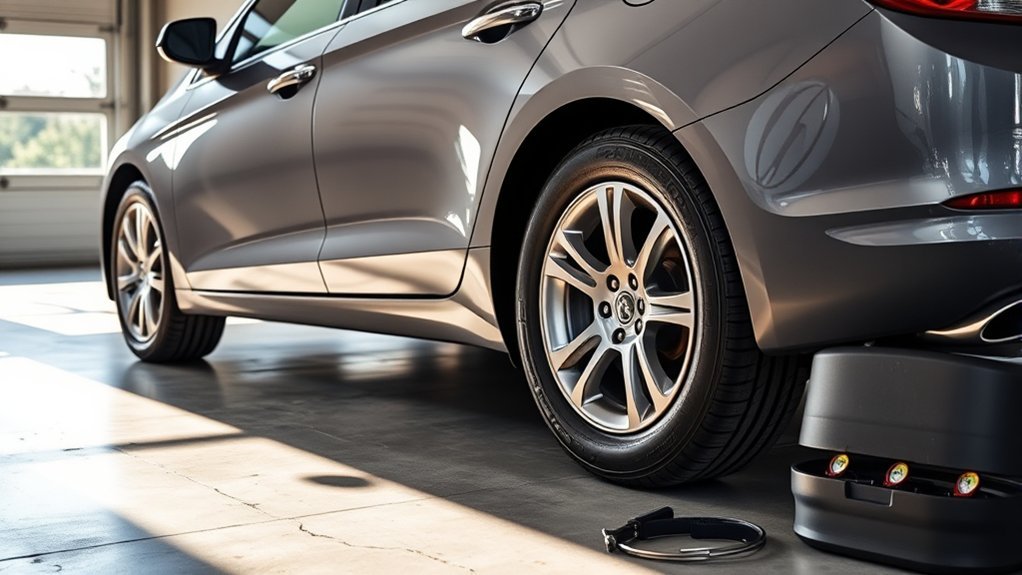
Hyundai recommends rotating tires every 12,000 km or 7,500 miles, or sooner if irregular wear develops. Your tire warranty may also require rotation at a specific interval, so keep service records.
Regular rotation helps equalize tread wear, keeps traction more balanced, and gives you a better chance of replacing all four tires as a matched set.
Rotate sooner if you drive mostly in stop-and-go traffic, hit rough roads often, carry heavy loads, or notice uneven wear before the mileage interval.
What to Inspect When Rotating Tires?
A tire rotation is also a tire inspection. Before reinstalling each wheel, check:
- Tread depth: Use a tread depth gauge. If you use the penny test and can see the top of Lincoln’s head, the tire needs replacement.
- Sidewalls: Look for cuts, cracking, bubbles, bulges, scrapes, and exposed fabric.
- Tread face: Look for nails, screws, glass, cuts, flat spots, cupping, or separated tread.
- Pressure history: A tire that repeatedly loses air may have a puncture, valve-stem issue, bead leak, or wheel damage.
- Brake pads: Hyundai recommends inspecting disc brake pads whenever the tires are rotated.
- Wheel balance clues: Vibration at speed after rotation may point to balance or tire damage.
Also confirm that the OUTSIDE sidewall is still facing outward on every asymmetrical tire before driving.
[Products Worth Considering]

The JACO FlowPro Tire Inflator measures, inflates, and airs down tires up to 100 PSI with battery-free operation and ±2% accuracy after calibration. It features a glowing pressure dial for night visibility, a heavy-duty steel build with a hybrid hose, and a precision push-to-inflate thumb trigger. The patented Lightning Air Chuck locks on for a secure seal, and the kit includes quick-connect hardware for easy inline use with your air compressor.

Blackline Blackout is a water-based trim and tire dressing that restores rubber, vinyl, and plastic with a rich satin, blackout look. Its no-sling formula dries quickly and helps prevent messy transfer onto paint. The coating repels water and offers UV protection to help prevent fading, cracking, and discoloration for a clean, long-lasting finish.
Avoid These Mistakes When Rotating Your Asymmetrical Tires
The most common mistake is assuming every asymmetrical tire must stay on the same side. That rule applies to directional tires with rotation arrows, not every asymmetrical tire.
- Mistake: Confusing OUTSIDE with ROTATION. OUTSIDE tells you which sidewall faces outward. ROTATION tells you the tire’s rolling direction.
- Mistake: Crossing directional tires. If the sidewall has a rotation arrow, keep the tire on the same side unless it is professionally dismounted and remounted.
- Mistake: Ignoring staggered sizes. If front and rear tires are different sizes, do not use a standard rotation pattern.
- Mistake: Skipping torque. Lug nuts must be tightened evenly with a torque wrench, not guessed by feel.
- Mistake: Checking pressure hot and guessing. Use the cold pressure on the Sonata’s driver-door placard.
- Mistake: Rotating damaged tires. A rotation does not fix bulges, exposed cord, separated tread, or severe uneven wear.
Benefits of Regular Tire Rotation for Vehicle Safety
Regular tire rotation helps your Hyundai Sonata maintain more balanced tread depth across all four tires. That matters because the front and rear tires do different jobs. The front tires handle steering and a large share of braking forces, and on front-wheel-drive models they also handle drive torque.
Enhanced Tire Longevity
When one pair of tires stays in the same position for too long, it can wear faster than the others. Rotation spreads the workload so the tires wear more evenly. That can help you get more useful life from the set and avoid replacing only two tires at a time.
Improved Vehicle Handling
Even tread wear supports more predictable steering, braking, and wet-road traction. Rotation will not fix an alignment problem, but it can reveal one early. If the Sonata pulls, shakes, or makes new road noise after a rotation, have the balance, alignment, and tire condition checked.
| Benefit | Why It Matters |
|---|---|
| More even tread wear | Keeps all four tires closer in tread depth |
| Better handling balance | Reduces the chance of one axle having much less grip than the other |
| Earlier problem detection | Uneven wear can reveal pressure, alignment, or suspension issues |
| Longer tire-set life | Helps prevent one pair from wearing out far ahead of the other pair |
Tips for Maintaining Tire Health Beyond Rotation
Tire rotation works best when it is paired with simple monthly maintenance.
- Check tire pressure monthly. Measure when the tires are cold and use the pressure listed on the driver-door placard.
- Measure tread depth. Replace tires at 2/32 inch at minimum, and consider replacement sooner if wet traction is poor.
- Watch for age and cracking. Low-mileage tires can still age out or develop sidewall cracking.
- Keep alignment in check. If the car pulls or one shoulder wears faster, rotation alone is not enough.
- Balance when needed. Vibration after a rotation may mean a wheel needs balancing or a tire has damage.
- Keep records. Tire warranties often require proof of regular rotation.
Frequently Asked Questions
Can you rotate asymmetrical tires side to side?
Yes, many asymmetrical tires can move side to side if they are not directional, all four tires are the same size, and the side marked OUTSIDE still faces outward after installation. If the tire has a ROTATION arrow, keep it on the same side unless it is professionally dismounted and remounted.
What happens if you mount asymmetrical tires backwards?
If the side marked INSIDE faces outward, the tread is not working as designed. Handling, wet traction, wear, and road feel may suffer. Have the tire dismounted and reinstalled correctly by a tire professional.
Is it okay to rotate tires just front to back?
It is okay when your tires are directional, because the rolling direction must stay the same. For non-directional tires on many front-wheel-drive Sonata models, a forward-cross pattern gives each tire more varied positions and can help even out wear better.
How do you rotate tires on a Hyundai Sonata with asymmetrical tires?
First check the sidewall. If the tire only has OUTSIDE/INSIDE markings and all four tires are the same size, use the normal Sonata pattern for your drivetrain while keeping OUTSIDE facing outward. For many FWD Sonatas, that means front tires straight back and rear tires crossed to the front. If the tire has a ROTATION arrow, move each tire front-to-rear on the same side only.
How often should Hyundai Sonata tires be rotated?
Hyundai recommends rotating tires about every 7,500 miles or sooner if irregular wear develops. Also check your tire warranty, because some tire brands require a specific rotation interval for mileage coverage.
Should I rotate the compact spare into the pattern?
No. Do not include a compact temporary spare in normal tire rotation. It is designed for temporary emergency use, not regular driving positions.
Conclusion
To rotate asymmetrical tires on a Hyundai Sonata correctly, do not guess from the tread pattern alone. Read the sidewall first. If the tire has only an OUTSIDE marking, keep that side outward and use the correct pattern for your Sonata’s drivetrain and tire size. If it also has a ROTATION arrow, keep it on the same side and move it front-to-rear only. Finish the job by checking tread, pressure, brake pads, lug-nut torque, and any signs of damage before you drive.
Sources
- Hyundai Owner’s Manual — Tire Rotation — backs Hyundai rotation interval, inspection items, torque guidance, compact spare warning, and asymmetrical tire outside/inside marking guidance.
- Michelin USA — Tire Rotation: Why It Matters and How to Do It — backs FWD, RWD, AWD, and directional tire rotation pattern guidance.
- Michelin USA — Visual Tire Inspection Before Mounting — backs sidewall marking checks for directional and asymmetric tires.
- NHTSA TireWise — Tire Safety Ratings and Awareness — backs tire maintenance, pressure, rotation, balance, alignment, and tire safety guidance.
- NHTSA Summer Driving Tips — backs cold tire pressure checks, tire inspection, uneven wear guidance, and the 2/32-inch tread-depth threshold.

Related Articles

Danger of Using Summer Tires in Winter on a Hyundai Sonata
Potentially perilous, using summer tires in winter on your Hyundai Sonata can compromise safety—discover the hidden dangers that await you on icy roads.
Read More
Can You Mix Nitrogen and Air in Hyundai Sonata Tires? Answered
Discover the implications of mixing nitrogen and air in your Hyundai Sonata tires—are the benefits worth the risks? Explore the answer inside!
Read More
How to Tell If Hyundai Sonata Tires Are Too Old to Use Safely
Understand how to assess the age of your Hyundai Sonata tires and discover crucial signs of deterioration that could compromise your safety on the road.
Read More