
Advantages of Tire Rotation for a RAV4: Why You Shouldn’t Skip It

Regular tire rotation helps your Toyota RAV4 wear its tires more evenly, keep predictable traction, and avoid replacing one pair of tires too early. It is also a good time to check tread depth, tire pressure, sidewall damage, and uneven wear patterns before they turn into safety or repair problems.
Quick Answer
For many late-model Toyota RAV4s, plan tire rotation at scheduled maintenance: about every 5,000 miles or six months, whichever comes first. Rotation helps even out front and rear tire wear, but the correct pattern depends on your exact model year, tire type, drivetrain, and owner’s manual.
Key Takeaways
- Toyota’s 2024 RAV4 maintenance guide lists scheduled maintenance every 5,000 miles or six months, and tire rotation appears as a regular maintenance item.
- Rotation does not replace tire pressure checks, alignment, balancing, or replacing damaged tires.
- Use your exact owner’s manual for the rotation pattern, especially if your tires are directional, different sizes, or your RAV4 has AWD.
- If your RAV4 has a tire pressure warning system, follow Toyota’s guidance for initializing or updating the system after rotation.
At a Glance
| Time Required | About 30–60 minutes at a shop; longer for a careful DIY rotation. |
| Difficulty | Easy as a service appointment; moderate as a DIY job because safe lifting and correct lug-nut torque matter. |
| Tools Needed | Owner’s manual, tire pressure gauge, tread-depth gauge; for DIY, use a floor jack, jack stands, wheel chocks, and a torque wrench. |
| Cost | Varies by shop; some tire stores include rotations with tire purchase plans, while dealers and repair shops may charge separately. |
Why Regular Tire Rotation Matters for Your RAV4
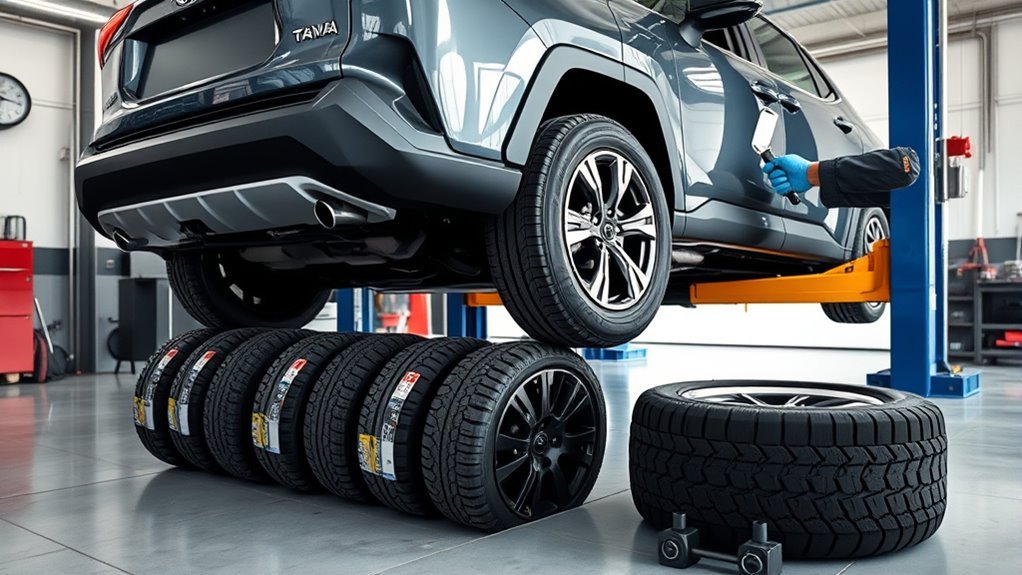
Your RAV4’s tires do not all work the same way. The front tires handle steering, much of the braking force, and, on front-wheel-drive models, most of the drive force. AWD and hybrid RAV4 models still place different loads on each tire depending on acceleration, turning, braking, road surface, and cargo weight.
That is why regular tire rotation matters. By moving tires to different positions at the right interval, you help spread wear across the full set instead of letting one pair wear out faster. Toyota’s RAV4 maintenance guide recommends scheduled maintenance every 5,000 miles or six months, whichever comes first, and tire rotation appears throughout the maintenance log.
Routine rotation also creates a natural checkpoint for tire pressure, tread depth, sidewall cracks, bulges, nails, and uneven wear. NHTSA warns that poor tire maintenance, including not rotating tires, can contribute to flat tires, blowouts, or tread separation.
Pro Tip: Pair your tire rotation with a quick tread-depth and pressure check. That makes one service visit cover wear, traction, fuel economy, and early damage detection.
[Products Worth Considering]

Universal magnetic jack pad with aluminum grooved design to protect vehicle pinch welds during lifting. Durable nylon pad inserts are upgraded and secured with screws to resist damage and keep in place. Designed to fit most single vehicle pinpoint welds for safer, stable jacking when changing tires, repairs, or performing oil changes.

This oesee 8-piece wheel care kit helps you clean, scrub, and dry wheels safely with purpose-built brushes and towels. The scratch-free microfiber wheel brush lifts brake dust and grime, while the stiff pro-grip tire brush removes tire browning and embedded dirt. A twist loop microfiber drying towel and an applicator help achieve a streak-free finish and cleaner, more even product application.

Blackline Blackout is a water-based trim and tire dressing that restores rubber, vinyl, and plastic with a rich satin, blackout look. Its no-sling formula dries quickly and helps prevent messy transfer onto paint. The coating repels water and offers UV protection to help prevent fading, cracking, and discoloration for a clean, long-lasting finish.
How Tire Rotation Promotes Even Tire Wear
Tire rotation works by changing where each tire carries load and stress. A tire that spent thousands of miles on the front axle may move to the rear, while a rear tire may move forward. Over time, this helps the full set stay closer in tread depth.
Why RAV4 Tires Wear Differently
Even on a well-maintained RAV4, tire wear is not perfectly equal. Front tires often wear faster because they steer and handle much of the braking load. Tires can also wear unevenly from underinflation, overinflation, wheel misalignment, worn suspension parts, hard cornering, frequent short trips, rough roads, or heavy cargo.
Common wear clues include:
- Outer-edge wear: often linked to underinflation, aggressive cornering, or alignment issues.
- Center wear: often linked to overinflation.
- One-shoulder wear: often linked to alignment or suspension problems.
- Cupping or scalloping: may point to imbalance, worn suspension parts, or repeated hard impacts.
- Feathering: often suggests toe alignment problems.
Rotation Patterns Depend on Your Tires
Do not assume every RAV4 uses the same tire rotation pattern. The correct pattern depends on the tire type, tire size, drivetrain, and the diagram in your exact owner’s manual.
| Tire Setup | What to Do |
|---|---|
| Same-size, non-directional tires | Follow the pattern shown in your Toyota owner’s manual or tire warranty guide. |
| Directional tires | Keep each tire on the same side unless the tire is dismounted and remounted correctly. |
| AWD RAV4 | Keep tread depths as even as possible and follow Toyota’s manual first. |
| Different front/rear tire sizes | Do not move tires front-to-rear unless your manual and tire shop confirm it is allowed. |
| Temporary spare tire | Do not include a temporary spare in routine rotation. |
What to Check During Tire Rotation
A good rotation is more than moving tires around. During each service, check:
- Tread depth across the inner, center, and outer grooves.
- Uneven wear patterns that may point to alignment, balance, or suspension issues.
- Sidewall cracks, cuts, bulges, punctures, or exposed cord.
- Cold tire pressure using the driver-door placard, not the maximum pressure on the tire sidewall.
- Wheel-nut torque using the value in your exact owner’s manual.
- TPMS position or initialization requirements if your RAV4 is equipped with a tire pressure warning system.
Note: Toyota’s late-model RAV4 tire guidance says not to fail to initialize the tire pressure warning system after rotation if equipped. Follow your model-year owner’s manual so the display and tire-position information stay accurate.
How Even Tire Wear Improves Fuel Efficiency
Tire rotation can support fuel efficiency, but it is important to be precise: the best-documented MPG benefit comes from proper tire inflation, not rotation alone. FuelEconomy.gov says keeping tires inflated to the proper pressure can improve gas mileage by 0.6% on average and up to 3% in some cases.
So where does tire rotation fit in? Rotation helps you catch problems that can hurt efficiency, including uneven wear, low pressure, dragging or damaged tires, and alignment-related wear. Even tread depth also helps keep tire contact more predictable, which supports smooth rolling and stable handling.
Rotation helps tires wear evenly; proper inflation is the direct fuel-economy win. Do both together for the best maintenance result.
How Tire Rotation Enhances Your RAV4’s Handling and Stability
A RAV4 feels more predictable when all four tires have similar tread depth and condition. If two tires are much more worn than the others, the vehicle may feel less balanced during cornering, braking, or wet-road driving.
Improved Traction Control
Even tire wear helps the tires respond more consistently when you accelerate, brake, or drive through rain. It also gives the vehicle’s traction and stability systems a more consistent tire-contact foundation to work with.
Enhanced Cornering Stability
When tread depth is closer across the set, the RAV4 is less likely to feel uneven from side to side or front to rear. That matters on highway ramps, wet streets, gravel roads, and emergency maneuvers.
| What You Notice | Possible Tire-Related Cause | Next Step |
|---|---|---|
| Vibration at speed | Imbalance, cupping, or tire damage | Inspect, balance, and rotate only if tires are safe. |
| Pulling to one side | Pressure mismatch, alignment issue, or uneven wear | Check pressure first, then alignment if it continues. |
| Noisy or choppy tread | Cupping, scalloping, or skipped rotations | Inspect suspension and balance before assuming rotation will fix it. |
How Tire Rotation Improves Safety
Regular rotation improves safety by helping you keep tread wear even and by forcing a close inspection of each tire. That inspection matters because damage, low tread, and poor inflation can reduce traction and increase the risk of tire failure.
U.S. tire-industry guidance says tires should be replaced when worn to 2/32 inch tread depth remaining anywhere on the tread face, and that loss of traction in adverse weather is more likely if worn tires are not replaced.
Warning: Do not rotate a tire that has exposed cord, a bulge, deep sidewall cracking, severe uneven wear, or tread at the replacement limit. Replace or repair the tire issue first.
Rotation also helps protect the money you have already spent on tires. A full set that wears evenly is easier to manage than replacing one or two tires early because they were left on the hardest-working positions too long.
When Should You Get Your Tires Rotated?
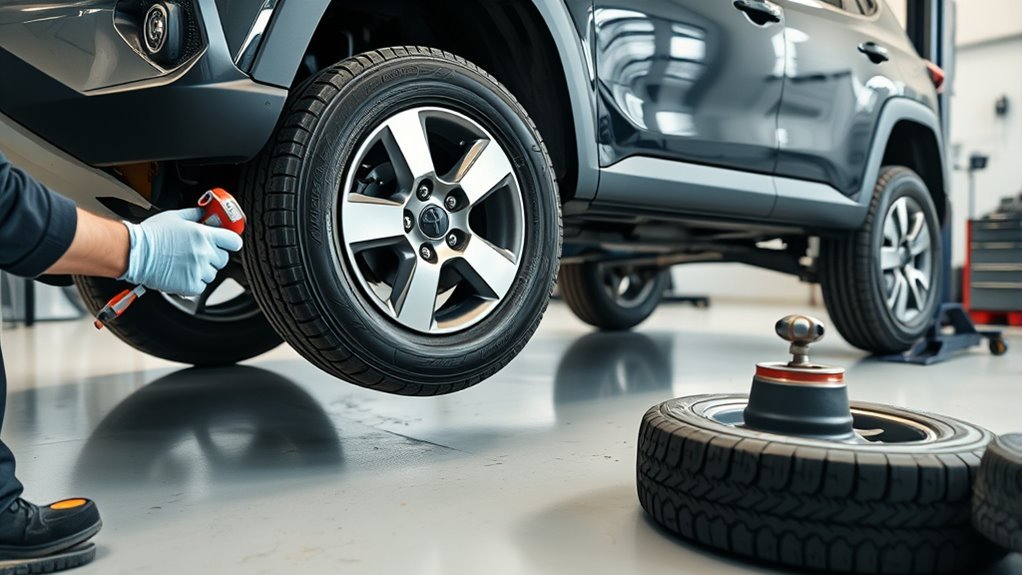
For many late-model Toyota RAV4 owners, the best routine is simple: rotate the tires at each scheduled 5,000-mile or six-month maintenance visit, whichever comes first. Always confirm the schedule in your exact model-year Toyota maintenance guide and in your tire warranty booklet.
You may need an earlier inspection if you notice:
- Uneven tread depth between front and rear tires.
- Steering vibration or new road noise.
- Pulling to one side on a straight, level road.
- Cupping, feathering, or one-shoulder wear.
- A recent pothole hit or curb impact.
- Frequent driving on rough roads, dirt roads, heavy loads, or stop-and-go routes.
Note: A tire rotation may reveal a problem, but it will not fix alignment, balancing, bent wheels, or worn suspension parts by itself.
[Products Worth Considering]

The JACO FlowPro Tire Inflator measures, inflates, and airs down tires up to 100 PSI with battery-free operation and ±2% accuracy after calibration. It features a glowing pressure dial for night visibility, a heavy-duty steel build with a hybrid hose, and a precision push-to-inflate thumb trigger. The patented Lightning Air Chuck locks on for a secure seal, and the kit includes quick-connect hardware for easy inline use with your air compressor.

Keep RV, trailer, or truck dual-axle tires protected with waterproof, UV-resistant covers that help guard against sunlight, snow, rust, and dirt. The dual tire covers are easy to install with a rope/bungee fastener for a stable fit that won’t easily slip. Designed for 27–30 inch diameter wheels, they help maintain tire condition through harsh weather.
Tire Rotation vs. Alignment vs. Balancing
These services are related, but they are not the same:
- Tire rotation moves tires to different wheel positions to promote even wear.
- Wheel alignment adjusts suspension angles so the tires meet the road correctly.
- Wheel balancing corrects weight imbalance in the tire and wheel assembly to reduce vibration.
If your RAV4 only needs routine maintenance, rotation may be enough. If it pulls, vibrates, or shows one-sided wear, ask the technician to inspect alignment, balance, suspension, and wheel condition before simply rotating the tires.
Can You Rotate RAV4 Tires Yourself?
You can rotate RAV4 tires at home if you have the right equipment, a safe work area, and the correct specs from your owner’s manual. However, do not treat it like a casual driveway shortcut. Lifting a vehicle incorrectly can cause serious injury or vehicle damage.
Warning: Never crawl under or work around a vehicle supported only by a jack. Use wheel chocks, approved jack points, jack stands, and a torque wrench. If you are not confident, schedule the rotation with a qualified shop.
After a DIY rotation, set cold tire pressure to the door-placard value, tighten the lug nuts to the manual’s torque specification, and follow the owner’s manual for any tire pressure warning system initialization steps.
Frequently Asked Questions
What does Toyota recommend for RAV4 tire rotation?
Toyota’s 2024 RAV4 maintenance guide recommends scheduled maintenance every 5,000 miles or six months, whichever comes first, and tire rotation is listed in the maintenance log. Check your exact model-year guide because details can vary.
Is it bad to skip a tire rotation?
Yes. Skipping rotations can let one pair of tires wear faster than the rest, which may reduce tire life, traction, and ride quality. It can also hide problems like uneven wear, low pressure, or tire damage until they become more expensive.
How often should you rotate tires on a Toyota RAV4?
A strong rule for many late-model RAV4s is every 5,000 miles or six months, whichever comes first. Rotate sooner if you see uneven wear, vibration, cupping, or a tread-depth difference between tires.
Do AWD RAV4 models need tire rotation?
Yes. AWD models still need routine tire rotation, and keeping tread depths close across all four tires is especially important. Follow Toyota’s manual and ask a technician to inspect any large tread-depth difference.
Should I reset or initialize TPMS after rotating RAV4 tires?
If your RAV4 has a tire pressure warning system, follow the owner’s manual after rotation. Toyota’s late-model RAV4 tire guidance says not to fail to initialize the tire pressure warning system after rotation when equipped.
Can tire rotation fix uneven wear?
Rotation can slow normal uneven wear, but it does not fix the cause of abnormal wear. If you see cupping, feathering, one-sided wear, vibration, or pulling, check pressure, alignment, balance, suspension, and tire condition.
Conclusion
Regular tire rotation is one of the simplest ways to protect your RAV4’s tires, handling, and safety. The best routine is to rotate at Toyota’s scheduled maintenance interval, inspect each tire closely, set the correct cold pressure, and follow the owner’s manual for the right pattern and TPMS steps. Do that consistently, and your RAV4 is more likely to ride smoothly, brake predictably, and use the full life of every tire.
Sources
- Toyota 2024 RAV4 Warranty & Maintenance Guide — Toyota maintenance interval and tire rotation schedule.
- Toyota 2025 RAV4 Tires Owner’s Manual Section — tire rotation and tire pressure warning system guidance.
- NHTSA TireWise Tire Safety — tire maintenance, pressure, rotation, and safety information.
- FuelEconomy.gov Gas Mileage Tips — tire inflation and fuel-economy impact.
- U.S. Tire Manufacturers Association Tire Care and Safety Guide — rotation, tread-depth, wear, and inspection guidance.

Related Articles

Toyota RAV4 TPMS Reset: Easy Steps That Work
Unlock the secrets to resetting your Toyota RAV4's TPMS effortlessly—discover the essential steps to ensure your tires are always safe.
Read More
Toyota RAV4 Tire Rotation: DIY Steps & Pattern
Take control of your Toyota RAV4's tire maintenance with our simple DIY rotation guide—discover the best steps for optimal performance and longevity!
Read More
Mix Tire Brands on a Toyota RAV4? Expert Guide
Keeping your RAV4 safe? Learn when mixing tire brands risks traction, ABS/TCS and AWD damage — and what exact matches you must insist on.
Read More